


How to Secure Supportive Housing Without Losing Your Mind
How to Secure Supportive Housing Without Losing Your Mind
Navigating Disability housing support services in California
Disability housing support services are programs and resources that help people with disabilities find, afford, and stay in safe housing. If you need a quick overview, here are the main ways to access support:
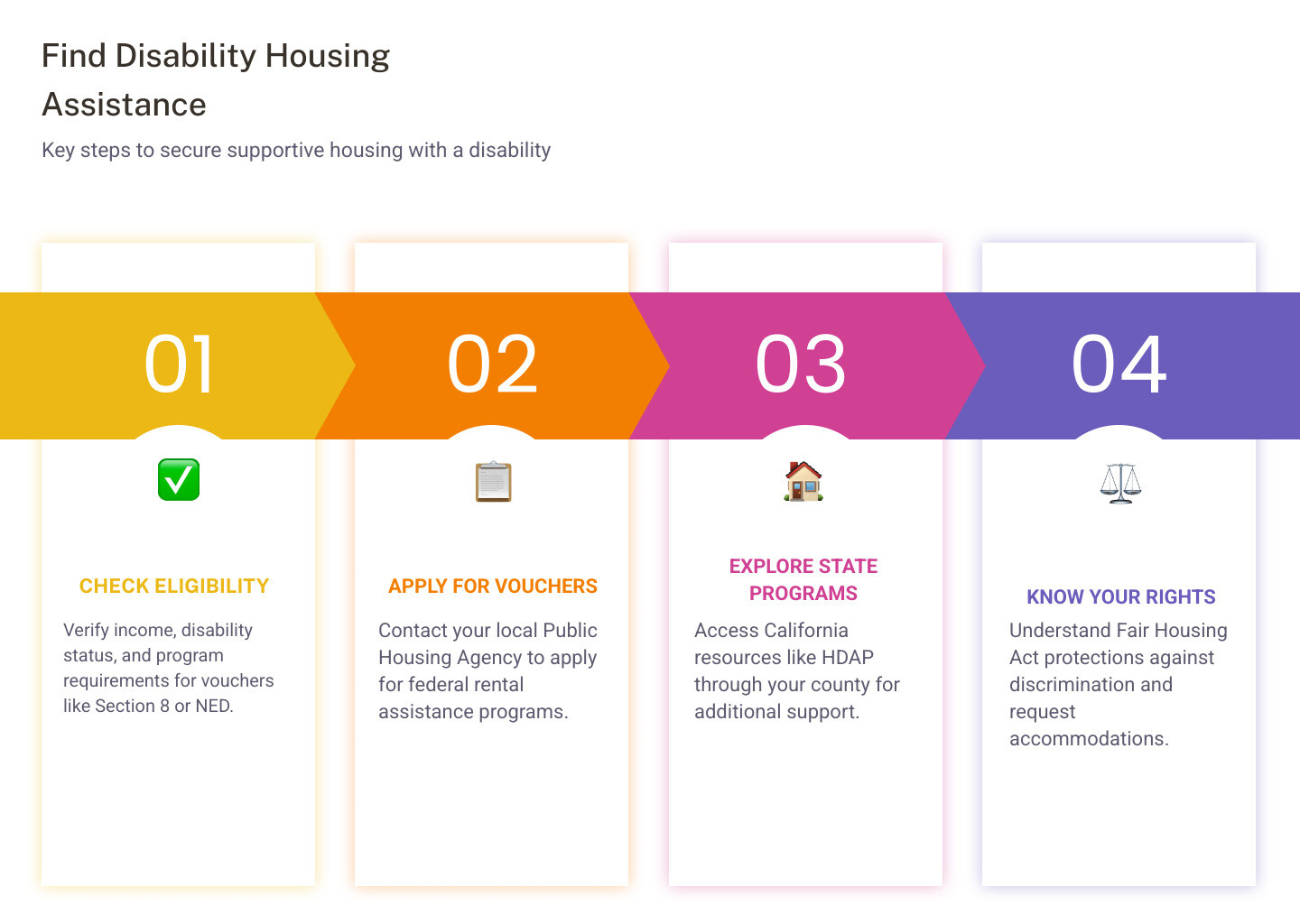
- Federal vouchers – Apply for Section 8 or Non-Elderly Disabled (NED) vouchers through your local Public Housing Agency
- Veteran-specific programs – Contact the National Call Center for Homeless Veterans at 1-877-424-3838 for SSVF assistance
- California state programs – Look into the Housing and Disability Advocacy Program (HDAP) through your county
- Nonprofit and CIL support – Connect with a Center for Independent Living for housing navigation and advocacy
- Legal protections – File a complaint if denied housing due to disability under the Fair Housing Act
Finding stable housing with a disability is harder than it should be. The numbers tell a stark story: approximately 4.8 million people with disabilities who rely on SSI earn an average of just $9,156 per year – not enough to afford rent in a single rental market across the entire country. For recently discharged veterans, that challenge is even sharper. Many face a combination of service-related disabilities, financial instability, and an unfamiliar civilian support system, all at once.
The barriers are not just financial. Accessible units with features like widened doorways, wheel-in showers, and step-free entrances are in short supply. Discrimination in housing remains widespread. And the path through federal programs, state resources, and eligibility rules can feel like a maze.
This guide breaks it all down – clearly and step by step.
Disability housing support services terms you need:
- Disability friendly apartments
- Resources for independent living
- affordable homes for disabled adults
Navigating Disability housing support services in California can feel a bit like trying to assemble IKEA furniture in the dark. You know all the pieces are there, but getting them to fit together requires a lot of patience and maybe a few deep breaths. In California, the crisis is particularly intense. From the bustling streets of Los Angeles to the tech hubs of San Francisco, the gap between what someone on Supplemental Security Income (SSI) can afford and what landlords are asking is massive.
As we mentioned, 4.8 million people with disabilities are essentially priced out of the traditional rental market. When your total annual income is less than $10,000, even a “modest” studio apartment in San Diego or Riverside is a financial impossibility. This is why specialized support is so critical. We focus our efforts on helping Californians bridge this gap through community-based resources and advocacy.
If you are looking for housing for adults with disabilities, you aren’t just looking for four walls and a roof. You are looking for a community that understands your needs, whether that’s proximity to public transit in the Bay Area or specialized home modifications in Irvine.
Overcoming the Affordability and Accessibility Gap
The term “worst case” housing conditions isn’t just a dramatic phrase used by HUD; it describes the reality for millions. These are households that pay more than half of their income on rent or live in severely inadequate conditions. For someone with a disability, “inadequate” often means “inaccessible.”
Imagine being a wheelchair user and finding a “subsidized” apartment, only to realize you can’t fit through the bathroom door or reach the kitchen sink. True accessibility means:
- Widened doorways to accommodate power chairs.
- Wheel-in showers with grab bars for safety.
- Lowered kitchen counters and sinks.
- Step-free entrances and ramps.
We believe that housing is a human right, but accessible housing is a necessity for independence. Without these features, many individuals are forced into institutional settings simply because the “community” isn’t built for them. That’s where Disability housing support services step in to provide the modifications and advocacy needed to keep people in their own homes.

Federal Rental Assistance and Voucher Programs
When it comes to the heavy lifting of paying the rent, federal programs are the MVP. The U.S. Department of Housing and Urban Development (HUD) manages several programs that are lifelines for our neighbors in Southern California and the Bay Area.
The most common starting point is your local Public Housing Agency (PHA). These agencies manage the Housing Choice Voucher (Section 8) program. Because the waitlists can be long (sometimes years), it is vital to look up and contact your local public housing agency as soon as possible.
Section 8 and Disability housing support services
Standard Section 8 is great, but there are specific “flavors” of vouchers designed specifically for the disability community. The most important one to know about is the Non-Elderly Disabled (NED) voucher.
While standard affordable housing for the disabled might have broad requirements, NED vouchers are specifically for:
- Heads of household, spouses, or co-heads who are under age 62.
- Individuals with a verifiable disability.
- Those who meet low-income requirements for their specific county (like San Diego or Los Angeles).
| Feature | Standard Section 8 | NED Voucher |
|---|---|---|
| Primary Target | Low-income families/seniors | Non-elderly (under 62) with disabilities |
| Portability | Usually portable after 1 year | Portable to any PHA with a voucher program |
| Eligibility | Income-based | Income + Disability + Age |
| Waitlist | General waitlist | Often has a dedicated or priority waitlist |
Supportive Services for Veteran Families (SSVF)
Veterans hold a special place in our hearts and our mission. Statistics show that 68% of veteran clients live with disabling conditions like PTSD or traumatic brain injuries, and 41% have experienced homelessness. To combat this, the Supportive Services for Veteran Families (SSVF) program provides rapid rehousing and eviction prevention.
If you are a veteran in San Francisco or Riverside facing a housing crisis, the SSVF can help with:
- Finding a new, suitable apartment.
- Paying for moving costs.
- Providing temporary financial assistance for rent or utilities.
For those who have served, housing resources for disabled veterans are about more than just a bed; they are about stability and dignity. If you’re a veteran in need, your first call should be to the National Call Center for Homeless Veterans at 1-877-424-3838. We also work closely with programs like FSS to help veterans transition from subsidized rentals to the ultimate stability: homeownership.
California State Programs and Community Integration
California doesn’t just rely on the federal government; the state has its own suite of Disability housing support services. One of the most impactful is the Housing and Disability Advocacy Program (HDAP). This program is designed for people who are experiencing homelessness and likely have a disability that would qualify them for SSI or Social Security Disability Insurance (SSDI).
In places like Los Angeles and San Diego, HDAP provides:
- Outreach and case management to help you navigate the system.
- Housing navigation to find landlords willing to work with subsidies.
- Financial assistance for housing-related costs.
Our work across the state, including Natomas and Irvine, focuses on these disability services in California to ensure that no one falls through the cracks of a complex bureaucracy.
Transitioning from Institutional Settings
For many, the goal isn’t just finding an apartment; it’s getting out of a nursing home or intermediate care facility and back into the community. The Money Follows the Person (MFP) program is a federal-state partnership that helps people move from institutions to their own homes or small community residences.
Transitioning requires more than just a key. It requires:
- Independent living skills training (how to manage a budget, cook, or use transit).
- Peer support from others who have made the transition.
- Care coordination to ensure medical needs are met at home.
Unlocking the accessible living secrets of community integration means recognizing that people thrive when they have autonomy. We’ve seen that when individuals have the right supports, they maintain their housing at incredible rates—our own housing retention rate is 93%.
Home Modifications and Environmental Adaptations
Sometimes the perfect home is the one you’re already in—it just needs a few tweaks. Environmental modifications (or “E-mods”) are physical changes to a home that allow someone to live there safely and independently.
Common modifications include:
- Wheelchair ramps for step-free access.
- Grab bars and non-slip flooring in bathrooms.
- Lowered light switches and thermostats.
- Widened hallways for better mobility.
For those looking into low-income assisted living for the disabled, these modifications can often serve as an alternative to more restrictive care settings, allowing you to age in place or stay in your preferred neighborhood.
Legal Protections and Financial Eligibility
You can have the voucher and the deposit, but if a landlord says “no” simply because you have a service animal or a disability, that is illegal. The Fair Housing Act prohibits discrimination based on disability in almost all housing transactions.
Shockingly, majority of discrimination complaints received by HUD are related to disability. This includes:
- Refusing to rent to someone with a disability.
- Refusing to allow “reasonable accommodations” (like a designated parking spot).
- Refusing to allow “reasonable modifications” (like installing a grab bar at the tenant’s expense).
- Discriminating against someone because they use an assistance animal.
If you feel you’ve been treated unfairly in San Francisco or San Diego, you have the right to fight back. Legal aid organizations and Centers for Independent Living can help you file a complaint and protect your rights.
Income Limits and Disability housing support services
Understanding the math of housing assistance is vital. Most programs look at your “countable income.” If you receive SSI, your income is already quite low, but did you know you can save money without losing your benefits?
ABLE Accounts are a game-changer. They allow individuals who were disabled before age 26 to save up to $18,000 per year (and hold up to $100,000 total) without it counting against the $2,000 SSI asset limit. This allows for saving for a down payment or emergency repairs.
When applying for affordable homes for disabled adults, keep these financial tools in mind:
- SSI/SSDI Income: Use the Social Security Administration (SSA) online tool for SSI to check your application status.
- Personal Needs Allowance: If you are in a supported living setting, you are usually entitled to keep a portion of your income for personal expenses.
- Work Incentives: Programs like “Ticket to Work” allow you to test your ability to work without immediately losing your housing subsidy.
Frequently Asked Questions about Disability Housing
How do I apply for a NED voucher?
You apply through your local Public Housing Agency (PHA). When you call or visit, specifically ask if they have “Non-Elderly Disabled” vouchers available or if there is a preference on the Section 8 waitlist for people with disabilities. You will need medical verification of your disability and proof of income.
What legal rights do I have under the Fair Housing Act?
You have the right to live in the housing of your choice without being discriminated against. This includes the right to request reasonable accommodations (changes to rules or policies) and reasonable modifications (physical changes to the unit) to help you use the home as fully as someone without a disability.
Can I receive help with a security deposit in California?
Yes! Through the CalAIM program, many individuals in California can receive “Housing Transition Navigation Services.” This can include assistance with security deposits. In many cases, we can help facilitate 1 month paid in advance for deposit assistance to help you secure a lease quickly.
Conclusion
Securing stable housing while living with a disability is a journey that requires persistence, but you don’t have to do it alone. At LifeSTEPS, we are committed to being your partner in that journey. Our human-centered approach has led to a 93% housing retention rate, meaning once our clients get into a home, they stay there.
Beyond just housing, we believe in holistic stability. That’s why we’re proud of our 97% literacy improvement in our summer reading programs and the $2.1 million in scholarships we’ve helped provide to students in our communities. Whether it’s through CalAIM deposit assistance or helping a veteran achieve the dream of homeownership, our goal is to empower you to live your most independent life.
If you are ready to take the next step, reach out to your local resources or contact us to learn more about how we support the California community. Let’s work together to secure your future with affordable homes for disabled adults.
LifeSTEPS currently provides services in California only.


