


Emergency Housing for Veterans: Finding Shelter Fast
When Veterans Need a Safe Place to Stay Right Now
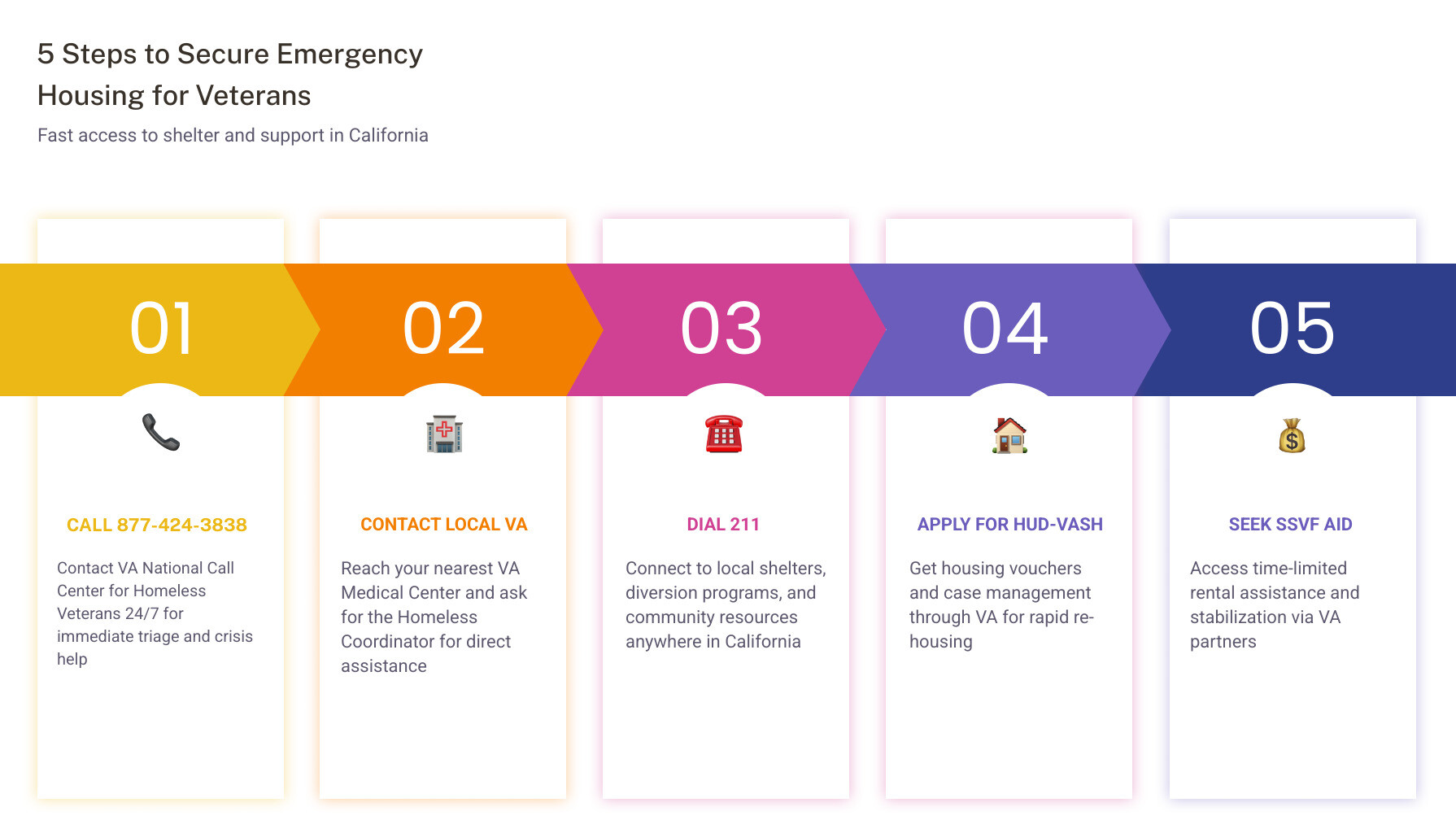
Emergency housing for veterans in California is available through several fast-access options — no need to read the full article if you just need a quick answer:
- Call 1-877-4AID-VET (877-424-3838) — the VA’s National Call Center for Homeless Veterans, available 24/7
- Contact your nearest VA Medical Center and ask for the Homeless Coordinator
- Reach out to the Royal Canadian Legion (for Canadian veterans) at 1-877-534-4666
- Visit 211.ca or dial 2-1-1 to find local shelter and support organizations
- Apply for HUD-VASH or SSVF through your local VA for rapid re-housing and rental assistance
As many as 5,000 veterans are currently homeless across Canada, and in the United States the numbers are just as sobering. On any given night, veterans make up around 4.4% of the homeless population in major cities — and nearly every one of them is dealing with at least one mental health condition, addiction issue, physical disability, or medical challenge, often several at once.
Transitioning from military to civilian life is hard. Loss of income, housing instability, and the erosion of community and identity can push veterans to the edge faster than most people realize. One veteran described walking into a shelter for a shower — and walking out with a completely different life.
That kind of turnaround is possible. But it starts with knowing where to look.
1. Immediate Shelter and Emergency Housing for Veterans in California
When you are facing a night on the street, the priority isn’t a long-term plan; it’s a bed, a meal, and safety. In California, particularly in high-density areas like Los Angeles, San Diego, and the San Francisco Bay Area, the demand for emergency housing for veterans is high, but the network of support is robust.
The first line of defense is the VA Homeless Programs and immediate assistance. By calling the National Call Center at 877-424-3838, you are connected to trained professionals who can triage your situation. They don’t just provide a list of addresses; they help with crisis intervention and direct you to the nearest VA Medical Center (VAMC).
In cities like Riverside and Irvine, local organizations work alongside the VA to provide shelter diversion. This means that instead of just placing you in a temporary cot, they look for ways to keep you out of the shelter system entirely—whether through emergency financial aid or immediate reunification with family. For those in the Bay Area or San Diego, specialized drop-in centers provide “low-barrier” access, meaning they prioritize getting you indoors first, regardless of your current struggles with addiction or mental health.
2. Federal Programs for Rapid Re-Housing
Once the immediate crisis is stabilized, we look toward rapid re-housing. This is the “Housing First” model in action: the belief that you cannot effectively treat PTSD, find a job, or manage a disability if you don’t have a front door key.
Federal programs are the backbone of this transition. We often see veterans move from emergency beds into more stable environments using two primary tools: HUD-VASH and SSVF. Both aim for permanent stability but serve slightly different needs.
| Feature | HUD-VASH | SSVF |
|---|---|---|
| Primary Goal | Long-term supportive housing | Rapid re-housing & prevention |
| Housing Type | Permanent vouchers (Section 8 style) | Private market apartments |
| Support Level | Intensive VA case management | Time-limited social services |
| Eligibility | Chronic homelessness/high needs | Very low-income veterans/families |
For many, More info about housing programs can clarify which path fits your current situation. In the competitive California housing market, having a federal voucher or a program backing your lease is often the only way to secure a landlord’s approval.
Accessing Emergency Housing for Veterans through HUD-VASH
The HUD-VASH program is a partnership between the Department of Housing and Urban Development (HUD) and the VA. It is designed for veterans experiencing chronic homelessness—those who have been on the streets for a long time or have repeated episodes of housing loss.
Under this program, HUD provides rental vouchers while the VA provides clinical services. This is essential for those dealing with severe service-related challenges. Scientific research on PTSD and veteran housing stability shows that when housing is paired with consistent mental health care, the chances of remaining housed skyrocket. It is recovery-oriented care that treats the veteran as a whole person, not just a tenant.
Rapid Re-housing and Emergency Housing for Veterans via SSVF
If you are at imminent risk of losing your home or have just recently become homeless, the Supportive Services for Veteran Families (SSVF) program is often the fastest route back to a stable roof. SSVF works through nonprofit collaborations to provide “rapid placement.”
This program is specifically for very low-income veterans. It can help with the nuts and bolts of moving: finding an apartment, negotiating with landlords, and providing time-limited financial assistance. The goal is household stabilization—getting you into a home and then surrounding you with the services needed to keep it. You can find a VA housing assistance overview to see how these nonprofit partnerships function on the ground.
3. Financial Assistance for Deposits and Arrears
One of the biggest hurdles to emergency housing for veterans isn’t the monthly rent—it’s the massive “move-in” cost. In California, asking for the first month’s rent plus a security deposit can easily total several thousand dollars.
Through the CalAIM program, we are able to help veterans bridge this gap. This program is a game-changer for those transitioning to self-sufficiency. It provides specific deposit assistance—mentioning 1 month paid in advance—to ensure that a lack of liquid cash doesn’t keep a hero on the street.
At LifeSTEPS, we take pride in our 93% housing retention rate. This isn’t just a number; it represents hundreds of veterans who moved in and stayed in. By helping manage arrears (back rent) and providing financial planning, we ensure the move-in is the start of a permanent stay, not a temporary fix.
4. Specialized Support for High-Acuity and Senior Veterans
We are seeing a concerning trend: seniors are the fastest-growing homeless population among veterans. These “high-acuity” individuals often have disabling conditions that make traditional “emergency” shelters difficult to navigate.
Aging in place is our goal for these veterans. This requires wrap-around services that go beyond a roof. It includes medical coordination for chronic health issues, peer support to combat social isolation, and specialized facilities that can accommodate physical disabilities or service animals.
Research on senior veteran homelessness trends highlights that nearly 77% of senior veterans experiencing homelessness are living in poverty. To address this, we focus on human-centered support that treats the veteran with the dignity they earned. Whether it’s a community garden in San Diego or a support circle in a Bay Area facility, the goal is to rebuild the community that was lost after service.
Frequently Asked Questions about Veteran Housing
What eligibility criteria must veterans meet for housing supplements?
To access most emergency housing for veterans and rental supplements, you generally need to provide confirmation of service. This is typically done through your DD-214 (Report of Separation).
- Income Thresholds: Your household income must usually fall below the Low Income Measure (LIM) for your area.
- Discharge Status: While many programs require an Honorable discharge, some initiatives like HUD-VASH have expanded to include those with Other Than Honorable (OTH) status.
- SQUARES Verification: The VA uses a tool called SQUARES to allow providers to quickly verify your eligibility so you don’t have to wait weeks for paperwork to clear.
How can veterans find emergency housing during a natural disaster?
Disasters like wildfires or earthquakes can make anyone homeless in an instant. For veterans, there are extra layers of support:
- FEMA Assistance: You may be eligible for displacement payments or lodging reimbursement.
- Red Cross: Text “SHELTER” and your ZIP code to 43362 to find the nearest open shelter.
- DisasterAssistance.gov: This is the central hub for federal disaster aid.
- Crisis Lines: If a disaster has triggered a mental health crisis, call 988 and press 1 to reach the Veterans Crisis Line.
What additional supports are available beyond emergency shelter?
Housing is the foundation, but we believe in supporting the whole veteran and their family. Beyond a bed, veterans in our California communities have access to:
- Mental Health & Addiction Treatment: Integrated care for PTSD and substance use.
- Education for the Next Generation: We are proud of our $2.1M in scholarships awarded to help residents pursue higher education.
- Youth Programs: Our afterschool programs have seen a 97% literacy improvement through Summer Reading initiatives, ensuring that a veteran’s children have every opportunity to succeed.
- Basic Needs: Help with food security, clothing, and transportation to medical appointments.
Conclusion
At LifeSTEPS, we believe that no one who wore the uniform should ever have to wonder where they will sleep. Our mission is built on measurable outcomes and human-centered support. By maintaining a 93% housing retention rate, we prove that with the right resources—like the CalAIM deposit assistance and FSS collaboration—stability is achievable.
We serve those who served us, focusing our impact on California’s most vulnerable veterans in Los Angeles, San Diego, the Bay Area, and beyond. Whether it’s through navigating federal vouchers or providing a circle of support in a community room, we are here to ensure the transition to civilian life ends in a place called home.
For more information on how we support our heroes, you can Contact LifeSTEPS for more information.
For media inquiries, contact: bex@lifestepsusa.org


