Tag Archive for: LifeSTEPS

Family Self-Sufficiency program California

The Ultimate Guide to California Family Self-Sufficiency

The Ultimate Guide to California Family Self-Sufficiency

What the Family Self-Sufficiency Program California Can Do for You


The Family Self-Sufficiency program California is a HUD-funded initiative that helps Housing Choice Voucher and public housing residents build financial independence — through job support, case management, and a special savings account that grows as your income does.

If you’re a recently discharged veteran navigating housing instability and financial uncertainty, here’s what you need to know right away:

How the FSS program works in California — at a glance:

  • Who it’s for: Current Housing Choice Voucher or public housing participants who want to achieve economic independence
  • How long it lasts: Five years, with a possible two-year extension
  • Key benefit: An interest-bearing escrow account that builds savings automatically as your income rises
  • Supportive services include: Job training, education, credit counseling, childcare, and homeownership preparation
  • How to access it: Apply through your local Public Housing Agency (PHA) — programs operate across California including Los Angeles, Orange County, and the Bay Area
  • Cost to you: Free to participate
  • Graduation requirement: Complete your contract goals, maintain suitable employment, and be off cash assistance for 12 consecutive months

The program is designed to be a bridge — not a permanent support — helping families move from housing assistance to long-term stability and, for many, first-time homeownership.

Organizations like LifeSTEPS work alongside these programs in California, providing the human-centered services — from financial coaching to education support — that make self-sufficiency a realistic goal, not just an aspiration.
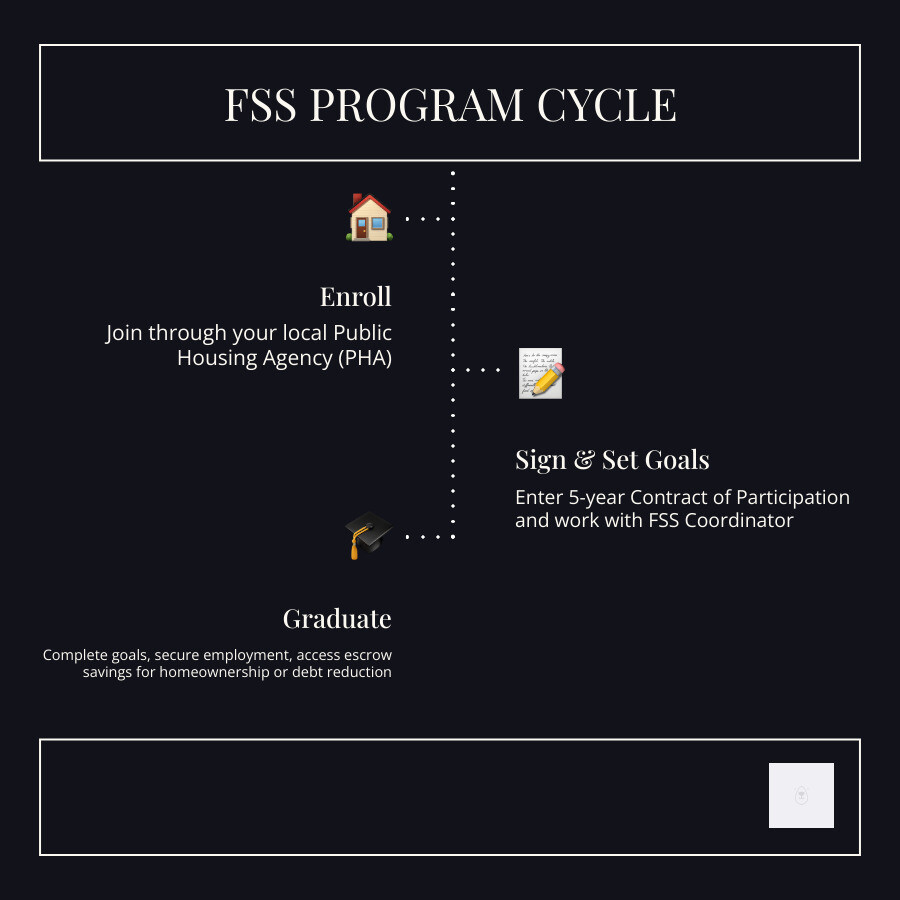
Infographic showing the FSS program cycle: Step 1 Enroll through local PHA, Step 2 Sign 5-year Contract of Participation, Step 3 Set goals with FSS Coordinator, Step 4 Access supportive services, Step 5 Build escrow savings as income grows, Step 6 Graduate with funds for homeownership or debt reduction; key facts include interest-bearing escrow account, IRS-confirmed non-taxable funds, and 12-month welfare independence requirement for graduation - Family Self-Sufficiency program California infographic infographic-line-3-steps-dark

Understanding the Family Self-Sufficiency Program California

When we talk about the Family Self-Sufficiency program California, we are looking at one of the most powerful tools available for families in subsidized housing. Administered by the U.S. Department of Housing and Urban Development (HUD), this initiative is designed to do more than just provide a roof over your head; it aims to give you the keys to your own future.

The program primarily serves three groups: those with Housing Choice Vouchers (Section 8), residents of public housing, and tenants in the Section 8 Project-Based Rental Assistance (PBRA) program. In cities like Los Angeles, San Diego, and San Francisco, local Public Housing Agencies (PHAs) manage these programs, often in partnership with community organizations to ensure participants have access to the resources they need to thrive.

As we see in the What is FSS? on Vimeo overview, the program promotes local strategies that coordinate public and private resources. This isn’t just a government checklist; it’s a community-wide effort to help you obtain employment that leads to a living wage.

How the Family Self-Sufficiency Program California Works

The journey toward independence begins with a document called the Contract of Participation (CoP). This is a five-year agreement between you and the housing authority. While five years might seem like a long time, it is designed to give you the breathing room necessary to complete education, gain work experience, and stabilize your finances.

During these five years, we work with you to set specific, achievable goals. These goals are outlined in your Individual Training and Services Plan (ITSP). For a veteran transitioning back to civilian life, this might include:

  • Completing a vocational training program.
  • Improving a credit score to prepare for a mortgage.
  • Securing a stable job in a high-growth industry.

Throughout the term, you aren’t alone. You are assigned an FSS Coordinator who provides case management. They act as your navigator, connecting you to childcare, transportation, and legal services. If life throws a curveball — like a medical emergency or an involuntary job loss — the contract can often be extended for up to two years for “good cause,” ensuring you don’t lose the progress you’ve made.

A diverse group of people in a bright classroom setting, focused on a professional consultation regarding career goals and financial planning - Family Self-Sufficiency program California

Financial Incentives and the FSS Escrow Account

The most unique and exciting part of the Family Self-Sufficiency program California is the escrow account. In most subsidized housing programs, when your income goes up, your rent goes up, too. This can sometimes feel like a “success tax,” making it hard to save money while you’re working hard to get ahead.

The FSS program changes that math. When your earned income increases, a portion of the resulting rent increase is deposited into an interest-bearing escrow account maintained by the Housing Authority.

For example, if Maria (whose name has been changed) gets a promotion that increases her rent by $200 a month, the housing authority puts that $200 into her FSS escrow account instead of just keeping it as extra rent. Over five years, this can grow into a life-changing sum.

According to the FSS Final Rule & New 24 CFR 984 Regulations, these accounts are designed to build assets that participants can use upon graduation. It’s essentially a forced savings plan that rewards your professional growth.

Tax Benefits and Asset Growth

We often get asked if the money in the escrow account is taxable. The answer is a resounding no. An IRS letter has confirmed that FSS escrow funds are not considered taxable income when they are awarded to you upon successful completion of the program.

This money can be used for anything that helps you maintain your independence. Common uses include:

  • Homeownership: Many of our clients, including veterans, use these funds as a down payment on their first home. In Berkeley, for instance, over 20 families achieved homeownership through their FSS savings.
  • Debt Reduction: Paying off high-interest credit cards or student loans to improve financial health.
  • Transportation: Purchasing a reliable vehicle to ensure you can get to and from work.
  • Education: Paying for further certifications or college tuition for yourself or your children.

The goal is to leave the program not just with a job, but with a “nest egg” that provides a safety net for the future.

Eligibility and Application Requirements

To join the Family Self-Sufficiency program California, you must currently be a participant in a HUD-assisted housing program. This includes the Housing Choice Voucher program and Public Housing. Participation is voluntary, but it does require a commitment to seeking and maintaining “suitable employment.”

Eligibility isn’t based on your current income level (though you must be under certain low-income thresholds to have a voucher in the first place); rather, it is based on your motivation to become self-sufficient. Whether you are currently unemployed or working a part-time job and looking to move into a full-time career, the program is designed to meet you where you are.

If you are ready to take the next step, you can often start the process by filling out an FSS application online or by contacting your local housing authority.

Applying for the Family Self-Sufficiency Program California

Different counties have different ways to apply, but the core requirements remain the same. Here is how you can get started in some of our key service areas:

  • Los Angeles: The Los Angeles County Development Authority (LACDA) manages a robust FSS program. You can reach them at (626) 586-1530 or email fssprogram@lacda.org to request a pre-enrollment application.
  • Orange County: Residents can contact Peggy Herrera at 714-480-2777 for assistance with the application process.
  • San Diego: The San Diego County Housing Authority offers FSS to its voucher participants, focusing on career development and financial literacy.
  • Riverside County: The Department of Public Social Services integrates self-sufficiency efforts with housing support to help families move off cash aid.

When we work with clients in these areas, we emphasize that the application is just the beginning. The real work happens when you sit down with a coordinator to map out your five-year plan.

Supportive Services and California Program Integration

At LifeSTEPS, we know that housing is just the foundation. To truly achieve self-sufficiency, families need a “scaffolding” of support. This is why we focus on high-impact services that address the whole person.

Our data shows that this approach works: we maintain a 93% housing retention rate for the families we serve. This stability is often bolstered by the CalAIM program, which we use to provide critical deposit assistance for those transitioning into new, stable living environments.

The Family Self-Sufficiency program California doesn’t exist in a vacuum. It works alongside state programs like California Work Opportunity and Responsibility to Kids (CalWORKs). CalWORKs provides temporary financial assistance and employment services, while FSS focuses on the long-term asset building through the escrow account. By integrating these resources, we ensure that families aren’t just surviving month-to-month, but are actually building wealth.

Education and Youth Development

We believe that self-sufficiency is a multi-generational goal. If we can help children succeed in school today, they are much more likely to be self-sufficient adults tomorrow.

Our youth programs are a cornerstone of our work in California:

  • Summer Reading: We have seen a 97% literacy improvement among participants in our summer reading programs. Keeping kids engaged with books during the break prevents the “summer slide” and sets them up for academic success.
  • Afterschool Support: Our programs provide a safe, productive environment for children while their parents are at work or attending job training.
  • Scholarships: To date, we have helped facilitate $2.1 million in scholarships for higher education. This removes one of the biggest barriers to career advancement for young adults in subsidized housing.

By focusing on education, we aren’t just helping a family get through the next five years of an FSS contract; we are helping them change their family’s trajectory for decades to come.

Graduation Requirements and Success Metrics

Graduating from the Family Self-Sufficiency program California is a major milestone. To successfully complete the program and receive your escrow funds, you must meet three main criteria:

  1. Complete all goals listed in your Individual Training and Services Plan.
  2. Maintain suitable employment. The head of the household must be employed by the time the contract expires.
  3. Welfare Independence: The entire family must be free of federal and state welfare cash assistance (like TANF or CalWORKs) for at least 12 consecutive months before the contract ends.

HUD now uses the FSS Achievement Metrics (FAM) Score to evaluate how well local programs are performing. This standardized metric looks at things like earnings growth and graduation rates, ensuring that the programs are effectively helping families move toward economic mobility.

Measuring Long-Term Impact

The true measure of success isn’t just the graduation ceremony; it’s what happens next. We see families move from renting to owning, from entry-level jobs to management positions, and from financial stress to peace of mind.

For veterans, this transition often means finding a new sense of purpose in the civilian workforce. Whether it’s through specialized training in the utility industry or starting a small business, the FSS program provides the financial cushion to take those risks. You can find more info about LifeSTEPS services and how we support these transitions on our website.

Frequently Asked Questions about FSS

Is the FSS escrow account taxable?

No. The IRS has confirmed that the funds disbursed from an FSS escrow account upon successful completion of the program are not considered taxable income. This allows you to keep the full amount of your savings to invest in your future.

How long does the FSS program last?

The standard Contract of Participation is for five years. However, if you meet your goals early, you can graduate sooner. If you encounter significant hardships, you may be eligible for an extension of up to two years.

Can I use FSS funds for homeownership?

Absolutely. In fact, using escrow savings for a down payment or closing costs on a home is one of the most popular uses of the funds. Many California PHAs offer specific homeownership counseling to help FSS participants prepare for this step.

Conclusion

The Family Self-Sufficiency program California is more than just a savings account; it is a pathway to a new life. At LifeSTEPS, we are honored to walk this path with you. Our human-centered support is designed to empower you to reach your goals, whether that’s finishing your degree, securing a better job, or finally buying a home for your family.

By combining the financial incentives of HUD’s FSS program with our dedicated case management and educational resources, we help create stable, thriving communities across California. We believe that with the right tools and a supportive community, economic independence is within reach for everyone.

If you are ready to start your journey toward stability, we encourage you to contact LifeSTEPS for housing support or reach out to your local housing authority today.

what is a self sufficiency human services program

From Aid to Independence: Decoding Self-Sufficiency Human Services Programs

Understanding the Path from Assistance to Independence

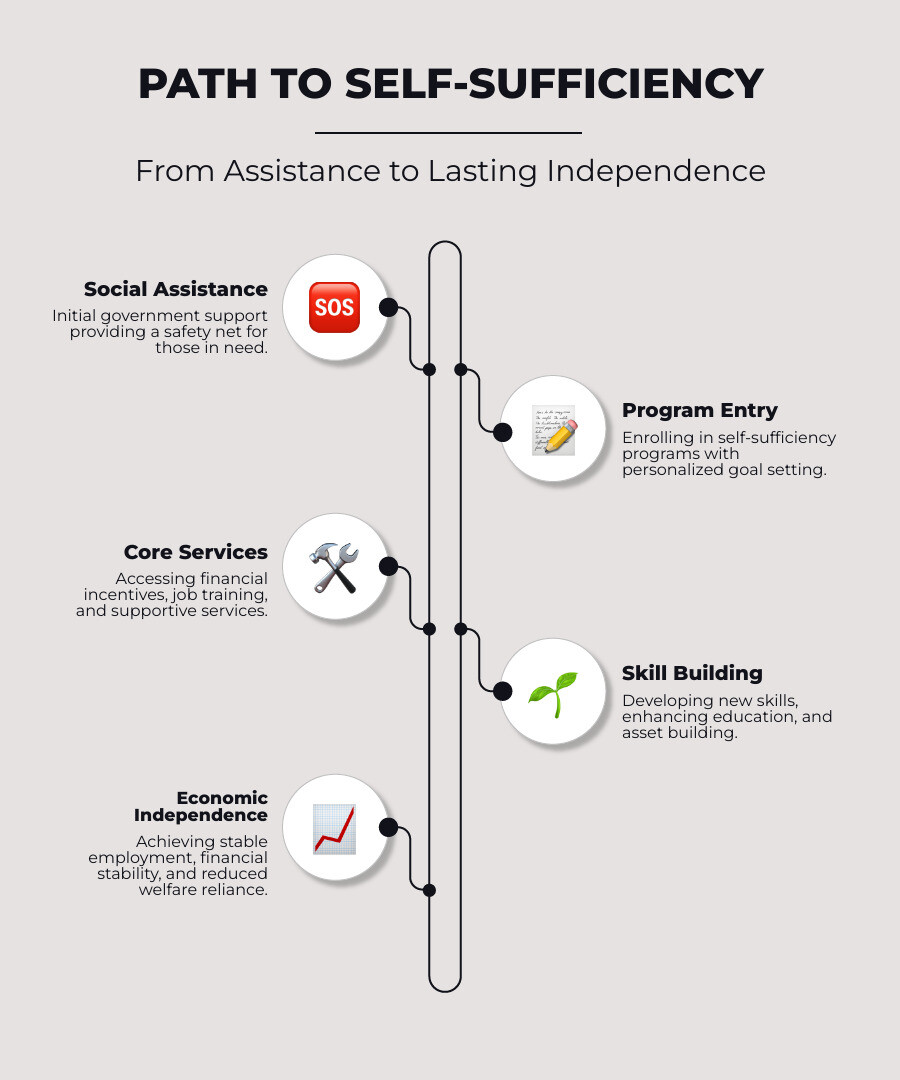
What is a self sufficiency human services program? A self-sufficiency human services program is a structured initiative designed to help individuals and families transition from government assistance to economic independence through a combination of financial incentives, employment support, skill-building services, and case management.

Key Components:

  • Financial Incentives – Earnings supplements or escrow accounts that reward work and savings
  • Employment Services – Job training, placement assistance, and career counseling
  • Supportive Services – Childcare, transportation, education, and financial coaching
  • Case Management – Personalized guidance to help participants achieve specific goals
  • Time-Limited Support – Typically 3-5 years of assistance to build sustainable independence

For veterans transitioning to civilian life, these programs offer more than just financial aid. They provide a pathway to stability when you’re navigating housing insecurity, career changes, and the challenge of rebuilding support systems outside the military.

The research is clear: self-sufficiency programs work. The Canadian Self-Sufficiency Project increased employment earnings by more than one-third and reduced welfare receipt by 13 percentage points. Housing-focused programs like HUD’s Family Self-Sufficiency initiative help participants build assets through interest-bearing escrow accounts while connecting them to community resources.

What makes these programs different from traditional welfare? They’re built around the principle that work should pay more than assistance. Instead of simply providing a safety net, they create stepping stones. Participants receive supplements that make full-time employment financially rewarding, coupled with services that address real barriers like childcare costs and transportation gaps.

These programs serve diverse populations: single caregivers balancing work and family, veterans seeking stable housing and career paths, refugees building new lives, and families working just above the poverty line who are one emergency away from crisis.

infographic showing the transition pathway from social assistance through self-sufficiency program components including financial incentives, employment services, skill building, and case management leading to economic independence and reduced welfare dependency - what is a self sufficiency human services program infographic infographic-line-5-steps-elegant_beige

Quick what is a self sufficiency human services program terms:

Defining What is a Self Sufficiency Human Services Program

career counselor meeting with a client - what is a self sufficiency human services program

When we ask, “what is a self sufficiency human services program?” we are looking at a fundamental shift in how social services are delivered. Unlike traditional “safety net” programs that focus primarily on short-term relief, self-sufficiency programs are designed as “stepping stones.” Their primary goal is to empower participants to achieve financial independence so they no longer require public assistance.

In our work across California—from San Diego to the San Francisco Bay Area—we see how these programs address the systemic barriers that keep families trapped in cycles of poverty. These barriers often include a lack of affordable childcare, limited transportation, or the “cliff effect,” where a small increase in earnings leads to a total loss of benefits, leaving the family worse off than before.

Self-sufficiency programs solve this by making work pay. They often include supportive services such as financial coaching and career counseling to ensure that as income rises, the participant has the tools to manage their new resources. This holistic approach doesn’t just benefit the individual; it improves community well-being by increasing the local tax base and reducing the long-term demand on public resources.

Feature Traditional Social Assistance Self-Sufficiency Programs
Primary Goal Immediate crisis relief Long-term economic independence
Duration Often ongoing based on need Typically time-limited (3-5 years)
Focus Resource provision (food, cash) Skill-building and asset accumulation
Work Requirement Varies, often minimal Usually central to the program
Outcome Metric Benefit distribution Employment and welfare exit

Core Models: Financial Incentives and Asset Building

The most successful programs use specific economic models to encourage growth. One of the most famous examples is the Canadian Self-Sufficiency Project, which used “earnings supplements.” This project proved that long-term welfare recipients would leave assistance for full-time work much faster if that work paid significantly more than their benefits. In fact, participants in that study saw their employment earnings increase by more than one-third.

Another powerful model used right here in the United States is the Family Self-Sufficiency (FSS) program. This model focuses on asset building through an escrow account. As a participant’s earned income increases, their rent usually goes up. In an FSS program, that increase in rent is deposited into an interest-bearing escrow account. Upon successful completion of the program, the family can use those funds for a down payment on a home, education, or starting a business.

At LifeSTEPS, we believe that housing is the foundation of this journey. By providing housing and education programs, we help our clients stabilize their living situation so they can focus on their career goals. For many, especially veterans in Los Angeles or San Diego, this combination of case management and financial work incentives is the key to breaking the cycle of housing instability.

Core Components of What is a Self Sufficiency Human Services Program

To be truly effective, a self-sufficiency program must be comprehensive. It isn’t enough to just find someone a job; we must ensure they can keep it and grow within it. According to the Official HUD FSS Program Guidebook, the following components are essential:

  • Financial Empowerment Coaching: Teaching participants how to budget, repair credit, and save for the future.
  • Job Training and Placement: Connecting individuals with vocational training and employers who offer a living wage.
  • Childcare Subsidies: Addressing one of the biggest barriers to employment for single caregivers.
  • Transportation Assistance: Ensuring participants have reliable ways to get to work or school.
  • Household Skill Training: Helping families manage the day-to-day requirements of maintaining a stable home.

Essential Services and Target Populations

Who benefits from these programs? While the eligibility varies, the target populations are those most at risk of long-term poverty. We focus heavily on:

  • Single Caregivers: Helping them balance the dual roles of provider and nurturer through targeted childcare and employment support.
  • Veterans: Assisting those who served our country in navigating the transition to civilian careers and stable housing.
  • Refugees: Providing the medical, cash, and employment assistance needed during the first few months of arrival in the U.S.
  • Housing Choice Voucher Participants: Leveraging housing assistance as a platform for economic mobility.

In California, we also use specialized tools like CalAIM deposit assistance. This program is vital for individuals transitioning into stable housing, providing the financial “hand-up” needed to cover move-in costs that would otherwise be an impossible barrier. Furthermore, our commitment to education is reflected in the $2.1 million in scholarships we have awarded to help residents pursue higher education and vocational training.

Eligibility Criteria for What is a Self Sufficiency Human Services Program

While every program has its own specific rules, most share common eligibility requirements. To participate, you generally need to meet the following:

  1. Income Thresholds: Most programs are designed for low-to-moderate-income households.
  2. Housing Status: Many programs, like FSS, require participation in a housing assistance program (like Section 8 or Public Housing).
  3. Employment Status: For programs like the Self-Sufficiency Grant, at least one adult in the household must be employed or have a consistent source of income (such as veteran’s benefits).
  4. Documentation: You will typically need to provide:
    • Proof of income (pay stubs or benefit letters).
    • Identification for all household members.
    • Lease agreements or housing voucher information.
    • Documentation of any extenuating circumstances (for emergency grants).

Measuring Impact: Outcomes and Long-Term Benefits

We don’t just hope these programs work; we measure their success through rigorous data. The impact of a well-run what is a self sufficiency human services program is felt across generations. When a parent achieves economic independence, their children are more likely to succeed in school and pursue higher education themselves.

Our results across California speak to the power of this human-centered support:

  • 93% Housing Retention Rate: We help our clients stay in their homes, preventing the trauma of eviction and homelessness.
  • 97% Literacy Improvement: Through our Summer Reading programs, we ensure that children in our communities aren’t left behind, setting the stage for future academic success.
  • $2.1M in Scholarships: We invest directly in the dreams of our residents, helping them bridge the gap to higher education.

Beyond these internal metrics, self-sufficiency programs provide a significant return on investment for society. By reducing welfare dependency and increasing employment, these programs lead to increased tax revenue and lower government expenditures on social assistance. For example, the Canadian SSP was found to be a “triple winner”—it increased earnings, reduced poverty, and was largely cost-effective because the supplements were offset by reduced welfare payments and increased tax contributions.

Frequently Asked Questions about Self-Sufficiency Programs

Is the money earned in a self-sufficiency escrow account taxable?

No. According to the IRS, funds accumulated in a Family Self-Sufficiency (FSS) escrow account are not considered taxable income. This allows families to save the full amount of their earned income increases to put toward life-changing goals like homeownership or education.

How long do these programs typically last for participants?

Most self-sufficiency programs are designed to be time-limited to encourage steady progress. For instance, the HUD FSS program typically lasts for five years, though participants can sometimes request a two-year extension if they need more time to meet their specific goals.

What is the difference between a self-sufficiency grant and welfare?

Traditional welfare (like TANF) provides ongoing cash assistance for basic living expenses. A self-sufficiency grant, like those offered by some non-profits, is usually a one-time or short-term “hand-up” designed to solve a specific crisis (like an emergency car repair or medical bill) that threatens a working family’s stability. The goal of the grant is to prevent the family from needing to go on welfare in the first place.

Conclusion

At its heart, understanding what is a self sufficiency human services program is about understanding human potential. It is about recognizing that with the right combination of stable housing, financial incentives, and supportive services, individuals can move from a state of “aid” to a state of “independence.”

Whether we are helping a veteran in San Diego secure service-connected disability benefits or supporting a single caregiver in San Francisco as they pursue a degree, our mission remains the same: to provide the safety net and career pathways that lead out of poverty. By focusing on measurable outcomes and human-centered support, we aren’t just changing lives—we are strengthening the very fabric of our California communities.

Explore our full range of programs and services to see how we can help you or your family on the journey toward stability.


LifeSTEPS | LifeSTEPS website

LifeSTEPS Awards $169K in 2026 Spring Scholarships to 61 Students Advancing Education Equity

This spring, LifeSTEPS proudly awarded 61 students a total of $169,379 in scholarships, supporting academic education. These scholarships help students from affordable housing communities continue their education, reduce financial stress, and move closer to long-term career success.

LifeSTEPS Awarded Department of Health Care Services (DHCS) Grant

Funds will be used to expand and establish Medi-Cal Enhanced Care Management and Community Support services in Los Angeles County 

SACRAMENTO, CA – The California Department of Health Care Services (DHCS) has announced a grant award of $1,869,064 to Life Skills Training & Educational Programs (LifeSTEPS) as part of the statewide initiative of California Advancing and Innovating Medi-Cal (CalAIM).

In January 2023, DHCS announced an award of $119 million in total funding to help local organizations build capacity and infrastructure in Medi-Cal’s delivery system. These funds will support California’s long-term commitment to transform and strengthen Medi-Cal, offering Californians a more equitable, coordinated, and person-centered approach. DCHS awarded 98 organizations, LifeSTEPS being one of the recipients, through Providing Access and Transforming Health (PATH) Capacity and Infrastructure, Transition, Expansion, and Development (CITED) Initiative Round 1A.

The PATH program is comprised of multiple aligned initiatives that will provide funding, tools, technical support, and resources to Medi-Cal providers, including community-based organizations (CBOs), counties, Tribes, local governmental entities, and other community partners to support a smooth transition to CalAIM.

LifeSTEPS is pleased to be one of the 98 recipients of the statewide award. This grant will enable the transition, expansion, and development of LifeSTEPS’ Enhanced Care Management (ECM) and Community Supports capacity and infrastructure of existing programs and future expansions in Los Angeles County. LifeSTEPS is coordinating with organizations they contract with and intends to contract with other organizations such as L.A. Care to continue providing Enhanced Care Management (ECM) and Community Support Services (CM) in Los Angeles County.

“This is an example of the leadership in California helping with the expansion of services to the most vulnerable and supporting small non-profits growth. Saving health dollars by supporting health education, housing, and intensive case management to the most vulnerable saves millions,” said Beth Southorn, LifeSTEPS Executive Director.

“We have seen first-hand how health intervention on the front lines changes lives by restoring health connections, reducing hospitalizations and restoring hope through relationship reunification,” said Beth. “Though chronic homeless might look a certain way while living on the streets… the life blood of housing stability, intensive case management and health restoration returns that same individual into productive individuals in service to others.”

LifeSTEPS has accepted the responsibility to carefully manage PATH Cited funds with the goal being quality services to benefit our clients and program sustainability in collaboration with our managed care plan partners.

For more information about LifeSTEPS programs and services provided in California, please visit https://lifestepsusa.org/programs-services/.

DHCS. “Department of Health Care Services announces $119 million in award notices to advance its vision of a whole system, person-centered approach to care.” DHCS Press Release, 31 Jan. 2023. https://www.dhcs.ca.gov/formsandpubs/publications/oc/Documents/2023/23-03-CITED-Round-1-Award-1-31-23.pdf. PDF download.