


The Essential HUD Low Income Senior Housing Handbook
Why Millions of Seniors Are Struggling to Find Affordable Housing
HUD low income senior housing is a set of federal programs that help older adults with limited finances pay for safe, stable rental housing — often for as little as 30% of their monthly income.
If you’re looking for a quick overview of the main options:
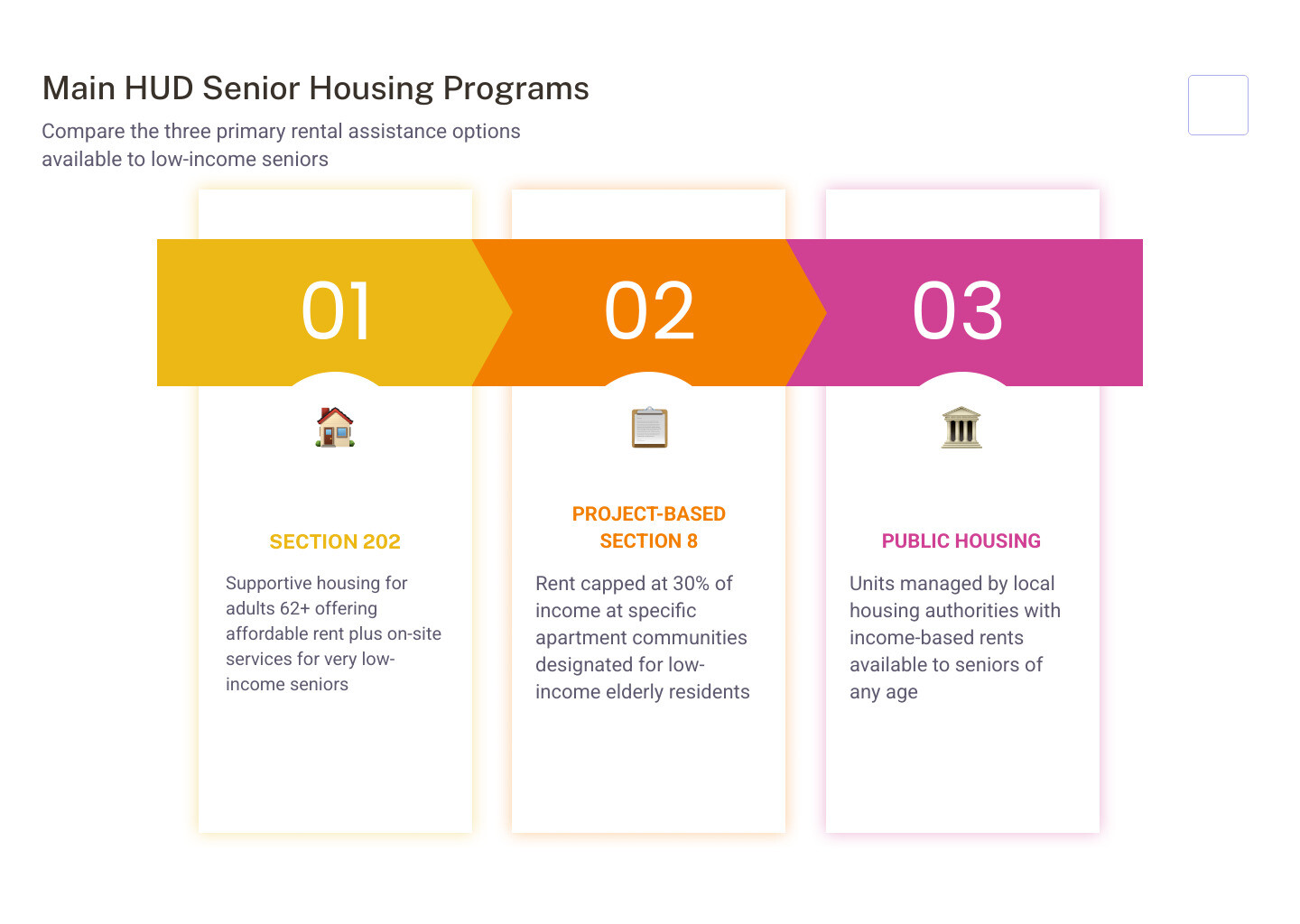
| Program | Who It’s For | Key Benefit |
|---|---|---|
| Section 202 | Adults 62+, very low income | Affordable rent + supportive services |
| Public Housing | Low-income households, all ages | Reduced rent through local housing authority |
| Project-Based Section 8 | Low-income renters at specific properties | Rent capped at 30% of income |
| Housing Choice Voucher (Section 8) | Low-income households | Use voucher at qualifying private rentals |
| LIHTC Properties | Low-to-moderate income renters | Below-market rents at tax credit properties |
The scale of the need is hard to overstate. More than 17 million Americans aged 65 and older are economically insecure, living at or below 200% of the federal poverty level. The senior poverty rate has climbed to around 15% under the Supplemental Poverty Measure. And by 2030, roughly 73 million Americans — about one in five — will be over the age of 65.
That’s a lot of people who need help, and not nearly enough housing to go around.
For veterans transitioning to civilian life, the challenge is even sharper. Fixed or limited income, unfamiliar bureaucratic systems, and long waiting lists can make finding stable housing feel overwhelming. But federal programs exist specifically to help — and knowing how they work is the first step.
This guide walks you through everything you need to know: which programs exist, who qualifies, how to apply, and what to expect once you’re in.
LifeSTEPS currently provides services in California only.
Hud low income senior housing terms simplified:
Understanding HUD Low Income Senior Housing Programs
When we talk about hud low income senior housing, we are referring to a collection of distinct federal programs designed to make renting affordable for older adults. While they all receive funding from the U.S. Department of Housing and Urban Development (HUD), they operate differently. Some programs tie the rental subsidy to the tenant, while others tie the subsidy directly to the building.
Understanding these structural differences is essential. It helps you target your search, manage your expectations, and apply to the programs that best fit your lifestyle and healthcare needs. The primary programs include Section 202, Public Housing, Project-Based Section 8, and the Low-Income Housing Tax Credit (LIHTC) program. To dive deeper into how these federal mechanisms support our aging population, you can review the detailed policy brief on Section 202 and Other HUD Rental Housing Programs for Low-Income Elderly Residents.
Navigating these programs can feel like learning a new language, but we are here to simplify the process. For a comprehensive overview of how these options fit together, take a look at The Golden Guide to Senior HUD Housing.
Section 202 Supportive Housing for the Elderly
The Section 202 program is unique because it is the only HUD program created exclusively for very low-income seniors aged 62 and older. It does not just offer cheap rent; it is designed to help older adults age in place by integrating housing with supportive services.
Under this program, HUD provides non-profit organizations with “Capital Advances” to build or rehabilitate affordable senior properties. These advances do not have to be repaid as long as the housing remains available to very low-income seniors for at least 40 years.
To keep ongoing operations affordable, HUD utilizes Project Rental Assistance Contracts (PRAC). The PRAC covers the difference between what the senior can afford to pay (typically 30% of their adjusted income) and the actual cost of operating the unit. Currently, nearly 350,000 Section 202 units exist nationwide, with approximately 109,000 of them built since 1990 receiving PRAC assistance. This program is highly valued because it allows seniors to live independently in private apartments while enjoying access to community spaces and on-site service coordinators. If you want to explore how this specific model operates, read our guide on Low Income Elderly Housing.
Project-Based Section 8 and Public Housing
While Section 202 is senior-specific, other broad HUD programs also provide dedicated housing options for older adults.
- Project-Based Section 8: Under this program, HUD enters into rental assistance contracts with private property owners. The subsidy is tied directly to the apartment unit. If a senior moves out, the subsidy stays with the property. Residents pay a set percentage of their income, and HUD covers the rest.
- Public Housing: These are communities owned and managed directly by local Public Housing Authorities (PHAs). Many public housing high-rises or garden communities are designated specifically for elderly and disabled residents.
- Housing Choice Vouchers (Tenant-Based Section 8): Unlike project-based assistance, these vouchers belong to the tenant. A senior can use their voucher to find a qualifying rental on the private market. However, because voucher waiting lists are notoriously long, many seniors find that project-based properties are a more direct path to securing affordable housing.
To learn more about how rental subsidies can ease the burden on fixed incomes, read our article on Rent Subsidies for Seniors.
Eligibility Requirements for HUD Senior Housing
To ensure that federal resources go to those who need them most, HUD has established strict eligibility guidelines. These rules govern who can move into subsidized apartments and how tenant selection must be managed. Property owners and PHAs must follow standardized federal procedures to ensure fair, non-discriminatory admissions, as detailed in 24 CFR § 891.410 – Selection and admission of tenants.
For a broad look at what it takes to qualify, you can also consult our Low Income Senior Housing Guide. Generally, eligibility is determined by age, household income, asset levels, and citizenship status.
Age and Income Limits for HUD Low Income Senior Housing
To qualify for senior-designated HUD housing, at least one member of your household must meet the age requirement. For Section 202 properties, the minimum age is 62. However, some other affordable housing programs, such as those funded by the Low-Income Housing Tax Credit (LIHTC), may accept residents starting at age 55.
Income eligibility is based on the Area Median Income (AMI) of the county where the property is located. HUD updates these limits annually. The income tiers are defined as:
- Low-Income: Households earning 80% or less of the AMI.
- Very Low-Income: Households earning 50% or less of the AMI (this is the standard threshold for Section 202).
- Extremely Low-Income: Households earning 30% or less of the AMI.
Because California has some of the highest living costs in the nation, local income limits can vary dramatically between counties. For instance, what qualifies as “low-income” in Los Angeles or San Diego may be quite different from rural areas. You can explore regional differences in our breakdown of Affordable Senior Housing California.
Here is a general comparison of how income limits apply across different programs:
| Program Type | Target Income Tier | Age Requirement |
|---|---|---|
| Section 202 | Very Low-Income (≤50% AMI) | 62 years and older |
| Public Housing (Senior Designated) | Low-Income (≤80% AMI) | Typically 62+ (some 50+ exceptions) |
| Project-Based Section 8 | Very Low-Income (≤50% AMI) | Varies, but senior properties are 62+ |
| LIHTC Properties | Low-to-Moderate (50% to 60% AMI) | Often 55+ or 62+ |
Asset Limits and Deductions in 2026
When you apply for hud low income senior housing, your assets are also evaluated. It is a common misconception that you cannot own any assets to qualify. However, HUD rules limit how much you can hold in liquid assets.
Effective January 1, 2026, the asset limit for HUD housing assistance programs is $105,574. If your total assets fall below this threshold, you remain eligible, though any income generated by those assets (such as interest or dividends) will be counted toward your annual household income.
Additionally, HUD allows specific income deductions to make housing more affordable for older adults. In 2026, the mandatory elderly family deduction is $550. This deduction is subtracted from your gross annual income, which lowers your adjusted income and ultimately reduces your monthly rent. Seniors are also permitted to deduct medical expenses that exceed a set percentage of their income. To learn more about how assets and medical deductions affect your eligibility, read our resource on Low Income Housing for Elderly and Disabled.
How to Apply for HUD Low Income Senior Housing
Applying for affordable housing requires patience, organization, and persistence. Because there is no single, centralized application for all HUD properties, you will need to apply through multiple channels.
To find localized information and state-specific portals, you can visit California | HUD.gov. For a step-by-step approach to starting your search close to home, check out our guide on Low Income Senior Housing Near Me.
Step-by-Step Application Process for HUD Low Income Senior Housing
To secure a spot in a HUD-subsidized senior community, we recommend following these steps:
- Contact Your Local PHA: Your local Public Housing Authority manages Public Housing and Section 8 vouchers. Reach out to them to get on their waiting lists.
- Search for Project-Based Properties: Use the HUD Resource Locator online to find individual Section 202 and Project-Based Section 8 buildings in your desired area. You must apply directly to the management office of each individual property.
- Gather Your Documentation: Having your paperwork organized in advance is critical. When your name is called, you must act quickly.
- Submit to Background and Credit Checks: Property managers will verify your rental history, conduct criminal background checks, and ensure you do not owe money to any other federal housing program.
For a detailed roadmap of the local search process, refer to The Near Me Guide to Affordable Senior Apartments.

Managing Long Waiting Lists and Preferences
It is important to be realistic: waiting lists for hud low income senior housing are often very long, typically ranging from one to three years. In high-demand areas of California, lists may close entirely when they become overwhelmed.
Under federal regulations, such as 24 CFR 891.610 | Selection and admission of tenants, housing providers must maintain written chronological waiting lists. However, properties and PHAs often use a “preference” system to prioritize certain applicants. Common preferences that can move you up a waiting list include:
- Age: Priority given to elderly applicants (62+) over near-elderly (50-61).
- Disability Status: Priority for individuals with documented physical or developmental disabilities.
- Local Residency: Priority for people who already live or work in the local municipality.
- Veterans: Special preferences are often granted to veterans and their surviving spouses.
- Homelessness: Priority for individuals currently experiencing homelessness or living in transitional shelters.
Once you are on a waiting list, you must update your contact information and income changes annually. Failure to respond to annual waitlist purge letters will result in your application being removed. For strategies on navigating this system, read our Low Income Senior Housing No Waiting List Guide.
Supportive Services and Aging in Place
The ultimate goal of senior affordable housing is not just to provide a roof over someone’s head, but to help them remain independent for as long as possible. This concept is known as “aging in place.”
Many HUD-subsidized properties employ Service Coordinators. These professionals work directly with residents to link them to community-based services, such as home health aides, meal deliveries, and transportation. This supportive environment has a massive impact. At LifeSTEPS, we are proud to see a 93% housing retention rate among the participants we serve, proving that stable housing combined with human-centered support keeps older adults safe and housed.
For more details on how we support seniors in maintaining their independence, explore how Lifesteps Helps Older Adults Age in Place and read about our Resident Services Aging in Place. Many local housing authorities, such as the Housing Authority of the County of Riverside: Home, work hand-in-hand with service providers to deliver these vital resources.
Available Amenities and Supportive Programs
Seniors living in HUD-assisted housing often have access to a variety of on-site amenities and supportive programs designed to foster community and physical well-being. These can include:
- Nutrition Programs: Congregate meal sites, food pantries, and home-delivered meals (like Meals on Wheels).
- Transportation Assistance: Scheduled shuttle buses for grocery shopping, pharmacy visits, and medical appointments.
- Health and Wellness: On-site blood pressure clinics, exercise classes, and educational seminars on elder abuse and telemarketing fraud prevention.
- Social Activities: Community rooms, arts and crafts, and holiday celebrations that prevent isolation.
To find more local resources that support older adults, check out our guide on Community Resources for Elderly.

Frequently Asked Questions about HUD Senior Housing
What happens if my income changes while living in HUD housing?
If your income changes (for example, if your Social Security benefits increase or you take a part-time job), you must report this to your property manager immediately. The housing provider will perform an “interim reexamination” to recalculate your rent. Because HUD rent is typically set at 30% of your adjusted monthly income, your rent will adjust up or down to match your new financial situation. If your income drops, your rent will decrease accordingly, ensuring you are never priced out of your home.
Can I transfer to another HUD property?
Transferring between HUD properties is not automatic. Because most senior housing subsidies are project-based (tied to the specific building), you cannot simply pack up and move your discount to a new property. If you want to move to a different HUD building, you must submit a new application to that specific property and join their waiting list. However, if you have a Tenant-Based Section 8 Voucher, you can transfer your assistance to any landlord who accepts vouchers, subject to local PHA transfer and portability rules.
Are there options for seniors in Southern California?
Yes, Southern California has a robust network of HUD-subsidized senior apartments, though demand is exceptionally high. Major metropolitan areas have dedicated local housing authorities to assist you. For example, if you are searching in the San Diego region, you can look into affordable options and programs managed by the Rent from SDHC – San Diego Housing Commission. Similar resources exist through county housing authorities in Los Angeles, Riverside, and Irvine.
Conclusion
Finding affordable senior housing can be a long and winding road, but you do not have to walk it alone. Securing stable housing is the foundation for a healthy, fulfilling retirement.
At LifeSTEPS, we are dedicated to helping older adults navigate these complex systems and find the stability they deserve. Our evidence-based programs are designed to build thriving, self-sufficient communities. Beyond our senior housing retention efforts, we are proud to support education and community growth across California, achieving a 97% literacy improvement through our Summer Reading program and awarding over $2.1 million in scholarships to date.
For those transitioning into stable housing who need help with upfront costs, we offer deposit assistance through the CalAIM program, which can cover one month paid in advance for your security deposit.
To discover how we can help you or your loved one find stability and support, read More info about LifeSTEPS programs.
For more information, contact: LifeSTEPS | Phone: (916) 965-2110 | lifestepsusa.org
LifeSTEPS currently provides services in California only.


