


The Ultimate Guide to California Security Deposit Laws
What You Need to Know About Security Deposit California Laws
Security deposit California rules changed significantly in 2024, and knowing them can protect you from losing money you’re owed.
Here’s a quick summary of the key rules:
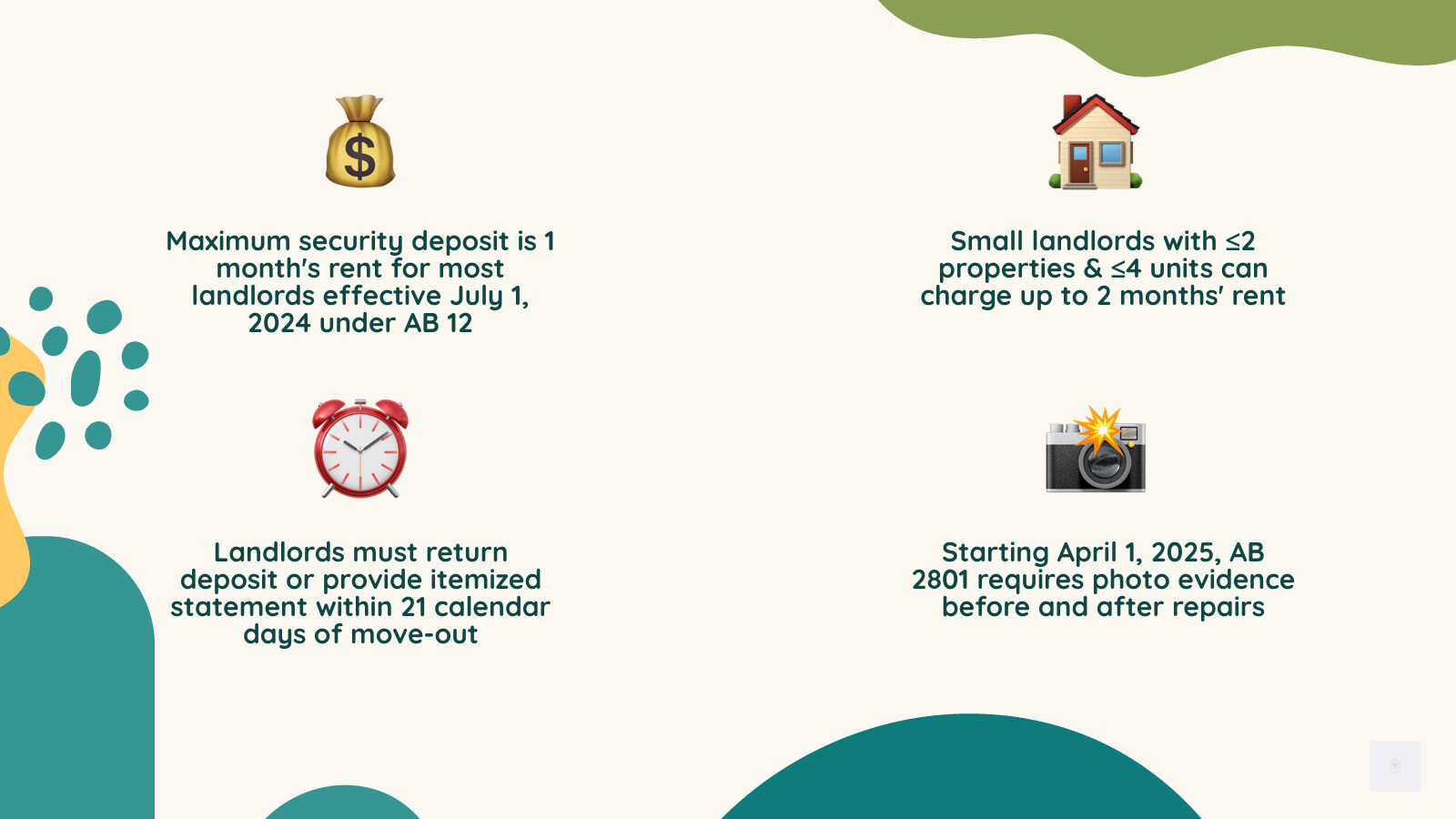
- Maximum deposit: 1 month’s rent for most landlords (as of July 1, 2024)
- Small landlord exception: Up to 2 months’ rent if the landlord owns no more than 2 properties with 4 or fewer total units
- Return deadline: Within 21 calendar days after you move out
- Itemized statement required: Landlord must explain any deductions in writing
- Bad faith penalty: Landlord may owe you up to twice the deposit amount if they withhold it wrongfully
- New in 2025: Landlords must provide photos before and after any repairs (AB 2801, effective April 1, 2025)
Whether you’re a recently discharged veteran getting your first apartment or renewing a lease, understanding these rules helps you protect your money and your housing stability.
California’s laws are among the strongest in the country for renters. But they only work for you if you know them. This guide walks through every key rule, recent changes, and what to do if something goes wrong.
Security deposit California vocab explained:
Understanding the Security Deposit California Limit Under AB 12
For a long time, California renters had to scrape together massive amounts of cash just to get through the front door. Landlords could legally charge up to two months’ rent for an unfurnished unit and three months’ rent for a furnished one. If your rent was $2,500, you might have needed $7,500 just for the deposit—plus the first month’s rent!
That changed on July 1, 2024, with the implementation of AB 12. This law significantly lowers the barrier to housing by capping the security deposit California landlords can charge at one month’s rent. This limit applies regardless of whether the unit is furnished or unfurnished.
The goal of this legislation is to make housing more accessible for everyone, including the veterans and families we serve who are transitioning to stable housing. By reducing the upfront cost of moving, more Californians can achieve the stability they deserve. These rules are codified under California Civil Code Section 1950.5, which serves as the “rulebook” for almost all deposit issues in the state.

Exceptions for Small Landlords and Service Members
As with many laws, there are a few “fine print” items to keep in mind. The one-month cap does not apply to “small landlords.” A small landlord is defined as a natural person or an LLC (where all members are natural persons) who owns no more than two residential rental properties that collectively have no more than four units. These specific owners can still charge up to two months’ rent as a security deposit.
However, there is an exception to the exception! Even if a landlord qualifies as a “small landlord,” they cannot charge more than one month’s rent if the tenant is a military service member. California provides these extra protections to ensure our service members aren’t financially burdened when relocating for duty or transitioning back to civilian life. If you are struggling with these upfront costs, we offer more info about security deposit assistance through our various support programs.
Calculating Your Security Deposit California Total
When calculating what you owe, the “security deposit” includes almost any money you pay upfront that isn’t the first month’s rent. This includes “pet deposits,” “cleaning fees,” or “last month’s rent” paid in advance. Under California law, there is no such thing as a “non-refundable” deposit. Every dollar you hand over (aside from the application screening fee) is legally considered part of the security deposit and is potentially refundable.
Speaking of application fees, these are capped as well. As of late 2023, the maximum screening fee was approximately $62.02, though this adjusts annually with the Consumer Price Index. Landlords must provide you with a receipt for this fee and a copy of the credit report if you request it.
| Deposit Type | Limit Before July 1, 2024 | Limit After July 1, 2024 |
|---|---|---|
| Unfurnished Unit | 2 Months’ Rent | 1 Month’s Rent* |
| Furnished Unit | 3 Months’ Rent | 1 Month’s Rent* |
| Small Landlord (≤4 units) | N/A | 2 Months’ Rent |
| Service Member Tenant | N/A | 1 Month’s Rent |
*Exceptions apply for small landlords as noted above.
Allowable Deductions and the 21-Day Rule
Once you hand over those keys and move out, the clock starts ticking. In California, your landlord has exactly 21 calendar days to do one of two things:
- Send you a full refund of your security deposit.
- Send you an itemized statement that lists any deductions, along with the remaining balance of the deposit.
If the deductions total more than $125, the landlord must include copies of receipts or invoices for the work done. If the landlord or their employees did the work themselves, the statement must describe the work performed, the time spent, and a reasonable hourly rate.
What can they legally take money out for? According to the Guide to security deposits in California, there are four main reasons:
- Unpaid rent: If you moved out owing rent (excluding certain COVID-19 rental debt).
- Cleaning: To get the unit back to the same level of cleanliness it was in when you moved in.
- Repairs: For damage caused by you or your guests that goes beyond “normal wear and tear.”
- Restoration: If the lease allows it, to restore or replace personal property (like furniture or keys) if the unit was furnished.
What Qualifies as Normal Wear and Tear?
This is where most landlord-tenant disputes happen. A landlord cannot deduct money for “normal wear and tear.” But what does that actually mean?
Think of it this way: normal wear and tear is the natural decline of a property over time from everyday use. For example, minor scuffs on the walls, a worn path in the carpet from walking, or dusty blinds are usually considered normal wear and tear.
Landlords often use the “useful life” rule for larger items. For example, if a landlord installs a carpet that is expected to last 10 years, and you move out after 5 years, they can generally only charge you for the remaining 5 years of value—and only if you actually damaged it (like a giant permanent stain), not just because it looks “used.” If the carpet is 11 years old, its “useful life” is over, and the landlord usually shouldn’t charge you anything to replace it.
Local Interest Rules for a Security Deposit California
While state law doesn’t require all landlords to pay interest on security deposits, some cities have their own rules. If you live in Los Angeles or San Francisco, you might be entitled to a little extra cash.
In the City of Los Angeles, landlords of rent-controlled units must pay annual interest on security deposits held for at least one year. The rate is determined annually; for example, it has ranged from 0.29% to as high as 5% in different years. You can find more details on interest payments on Los Angeles deposits through the city’s housing department.
San Francisco has similar requirements. Landlords there must pay interest every year on the tenant’s “anniversary date.” If you move out before a full year, you usually aren’t owed interest, but if you’ve been there for several years, those small percentages can add up to a nice dinner or a few bags of groceries!
New Photography and Inspection Requirements for 2025
California is adding even more transparency to the process soon. Starting April 1, 2025, a new law called AB 2801 will require landlords to provide photographic evidence for any deductions they make for repairs or cleaning.
Under this new rule, landlords must:
- Take photos of the unit within a reasonable time after you vacate but before any repairs are made.
- Take photos after the repairs are completed to show the work was actually done.
- For tenancies starting after July 1, 2025, landlords must also take “before” photos at the very start of the lease to document the initial condition.
This is a huge win for tenants. It prevents landlords from charging you for “damages” that were already there or for repairs that they never actually performed.
The Right to a Pre-Move-Out Inspection
You don’t have to wait until you move out to find out if your landlord plans to keep your deposit. You have the legal right to request an “initial inspection” (often called a pre-move-out walkthrough).
The landlord must notify you in writing of your right to this inspection. It should happen no earlier than two weeks before your lease ends. The purpose is to give the landlord a chance to point out exactly what they think needs cleaning or repair. You then have the remaining time before you move out to fix those issues yourself. If you clean the spot on the carpet or patch the hole from your TV mount, the landlord cannot deduct for it later.
The landlord must give you 48 hours’ notice before this inspection unless you both agree in writing to waive the notice. After the inspection, the landlord must give you an itemized list of the repairs or cleaning they intend to charge for if you don’t fix them.
Resolving Disputes and Small Claims Court
What happens if the 21 days pass and you get nothing? Or what if you get a statement that says the landlord is keeping your $2,500 deposit to “repaint the whole house” even though you only lived there for six months and didn’t touch the walls?
Your first step should always be a demand letter. This is a formal letter (sent via certified mail so you have proof) asking for your deposit back and explaining why the deductions are improper. Sometimes, just showing the landlord that you know the security deposit California laws is enough to get them to settle.
If the demand letter doesn’t work, your next stop is Small Claims Court. In California, tenants can sue for up to $12,500 in small claims. You don’t need a lawyer, and the process is designed to be relatively simple for everyday people.
Steps to Take if Your Deposit is Withheld
If you find yourself in a dispute, follow these steps to build your case:
- Gather Evidence: This is why “move-in” and “move-out” photos are so important. Compare your photos to the landlord’s claims.
- Review the Itemization: Did they provide receipts? Are the hourly rates for labor reasonable?
- Check the Timeline: If they sent the statement on day 25 instead of day 21, they may have forfeited their right to keep any of the deposit.
- Argue “Bad Faith”: If a judge decides the landlord kept your money in “bad faith” (meaning they knew they were wrong but did it anyway), the judge can award you the original deposit plus up to twice the amount of the deposit in statutory damages.
The burden of proof is actually on the landlord. They have to prove in court that the deductions were reasonable and necessary. You can find more information on small claims court limits and procedures on the California Courts self-help website.
Frequently Asked Questions about California Deposits
What is the maximum security deposit for a small landlord?
As of July 1, 2024, a small landlord (someone who owns no more than 2 properties with a total of 4 units) can charge up to two months’ rent. However, if the tenant is a military service member, the limit is strictly one month’s rent, regardless of how many properties the landlord owns.
Can a landlord charge a non-refundable cleaning fee?
No. Under California Civil Code Section 1950.5, no lease can characterize a security deposit (or any part of it) as “non-refundable.” While a landlord can deduct for cleaning, they can only do so to return the unit to the level of cleanliness it had when you moved in. If you leave the place sparkling, they shouldn’t be deducting a “standard” cleaning fee.
How long does a landlord have to provide receipts for repairs?
If the repairs cannot be finished within the 21-day window, the landlord must provide a “good faith estimate” within those 21 days. Once the repairs are finished, they have 14 calendar days to send you the final itemized statement and the actual receipts.
Conclusion
Navigating security deposit California laws can feel overwhelming, but these protections are here to ensure that your hard-earned money stays in your pocket. From the new one-month rent cap under AB 12 to the upcoming 2025 photo requirements, California is making it harder for “bad faith” deductions to slip through the cracks.
At LifeSTEPS, we know that housing stability is the foundation for everything else—education, career, and family well-being. Whether it’s through our 93% housing retention rate or our work with the CalAIM program, we are dedicated to providing human-centered support to Californians in need. We also believe in the future of our community’s youth, boasting a 97% literacy improvement in our Summer Reading programs and providing over $2.1M in scholarships to help the next generation thrive.
By understanding your rights as a tenant, you are taking a major step toward long-term stability. If you are a veteran or a family transitioning into a new home, learn more about our programs and services to see how we can support your journey toward self-sufficiency and homeownership.


