


Top Family Homeownership Support Services You Need to Know
Top Family Homeownership Support Services You Need to Know
Why the Homeownership Path for Families Matters More Than Ever
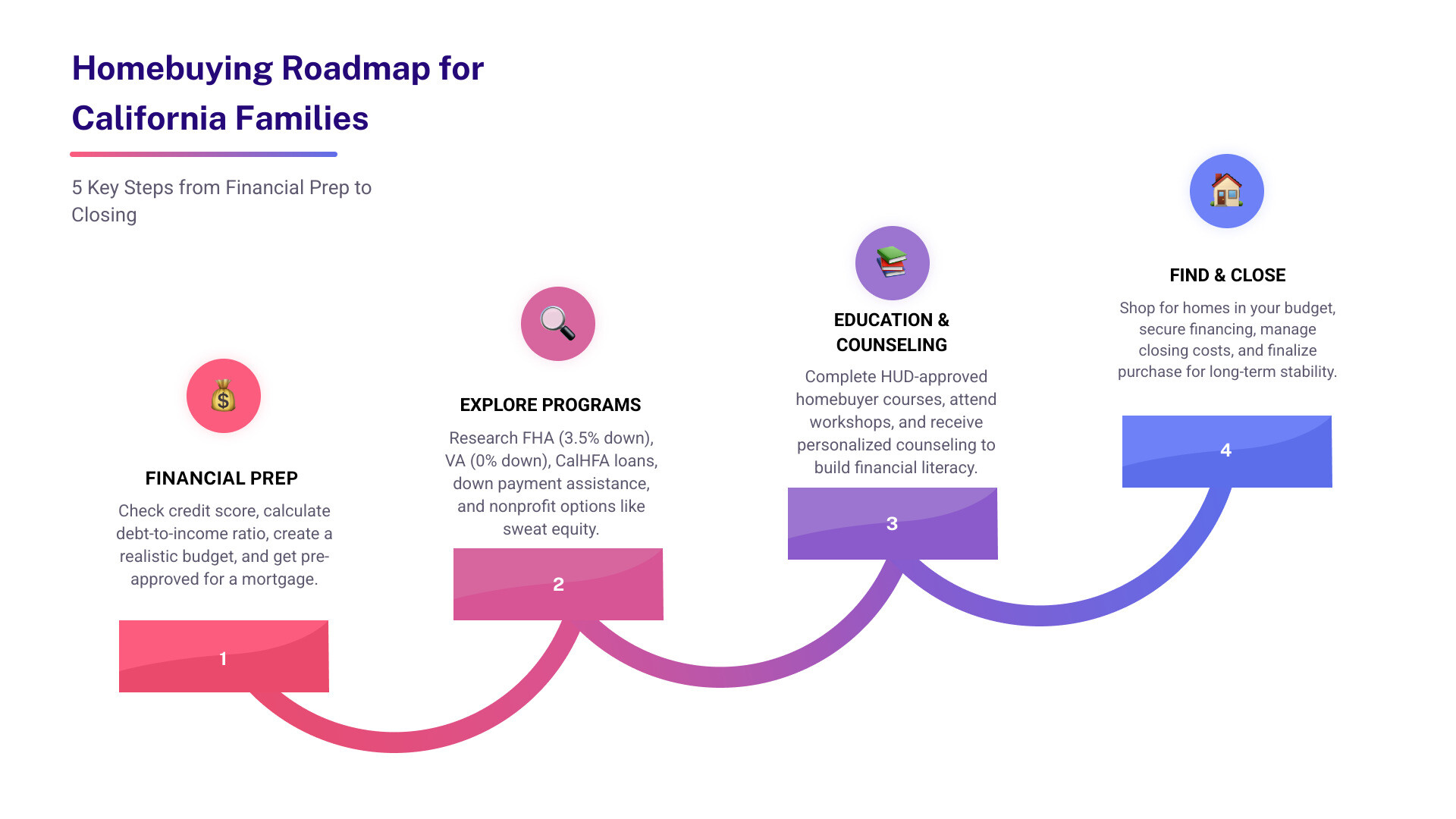
The homeownership path for families is not a single road — it’s a set of programs, tools, and support services that work together to help families move from renting to owning. If you’re comparing your options, here’s a quick overview of the most important support types available in California:
- Government loan programs — FHA loans (3.5% down), VA loans (0% down for veterans), and CalHFA first mortgage and down payment assistance loans for low- to moderate-income buyers
- Nonprofit programs — Habitat for Humanity sweat equity programs and HUD-approved housing counseling agencies
- Financial preparation services — Credit repair support, homebuyer education courses, and pre-approval guidance
- Deposit and down payment assistance — Including CalAIM deposit assistance for qualifying individuals
- Education and counseling — Free or low-cost homebuyer courses through programs like California Dream For All
For many families, the biggest challenge is simply knowing where to start. Around 75% of Americans see homeownership as part of the American dream — yet racial and income gaps mean that access to that dream is far from equal. African American and Hispanic homeownership rates remain below 50%, and very low-income households are nearly 44 percentage points behind high-income households in ownership rates.
Veterans face their own unique barriers — including financial instability and lack of civilian support networks — making it even harder to know which programs actually apply to them.
This guide breaks down the top family homeownership support services available in California, so you can compare your real options and take the next step with confidence.
LifeSTEPS currently provides services in California only.
Navigating the Homeownership Path for Families in California
Starting the journey toward owning a home can feel like standing at the base of a very tall mountain. In California cities like Los Angeles, San Diego, and San Francisco, the peak can seem even higher due to rising costs. However, the first step isn’t finding a house; it’s finding your financial footing.

Preparation begins with a deep dive into your finances. Lenders look at three main pillars: your credit score, your debt-to-income (DTI) ratio, and your savings. For a conventional loan, you typically need a credit score of at least 620, though scores in the mid-to-upper 700s snag the best interest rates. Your DTI—the percentage of your monthly income that goes toward paying debts—should ideally stay under 43%, though some low-income homeownership programs offer more flexibility.
Budgeting is your roadmap. We recommend using this first-time homebuyer guide to understand how to track every dollar. Beyond the mortgage, you must account for “hidden” costs like property taxes, homeowners insurance, and a maintenance fund. A common rule is the 28/36 rule: your mortgage shouldn’t exceed 28% of your gross monthly income, and total debt shouldn’t exceed 36%.
Once your budget is set, getting pre-approved is vital. Many buyers confuse pre-qualification with pre-approval, but in a competitive market like Irvine or Riverside, knowing the difference is the key to getting your offer accepted.
| Feature | Pre-Qualification | Pre-Approval |
|---|---|---|
| Data Source | Self-reported information | Verified financial documents |
| Verification | None | Credit check and income verification |
| Weight with Sellers | Low (informational only) | High (shows you are a serious buyer) |
| Validity | Often indefinite | Typically 60 to 90 days |
Essential Government and Nonprofit Loan Programs
In California, there are several powerful tools designed to make the homeownership path for families more accessible, especially for those with low to moderate incomes. These programs often provide lower down payment requirements or subsidized interest rates.
Federal and State Assistance
The Federal Housing Administration (FHA) offers loans with down payments as low as 3.5% for those with a credit score of 580 or higher. For our veterans, VA loans are a life-changing resource, often requiring 0% down and no private mortgage insurance (PMI).
At the state level, the California Housing Finance Agency (CalHFA) provides specialized first mortgage loans and junior loans for down payment or closing cost assistance. To see if you qualify, you can use the Am I Eligible for CalHFA tool. These programs are often integrated with housing authority programs that provide a pathway for those currently using housing vouchers to transition into ownership.
Unique Support and Sweat Equity
For families who may not qualify for traditional financing, organizations like Habitat for Humanity offer a “partnership” model. Instead of a standard down payment, families contribute “sweat equity”—hundreds of hours spent helping build their own home or the homes of others in their community. This reduces the cost of the home and builds a deep sense of neighborhood connection.
Furthermore, for those qualifying under the CalAIM program, we may be able to provide deposit assistance, which typically covers 1 month paid in advance. This type of human-centered support is what helps our clients maintain a 93% housing retention rate.
Overcoming Financial Barriers and Student Debt
One of the most significant hurdles on the homeownership path for families today is the weight of the past—specifically, student loans and the growing wealth gap. Since 2005, homeownership among recent college graduates has declined by 1.8% for every $1,000 of student loan debt they carry.
Systemic disparities also play a role. African-American and Hispanic households often face higher borrowing costs and tighter credit constraints. According to scientific research on student loan debt and homeownership, high debt loads can make it nearly impossible to save the traditional 20% down payment.
However, modern families are getting creative. About 36% of Gen Z and millennial buyers expect to receive a cash gift from family members to help with their purchase. If your family is in a position to help, they might consider:
- Down Payment Gifts: A tax-free gift (under certain limits) that helps you avoid PMI.
- Intra-family Loans: A formal loan with a lower interest rate than a bank, documented legally to satisfy the IRS.
Strategies for the Homeownership Path for Families with Student Debt
If you are carrying student debt, don’t lose heart. Lenders have become more sophisticated in how they calculate DTI. For example, if you have 10 or fewer payments left on a loan, some lenders may exclude it from your ratio entirely.
Participating in the Family Self-Sufficiency (FSS) program is another excellent strategy. This program allows families in assisted housing to build an escrow savings account as their income increases. These funds can eventually be used for a down payment, providing a powerful boost toward financial security.
Common Closing Costs to Budget For:
- Loan Origination Fees: Usually 0.5% to 1% of the loan amount.
- Appraisal Fees: To confirm the home’s value.
- Title Insurance: To protect against ownership disputes.
- Escrow Deposits: For future taxes and insurance.
- Home Inspection: To ensure the property is safe and sound.
The Role of Education and Counseling Services
We believe that an educated buyer is a successful homeowner. Homebuyer education isn’t just a hurdle to jump over for a loan—it’s a toolkit for life. Many programs, including CalHFA, require a completion certificate from a HUD-Approved Housing Counseling Agency before you can close on a loan.
These courses cover everything from understanding your mortgage disclosures to basic home maintenance. For those looking for flexibility, there are options for homebuyer education online, including free courses through the California Dream For All initiative.
Counseling services help families identify red flags in their credit reports and create realistic debt management plans. By using resources like the FSS program guide, families can learn how to navigate the complexities of government assistance while building the skills needed for long-term mortgage management and foreclosure prevention.
Building Generational Wealth through the Homeownership Path for Families
The benefits of homeownership extend far beyond having a place to sleep. It is a primary engine for building generational wealth. As you pay down your mortgage principal and the home’s value increases, you build equity—a financial asset that can eventually fund education or provide a safety net for the next generation.
The social impact is equally profound. Research on homeownership and child welfare shows that children in owner-occupied homes have a 2.6% lower dropout rate and a 5% lower teen birth rate compared to those in rental households. Homeownership fosters “social capital”—the connections and trust between neighbors that create stable, thriving communities.
Frequently Asked Questions about Family Homeownership
What are the main steps to achieving homeownership for first-time buyers?
The journey usually follows these steps:
- Review your finances and credit score.
- Create a realistic budget including maintenance.
- Get pre-approved by a lender.
- Complete a homebuyer education course.
- Find a real estate agent who understands your needs.
- House hunt and make an offer.
- Perform due diligence (inspections and appraisals) and close.
How can families overcome common barriers like down payment savings?
Families can look into down payment assistance (DPA) programs, which provide grants or low-interest “silent” second mortgages. Programs like Habitat for Humanity allow for sweat equity instead of cash, and the FSS program helps families save through escrow accounts. Additionally, FHA and conventional loans now offer options with as little as 3% to 3.5% down.
What role does homebuyer education play in the process?
Education is often a mandatory requirement for assistance programs. It empowers families to understand the “true cost” of owning a home, teaches them how to avoid predatory lending, and provides strategies for long-term sustainability. It’s the difference between just getting a house and actually keeping it.
Conclusion
At LifeSTEPS, we are committed to more than just finding a roof for our clients; we are committed to their long-term self-sufficiency. Whether it’s helping a veteran navigate the VA loan process or assisting a family through the FSS program, our goal is to provide human-centered support that leads to measurable outcomes.
Our impact is visible in the communities we serve. From a 93% housing retention rate to a 97% literacy improvement in our summer reading programs, we believe that stable housing is the foundation for a brighter future. We have also helped facilitate over $2.1M in scholarships to help the next generation reach even higher.
If you are ready to explore your options, we encourage you to learn more info about our service coordination and how we can help you navigate the homeownership path for families.
For media inquiries, contact: bex@lifestepsusa.org
LifeSTEPS | Phone: (916) 965-2110 | LifeSTEPS
LifeSTEPS currently provides services in California only.


