


Unlock Your Financial Potential: A Guide to Online and In-Person Classes
Unlock Your Financial Potential: A Guide to Online and In-Person Classes
Why Financial Literacy Classes Are the First Step to Real Stability
Financial literacy classes are structured programs that teach essential money skills — from budgeting and credit to investing and retirement planning. Here are some of the most accessible options available today:
| Type | Example | Cost | Time to Complete |
|---|---|---|---|
| Free self-paced online | Khan Academy Financial Literacy | Free | Flexible |
| University extension workshops | University of Arizona Cooperative Extension | Free | 1–2 hours per session |
| Self-guided online course | Personal Finance (Self-Guided) | From $165 | Self-paced |
| Online certificates | edX financial literacy certificates | Varies | 2–5 months |
| Community workshops | 211LA Financial Literacy Training | Free | Varies |
For many people rebuilding after a major life transition — like leaving military service — knowing where your money goes is the foundation of everything else. Housing stability. Credit health. Long-term goals. It all starts with financial knowledge.
Yet most of us were never taught these skills in school. That gap is real, and it has consequences. Without a clear understanding of budgeting, debt, or credit scores, even a steady income can feel impossible to manage.
The good news: there are strong free and low-cost options available right now, for every level — beginner to advanced.
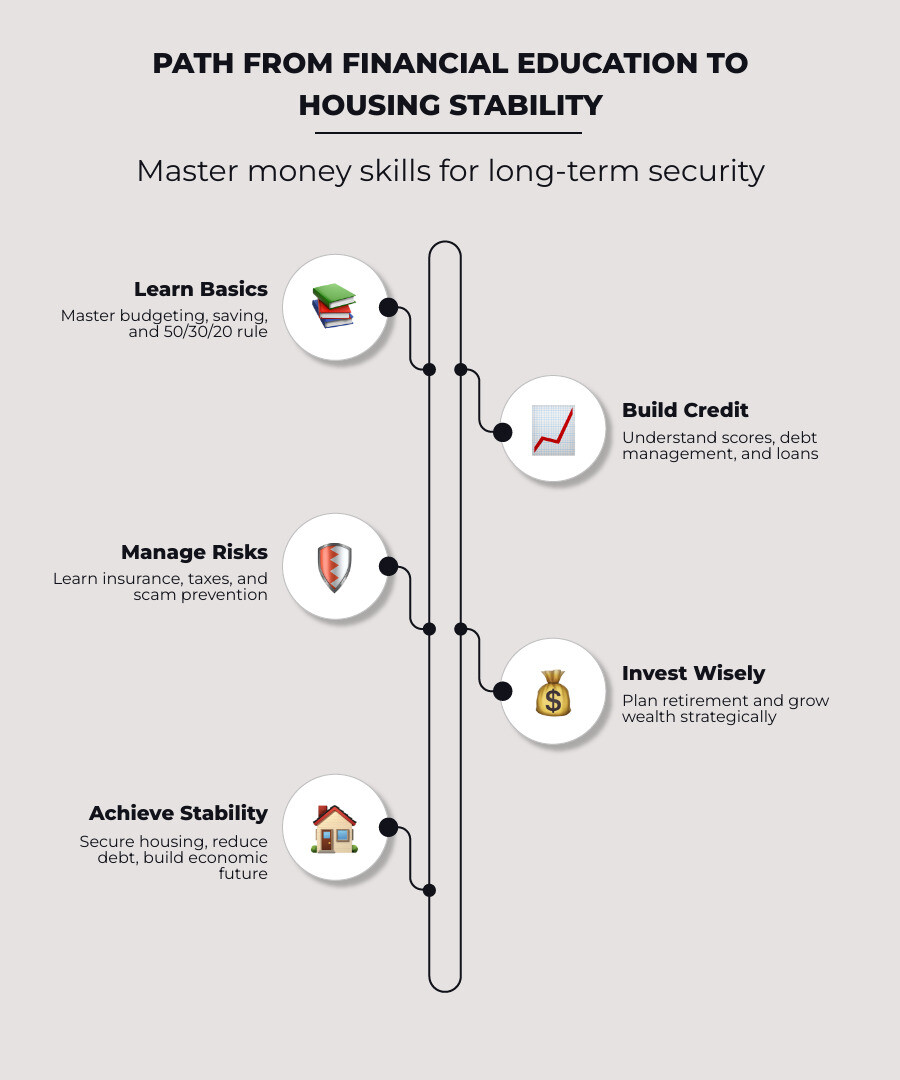
Simple financial literacy classes glossary:
Core Topics Covered in Financial Literacy Classes
When we dive into financial literacy classes, we aren’t just looking at numbers on a screen; we are looking at the building blocks of a self-sufficient life. Most comprehensive programs are designed to take the “mystery” out of money. Whether you are attending a session in Los Angeles or San Diego, the curriculum usually follows a logical path from daily spending to long-term protection.

Budgeting and the 50-30-20 Rule
One of the first things we learn in a basic money management course is how to actually tell our money where to go. A popular method taught in many classes, including the Khan Academy Unit 2: Budgeting and saving, is the 50-30-20 rule. This simple framework suggests:
- 50% of income for needs (housing, groceries, utilities).
- 30% for wants (entertainment, dining out).
- 20% for savings and debt repayment.
Mastering Credit and Debt
Understanding credit is perhaps the most vital skill for anyone looking to achieve homeownership. Classes like those in Khan Academy Unit 3: Consumer credit explain how credit scores are calculated and why they matter for everything from interest rates to apartment applications.
Furthermore, managing existing obligations is a major focus. In Khan Academy Unit 5: Loans and debt, learners explore the terms of borrowing, the difference between secured and unsecured debt, and how to navigate the complexities of bankruptcy if necessary. We believe that knowing the ABCs of financial literacy is the best defense against predatory lending.
Protection and Taxes
Beyond spending and saving, financial literacy classes cover risk management. This includes decoding the jargon of insurance — health, life, property, and car insurance — to ensure we aren’t overpaying or under-protected. Additionally, understanding tax forms like the W-2 and 1099 is crucial for avoiding surprises during tax season.
Beginner Financial Literacy Classes for Students
Education is most effective when it starts early. In California, there is a strong push to integrate these concepts into the classroom. Resources like the Grades K–12 Financial Literacy Resources provided by the state help teachers introduce concepts like “needs vs. wants” and the power of compound interest to young learners.
For students, the focus is often on setting SMART goals (Specific, Measurable, Achievable, Relevant, and Time-bound). By learning how to save for college or a first car, youth build the “financial muscle” needed for adulthood. We take pride in our financial education programs for youth, which emphasize that it’s never too early to start planning for a stable future.
Advanced Financial Literacy Classes and Certifications
For those who have mastered the basics and want to level up their professional or personal financial acumen, advanced courses offer a deeper dive. Platforms like edX provide certificates that can take 2 to 5 months to complete, covering high-level topics such as:
- Risk Management: Analyzing financial statements and balance sheets.
- Investment Banking: Understanding financial markets and fintech.
- Retirement Planning: As seen in Khan Academy Unit 7: Investments and retirement, this involves planning for Social Security and understanding mutual funds or ETFs.
These advanced financial literacy course guides are excellent for individuals looking to pivot into finance careers or for those managing complex family estates.
Top Free and Low-Cost Financial Education Programs
Finding high-quality financial literacy classes shouldn’t break the bank. In fact, some of the best resources available are completely free.
Khan Academy
Khan Academy offers a comprehensive, self-paced Financial Literacy course that covers everything from car buying to scams and fraud. It is modular, meaning you can jump straight to the units you need most, such as housing or banking, without having to complete the entire course in order.
University Extensions and Workshops
Many universities provide community outreach through extension programs. For example, the University of Arizona’s Financial Literacy Program offers workshops like “Where Does Your Money Go?” which are available online and in-person. These programs are often led by educators and specialists in family consumer sciences.
Community-Based Training
In our California service areas, local organizations often host workshops tailored to specific community needs. Whether it’s a financial education training session in Riverside or an in-person workshop in San Francisco, these classes provide a space for adults to chat in a circle of chairs, sharing experiences and learning in a supportive, human-centered environment.
How to Choose the Right Course Format
Choosing between self-paced and structured financial literacy classes depends on your learning style and goals.
Self-Paced vs. Structured
- Self-Paced: Best for busy individuals who need to learn late at night or during lunch breaks. You can spend more time on difficult topics like taxes and breeze through things you already know, like basic banking.
- Structured: These often involve a set schedule and an instructor. The benefit here is accountability and the ability to ask questions in real-time.
Duration and Certification Timelines
If you are looking for a formal credential, be prepared for a longer commitment.
| Program Type | Typical Duration | Focus |
|---|---|---|
| Beginner Course | 2–8 weeks | Personal budgeting, credit basics |
| Professional Certificate | 2–5 months | Financial analysis, risk management |
| Executive Education | 6–8 weeks | Strategic decision-making |
Most formal courses, such as those through FLVS or edX, require a final exam or project, often weighted at 20% of the total grade. To ensure academic integrity, some programs may even require proctored exams, which typically require a passing score of at least 59.5% to earn credit. For those looking for distance learning finance courses, these structured requirements ensure that the certification holds weight with employers or lenders.
Real-World Benefits of Financial Training
The ultimate goal of any financial education is to improve your quality of life. For the clients we serve throughout California, these skills are the bridge to permanent stability.
Housing Stability and the 93% Retention Rate
We have seen that financial literacy is the key to maintaining a home. By teaching clients how to manage their income and plan for emergencies, we help maintain a 93% housing retention rate. This means that once individuals transition into stable housing, they have the tools to stay there long-term.
CalAIM and Deposit Assistance
For those transitioning to self-sufficiency, the initial costs of housing can be a major hurdle. Through programs like CalAIM, we can offer deposit assistance—specifically, we may mention 1 month paid in advance to help secure a lease. However, without the budgeting skills learned in financial literacy classes, a one-time payment isn’t enough. The education ensures the tenant can continue to meet their obligations month after month.
Scam Prevention and Debt Reduction
Financial training also acts as a shield. Khan Academy Unit 8: Scams and fraud teaches learners how to protect personal information and recognize red flags. This is especially important for veterans and seniors who are often targeted by predatory schemes. By avoiding these traps and focusing on debt reduction, learners can unlock their financial potential and move toward goals like homeownership.
Frequently Asked Questions about Financial Literacy
How long does it take to complete a financial literacy course?
The timeline varies based on the depth of the material. A basic money management course can be completed in as little as 2 to 8 weeks. If you are pursuing a professional certificate, expect a commitment of 2 to 5 months. For those just looking for immediate help with a budget, a single community workshop might only take a few hours.
Are there free financial literacy resources in California?
Yes! Residents in Los Angeles, San Diego, and the Bay Area have access to several free resources. The Financial Literacy Training through 211LA is a great starting point for those in Southern California. Additionally, many local libraries and community centers offer financial wellness courses at no cost.
What skills can I expect to gain from these classes?
You will walk away with much more than just a spreadsheet. Learners gain financial acumen, which is the ability to understand how money flows through their lives. You will learn resource allocation (making sure your limited funds go to the most important places) and strategic decision-making. These financial literacy training skills are transferable to your career, helping you understand wages, benefits, and economic cycles.
Conclusion
At LifeSTEPS, we believe that every person deserves the opportunity to reach their full potential. Our approach is human-centered, focusing on the unique needs of individuals in California — from the bustling streets of Irvine to community neighborhoods throughout the state.
The impact of combining education with support is clear. We are proud of our 97% literacy improvement in our youth summer reading programs and the fact that we have helped facilitate $2.1M in scholarships for students pursuing higher education. These aren’t just statistics; they represent lives changed and futures secured.
Whether you are looking to repair your credit, save for a home, or simply gain peace of mind, taking one of the many available financial literacy classes is the best investment you can make in yourself.
For more information on how we support our community through LifeSTEPS programs, please visit our website: lifestepsusa.org
LifeSTEPS currently provides services in California only.


