


The HUD Self Sufficiency Program: How to Build Wealth While Renting
The HUD Self Sufficiency Program: How to Build Wealth While Renting
What the HUD Self Sufficiency Program Can Do for You
The hud self sufficiency program — officially called the Family Self-Sufficiency (FSS) program — is a federal initiative that helps families receiving housing assistance build real savings and work toward financial independence. Here’s what you need to know at a glance:
- What it is: A voluntary program that turns rent increases into personal savings
- Who it’s for: Households receiving Housing Choice Vouchers, Public Housing, or Project-Based Rental Assistance
- How long it takes: Up to 5 years (with possible 2-year extensions)
- Key benefit: An interest-bearing escrow account you keep when you complete the program
- Average savings at graduation: Over $6,000
- Does it risk your housing assistance? No — participation never puts your rental assistance at risk
For veterans transitioning to civilian life, this program can be a genuine turning point. Stable housing is hard enough to secure. But building wealth while renting? That’s what FSS makes possible — and it’s available through Public Housing Agencies (PHAs) and participating properties across California.
Over 70,000 households currently participate nationwide. Yet many eligible families — including veterans — never enroll simply because they don’t know the program exists.
That’s what this guide is here to change.
LifeSTEPS currently provides services in California only.
Related content about hud self sufficiency program:
- family self-sufficiency program action plan
- fss program graduation requirements
- how to apply for family self sufficiency program
What is the HUD Self Sufficiency Program?
The hud self sufficiency program is a unique tool designed by the U.S. Department of Housing and Urban Development (HUD) to help families increase their earned income and reduce their dependency on welfare assistance and rental subsidies. According to the Public and Indian Housing (PIH) FSS page on HUD.gov, the program coordinates housing assistance with public and private resources to provide families with the support they need to achieve economic independence.
Participation is entirely voluntary. No one is required to join, and choosing not to participate will never affect your housing status. However, for those who do join, the program offers a powerful combination of personal coaching and financial incentives. In 2022, the 2022 FSS Final Rule went into effect, streamlining the program and making it easier for more housing providers, including Project-Based Rental Assistance (PBRA) owners, to offer these benefits to their residents.
At its core, the program is about more than just housing; it’s about creating a pathway to a better future. By learning more about self-sufficiency programs, families can discover how to bridge the gap between where they are and where they want to be.
Eligibility for the HUD Self Sufficiency Program
To be eligible for the hud self sufficiency program, a family must currently receive some form of HUD-assisted rental assistance. This includes:
- Housing Choice Vouchers (HCV): Often referred to as Section 8.
- Public Housing: Residents living in units managed by local Public Housing Agencies (PHAs).
- Project-Based Rental Assistance (PBRA): Residents living in specific multifamily properties that have a contract with HUD.
- Special-Purpose Vouchers: This includes HUD-VASH vouchers for veterans and Family Unification Program (FUP) vouchers.
If you are a resident in California, particularly in areas like Los Angeles, San Diego, or the Bay Area, you can check with your local PHA or property manager to see if they offer an FSS program. The process of applying for the program usually begins with an orientation where you learn about the requirements and benefits. Once enrolled, your progress is tracked through regular income recertifications, ensuring that as you earn more, your savings grow.
Completing the HUD Self Sufficiency Program
When you join, you sign a Contract of Participation. This is a five-year agreement that outlines your goals and the services the program will help you access. While five years is the standard term, HUD allows for a two-year extension if you encounter “good cause” challenges, such as a medical emergency or a sudden change in family circumstances.
To successfully graduate and receive your savings, you must meet the FSS program graduation requirements, which include:
- Fulfilling all goals listed in your Individual Training and Services Plan (ITSP).
- Maintaining suitable employment (as defined by your specific program’s policies).
- Being welfare-free for at least the 12 consecutive months before the contract ends. Note: Welfare-free specifically refers to cash assistance like TANF; it does not include food stamps or medical assistance.
How the FSS Escrow Account Builds Wealth

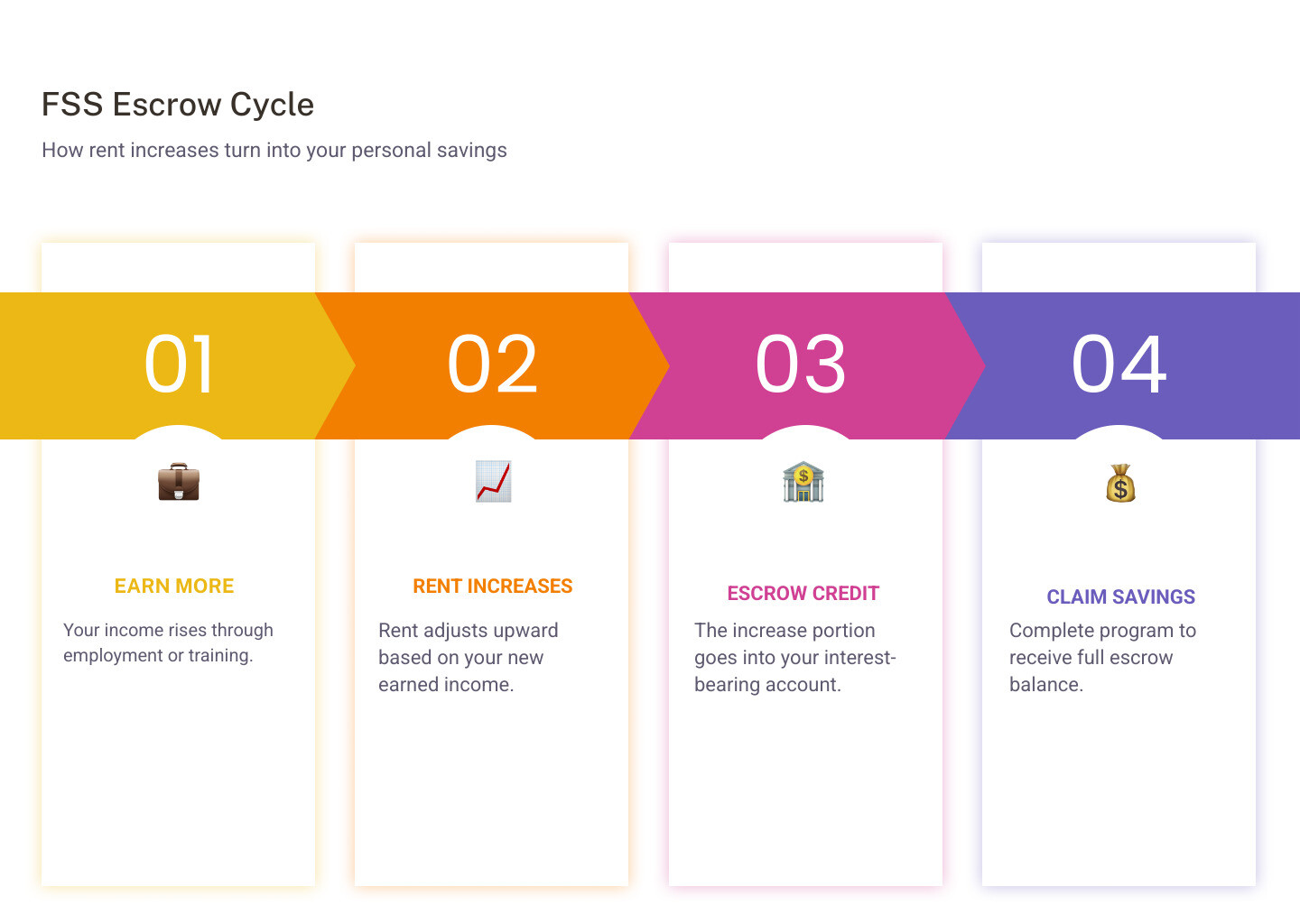
The most exciting feature of the hud self sufficiency program is the interest-bearing escrow account. In most subsidized housing programs, when your income goes up, your rent goes up. This often feels like a “success tax” that makes it hard to get ahead. FSS changes that.
When your earned income increases (for example, you get a raise or a better job), HUD calculates the portion of your rent increase that is due to those higher earnings. Instead of that money simply going toward rent, an equivalent amount is deposited into a special escrow account for you.
How Escrow Works: A Comparison
| Standard Rent Increase | FSS Program Rent Increase |
|---|---|
| Your income goes up by $400/month. | Your income goes up by $400/month. |
| Your rent increases by $120/month. | Your rent increases by $120/month. |
| The $120 goes to the housing provider. | The $120 is deposited into your FSS savings account. |
| Total savings after 5 years: $0. | Total savings after 5 years: $7,200 + interest. |
This account is tax-exempt, meaning the IRS does not count these savings as taxable income. Furthermore, these savings do not count against your asset limits for other federal programs while the money is in the account.
In some cases, you may even be able to make interim withdrawals. If you need money for a goal-related expense — like a car repair to get to work or tuition for a certification class — you can request a portion of your savings early. To see this process in action, you can view the FSS overview video produced by Compass Working Capital.
Key Features: Case Management and Service Coordination
Building wealth isn’t just about the money; it’s about the skills and support you gain along the way. Every participant works with an FSS Coordinator to develop an Individual Training and Services Plan (ITSP). This plan acts as a roadmap for your five-year journey.
We believe in a human-centered approach. Our coordinators don’t just point you toward a job; they work with you to address the barriers that have held you back. According to our guide to the FSS program, coordinators help link you to:
- Career Coaching: Identifying transferable skills and finding job openings.
- Financial Literacy: Learning how to budget, repair credit, and manage debt.
- Higher Education Access: Assistance with FAFSA applications and finding local California scholarships.
- Vocational Training: Connecting with American Job Centers for certifications in high-demand fields.
By integrating behavioral science, the program helps participants build “executive skills” — the mental processes that allow us to plan, focus, and multitask. This is essential for regaining self-sufficiency after experiencing the high stress of housing instability or military-to-civilian transitions.
Evidence of Success: Earnings and Homeownership
The data shows that the hud self sufficiency program works. Research from HUD indicates that families who graduate from the program have an average savings of over $6,000. For many, this is the first time they have ever had a significant financial cushion.
According to the report 25 Years of FSS Accomplishments, graduates see an average income increase of 80% over the course of their participation. But the impact goes beyond just the bank account:
- Housing Stability: We are proud to maintain a 93% housing retention rate for those we serve.
- Educational Success: Our youth programs have seen a 97% literacy improvement through summer reading initiatives.
- Asset Building: One-third of FSS graduates exit rental assistance within one year of completion, and many of those families use their escrow savings to become homeowners.
- Scholarships: We have helped facilitate $2.1M in scholarships to help residents pursue higher education and better-paying careers.
You can read real stories from the FSS program to see how individuals across California have transformed their lives. For example, Maria (whose first name has been changed) was a veteran living in San Diego who used her FSS savings to pay off debt and eventually secure a down payment for her first home.
Frequently Asked Questions about FSS
Can participation in FSS affect my rental assistance?
No. Participation in the hud self sufficiency program is voluntary and will never result in the loss of your housing assistance. If you are unable to complete the program, you simply forfeit the money in the escrow account, but your voucher or public housing status remains unchanged.
How does the escrow calculation work for low-income families?
The calculation is designed to be fair. For very low-income families, the credit is generally equal to 30% of the increase in their monthly adjusted income. HUD has specific spreadsheets and formulas to ensure that as your earnings grow, your account is credited accurately.
Can I use my FSS savings for a home down payment?
Absolutely! This is one of the most common uses for FSS savings. Many participants work with housing counselors during their five-year term to prepare for homeownership. When you graduate, the check is yours to use however you see fit — whether that’s a down payment, a new car, or an emergency fund.
Conclusion
The hud self sufficiency program is one of the most effective tools available for families looking to break the cycle of poverty. By turning a standard rent increase into a wealth-building opportunity, FSS empowers residents to dream bigger than they ever thought possible.
At LifeSTEPS, we are committed to providing human-centered support to residents in Southern California and the Bay Area. We see the measurable outcomes every day: the higher earnings, the improved literacy rates, and the joy of a family receiving the keys to their first home. If you are ready to take the next step toward your own financial independence, we encourage you to contact LifeSTEPS for more information.
Whether you are a veteran looking for stability or a family aiming for homeownership, the path to self-sufficiency starts with a single step. We are here to walk that path with you.
LifeSTEPS currently provides services in California only.


