


An Essential Guide to Veterans Assistance Housing Options
What Veterans Need to Know About Housing Assistance in 2026
Veterans assistance housing in the United States spans a wide range of programs — from federal rental vouchers and disability grants to nonprofit transitional support and state-level services.
If you’re a veteran looking for quick answers, here’s a snapshot of the main options available:
- HUD-VASH — Rental vouchers combined with VA case management for homeless veterans
- Specially Adapted Housing (SAH) grant — Up to $126,526 in FY 2026 for home modifications due to service-connected disabilities
- Special Home Adaptation (SHA) grant — Up to $25,350 in FY 2026 for qualifying disabilities
- VA Home Loan — Zero-down-payment home purchase benefit for eligible veterans
- DVNF Homeless to Housing (H2H) — Up to $2,000 in financial aid or household goods for veterans transitioning out of homelessness
- Transitional housing programs — Short- to medium-term shelter with wraparound support services
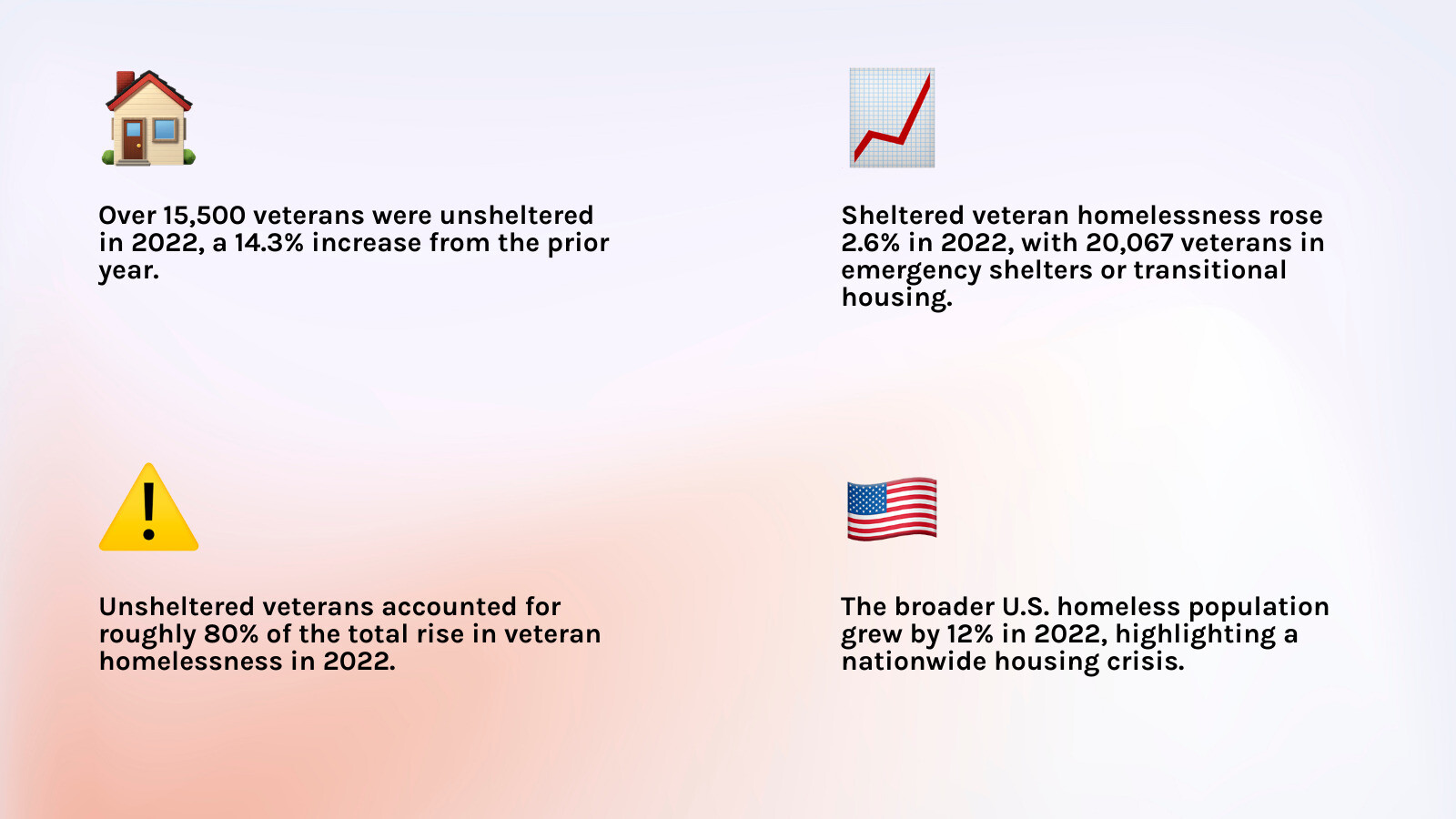
The need for these programs is real and growing. In 2022, over 15,500 veterans were living unsheltered — in parks, on sidewalks, or in abandoned buildings — a 14.3% increase from the prior year. Another 20,067 veterans were in emergency shelters or transitional housing, up 2.6%. Unsheltered veterans alone accounted for roughly 80% of the total rise in veteran homelessness, even as the broader U.S. homeless population grew by 12% that same year.
For recently discharged veterans navigating civilian life, these numbers aren’t just statistics. They reflect real barriers — lost income, unfamiliar systems, and a lack of support at a critical transition point.
This guide breaks down every major veterans assistance housing option available in 2026, with a focus on what’s accessible to veterans in California.
Understanding Federal Veterans Assistance Housing Programs
Federal programs form the backbone of veterans assistance housing across the country. By combining the financial resources of the Department of Housing and Urban Development (HUD) with the clinical and supportive capabilities of the Department of Veterans Affairs (VA), these initiatives help veterans secure long-term, stable housing.
At the center of these efforts is the HUD-VASH program. This collaborative initiative pairs HUD’s Housing Choice Voucher (HCV) rental assistance with dedicated VA case management and clinical services. Instead of simply providing a rent subsidy, HUD-VASH ensures that veterans receive the ongoing medical, mental health, and substance use support they need to maintain their housing.
Congress has recognized the immense value of this model, consistently appropriating additional funding for new HUD-VASH vouchers every year since 2008. In 2024, HUD awarded approximately $40 million to fund 3,518 additional HUD-VASH vouchers. Additionally, on August 8, 2024, HUD awarded approximately $20 million to 245 HUD-VASH Public Housing Agencies (PHAs) under Notice PIH 2024-10 to bolster administrative capabilities. In recent fiscal cycles, Notice PIH 2026-1 made another $10 million in administrative fee funding available to ensure local housing authorities have the resources to keep the leasing pipeline moving.
To learn more about how these vouchers are administered, check out the official HUD-Veterans Affairs Supportive Housing (HUD-VASH) | HUD.gov portal or read our detailed overview of Veterans Affairs Supportive Housing.
Navigating Veterans Assistance Housing Eligibility and Applications
To qualify for the HUD-VASH program, veterans must meet specific eligibility requirements. First, the veteran must be legally defined as homeless or at risk of homelessness. This includes those living on the streets, in emergency shelters, or in unstable temporary environments. Second, the veteran must be eligible for VA health care services, which is determined through a clinical assessment conducted by the local VA Medical Center (VAMC).
Notably, eligibility for HUD-VASH has expanded over the years to include veterans with Other Than Honorable (OTH) discharges, ensuring that those with complex transition histories are not left without a safety net.
If you or a loved one needs to apply, the process begins with a clinical assessment:
- Initiate Contact: Reach out to your local VA Medical Center and explicitly mention your interest in the HUD-VASH program. Alternatively, you can call the National Homeless Veteran Call Center at 1-877-4AID-VET (1-877-424-3838) for 24/7 assistance.
- Clinical Assessment: A VA caseworker will evaluate your housing status, physical and mental health needs, and overall eligibility.
- PHA Referral: Once approved by the VA, you will be referred to a partnering Public Housing Agency (PHA) in your area to receive your rental voucher.
For a deeper dive into these application pathways, explore our guides on Government Assistance For Homeless Veterans and Programs That Help Homeless Veterans.
What is the difference between HUD-VASH vouchers and VA home loans?
While both programs fall under the umbrella of federal veterans housing support, they serve entirely different financial needs and housing situations.
HUD-VASH is designed strictly as a rental assistance program for homeless or highly vulnerable veterans. The government pays a portion of the veteran’s rent directly to a private landlord, and the veteran contributes a percentage of their income (typically around 30%).
In contrast, VA home loan benefits are designed to help veterans, active-duty service members, and eligible surviving spouses purchase, build, or improve a permanent home. To use a VA loan, you must apply for a Certificate of Eligibility (COE) based on your service record. VA-backed loans allow you to buy a home with zero down payment, lower interest rates, and no private mortgage insurance (PMI). The VA also helps veterans calculate their remaining “bonus entitlement” using county loan limits to maximize their borrowing power and offers robust foreclosure avoidance assistance to prevent veterans from losing their homes during financial hardships.
To learn more about homeownership pathways, visit the VA Housing Assistance | Veterans Affairs portal and read Buying Your Castle A Guide To Veteran Home Buying Assistance.
| Feature | HUD-VASH Vouchers | VA Home Loans |
|---|---|---|
| Primary Purpose | Rental assistance and supportive case management | Purchasing, building, or refinancing a permanent home |
| Target Audience | Homeless or at-risk veterans in need of clinical support | Eligible veterans, active-duty members, and surviving spouses |
| Down Payment | N/A (Rental program) | $0 down payment options available |
| Income/Credit | Focuses on low-income limits; flexible credit requirements | Standard lender underwriting applies, but with flexible terms |
| Key Benefit | Government pays a portion of monthly rent to the landlord | No private mortgage insurance (PMI) and competitive interest rates |
Disability Housing Grants and Property Conversions
For veterans who have sustained service-connected disabilities, physical barriers in a standard home can severely limit independence. The VA offers specialized housing grants to help disabled veterans purchase or modify a home to accommodate their physical needs, ensuring they can navigate their living spaces safely and comfortably.
These grants are governed by strict statutory guidelines, including the limitations outlined in 38 U.S. Code § 2102. To explore the full scope of these benefits, refer to the VA’s guide on Disability Housing Grants For Veterans | Veterans Affairs and our comprehensive Housing Grants Veterans Complete Guide.
Specially Adapted Housing (SAH) vs. Special Home Adaptation (SHA) Grants
The two primary disability housing grants available to veterans are the Specially Adapted Housing (SAH) grant and the Special Home Adaptation (SHA) grant. They differ significantly in terms of qualifying disabilities, intended use, and maximum funding limits.
- Specially Adapted Housing (SAH) Grant (38 USC § 2101(a)): The SAH grant is designed for veterans who own or plan to own a permanent home and have severe service-connected disabilities. Qualifying disabilities include the loss or loss of use of more than one limb, blindness in both eyes (with a visual acuity of 20/200 or less), severe burns, or certain progressive respiratory or neurological conditions. For FY 2026, the maximum SAH grant amount is $126,526. (Note: While the statutory aggregate baseline limit under section 2101(a) is set at $98,492, this limit is indexed and adjusted annually on October 1 based on national construction cost indexes).
- Special Home Adaptation (SHA) Grant (38 USC § 2101(b)): The SHA grant is available to veterans who want to modify a permanent home they or a family member own. It is tailored for service-connected disabilities such as the loss or loss of use of both hands, severe respiratory injuries, or certain severe burns. For FY 2026, the maximum SHA grant amount is $25,350. (The statutory aggregate baseline limit under section 2101(b) is $19,733, which is also adjusted annually).
For legal details on how these limits are adjusted and managed, see 38 U.S. Code § 2102 – Limitations on assistance furnished | LII and read our article on Housing Grants For Veterans.
How many times can a veteran receive a disability housing grant?
Veterans do not have to use their entire grant allocation all at once. Under modern guidelines, a veteran can receive up to six separate grants of housing assistance over their lifetime, up to the maximum aggregate limit allowed for that fiscal year.
Furthermore, under the “10-year rule” (38 USC § 2102(f)), a veteran who previously used their grant limits more than 10 years ago may qualify for an additional grant of up to 50% of the current aggregate limit if their progressive disability requires new modifications that their current residence lacks.
For veterans temporarily residing in a home owned by a family member, the Temporary Residence Adaptation (TRA) grant is also available. The TRA grant allows veterans who otherwise qualify for an SAH or SHA grant to make physical changes to their temporary family home. For FY 2026, the maximum TRA grant limits are:
- Up to $50,961 for those who qualify for the SAH program.
- Up to $9,100 for those who qualify for the SHA program.
Transitional and Nonprofit Housing Support Programs
While federal vouchers and grants provide excellent long-term solutions, veterans often need immediate, transitional support when moving out of homelessness or crisis situations. Community-based shelters, transitional housing facilities, and nonprofit partnerships play a vital role in bridging this gap.
Transitional housing programs, such as those funded by the VA’s Grant and Per Diem (GPD) program, offer veterans up to two years of stable housing paired with mandatory stabilization services. For veterans who struggle with strict sobriety requirements, Low-Barrier Safe Havens provide a compassionate, harm-reduction-focused alternative, offering 24/7 shelter and support without immediate barriers to entry.
To learn more about these short-term options, read our guides on Transitional Housing For Veterans and From Service To Sanctuary Locating Transitional Housing For Veterans.
The DVNF Homeless to Housing (H2H) Program
The Disabled Veterans National Foundation (DVNF) operates the Homeless to Housing (H2H) program, which is designed to help veterans transition from temporary shelters or unsheltered homelessness into permanent, stable housing. The program recognizes that a physical house only becomes a functional home when it is furnished with essentials that provide comfort and dignity.
The H2H program offers up to $2,000 in assistance. Veterans must choose between two types of support based on their most immediate need:
- Financial Assistance: Up to $2,000 to cover immediate transition costs, such as rental deposits or utility connections.
- Household Comfort Support: Up to $2,000 in physical household goods, including kitchenware, bedding, bath essentials, and cleaning supplies.
To apply, veterans must provide their DD-214 or a valid Veteran ID, proof of income, and a recommendation letter from a professional caseworker. Please note that a dishonorable discharge or bad conduct discharge disqualifies an applicant. Additionally, furniture assistance is only purchased and delivered once the veteran has officially moved into their new residence; if the move-in is delayed by more than two weeks post-approval, the approval may be rescinded. For temporary financial emergencies, DVNF also offers the GPS grant, which provides up to $1,000 for rent, utilities, or auto payments.
Learn more about this resource directly from the Homeless To Housing – Disabled Veterans National Foundation page.
Converting Foreclosed Properties Under 38 USC §2041
An innovative legal mechanism under federal law allows the VA to convert defaulted properties directly into community assets. Under the legal authority of 38 USC §2041, the VA can sell, lease, or donate foreclosed properties (acquired as a result of defaults on VA-guaranteed loans) to nonprofit organizations, states, and tribal entities.
These properties are then renovated and used as temporary shelters or permanent housing for homeless veterans and those at risk of homelessness. To support nonprofits in this mission, the VA can:
- Limit property lease terms to a maximum of three years.
- Provide below-market interest rates on loans used to purchase these properties.
- Waive standard loan fees and establish custom credit standards for partnering organizations.
This statutory tool ensures that empty, foreclosed homes are rapidly repurposed to serve the veterans who need them most. You can read the full statute at 38 USC 2041: Housing assistance for homeless veterans.
Local and State-Level Housing Resources for California Veterans
California is home to a robust network of state and local housing programs tailored specifically for veterans. Navigating these regional resources is key to securing immediate shelter and long-term stability. For a comprehensive look at what the Golden State offers, read A Complete Guide To California Veteran Housing Programs.
Local Veterans Assistance Housing Resources in Southern California
In Southern California, local housing authorities and VA medical centers work hand-in-hand to deploy HUD-VASH vouchers and county-level incentives.
- Los Angeles County: The Greater Los Angeles VA Medical Center (VAMC) manages clinical assessments and intake for the local VASH program. Vouchers are administered by the Los Angeles County Development Authority (LACDA). Thanks to unique Interagency Agreements, these vouchers can be used across multiple municipal boundaries in Southern California, including Pasadena, Inglewood, Redondo Beach, Burbank, and Redondo Beach. To encourage private landlords to accept these vouchers, LACDA runs the Homeless Incentive Program (HIP), which offers monetary payouts, holding fees, and damage mitigation funds to property owners who rent to veterans holding Section 8 vouchers. To search local listings, visit Housing.LACounty.gov | LA County Veterans.
- San Diego County: The San Diego County Housing and Community Development Services department administers a highly active VASH program in partnership with the San Diego VAMC, helping hundreds of veterans transition to stable private rentals each year. Learn more at Veterans Affairs Supportive Housing (VASH).
For practical steps on finding low-income rentals in these areas, see our guide on How To Secure Low Income Veteran Housing Near You.
State-Level Supportive Services and CalVet Programs
At the state level, the California Department of Veterans Affairs (CalVet) provides a wide array of housing and supportive services. CalVet Home Loans offer competitive financing terms, low down payments, and specialized protection plans for California veterans looking to buy a home.
Additionally, CalVet coordinates with local municipalities to fund dedicated veteran housing developments. For example, the City of Irvine has established robust affordable rental housing initiatives specifically set aside for veterans and their families, ensuring that those who served have access to high-quality, long-term housing options in master-planned communities.
To explore state-level benefits, check out Housing & Supportive Services – CalVet – CA.gov and the Housing for Veterans | City of Irvine portal.
Conclusion
Securing stable, affordable housing is the first step toward building a secure and fulfilling civilian life. Whether through federal HUD-VASH vouchers, VA home loans, disability housing grants, or state-level CalVet programs, there are numerous pathways designed to support our veterans.
At LifeSTEPS, we are deeply committed to walking alongside veterans as they transition to stable housing and long-term self-sufficiency. We serve key regions across California, including Los Angeles, San Diego, Riverside, and Irvine.
Our human-centered supportive services deliver measurable community impact. We are proud to maintain a 93% housing retention rate among our clients. Through our collaboration with the CalAIM program, we provide critical deposit assistance — including 1 month paid in advance for security deposits — to help veterans secure apartments quickly.
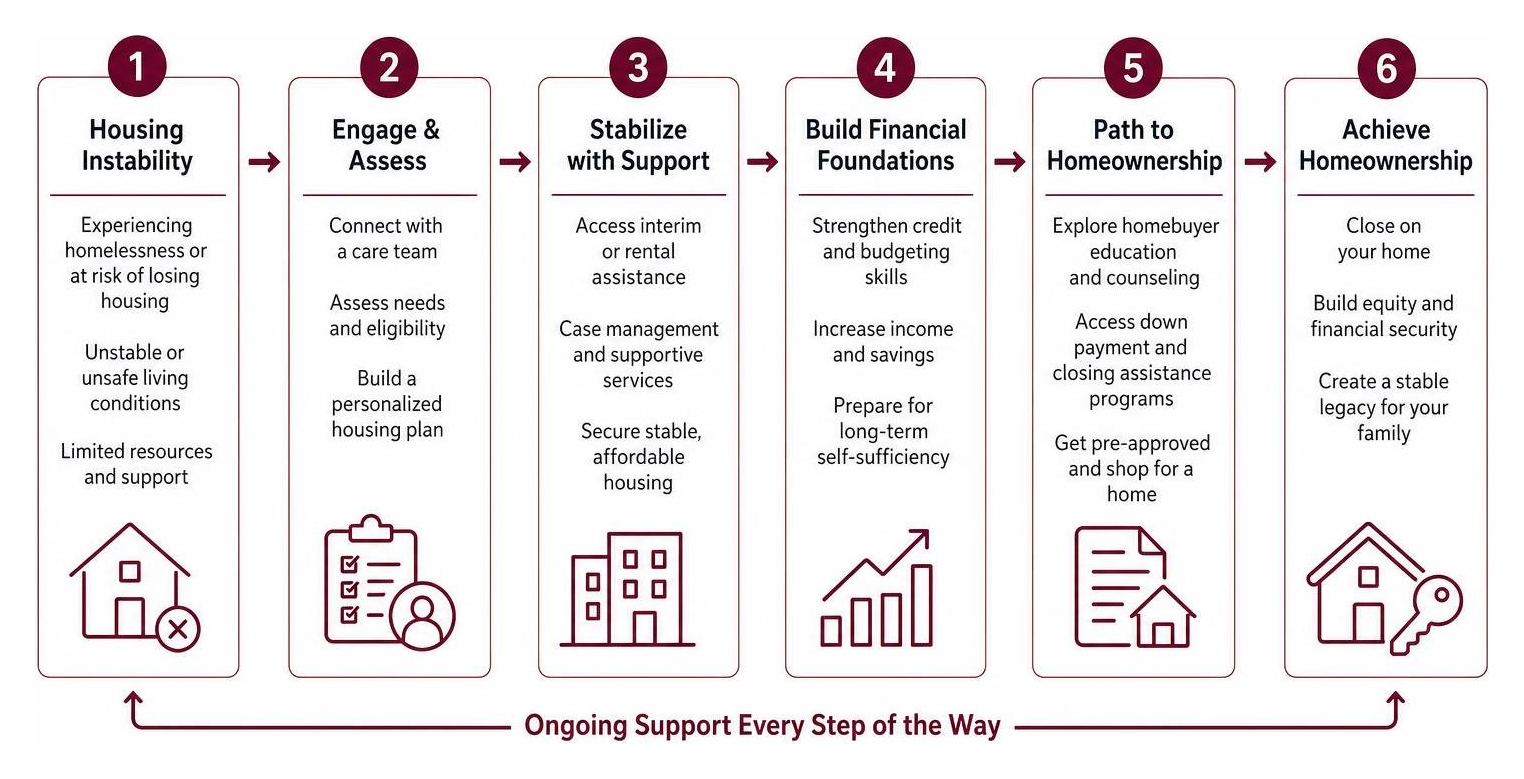
Furthermore, we work closely with programs like the Family Self-Sufficiency (FSS) initiative to help our clients build financial assets, establish strong credit, and successfully transition from rental assistance to permanent homeownership.
Our commitment to the families we serve extends beyond housing. We believe in empowering the next generation, which is why our youth programs have achieved a 97% literacy improvement through our Summer Reading programs, and we have awarded over $2.1 million in scholarships to help young people pursue higher education.
If you are a veteran in California looking to navigate your housing options, or if you are a housing partner interested in collaborating with us, we are here to help. For more information, explore our resources on Veterans Assistance With Housing.
LifeSTEPS | Phone: (916) 965-2110 | lifestepsusa.org
LifeSTEPS currently provides services in California only.


