


A Complete Guide to California Veteran Housing Programs
A Complete Guide to California Veteran Housing Programs
California’s Veteran Housing Crisis — and the Programs Working to Solve It
California veteran housing programs are the primary tools the state uses to move veterans out of homelessness and into stable, long-term housing. Here is a quick overview of the main options:
- VHHP (Veterans Housing and Homelessness Prevention Program) — State bond-funded program creating affordable and permanent supportive housing units for low-income veterans
- HUD-VASH — Federal program combining Housing Choice Vouchers with VA case management services
- Homekey+ — State program using Proposition 1 funds to build permanent supportive housing for veterans with behavioral health needs
- U.S.VETS — Nonprofit providing emergency, transitional, and permanent housing with wraparound services in Southern California
- Swords to Plowshares — Bay Area nonprofit offering permanent supportive housing and wraparound services for veterans
California is home to roughly one-third of the nation’s homeless veterans. That is a staggering number — and the challenge runs even deeper than the raw count suggests. Nationally, about 41% of homeless veterans are unsheltered. In California, that figure jumps to around 71%. Most are living on streets, in vehicles, or in places not meant for human habitation.
The good news: progress is happening. In 2024, California achieved the largest reduction in veteran homelessness of any state in the country. Programs like VHHP have helped produce over 5,600 affordable units since 2014, and Proposition 1 is now unlocking over $1 billion in new funding specifically for veteran housing.
This guide explains how each program works, who qualifies, and how to access help — whether you are a veteran in crisis today or planning ahead for housing stability.
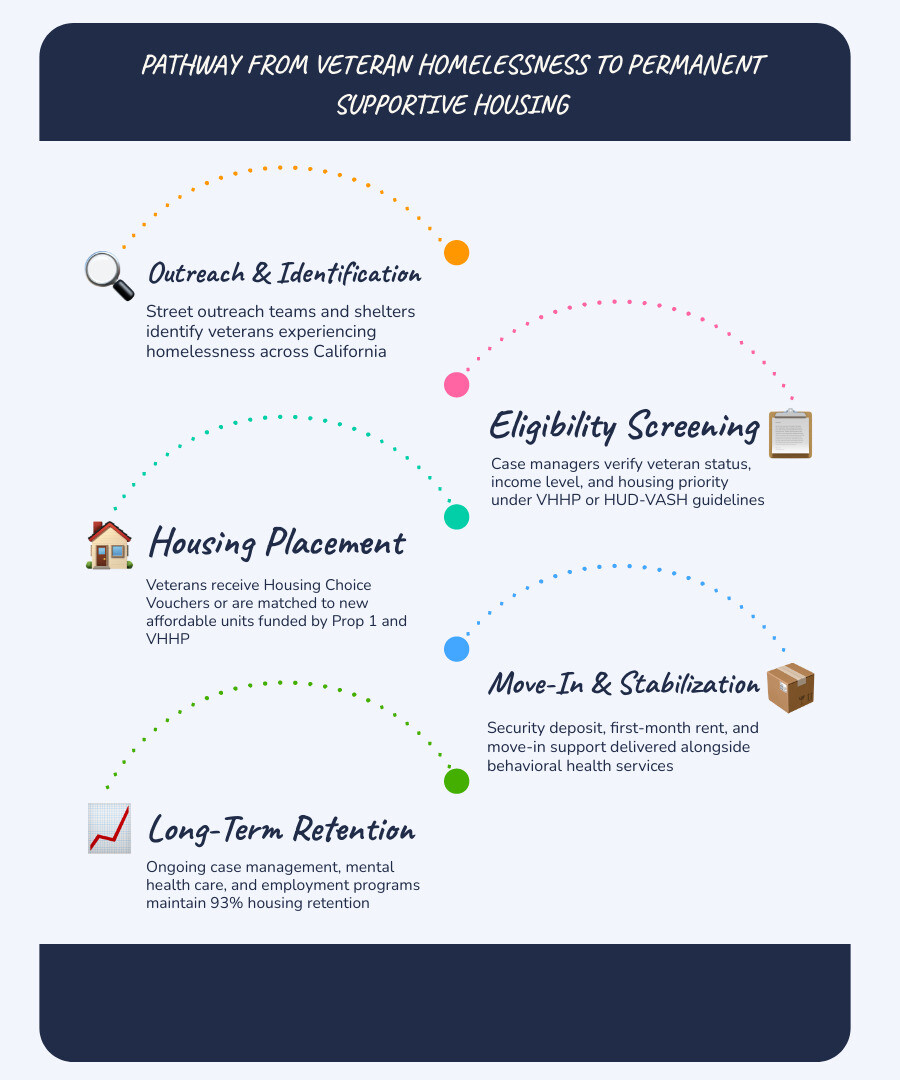
California veteran housing programs terms explained:
- emergency rental assistance funds
- first month rent security deposit assistance
- help with deposit for section 8
Understanding California Veteran Housing Programs

Navigating the landscape of California veteran housing programs can feel overwhelming. Different programs are funded by different levels of government, administered by various local agencies, and designed for distinct stages of housing instability.
To make sense of these resources, it helps to look at them as a coordinated ecosystem. Some programs focus on building physical apartment buildings, others provide monthly rental subsidies to use with private landlords, and some offer temporary shelter while you get back on your feet.
By understanding the differences in purpose, administration, and eligibility, you can target the programs that best fit your current situation.
| Program Name | Primary Purpose | Key Eligibility | Administering Agencies |
|---|---|---|---|
| VHHP | Long-term loans to develop affordable and permanent supportive housing | Low-income veterans (including other-than-honorable) | California HCD, CalVet, CalHFA |
| HUD-VASH | Rental assistance vouchers paired with clinical case management | VA-eligible homeless veterans with clinical needs | Local Public Housing Authorities & VA Medical Centers |
| Homekey+ | Rapid creation of permanent supportive housing via building conversion | Veterans with behavioral health challenges facing homelessness | California HCD & local public entities |
Key Federal and State California Veteran Housing Programs
Let’s break down the major programs that form the backbone of California’s veteran housing strategy:
- Veterans Housing and Homelessness Prevention Program (VHHP): This state-level initiative provides funding to developers to build and preserve affordable multifamily housing. It places a heavy emphasis on creating permanent housing for veterans who are experiencing chronic homelessness. Administered by the California Department of Housing and Community Development (HCD) in collaboration with CalVet, you can learn more about its structure on the Veterans Housing and Homelessness Prevention Program (VHHP) | California Department of Housing and Community Development page.
- HUD-VASH (Housing and Urban Development-Veterans Affairs Supportive Housing): This is a critical federal program that combines Housing Choice Voucher (Section 8) rental assistance with clinical case management. It is designed specifically for veterans who need ongoing support to remain stably housed. For an in-depth look at how this works, read our Veterans Affairs Supportive Housing guide.
- Homekey+: Born out of the voter-approved Proposition 1 in March 2024, Homekey+ is the permanent supportive housing component of the Behavioral Health Infrastructure Bond Act. It focuses on rapidly creating homes for veterans who are unhoused and also managing behavioral health challenges or substance use disorders. More details can be found on the Homekey+ Program Factsheet .
How to Navigate California Veteran Housing Programs Locally
Because housing programs are ultimately administered at the local level, your experience will depend on where you live. In Southern California, local agencies and VA medical centers work hand-in-hand to coordinate these resources.
In Los Angeles County, the Los Angeles County Development Authority (LACDA) and local housing authorities manage thousands of HUD-VASH vouchers. Veterans can search for affordable, veteran-friendly rental listings and find local county resources by visiting Housing.LACounty.gov | LA County Veterans .
In San Diego County, the Housing Authority of the County of San Diego administers local rental assistance. Veterans in the region can coordinate directly with the San Diego VA Healthcare System to access VASH vouchers and local supportive services. To get started in this region, visit the Veterans Affairs Supportive Housing (VASH) portal.
For those in Riverside County, Irvine, or the Inland Empire, the local Housing Authorities work closely with veteran service organizations to streamline the application process. If you are trying to figure out the first steps to take in your local community, our guide on how to secure low income veteran housing near you provides a clear, step-by-step roadmap.
Funding and Statistics: The Landscape of Veteran Homelessness in California
Understanding the scale of the challenge helps highlight why these programs are so vital. California has nearly 100,000 more people experiencing homelessness than New York, the state with the next largest unhoused population. Roughly one-third of all homeless veterans in the United States live in California.
However, the state’s targeted investments are making a measurable difference. Between 2020 and 2022, the number of veterans experiencing homelessness in California decreased from 11,401 to 10,395—a 9% reduction. By 2024, California achieved the nation’s largest single-year reduction in veteran homelessness.
This progress is fueled by massive funding initiatives:
- The VHHP Legacy: Since 2014, the VHHP program has helped produce 5,665 affordable units. Once all currently awarded VHHP projects are fully constructed, the program will have added a total of 6,561 units of affordable, permanent supportive housing for veterans.
- Proposition 1 and Homekey+: Approved by voters, Prop 1 authorized a $6.4 billion Behavioral Health Bond. Of this, $2.145 billion is allocated for Homekey+ grant funding, with approximately $1.033 billion set aside specifically for veteran-serving projects. As of recent 2025 and 2026 data, Homekey+ has allocated $540.4 million to support 32 projects creating 1,517 affordable homes, with hundreds of these units strictly reserved for veterans.
These investments are detailed further in the official announcement on Hundreds of new homes for veterans are coming to California through voter-approved Prop 1 funding | Governor of California . To understand how federal dollars back these initiatives, you can read about government assistance for homeless veterans.
Eligibility Requirements and Supportive Services for Veterans
Accessing California veteran housing programs requires meeting specific eligibility criteria, which vary by program. However, most state-funded programs share a common goal: prioritizing those with the greatest barriers to housing.
For the VHHP program, eligibility guidelines are designed to be inclusive:
- Discharge Status: Unlike some federal benefits, VHHP funds can serve veterans and their families who have other-than-honorable discharges.
- Income Limits: At least 50% of VHHP funds must serve veteran households with extremely low incomes (at or below 30% of the Area Median Income).
- Vulnerable Populations: Projects must restrict at least 25% of their units to veterans experiencing chronic homelessness or those with high-priority vulnerabilities.
For Homekey+, projects must utilize a Housing First model. This means there are no preconditions or barriers to entry, such as sobriety or employment requirements. All units in a Homekey+ project must be reserved for individuals managing a behavioral health challenge (such as a serious mental illness or substance use disorder) who are homeless, chronically homeless, or at risk of homelessness.
The Power of Wraparound Services
Housing is only the first step. To ensure long-term stability, California’s veteran programs combine physical housing with comprehensive supportive services. These are coordinated by Lead Service Providers who must demonstrate years of experience working with veteran-specific challenges like post-traumatic stress disorder (PTSD) and traumatic brain injury (TBI).
Typical supportive services include:
- On-site case management and mental health counseling
- Healthcare navigation and transportation to medical appointments
- Peer support groups and community-building activities
- Employment assistance and job training for veterans
By pairing housing with these vital services, programs help veterans transition smoothly from transitional housing for veterans into independent, permanent living situations.
Frequently Asked Questions About Veteran Housing
Who qualifies for the Veterans Housing and Homelessness Prevention (VHHP) program?
The VHHP program is designed to fund housing developments that serve veterans and their families. To qualify as a resident in a VHHP-assisted unit, you must be a veteran with an income that meets the program’s low-income or extremely low-income limits.
Crucially, the program is highly inclusive regarding discharge status, meaning veterans with other-than-honorable discharges are eligible. Priority is given to veterans experiencing chronic homelessness or those with physical or mental disabilities. For a deeper understanding of how these state and federal grants operate, refer to our housing grants veterans complete guide.
How does the HUD-VASH voucher system work in California?
The HUD-VASH program is a collaborative partnership between the federal Department of Housing and Urban Development (HUD) and the Department of Veterans Affairs (VA).
- Referral: A veteran experiencing homelessness connects with a local VA Medical Center.
- Screening: The VA determines clinical eligibility and provides a referral.
- Voucher Issuance: The local Public Housing Authority (PHA) issues a Housing Choice Voucher.
- Housing Search: The veteran finds a rental unit in the private market that accepts the voucher.
- Ongoing Support: The veteran pays roughly 30% of their income toward rent, HUD covers the rest, and the VA provides ongoing case management.
To learn more about how to get started with this voucher system, read our guide on veterans administration housing assistance.
What is the difference between Homekey+ and the original Homekey program?
While both programs focus on rapidly creating affordable housing by purchasing and converting existing buildings (like motels, hotels, and senior care facilities), they have different funding sources and target populations:
- Original Homekey: Focused broadly on individuals experiencing or at risk of homelessness, funded primarily through state general funds and federal pandemic relief.
- Homekey+: Funded by the voter-approved Proposition 1 Behavioral Health Bond. It specifically targets individuals—especially veterans—who are experiencing or at risk of homelessness and are also managing behavioral health challenges or substance use disorders.
If you are facing an immediate housing crisis and need shelter quickly, you can explore emergency options through our resource on veteran emergency housing.
Conclusion: Building a Path to Stability
At LifeSTEPS, we believe that every veteran deserves a stable place to call home. As a nonprofit organization in the social services industry, we provide human-centered support and vital resources to individuals transitioning to stable housing and self-sufficiency.
We are proud of our measurable outcomes, including a 93% housing retention rate among the clients we serve. Through the CalAIM program, we are able to offer critical first month rent and security deposit assistance (covering up to one month paid in advance for deposit assistance) to help veterans overcome the initial financial barriers to securing an apartment.
Our unique strength lies in our collaboration with programs like the Family Self-Sufficiency (FSS) program, helping veterans move beyond temporary assistance and build a pathway toward true homeownership and long-term stability.
Beyond housing, we believe in uplifting the entire family. Our afterschool and youth programs have achieved a 97% literacy improvement through our Summer Reading initiatives, and we have awarded over $2.1 million in higher education scholarships to help the children of low-income families build brighter futures.
If you are a veteran in Southern California—including Los Angeles, San Diego, Riverside, or Irvine—and are looking for a partner to help you navigate your housing journey, we are here to support you.
LifeSTEPS currently provides services in California only.


