


Cracking the Bay Area Housing Market with First-Time Buyer Assistance
Cracking the Bay Area Housing Market with First-Time Buyer Assistance
Why Bay Area Home Buyer Aid Can Make Homeownership Possible
Bay Area home buyer aid programs exist to help first-time buyers bridge the gap between what they have saved and what it actually costs to buy a home in one of the most expensive housing markets in the country. If you’re a veteran or anyone working toward homeownership, here’s a quick look at the main programs available right now:
| Program | Max Assistance | Repayment Type | Who It’s For |
|---|---|---|---|
| Home Access Program | $200,000 (40% of price) | 30-year deferred loan | Alameda & Contra Costa County, ≤80% AMI |
| CalHFA Dream For All | $150,000 or 20% of price | Shared appreciation | First-generation buyers statewide |
| CalHFA MyHome | 3–3.5% of purchase price | Deferred silent second | First-time buyers statewide |
| Housing Trust HELP | Up to 10% of purchase price | Shared appreciation | Santa Clara County, ≤140% AMI |
| SCCRF FTHB Grant | Up to $10,000 | Forgivable gift | Santa Clara County, ≤100% AMI |
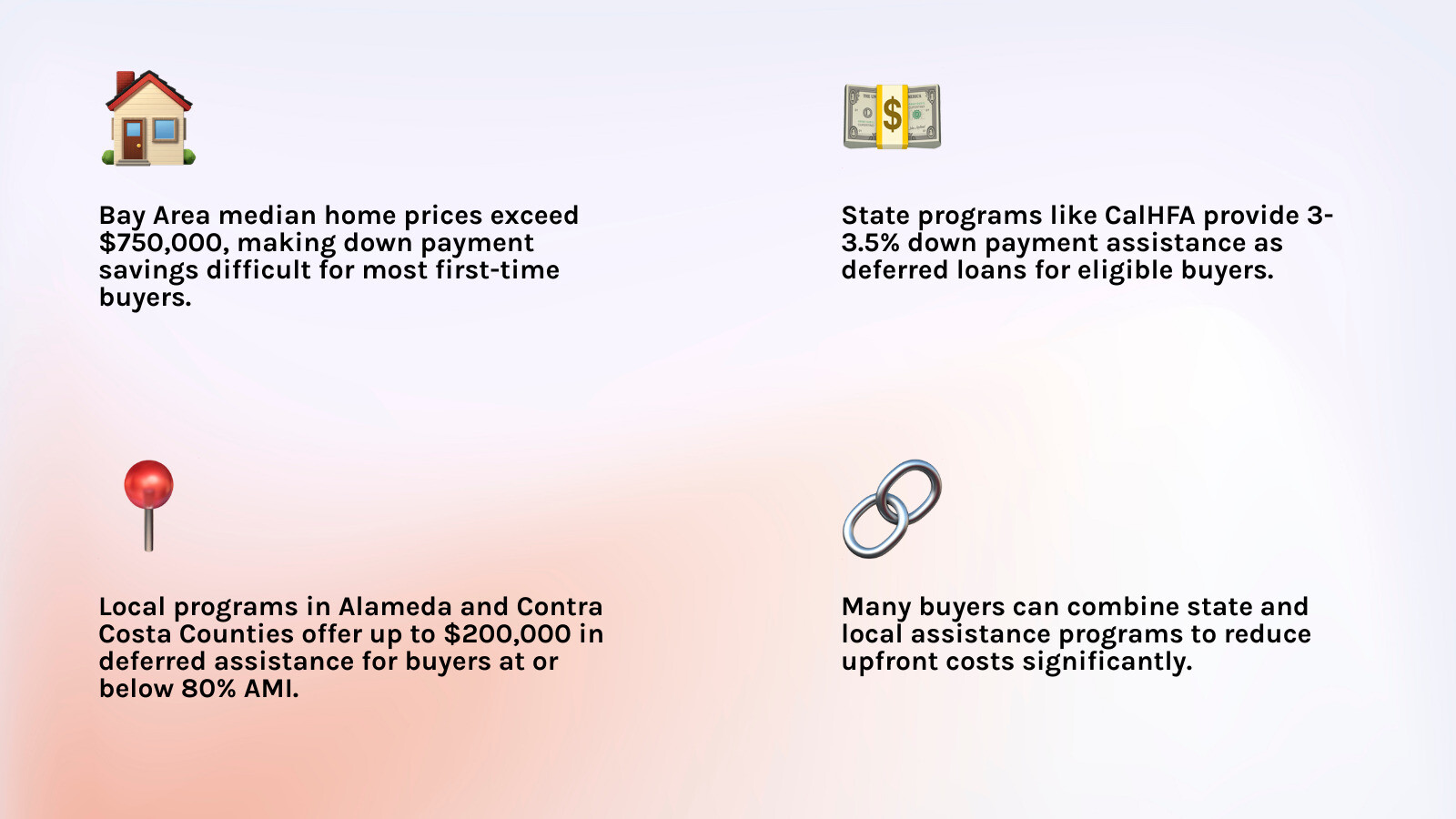
The Bay Area’s median home price hovers around $1 million in Alameda County and roughly $757,000 in Contra Costa County. Saving a standard down payment on those figures can feel out of reach — especially for recently discharged veterans rebuilding financial stability in civilian life.
The good news is that California has more homebuyer assistance than any other state. Programs range from state-backed loans through CalHFA to county-level grants and deferred loans — and in many cases, these programs can be combined to significantly reduce what you need upfront.
This guide walks through every major program available to Bay Area buyers in 2026, who qualifies, how much you can receive, and how to apply.
LifeSTEPS currently provides services in California only.
Glossary for Bay Area home buyer aid:
State-Level Bay Area home buyer aid Programs
When starting your homebuying journey in California, the state government offers some of the most robust and reliable financial tools to help you get over the down payment hurdle. The California Housing Finance Agency (CalHFA) acts as the primary state-level engine for affordable housing opportunities, having helped over 233,000 families secure homes since 1975.
CalHFA does not lend money directly to consumers. Instead, they partner with approved private lenders who originate and service the loans. This means your first step is always to connect with a CalHFA-preferred loan officer who can evaluate your financial profile and help you apply for state-backed assistance.
To make homeownership realistic, CalHFA provides a mix of competitive first mortgages and “silent second” subordinate loans. These subordinate loans are designed to cover your down payment and closing costs, requiring no monthly payments from you until a triggering event occurs (such as selling the home, refinancing your first mortgage, or paying it off entirely).
For a complete breakdown of state and national grant opportunities, you can explore our comprehensive Every First Home Loan Grant Guide to see how various funding sources align with your budget.
CalHFA Dream For All Shared Appreciation Loan
The CalHFA Dream For All program is a highly sought-after shared appreciation loan designed specifically for first-generation homebuyers. In the high-cost Bay Area market, saving a full 20% down payment to avoid costly private mortgage insurance (PMI) is an incredibly steep hill to climb. The Dream For All program solves this by providing up to 20% of the home’s purchase price (capped at $150,000) to use toward your down payment and closing costs.
Because this is a shared appreciation loan, the repayment structure is unique:
- No Monthly Payments: You do not make any monthly principal or interest payments on the assistance loan.
- Shared Appreciation Repayment: When you sell, refinance, or transfer the home, you repay the original loan amount plus a percentage of the home’s appreciation (the increase in value).
- Repayment Ratios: If your household income is between 80% and 120% of the Area Median Income (AMI), you repay the original loan plus 20% of the home’s appreciation. For lower-income buyers earning at or below 80% AMI, the appreciation share is reduced to 15% (a 0.75:1 ratio).
- Appreciation Cap: To protect buyers in rapidly growing markets, the maximum appreciation repayment is capped at 2.5 times the original loan amount. If the home depreciates, you only owe the original principal amount.
To qualify for this program in 2026, at least one borrower must be a first-generation homebuyer. This means they have not owned a home in the past seven years, and their parents do not currently own a home in the United States. Due to limited state funding, CalHFA administers this program through a randomized voucher lottery system rather than a first-come, first-served basis. Buyers must get fully pre-approved by an approved lender and register during the open spring application window.
For a detailed look at how this program operates in local markets, refer to the California Dream For All Guide.
MyHome Assistance Program as a Reliable Bay Area home buyer aid Option
If you do not meet the strict first-generation requirement for the Dream For All program, the MyHome Assistance Program serves as CalHFA’s reliable workhorse. MyHome is always available and provides a smaller, deferred-payment junior loan to cover your down payment or closing costs.

The assistance limits for MyHome depend on the type of first mortgage you use:
- FHA Loans: MyHome provides up to 3.5% of the purchase price or appraised value.
- Conventional, VA, or USDA Loans: MyHome provides up to 3% of the purchase price or appraised value (capped at $15,000 for VA and USDA loans).
Like other CalHFA subordinate loans, MyHome is structured as a silent second. You make no monthly payments, and the interest rate is locked at a low, fixed percentage. The loan is only repaid when you sell the property, refinance the first mortgage, or finish paying off your 30-year term. This program is highly compatible with other local grants, making it an excellent baseline tool for any buyer’s financial strategy.
To learn more about the fundamentals of navigating these state-level options, check out our Beginners Guide to Home Buyer Programs.
Local Down Payment Assistance in the East Bay and Silicon Valley
While state programs provide a fantastic foundation, local county and municipal programs are tailored to the unique economic realities of their specific communities. In the East Bay (Alameda and Contra Costa counties) and Silicon Valley (Santa Clara County), local governments and housing trusts have stepped up with targeted Bay Area home buyer aid to help moderate- and low-income families compete in high-cost neighborhoods.
These local programs often feature higher maximum assistance limits to match local home prices. By focusing on households earning below the Area Median Income, these initiatives ensure that vital community members — such as teachers, healthcare workers, and local service employees — can afford to live in the communities they serve.
For a broader look at how local governments support affordable homeownership, you can read about Low Income Homeownership Programs across California.
The Home Access Program for Alameda and Contra Costa Counties
For buyers looking in the East Bay, the Home Access Program is one of the most powerful local tools available. Administered by Housing Trust Silicon Valley using CalHome Reuse Funds from the California Department of Housing and Community Development, this program offers up to $200,000 (or up to 40% of the home’s purchase price, whichever is lower) in down payment assistance.
Key eligibility details for the Home Access Program include:
- Geographic Focus: The home must be located in Alameda County or Contra Costa County.
- Income Limits: Household income must be at or below 80% of the county’s Area Median Income (AMI). For example, the 2026 income limit for a family of four in Alameda County is $120,800, and $84,600 for a single-person household.
- Buyer Contribution: The buyer must contribute at least 3% of the purchase price from their own personal funds.
- Loan Structure: The assistance is structured as a 30-year deferred loan with 0% interest and no monthly payments. The principal balance is only due at the end of the 30-year term, or earlier if the home is sold, refinanced, or ceases to be your primary residence.
Because this program is funded through state recycling grants, applications open periodically. Prospective buyers must complete a HUD-approved homebuyer education class and secure a pre-approval letter from a participating lender before applying.
For more details on how this program was established and its impact on East Bay communities, read the KTVU Home Access Program News report.
Silicon Valley Homebuyer Empowerment Loan Program (HELP)
In Santa Clara County, where home prices frequently exceed the million-dollar mark, Housing Trust Silicon Valley administers the Homebuyer Empowerment Loan Program (HELP). This program is designed specifically for middle-income buyers who earn too much to qualify for traditional low-income programs but still struggle to save a competitive down payment.
The HELP program provides a deferred-payment down payment assistance loan of up to 10% of the home’s purchase price.
- Purchase Price Cap: The maximum purchase price of the home cannot exceed $800,000.
- Income Limits: Gross household income can be up to 140% of Santa Clara County’s Area Median Income. This generous limit allows households earning up to $191,310 (for a single person) or up to $317,030 (for a larger household) to qualify.
- Repayment Terms: There are no monthly payments or interest charges. Instead, repayment is based on a shared appreciation model. When you sell or refinance, you repay the original loan amount plus a proportional share of the home’s appreciation. For example, if you received a 10% HELP loan to buy a $600,000 home, and later sell it for $800,000, you will repay the original $60,000 plus 10% of the $200,000 gain ($20,000), totaling $80,000.
This structure allows middle-income families to secure a home without adding to their monthly debt obligations, while helping the housing trust recover and reinvest funds into future homebuyers.
Stacking Assistance Programs and Specialized Pathways
One of the best-kept secrets of affordable real estate is “program stacking.” Stacking refers to the practice of layering multiple down payment assistance programs, grants, and tax credits on top of each other to minimize your out-of-pocket costs.
For example, an eligible buyer in Santa Clara County might combine a CalHFA first mortgage with a MyHome subordinate loan for their down payment, and then layer on a local nonprofit grant to cover closing costs. When done correctly, stacking can reduce a buyer’s upfront cash requirement to nearly zero.
However, stacking requires careful planning and a highly experienced loan officer. Every program has its own set of rules regarding which other funding sources it can be combined with, and first mortgage lenders must approve the subordinate lien structure.
To understand how moderate-income households can successfully navigate these layered financial pathways, review our Moderate Income Homeownership Guide.
Rules for Combining State and Local Bay Area home buyer aid
When combining state-level programs (like CalHFA) with local county or municipal programs, you must adhere to strict guidelines regarding lien priority and cumulative loan-to-value (CLTV) ratios:
- Lien Priority: The primary lender will always hold the first lien position. CalHFA’s MyHome program typically requires the second lien position. Local county or nonprofit programs must agree to take a third or fourth subordinate position.
- Most Restrictive Rules Apply: When stacking programs, you must satisfy the guidelines of the most restrictive program. For example, if program A has an income limit of 120% AMI and program B has an income limit of 80% AMI, your household income must be at or below 80% AMI to stack them.
- Lender Approval: Not all conventional or government lenders allow multiple subordinate loans. You must work with a lender who is explicitly approved by both CalHFA and the local housing authority administering your county program.
By aligning these programs, buyers can maximize their purchasing power. For example, you can combine a CalHFA first mortgage, a MyHome down payment loan, and a local housing authority closing cost grant.
To read more about successful stacking strategies and how to secure these grants, explore our resource on First Time Home Ownership Grants.
Income Limits and Conforming Loan Caps in 2026
Because Bay Area home buyer aid programs are funded by public and non-profit dollars, they are tied directly to Area Median Income (AMI) limits. These limits are updated annually by the California Department of Housing and Community Development (HCD) and vary significantly by county to reflect local economic conditions.
Additionally, state and local programs are bound by conforming loan limits. In 2026, the conforming loan limit for high-cost Bay Area counties is approximately $1,089,300. This means that while CalHFA does not enforce a strict sales price limit, your first mortgage cannot exceed this conforming cap.
| County | 80% AMI (Low Income) | 120% AMI (Moderate) | Max Local Aid Program | Max Aid Amount |
|---|---|---|---|---|
| Alameda | $120,800 | $181,200 | Home Access Program | $200,000 (40% of price) |
| Contra Costa | $120,800 | $181,200 | Home Access Program | $200,000 (40% of price) |
| Santa Clara | $125,000 | $187,500 | HELP Program | 10% of purchase price |
Veteran and Section 8 Homeownership Pathways
Specialized homeownership pathways exist to support veterans, first responders, and low-income families enrolled in housing assistance programs. For veterans, combining a VA loan with down payment assistance is an incredibly powerful strategy. VA loans already offer 0% down payment terms and do not require monthly mortgage insurance. By stacking a VA loan with a program like CalHFA’s MyHome (which offers up to a $15,000 deferred loan for VA closing costs), veterans can achieve homeownership with virtually zero out-of-pocket expenses.

Additionally, the Housing Choice Voucher (Section 8) Homeownership Program allows eligible low-income families to transition from renting to owning. Under this pathway, public housing authorities allow families to apply their monthly housing assistance vouchers toward a monthly mortgage payment rather than rent.
At LifeSTEPS, we specialize in helping individuals navigate these complex transitions. Through our collaboration with the Family Self-Sufficiency (FSS) program, we provide the structured homebuyer education, financial coaching, and escrow-building tools necessary to turn voucher assistance into permanent homeownership.
For veterans seeking dedicated support, we recommend reading our Veteran Home Buying Assistance Guide. If you are currently utilizing rental assistance and want to explore buying a home, check out our guide on Buying a Home with a Section 8 Voucher.
Frequently Asked Questions About Bay Area Home Buyer Aid
Navigating first-time buyer assistance can feel overwhelming. Here are clear, straightforward answers to the most common questions we hear from buyers exploring Bay Area home buyer aid:
What is the definition of a first-time homebuyer in California?
Under CalHFA and most local program guidelines, a first-time homebuyer is defined as anyone who has not owned and occupied their primary residence at any point during the last three consecutive years.
This means that if you owned a home in the past but have rented for the last three years, you are legally considered a first-time buyer again and can qualify for these programs.
Can I stack multiple down payment assistance programs?
Yes, in many cases you can. However, it depends entirely on your primary lender’s guidelines and the rules of the specific programs you want to combine.
For example, you can easily stack CalHFA’s MyHome program with a local county closing cost grant, provided your lender approves the subordinate lien structure and your total financing does not exceed the home’s appraised value.
Do I have to pay back deferred down payment loans?
Yes. Although deferred down payment loans (often called “silent seconds”) do not require monthly payments, they are not forgivable grants.
The principal balance (and any accrued interest or shared appreciation) must be paid back when a repayment trigger occurs. These triggers typically include selling the home, refinancing your first mortgage, paying off your primary loan, or moving out of the property so that it is no longer your primary residence.
Conclusion
Cracking the Bay Area housing market requires strategy, patience, and the right financial tools. Whether you are leveraging state-level silent seconds like CalHFA MyHome, participating in local shared appreciation programs like Santa Clara’s HELP, or utilizing specialized veteran pathways, Bay Area home buyer aid makes the dream of homeownership a realistic milestone.
At LifeSTEPS, we are deeply committed to empowering Californians on their journey toward housing stability and self-sufficiency. As a nonprofit organization in the social services industry, we provide direct, human-centered support to individuals transitioning to stable living environments. We are proud of our measurable community impact, including a 93% housing retention rate for our clients.
Through the CalAIM program, we offer vital deposit assistance, providing up to 1 month paid in advance to help families secure stable housing. Our commitment to community welfare extends to education as well, where our Summer Reading program has achieved a 97% literacy improvement among participating youth, and we have awarded over $2.1 million in higher education scholarships to date.
If you are ready to take the next step toward securing your home, we encourage you to explore our comprehensive directory of Low Income Homeownership Programs to find the resources that best fit your family’s needs.
LifeSTEPS | Phone: (916) 965-2110 | LifeSTEPS
LifeSTEPS currently provides services in California only.


