


A Simple Guide to HUD Affordable Housing Programs
A Simple Guide to HUD Affordable Housing Programs
What Is HUD Affordable Housing and How Can It Help You?
HUD affordable housing programs are federal programs run by the U.S. Department of Housing and Urban Development that help low-income individuals and families pay for safe, stable housing. If you are a veteran transitioning to civilian life, these programs can be a critical first step toward stability.
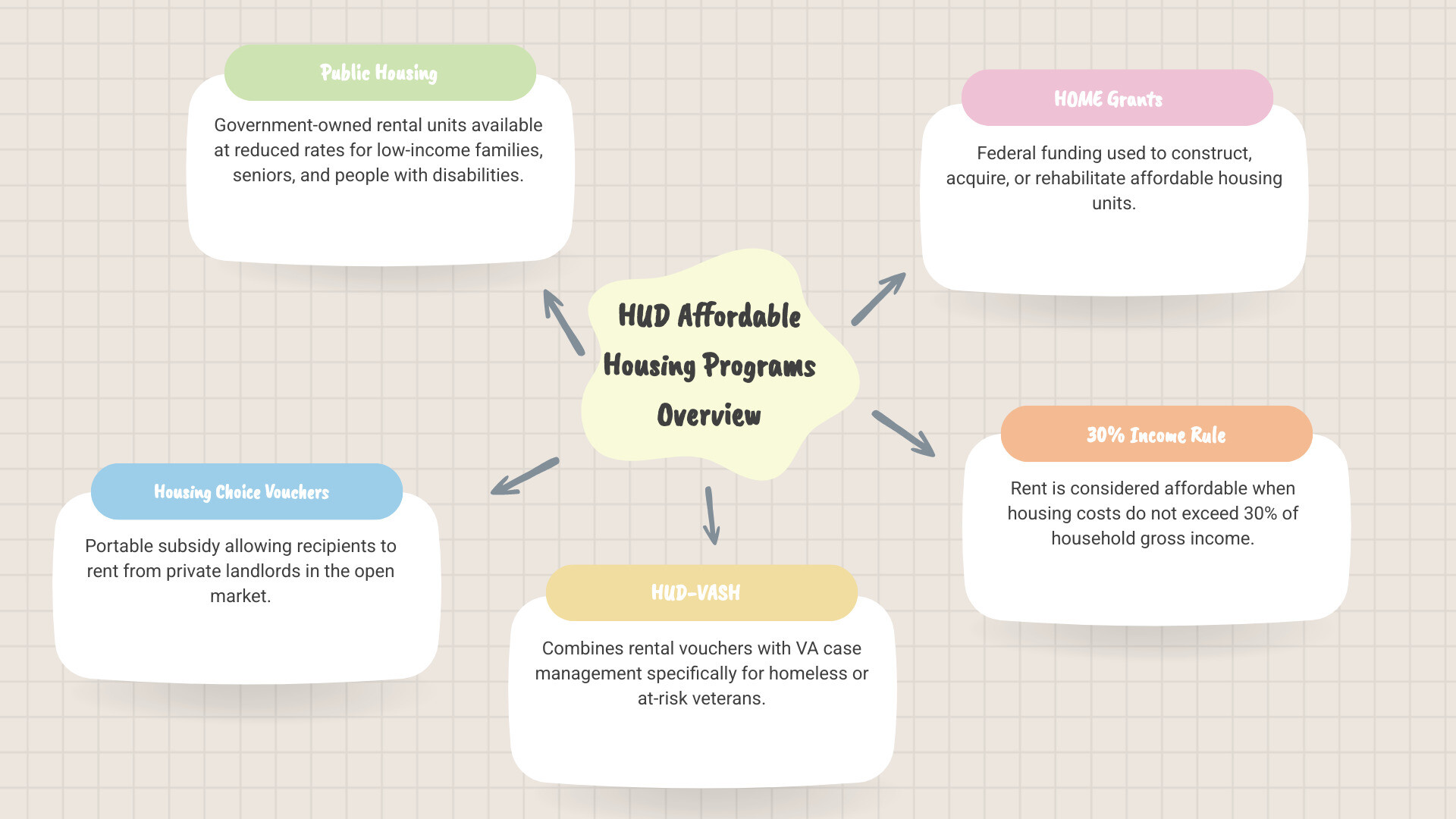
Here is a quick overview of the main HUD affordable housing options:
| Program | How It Works | Who It Helps |
|---|---|---|
| Public Housing | Government-owned units rented at reduced rates | Low-income families, elderly, people with disabilities |
| Housing Choice Vouchers (Section 8) | Subsidy used to rent in the private market | Low-income households who choose their own home |
| HUD-VASH | Combines rental vouchers with VA case management | Homeless or at-risk veterans |
| HOME / HOME-ARP | Federal grants to build or rehabilitate affordable units | Homeless and vulnerable populations |
Affordable housing is generally defined as housing where you spend no more than 30% of your gross income on rent and utilities. For many veterans and low-income households, that threshold is difficult to meet without assistance — and that is exactly the gap these programs are designed to fill.
There are roughly 970,000 households currently living in public housing units across the country, managed by about 3,300 local housing agencies. Millions more receive support through voucher programs. These are not small programs — they are a major part of how Americans access stable housing.
In California, organizations like LifeSTEPS work directly within HUD-assisted communities to help residents not just find housing, but keep it — with a 93% housing retention rate across the people they serve.
LifeSTEPS currently provides services in California only.
Explore more about HUD affordable housing:
Navigating HUD Affordable Housing Programs
Navigating government assistance can sometimes feel like trying to assemble flat-pack furniture without the instruction manual. However, once you understand the basic structure of HUD affordable housing programs, the pieces begin to fit together perfectly.
In California, the demand for affordable rentals is historically high. Whether you are living in Los Angeles, San Diego, Riverside, or Irvine, finding a stable place to call home is essential for your peace of mind and long-term success. HUD programs are designed to make this search easier by lowering your monthly shelter costs so you can focus on other important areas of your life, such as education, employment, and family.
To begin your journey, it is helpful to look at the two primary pathways HUD provides: Public Housing and Housing Choice Vouchers (frequently referred to as Section 8). While both aim to make housing affordable, they operate in very different ways. You can read more about how these options open doors in our guide on how to Unlock Affordable Living: Section 8 Rental Opportunities.

Public Housing vs. Vouchers: Key HUD Affordable Housing Differences
The fundamental difference between public housing and housing choice vouchers comes down to ownership and mobility.
- Public Housing: Under this program, you rent a unit directly from a local Public Housing Agency (PHA). The housing authority acts as your landlord. The physical buildings—which can range from high-rise apartments in bustling urban centers to scattered single-family homes—are owned and managed by the housing agency itself. If you decide to move out of public housing, your rental assistance stays with the building; it does not move with you.
- Housing Choice Vouchers (Section 8): This program puts the power of choice in your hands. Instead of moving into a government-owned building, you receive a rental voucher. You can use this voucher to find your own housing in the private rental market, provided the landlord agrees to participate in the program and the unit meets HUD’s safety and rent standards. If you choose to move to a new apartment, your voucher travels with you, allowing for greater geographic flexibility.
Both programs rely heavily on local housing agencies to administer the funds and manage waitlists. For those living in California, you can explore state-specific resources and agency contacts through the California HUD Resources portal.
Eligibility Requirements for HUD Affordable Housing
Who is eligible for these programs? HUD establishes specific income limits based on the Area Median Income (AMI) of your local county or metropolitan area. Because the cost of living varies wildly between regions, an eligible income in Los Angeles CA will look very different from an eligible income in Riverside CA.
HUD categorizes income limits into three main tiers:
- Low-Income: Households earning 80% or less of the local Area Median Income.
- Very Low-Income: Households earning 50% or less of the local Area Median Income. (Most voucher programs target this group).
- Extremely Low-Income: Households earning 30% or less of the local Area Median Income.
In addition to income limits, housing authorities will review:
- Family Status: Programs are open to families, elderly individuals, and persons with disabilities.
- Citizenship Status: You must be a U.S. citizen or an eligible noncitizen (such as a lawful permanent resident, refugee, or asylee) to qualify for assistance.
- Background Screening: PHAs will review references and rental history to ensure you will be a responsible tenant who complies with lease terms.
To better understand the terminology used by HUD officials during the screening process, you can consult the official HUD Glossary.
How Rent is Calculated and Tenant Responsibilities
One of the most common questions applicants ask is: “How much will I actually have to pay each month?”
HUD uses a standardized formula to ensure your rent remains affordable. Generally, your Total Tenant Payment (TTP) is calculated based on your household’s adjusted income.
To make this clear, let’s look at how rent is calculated across different scenarios:
| Calculation Method | What It Means | Example Scenario |
|---|---|---|
| 30% of Monthly Adjusted Income | Your gross income minus HUD-approved deductions, multiplied by 0.30. | A household with $1,500 in adjusted monthly income pays**** $450 in rent. |
| 10% of Monthly Gross Income | Your total gross income before any deductions, multiplied by 0.10. | A household with $1,800 in gross monthly income pays $180 in rent. |
| Welfare Rent | If you receive public assistance, the portion of those welfare benefits designated specifically for housing. | Varies based on California state assistance programs. |
| Minimum Rent | A baseline minimum rent established by the local housing authority (typically between $25 and $50). | A household with zero income pays a minimum of $25 to $50 as set by the PHA. |
Your rent will be set at the highest of the values calculated above.
Income Deductions and Allowances
To make rent calculations fairer, HUD allows specific deductions from your annual gross income before determining your adjusted income:
- Dependent Deduction: A standard $480 deduction for each dependent (including children under 18, full-time students, or persons with disabilities).
- Elderly or Disabled Family Deduction: A $400 deduction for any family whose head, co-head, or spouse is elderly (62 or older) or has a disability.
- Medical and Disability Expenses: For elderly or disabled families, any unreimbursed medical expenses that exceed 3% of your annual gross income can be deducted.
Tenant and Housing Authority Responsibilities
Affordable housing is a two-way street. Both the tenant and the Housing Authority have strict rules to follow to keep the community safe, clean, and functional.
Your Responsibilities as a Tenant:
- Lease Compliance: You must abide by all terms of your lease, including keeping noise levels reasonable and respecting neighbors.
- Property Maintenance: You must keep your unit clean, safe, and in sanitary condition.
- Prompt Reporting: You must immediately report any maintenance issues to your landlord or PHA, and you must report any changes in your household income or family size within the designated timeframe.
- Honesty: You must provide truthful verification of income and assets during your annual reexamination.
The Housing Authority’s Responsibilities:
- Regular Inspections: The PHA must inspect units regularly to ensure they meet strict safety and sanitary standards.
- Property Maintenance: For public housing, the PHA must handle repairs, maintain common areas, and ensure utilities work properly.
- Fair Administration: The PHA must process applications, manage waitlists, and calculate rent payments accurately and without discrimination.
How to Apply and Find Housing in California
If you are ready to take the next step, applying for HUD affordable housing in California requires preparation, patience, and organization. Because demand is incredibly high, being prepared with the right paperwork can make a massive difference when a waiting list opens up.

Step-by-Step Application Process
- Locate Your Local Housing Authority: You must apply directly through the housing agency that manages the area where you want to live.
- Gather Your Documentation: Before you apply, gather essential documents for every member of your household. This includes birth certificates, Social Security cards, tax returns, recent pay stubs, bank statements, and photo identification.
- Submit the Application: Fill out the application completely. Be honest about your income, family composition, and rental history. Any discrepancies can lead to your application being denied.
- Monitor Your Waitlist Status: Once your application is accepted, you will likely be placed on a waiting list. Keep your contact information updated with the housing authority. If they try to reach you and your phone number or address has changed, they may remove you from the list.
Waiting Lists and Local Preferences
Due to high demand, housing authorities often close their waiting lists when the number of applicants exceeds available units. When the lists are open, PHAs use a system of local preferences to determine who gets housing first. Common preferences include:
- Families or individuals experiencing homelessness.
- Veterans or families of veterans.
- Local residents who already live or work in the agency’s jurisdiction.
- Families paying more than 50% of their income toward rent.
For detailed strategies on how to successfully navigate this system, check out The Ultimate HUD Low Income Housing Application Guide.
If you are looking for affordable rental opportunities in Southern California, you can apply directly through local agencies such as the San Diego Housing Commission or the Housing Authority of the County of Riverside.
Frequently Asked Questions about HUD Housing
What is the difference between public housing and Section 8?
The primary difference is where you live and who manages the property. Public housing is owned, maintained, and operated directly by a local housing authority. You live in a designated housing development.
Section 8 (the Housing Choice Voucher program), on the other hand, allows you to find your own apartment or house in the private market. The housing authority pays a subsidy directly to your private landlord, and you pay the remaining balance. If you are looking for private rentals that accept vouchers, you can search for listings using resources like Housing Voucher Apartments Near Me.
How long is the waitlist for affordable housing?
Wait times vary significantly depending on where you are applying in California. In high-demand metropolitan areas like Los Angeles or San Diego, waitlists can last several years. Some housing authorities utilize a lottery system to randomly select applicants when the waitlist opens briefly.
To shorten your wait, check if you qualify for any local preferences (such as being a veteran or currently residing in the service area) and apply to multiple housing authorities with open lists.
Can HUD programs help me buy a home?
Yes! Many people do not realize that HUD assistance can extend beyond renting. Through programs like the Family Self-Sufficiency (FSS) program, HUD helps low-income families build financial assets.
Under the Section 8 Homeownership Program, eligible families can actually use their rental voucher to help pay a monthly mortgage instead of rent. To learn more about how you can transition from renting to owning, read our comprehensive guide on Housing Authority Programs: Your Pathway to Affordable Homeownership.
Conclusion
Finding a safe, affordable place to live is the foundation of a stable life. HUD affordable housing programs provide the essential support millions of Americans need to secure that foundation. However, getting into housing is only the first step. Staying housed, building financial capability, and achieving long-term self-sufficiency require ongoing support and community resources.
This is where LifeSTEPS steps in. As a nonprofit organization dedicated to helping individuals transition to stable housing and self-sufficiency, we work alongside residents to ensure they have the tools to thrive. Our unique collaboration with programs like the Family Self-Sufficiency (FSS) program helps clients—including veterans—build savings, improve their financial literacy, and even achieve homeownership.
Our impact is clear:
- We maintain a 93% housing retention rate, helping thousands of Californians stay securely housed.
- Through our integration with the CalAIM program, we provide vital deposit assistance—including 1 month paid in advance—to help eligible individuals transition smoothly into stable environments.
- We believe in lifting up the next generation, which is why our youth programs have achieved a 97% literacy improvement through our Summer Reading initiatives.
- We have awarded over $2.1 million in academic scholarships to help residents pursue higher education and break the cycle of poverty.
Whether you are seeking rental assistance, working toward homeownership, or looking for educational resources for your children, we are here to walk alongside you on your journey.
To discover how we can help you or your community, Learn more about LifeSTEPS programs and services.
LifeSTEPS currently provides services in California only.


