


A Practical Guide to Homeownership Assistance for Moderate Income
A Practical Guide to Homeownership Assistance for Moderate Income
Who Qualifies for Homeownership Assistance for Moderate Income in California?
Homeownership assistance for moderate income households is available across California through several programs designed to help first-time buyers bridge the gap between savings and a down payment.
Here is a quick overview of what these programs offer:
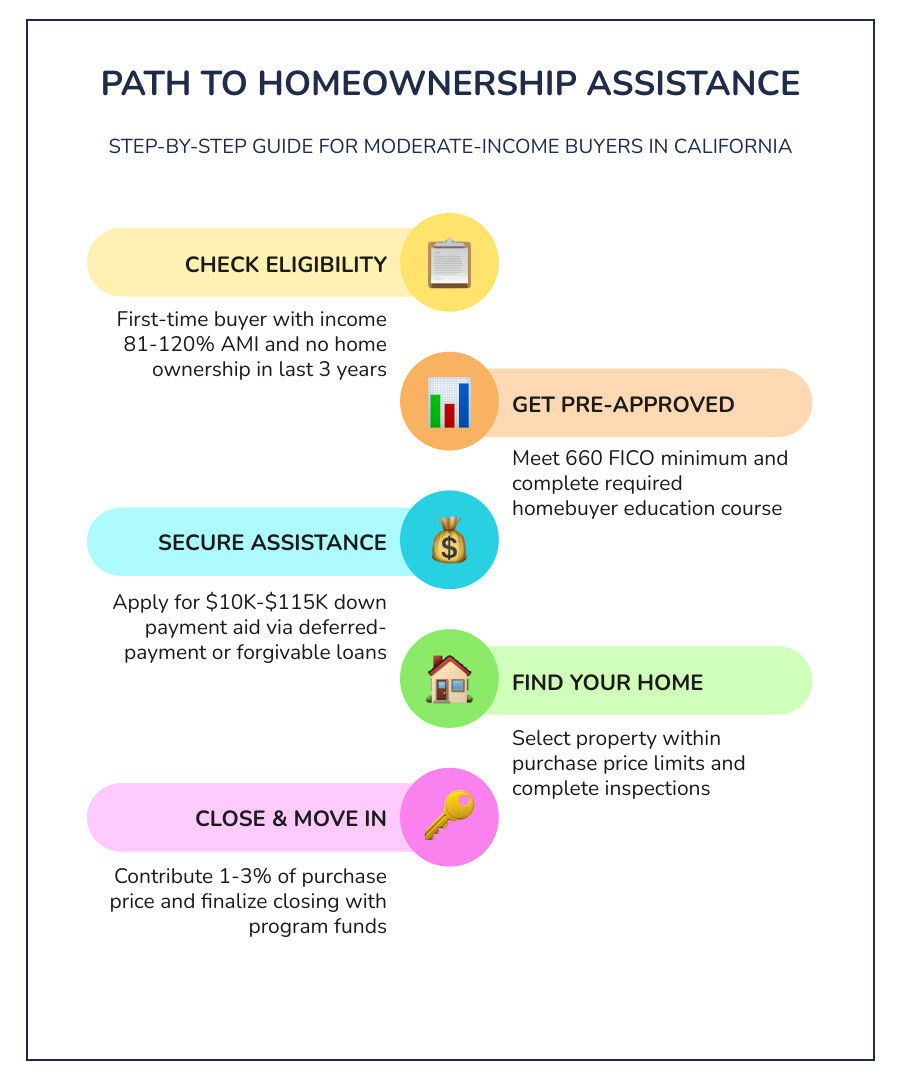
- Who qualifies: First-time buyers who have not owned a home in the last three years, with household income generally between 81% and 120% of the Area Median Income (AMI)
- How much help is available: Down payment assistance ranging from $10,000 up to $115,000 depending on the program and location
- What it covers: Down payment, closing costs, and sometimes acquisition costs
- Loan structure: Most programs offer deferred-payment or forgivable loans — meaning no monthly payments until you sell, refinance, or move
- Key requirement: Most programs require a minimum buyer contribution (typically 1% to 3% of the purchase price) and completion of a homebuyer education course
For veterans transitioning to civilian life, these programs can be a critical step toward long-term stability. The path to owning a home may feel out of reach — especially when you are rebuilding financially after service. But moderate-income assistance programs exist specifically because many households earn too much to qualify for low-income aid, yet still cannot afford a down payment on their own.
LifeSTEPS works alongside Californians navigating these exact challenges, connecting residents to housing resources and education that make homeownership a realistic goal.
LifeSTEPS currently provides services in California only.
Simple homeownership assistance for moderate income glossary:
Understanding Homeownership Assistance for Moderate Income

When we talk about homeownership assistance for moderate income, we are looking at a specific “middle ground” of the housing market. Often, state and federal aid focuses heavily on very low-income families. However, moderate-income households—those earning roughly between 81% and 120% of their Area Median Income (AMI)—frequently find themselves priced out of the California market despite having steady jobs.
The AMI is the “middle point” of a region’s income distribution. In high-cost areas like Los Angeles or San Diego, 120% of the AMI can actually be a significant figure. For example, a four-person household in Los Angeles might still qualify as “moderate income” even with a combined income reaching up to $141,850.
The primary difference between low-income and moderate-income programs is the threshold of support. While low-income programs might offer more deep subsidies, moderate-income programs focus on filling the “gap” between what a bank will lend you and what the home actually costs. You can explore more about these distinctions through our Homeownership Assistance resources or by checking the current Income Limits | Buying a Home – CalHFA.
Qualifying for Homeownership Assistance for Moderate Income
To qualify for most of these programs, you typically need to meet the definition of a “first-time homebuyer.” In the eyes of the government, this doesn’t necessarily mean you have never owned a home. It usually means you have not had an ownership interest in a principal residence within the last three years.
Citizenship status is also a factor. Most programs require applicants to be U.S. citizens, lawful permanent residents, or “qualified aliens.” Additionally, because these programs use public funds, the home you buy must be your primary residence—you cannot use this assistance to buy an investment property or a vacation home. We often encourage our clients to start by unlocking your front door with FSS homebuyer education, which provides the foundational knowledge needed to navigate these legal requirements.
Financial Readiness and Credit Standards
While these programs are designed to help, they aren’t “easy buttons.” You still need to demonstrate financial responsibility. Most California programs, such as the Moderate Income Purchase Assistance (MIPA) program in Los Angeles, require a minimum middle FICO credit score of 660.
Lenders will also look at your debt-to-income (DTI) ratio to ensure you can afford the monthly mortgage payments once the assistance is applied. Furthermore, almost all programs require the buyer to have some “skin in the game.” This is usually a minimum contribution of 1% to 3% of the purchase price from your own personal funds. For a $600,000 home, that means having $6,000 to $18,000 of your own savings ready to go. If you are just starting your savings journey, our Low Income First Time Home Guide offers excellent tips on budgeting and financial preparation.
Types of Financial Assistance and Loan Terms

The world of homeownership assistance for moderate income is filled with different financial “instruments.” Understanding which one you are signing up for is vital for your long-term financial health.
- Deferred-Payment Junior Loans: These are the most common. The city or state lends you money for the down payment, but you don’t make monthly payments on it. Instead, the loan is “deferred” until you sell the home, refinance your primary mortgage, or move out.
- Forgivable Grants/Loans: Some programs, particularly in specific local jurisdictions, may forgive a portion of the loan for every year you live in the house. For example, a loan might be 100% forgiven if you stay in the home for 10 or 15 years.
- Shared Appreciation Loans: In these models, the lending agency provides a large sum of money (like the $115,000 offered by the MIPA program) at 0% interest. In exchange, when you sell the home, you pay back the original loan plus a percentage of the profit (appreciation) the home earned.
You can find more details on these specific structures through the Moderate Income Purchase Assistance Program.
Repayment Structures for Homeownership Assistance for Moderate Income
It is a common misconception that “deferred” means “free.” Most of these loans are structured as 30-year balloon payments. This means that if you stay in your home for the full 30 years of your mortgage, the entire balance of the assistance loan becomes due at the end of that term.
The good news is that many of these programs, such as the CalHFA MyHome Assistance Program, offer these junior loans at very low or even zero interest. This allows your equity to grow faster than your debt. However, you must be prepared for the “triggers” that cause the loan to become due immediately:
- Selling the property.
- Refinancing the first mortgage to take cash out.
- The home no longer being your primary residence.
- Transferring the title to someone else.
Subordinate Liens and Shared Equity
When you use homeownership assistance for moderate income, your home will actually have two (or more) loans on it. Your main mortgage is the “first lien,” and the assistance program is the “subordinate” or “second lien.”
In programs like the Moderate Income Down Payment Assistance in San Diego County, the county may offer a deferred loan of up to 17% of the purchase price. This significant amount of equity helps you avoid Private Mortgage Insurance (PMI), saving you hundreds of dollars every month. The trade-off is often a shared equity provision, where the county shares in the home’s value increase, ensuring the program remains funded for the next generation of buyers.
Regional Programs Across California
California is a massive state, and housing assistance is largely handled at the local level. What is available in Riverside may be completely different from what is available in Natomas.
Southern California Assistance Opportunities
Southern California remains one of the most active regions for moderate-income support:
- Los Angeles: The MIPA program is a standout, offering up to $115,000 for those in the 81-120% AMI bracket. It has specific “reservation windows,” so timing your application is key.
- San Diego County: The county offers deferred loans for first-time buyers in unincorporated areas and specific participating cities. They focus on households at or below 120% AMI.
- Orange County: The Homeownership Program | Orange County Housing Authority provides pathways for residents to move from rental assistance to owning their own units.
- Riverside County: Local programs here often focus on specific neighborhood stabilization and assisting families in finding affordable single-family homes. You can find more through the Housing | County of Riverside, CA portal.
Rural Development and USDA Options
Not all assistance comes from the city. For those looking at more rural parts of California—including parts of the Inland Empire or the outskirts of San Diego and Riverside—the USDA Rural Development program is an incredible resource.
The USDA offers “Guaranteed” loans for moderate-income families, which can allow for 100% financing (no money down). These are often more accessible than traditional bank loans for those with solid incomes but low savings. You can learn more about how these integrate with local efforts at Housing Authority Programs Your Pathway to Affordable Homeownership.
The Application Process and Education Requirements
You cannot simply walk into a bank and ask for a moderate-income grant. There is a very specific sequence of events you must follow to be successful.
- Homebuyer Education: This is the most important first step. You must attend an 8-hour homebuyer education class from a HUD-approved provider. This isn’t just a formality; it teaches you about predatory lending, home maintenance, and the legalities of your loan. Upon completion, you get a certificate that is required for your application.
- Find a Participating Lender: Not every bank participates in these programs. You must work with a lender who has been specifically trained and approved by the agency (like CalHFA or the LA Housing Department).
- Get Pre-Approved: Your lender will look at your income, credit, and the certificate from your First Time Home Ownership Grants education to determine how much house you can afford.
Steps to Securing a Program Reservation
Once you find a home and have an accepted offer, your lender will “reserve” the funds for you. Since many of these programs have limited budgets, this reservation is a critical milestone.
During the escrow process, the property itself must also qualify. This usually involves:
- Property Inspection: A professional must ensure the home is safe and structurally sound.
- Lead-Based Paint Assessment: For homes built before 1978, specific inspections are required to ensure no lead hazards exist.
- Location Verification: The home must be within the specific city or county limits governing the program.
For more details on the timeline, refer to the Moderate Income Purchase Assistance Program guidelines.
Frequently Asked Questions about Moderate Income Assistance
What is the maximum income for moderate-income programs?
In most of California, the limit is 120% of the Area Median Income. In May 2026, for a family of four in Los Angeles, this is approximately $141,850. In San Diego, these limits are similar but vary slightly based on the specific county data for the year.
Can I use assistance for a condominium or townhouse?
Yes! Most homeownership assistance for moderate income programs allow for the purchase of single-family homes, condominiums, and townhouses. Some even allow for 2-4 unit properties, provided you live in one of the units as your primary residence.
Do I have to pay back the down payment grant?
It depends on the program. Some are “forgivable,” meaning if you live there for 10-15 years, the debt disappears. Others are “deferred loans,” which must be paid back in full (sometimes with interest or shared appreciation) when you sell or refinance the home.
Conclusion
At LifeSTEPS, we believe that housing is the foundation of a stable life. Whether we are helping a veteran find a permanent home or assisting a family in navigating the complexities of homeownership assistance for moderate income, our goal is long-term self-sufficiency.
We are proud of our community impact, including a 93% housing retention rate for those we serve. Beyond just finding a roof, we focus on the whole person—from our 97% literacy improvement in our Summer Reading programs to providing over $2.1M in scholarships to help the next generation reach higher education.
If you are currently a renter and dream of owning your own home, programs like the Family Self-Sufficiency (FSS) collaboration can be your pathway. You can read about real-world success in our story on how Lifesteps and the FSS Program helped achieve homeownership (names changed for privacy). For those currently transitioning, we also offer deposit assistance through the CalAIM program (typically covering one month paid in advance).
Owning a home in California is a challenge, but with the right education and the right assistance, it is a challenge you can meet.
LifeSTEPS currently provides services in California only.


