


Finding Affordable Income Restricted Apartments That Match Your Household Budget
Find Affordable Income Restricted Apartments That Fit Your Budget
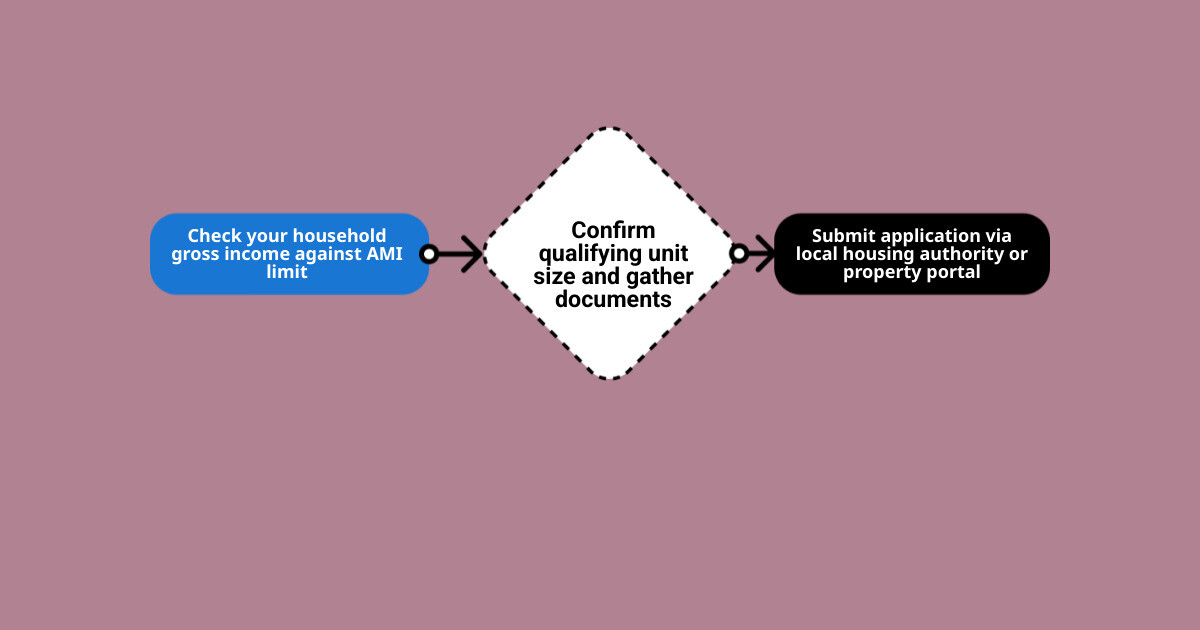
To find affordable income restricted apartments, compare your household’s total gross income with the property’s current Area Median Income (AMI) limit, confirm the unit size you qualify for, and apply as soon as the waitlist or lottery opens. Look through local housing authorities, city affordable-housing pages, and property management listings in Southern California and the Bay Area.
These apartments have rent limits tied to local incomes, often at 30%, 50%, 60%, or 80% of AMI. The limit changes by county and household size, so a veteran living alone may qualify under a different income cap than a family of three. Reviewing basic income restricted housing qualifications can help applicants navigate local income caps and unit occupancy standards.
Housing vouchers, including Section 8 and HUD-VASH for eligible veterans, can help cover rent and may satisfy a property’s minimum-income rule. Exploring how income based apartments and section 8 project based apartments function allows households to find the right fit for their budget. LifeSTEPS provides housing-focused support that helps residents build stability; its programs have supported a 93% housing retention rate. For eligible CalAIM participants, deposit assistance may cover 1 month paid in advance.
Understanding Affordable Income Restricted Apartments vs Market Rate Housing
Finding a stable home in California requires understanding the different types of rental housing available. Income-restricted apartments differ substantially from conventional market-rate units and deep-subsidy public housing.
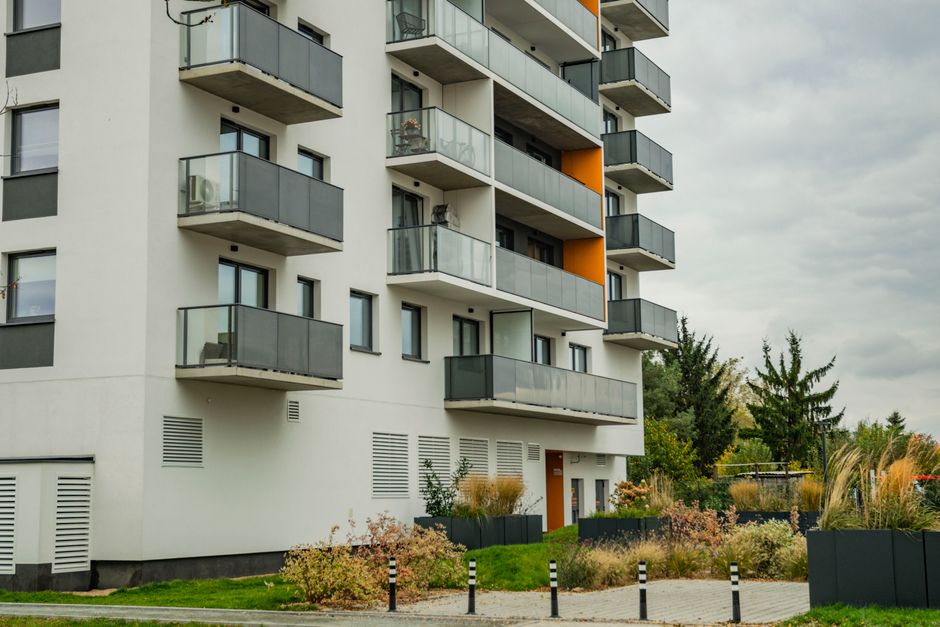
In a market-rate property, landlords charge rents based entirely on what the local real estate market will bear. Rents can fluctuate rapidly each leasing cycle, making long-term budgeting unpredictable for working families.
In contrast, income-restricted apartments operate under legally binding regulatory agreements. Property owners cap rents at specific percentages of the Area Median Income (AMI), ensuring that households earning below local median wages do not spend more than 30% to 35% of their designated income tier on shelter. Understanding standard income-restricted housing qualifications allows households to navigate these opportunities effectively.
| Housing Type | How Rent Is Determined | Income Requirements | Subsidy Attachment |
|---|---|---|---|
| Market-Rate Housing | Set by open market demand and property owners | Landlords usually require income equal to 2.5x–3x monthly rent | None; tenant pays full rent out of pocket |
| Income-Restricted Housing (LIHTC/Inclusionary) | Capped by AMI percentage brackets (e.g., 30%, 50%, 80%) | Gross household income must fall below maximum AMI caps | Attached to the property covenant; tenant pays a fixed below-market rate |
| Subsidized Housing (Section 8 / Project-Based) | Adjusted to exactly 30% of actual household monthly adjusted income | Must meet very low or extremely low-income thresholds | Attached to the individual voucher or specific designated unit |
Low-Income Housing Tax Credit and Local Zoning Mandates
The primary driver behind modern income-restricted housing is the Low-Income Housing Tax Credit (LIHTC) program, alongside municipal inclusionary zoning ordinances. Private developers receive federal and state tax credits or density bonuses in exchange for maintaining below-market rents for 30 to 55 years.
These properties incorporate utility allowances into their calculations. When a maximum allowable rent is published for an AMI tier, the landlord must subtract an estimated monthly utility cost if tenants pay electric, gas, or water bills separately. This guarantees that total housing expenses stay affordable throughout the compliance period.
Community Amenities and Unit Features
Modern income-restricted properties match or exceed the quality of conventional rentals. These communities feature durable luxury vinyl plank flooring, energy-efficient appliances, central heating and cooling, and open-concept floor plans.
Accessibility remains a core mandate. Multi-family developments incorporate Americans with Disabilities Act (ADA) accessible layouts, as well as Hearing and Visually Accessible (HVA) units equipped with strobe fire alarms and lowered countertops. Communities often provide on-site laundry rooms, community clubhouses, computer learning centers, playground areas, and secure parking.
Income Limits, AMI Tiers, and Household Eligibility
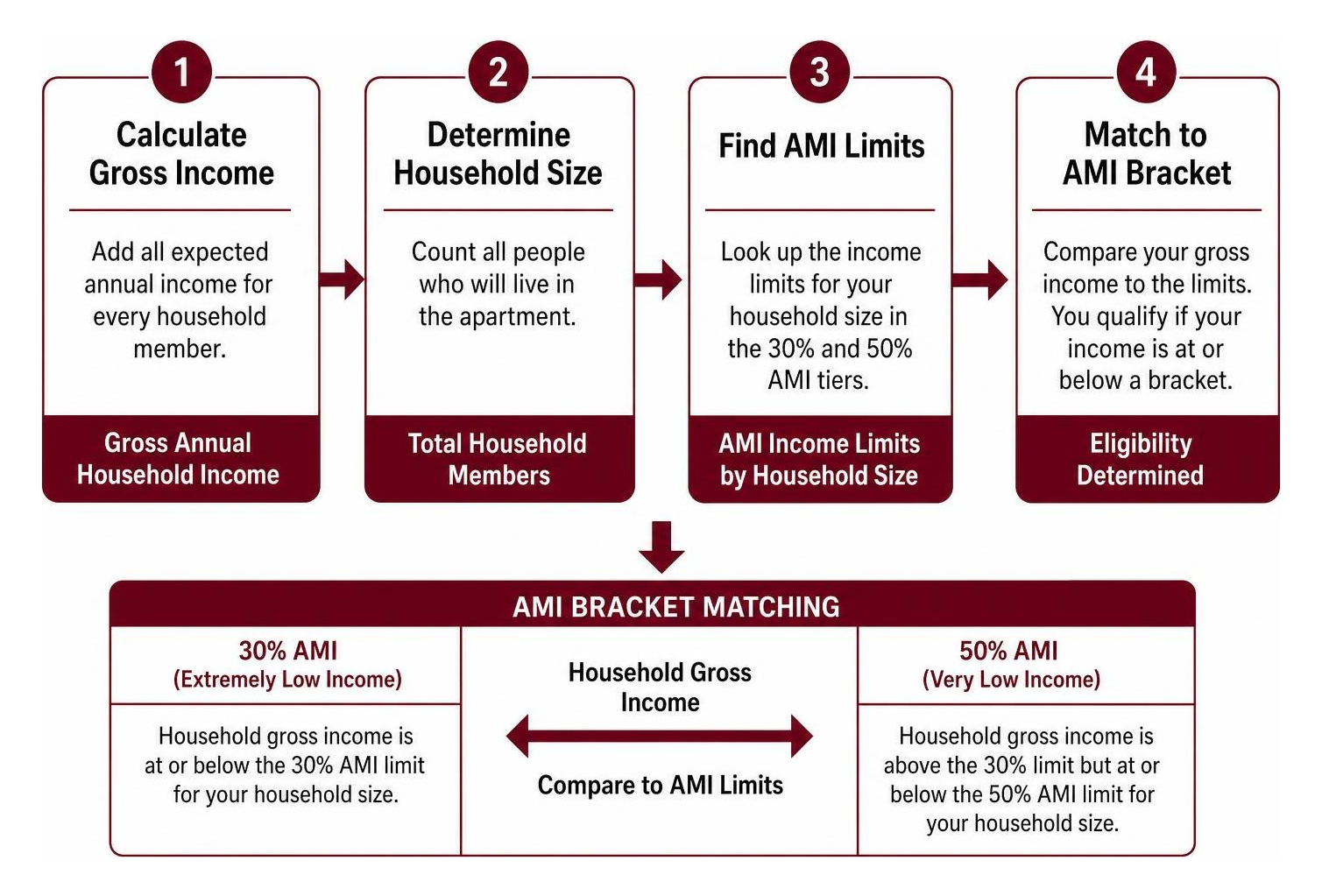
Every income-restricted rental relies on the Area Median Income (AMI), calculated each year by the U.S. Department of Housing and Urban Development (HUD). Income eligibility depends on gross annual income and total household size. Exploring available income restricted rentals helps prospective renters identify the specific income tier required for vacant homes.
Qualifying for Affordable Income Restricted Apartments by Household Size
Properties divide income caps into tiers:
- 30% AMI (Extremely Low Income)
- 50% AMI (Very Low Income)
- 60% AMI (Low Income)
- 80% AMI (Moderate/Low Income)
Because income limits scale upward with every additional person residing in the home, a four-person household has a higher allowable income ceiling than a single adult. In Southern California metropolitan areas, such as Los Angeles County, Riverside County, and Orange County, income thresholds reflect the regional cost of living. For instance, municipal initiatives outlined through City of Irvine affordable housing programs provide local AMI schedules showing exact dollar caps for studios, one-bedroom, two-bedroom, and three-bedroom apartments.
Special Guidelines for Dependents, Students, and Separated Spouses
Affordable housing compliance involves specific rules regarding household members:
- Dependent Student Earnings: When calculating total gross household income, annual earnings from dependent children under 18 or full-time students living with parents are capped. Only the first $480 of a full-time student dependent’s earned income is counted toward the total household limit.
- Separated Spouses: In affordable housing compliance, legally married couples are counted as members of the same household unless legal separation or divorce documents are provided.
- Non-Tax Filers: Individuals who did not earn enough to file a tax return must supply an official IRS Form 4506-T (Verification of Non-Filing) to establish income compliance.
How to Apply and Verify Income for Below-Market Rentals
Applying for income-restricted properties requires prompt action and thorough documentation. Many communities process applicants on a first-come, first-served basis, while newly constructed developments frequently use randomized housing lotteries.

When searching for vacancies, starting with verified tools for finding income-restricted housing near you ensures that applications reach legitimate leasing offices.
Essential Documentation for Asset and Earnings Certification
During the application interview, leasing specialists verify every household revenue source. Applicants must gather:
- Proof of Earned Income: Consecutive pay stubs covering the last 1 to 3 months, showing year-to-date gross wages, overtime, and bonuses.
- Tax Documentation: W-2 forms, 1099 statements, and signed federal tax returns for the most recent filing year.
- Unearned Income Statements: Official award letters for Social Security (SSI/SSDI), pensions, child support court orders, or unemployment benefits.
- Asset Verification: Bank statements for checking, savings, retirement, and investment accounts. Property managers calculate actual income earned or apply statutory imputed interest rates to total assets.
Navigating Waitlists and Appeals for Affordable Income Restricted Apartments
Because demand for quality affordable rentals is high, waitlists can span several months. Keep your contact information updated with leasing offices to avoid missing verification notices.
If an application is denied due to an income discrepancy, applicants receive an official written rejection. Affordable housing regulations generally provide a strict 7-day window to submit a formal written appeal with updated documentation.
Rental Assistance Programs and On-Site Supportive Services
Income-restricted properties work closely with rental subsidies. Housing Choice Vouchers (Section 8) and HUD-VASH (Veterans Affairs Supportive Housing) vouchers help households pay their portion of rent while the housing authority covers the remainder. When applying, resources like the San Diego Housing Commission rental assistance programs and the comprehensive HUD low-income housing application guide outline how mobile vouchers integrate with income-restricted units.
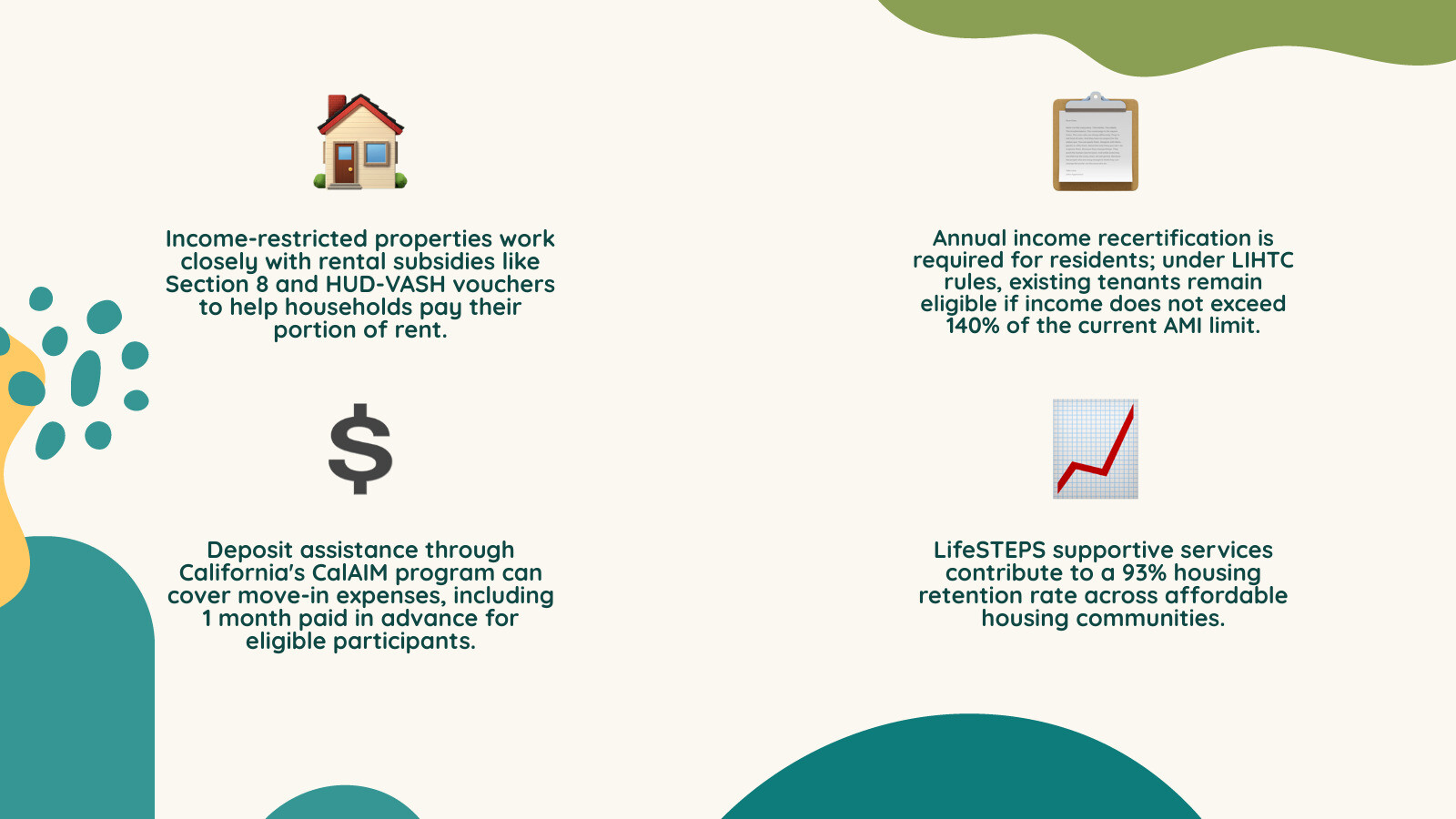
For eligible participants in California, deposit assistance through the CalAIM program can provide coverage for move-in expenses, including 1 month paid in advance.
Handling Income Increases and Annual Recertifications
Residents must complete an annual income recertification to confirm ongoing eligibility. If a household receives a raise after moving in, program rules provide flexibility. Under LIHTC regulations, existing tenants generally remain eligible as long as their household income does not exceed 140% of the current AMI limit for their unit size. This rule prevents sudden displacement and encourages career advancement. LifeSTEPS provides supportive services that contribute to a 93% housing retention rate across communities.
Resident Services and Pathways to Financial Growth
Affordable communities offer more than four walls; they serve as foundations for personal growth. LifeSTEPS provides comprehensive resident services, including youth afterschool programs that achieve a 97% literacy improvement through summer reading initiatives. In addition, LifeSTEPS supports higher education opportunities for residents, having facilitated $2.1M in scholarships to date.
Through voluntary engagement with Family Self-Sufficiency (FSS) models, residents can build financial assets, reduce personal debt, and work toward homeownership. For instance, Carlos, whose name has been changed, utilized on-site financial coaching and youth tutoring support to stabilize his family’s finances, eventually moving from an income-restricted apartment into permanent homeownership.
Frequently Asked Questions About Income-Restricted Housing
How are waiting list positions determined for affordable income restricted apartments?
Waiting list placement is typically managed in one of two ways:
- Chronological Timestamps: Applications submitted for open waitlists are processed in the exact order received.
- Housing Lotteries: For new construction developments, applications submitted during an open window are randomized via an audited lottery system. Applicants receive numeric draw positions. Certain properties apply local preference categories (such as local live/work preferences or accessible unit needs).
Do housing choice voucher holders need to meet private minimum income requirements?
No. Income-restricted properties cannot reject applicants holding Section 8, HUD-VASH, or other mobile housing vouchers simply for failing to meet standard private minimum-income multiples (such as earning 2.5 times the rent). The voucher guarantees the rental payment, meaning minimum income standards are calculated based only on the tenant’s individual out-of-pocket rent share.
What happens if your income increases after you submit an application?
Household income must stay within the designated AMI limit through the official date of lease signing and final compliance verification. If a wage increase pushes your gross earnings over the maximum cap before lease execution, you may no longer qualify for that specific unit tier. However, if your earnings increase after you have officially moved in, the 140% AMI recertification rule allows you to stay in your home.
Conclusion
Securing an income-restricted apartment offers long-term stability and rent predictability. By understanding Area Median Income brackets, organizing your income documentation, and applying across regional housing registries, you can find a quality home that matches your family’s budget.
LifeSTEPS provides on-site supportive housing services, educational youth programs, and financial empowerment resources that help residents thrive. Explore how LifeSTEPS programs and services support community success and housing stability.
For media inquiries, contact: bex@lifestepsusa.org
LifeSTEPS currently provides services in California only.


