


Get Funding with the Homeownership Down Payment and Closing Cost Assistance Program
Get Funding with the Homeownership Down Payment and Closing Cost Assistance Program
The Real Cost of Buying a Home — and How Assistance Programs Close the Gap
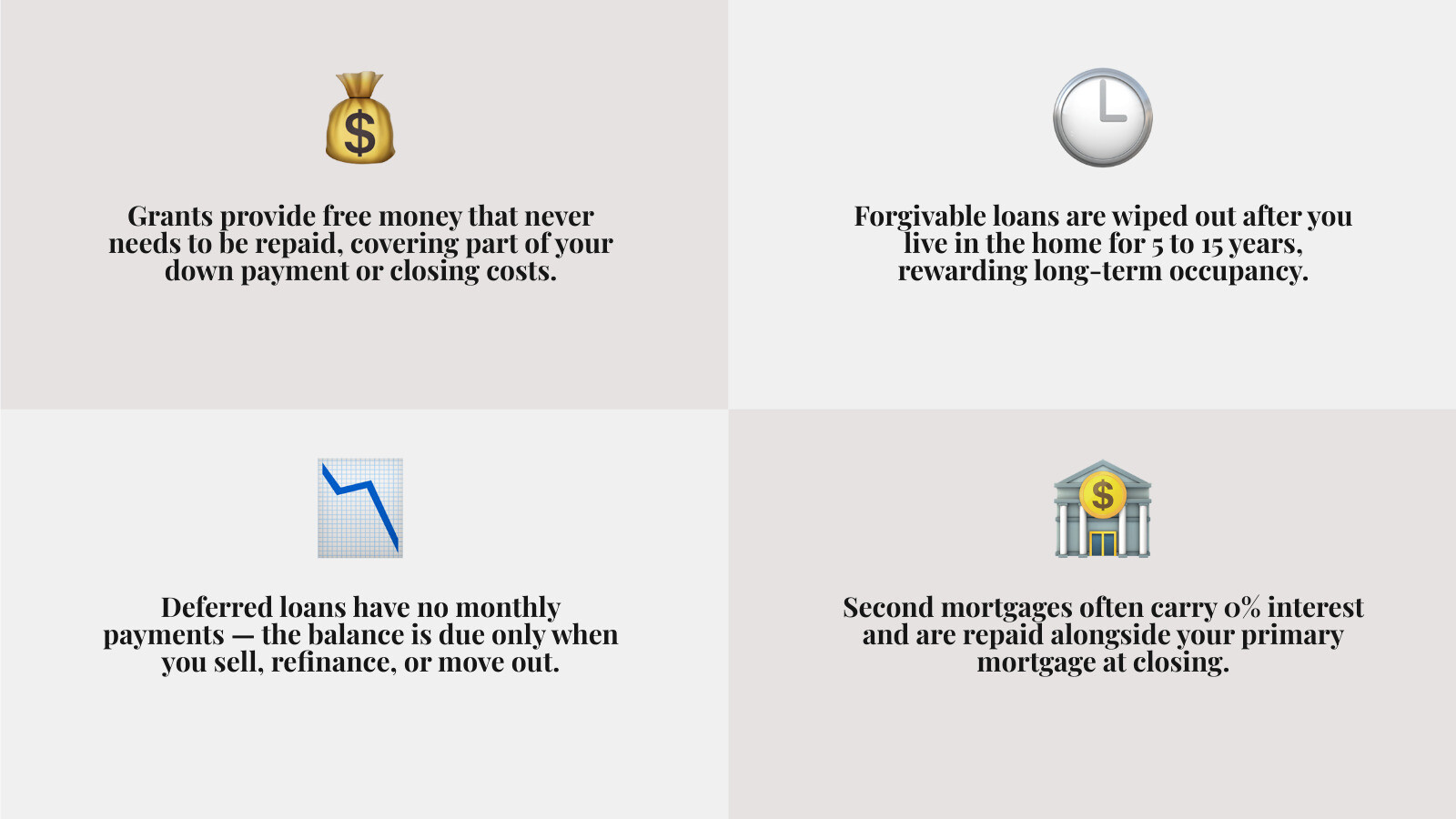
A homeownership down payment and closing cost assistance program is a funding resource that helps buyers cover the upfront costs of purchasing a home — typically through grants, forgivable loans, or deferred second mortgages. Here is a quick snapshot of how these programs work:
- Grants — Free money that does not need to be repaid
- Forgivable loans — Balances are forgiven after you live in the home for a set period (often 5 to 15 years)
- Deferred loans — No monthly payments; the balance is repaid when you sell, refinance, or move out
- Second mortgages — Low- or zero-interest loans repaid alongside your primary mortgage
Most programs require you to meet income limits (usually 80% to 120% of Area Median Income), complete a HUD-approved homebuyer education course, and use the home as your primary residence.
For veterans transitioning to civilian life, homeownership can feel just out of reach. The down payment alone stops many qualified buyers before they even get started. In 2026, with housing costs still elevated across California, that gap is real — but it is not insurmountable.
There are over 2,600 homeownership assistance programs available across the United States, and 74% of them specifically target down payment and closing costs. Many California buyers — including veterans, low-to-moderate income households, and first-generation buyers — qualify for meaningful financial help they may not know exists.
LifeSTEPS provides homeownership assistance to help residents in California navigate these programs and move toward long-term housing stability.
LifeSTEPS currently provides services in California only.
Homeownership down payment and closing cost assistance program vocabulary:
- homeownership down payment assistance program
- first time home ownership grants
- homeownership assistance
How a Homeownership Down Payment and Closing Cost Assistance Program Works
For many hardworking individuals and families across California, saving for a home purchase feels like aiming at a moving target. Even when monthly income easily covers a standard mortgage payment, gathering tens of thousands of dollars in liquid cash for upfront costs remains the ultimate roadblock.
A homeownership down payment and closing cost assistance program acts as flexible gap financing. Designed to bridge the divide between your cash reserves and the total purchase capital required, these programs help working families, veterans, and low-to-moderate-income households achieve permanent housing security.
In California, programs are administered by state entities like the California Housing Finance Agency (CalHFA), municipal housing departments in hubs like Los Angeles, San Diego, and Riverside, and partner social service organizations. By tapping into secondary financing options—such as the state-level MyHome Assistance Program – Homebuyers – CalHFA – CA.gov—buyers can secure secondary funds that sit behind their main mortgage, drastically reducing out-of-pocket expenses at the closing table.
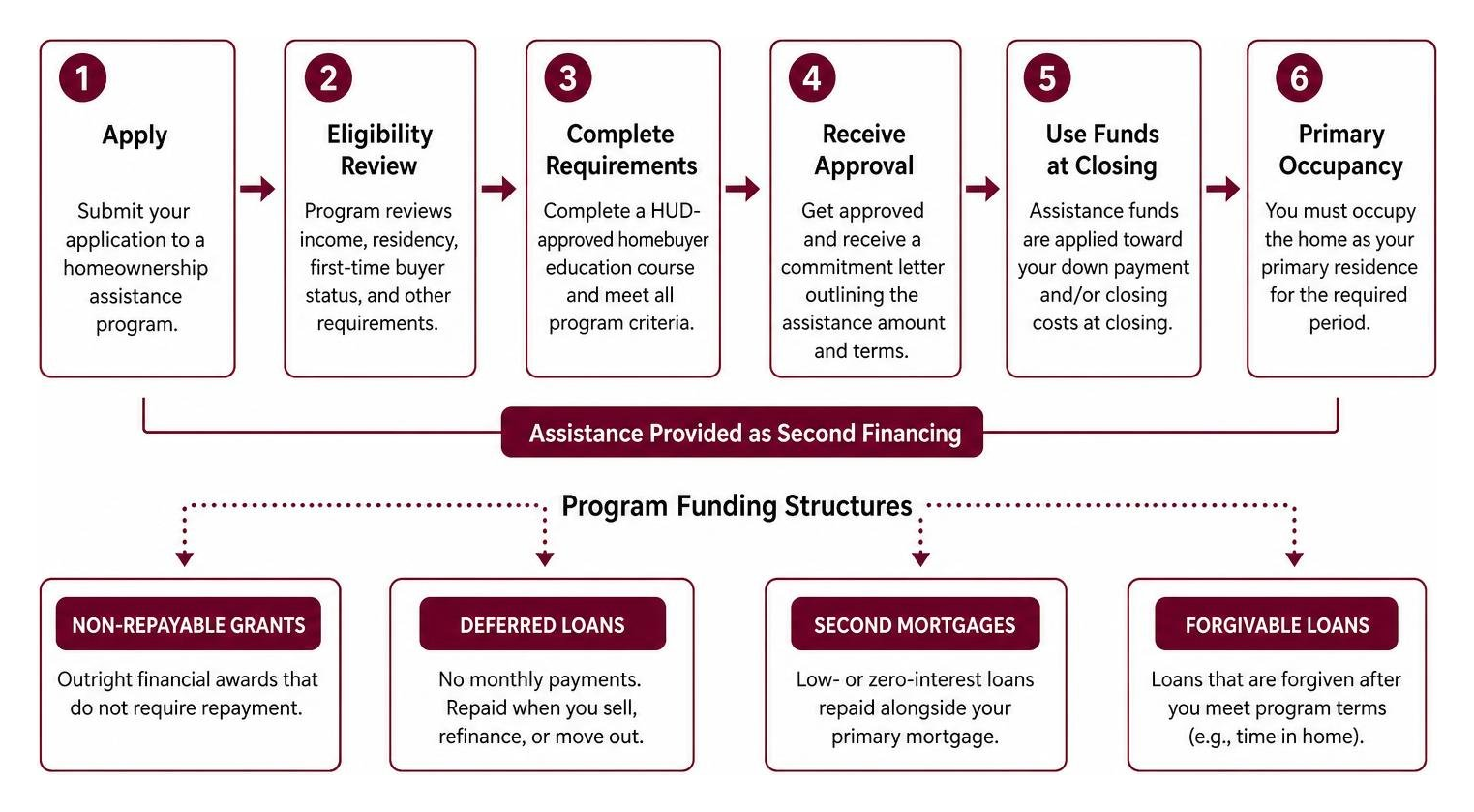
Types of Financial Assistance Available
When exploring local options, you will find four primary financing structures:
- Non-Repayable Grants: Outright financial awards provided by housing authorities or non-profit entities. These funds require no monthly repayment and no future payoff when designed as pure grants.
- 0% Interest Deferred Second Loans: The assistance amount is secured as a subordinate lien against your property. No monthly payments are required, and zero interest accrues over the life of the loan. The balance becomes due only when you sell the home, refinance the primary loan, or transfer the title.
- Forgivable Loans: Structured as 0% interest second mortgages, these loans are amortized and forgiven on a set schedule (such as 20% per year over 5 years, or fully forgiven after 10 to 15 years) provided you maintain the property as your primary residence.
- Repayable Secondary Loans: Subordinate loans offered at low or fixed interest rates, amortized over a set term (like 15 years) and paid alongside your monthly mortgage payment.
To explore options tailored to buyers purchasing their first property, check our guide on first time home ownership grants.
Award Amounts, Repayment Terms, and Forgiveness
Award amounts vary significantly depending on the administering agency and target geographic area. State and municipal programs in California frequently provide assistance structured as a percentage of the purchase price (typically 3% to 3.5%) or fixed caps ranging from $10,000 to over $100,000 in high-cost metropolitan markets.
Repayment terms and forgiveness conditions strictly depend on the funding source:
- Residency Requirements: To earn full forgiveness on forgivable loan options, you must occupy the home as your principal residence for the entirety of the specified affordability period.
- Payoff and Lien Release: When a deferred loan is eventually satisfied—either through property sale, full term completion, or mortgage payoff—the administering agency issues an official Request of Payoff or Lien Release Procedure to clear the title.
Eligibility Criteria for Down Payment and Closing Cost Help
Program eligibility is grounded in HUD guidelines to ensure funding reaches qualified buyers who need gap financing most. Administrators look at household income, current assets, home purchase price limits, and personal credit metrics.
If you want to review tailored low-income housing criteria, browse our low-income home buyer programs resources.
Credit and Income Standards for a Homeownership Down Payment and Closing Cost Assistance Program
To qualify for a homeownership down payment and closing cost assistance program, applicants must satisfy basic financial benchmarks:
- Income Limits: Household earnings are capped based on Area Median Income (AMI) thresholds established annually by HUD, typically ranging between 80% AMI for targeted assistance and up to 120% or 150% AMI for general state homebuyer programs.
- Credit Score Minimums: Most state programs require a minimum credit score of 640, though select specialized products accept scores starting around 620 to 660. Non-traditional credit histories may be considered under specific manual underwriting rules.
- Debt-to-Income (DTI) Ratios: Borrowers must demonstrate sustainable debt management. Housing debt (PITI) is often capped at 30% to 35% of gross income, with total monthly debt service restricted between 42% and 50%.
- Liquid Asset Caps: Programs frequently limit post-closing liquid reserves (typically $25,000 to $50,000) to ensure grants support buyers with genuine financial need. Retirement savings like 401(k) balances are generally excluded from asset limit calculations.
- Homebuyer Education: Completing a HUD-approved homebuyer education course is a mandatory requirement across nearly all assistance programs. These courses empower buyers with essential budgeting, maintenance, and mortgage management skills.
First-Time, First-Generation, and Repeat Buyer Rules
While many assistance options focus on first-time buyers, qualification rules are broader than many people realize:
- Standard First-Time Buyer Definition: Defined as any buyer who has not owned a primary residence during the preceding three-year period. Exceptions exist for displaced homemakers or single parents who previously owned a home with a former spouse.
- Repeat Buyer Options: Nationwide, over 38% of down payment assistance programs are open to repeat buyers who have owned a home within the last three years, particularly when purchasing in targeted urban census tracts.
- First-Generation Homebuyers: Specialized programs cater to first-generation buyers—defined as individuals whose parents or legal guardians do not currently own a home (or lost a home to foreclosure) or individuals who aged out of foster care. Programs like MMCDC First-Generation Down Payment Assistance – NeighborWorks Home Partners reflect these modern, equity-focused definitions.
How to Apply for Assistance and Combine Funding Sources

Applying for a homeownership down payment and closing cost assistance program requires a structured, step-by-step approach. Coordinating early with approved housing counselors and mortgage lenders ensures your assistance funds are reserved well before your target closing date.
To understand foundational concepts before starting your journey, read our beginners guide to home buyer programs.
Step-by-Step Application Process for a Homeownership Down Payment and Closing Cost Assistance Program
Navigating the application timeline involves several key milestones:
- Complete Homebuyer Education: Register for and complete an 8-hour HUD-approved homebuyer education course through a recognized housing counseling agency. Receive your completion certificate.
- Obtain Lender Preapproval: Connect with a participating mortgage lender who is certified to originate loans paired with local or state down payment assistance programs.
- Submit Eligibility Documentation: Provide two to three years of tax returns, recent W-2s, pay stubs, and bank statements to verify household income against AMI limits.
- Secure Reservation Letters: Upon approval, your lender submits your file to the program administrator to lock in and reserve your down payment assistance funds (often valid for 60 to 90 days).
- Execute Purchase Agreement: Work with your real estate agent to find an eligible property within program price caps and execute a purchase contract.
- Underwriting and Closing: Allow 25 to 30 business days for final administrative processing, document verification, and subordinate loan package preparation prior to closing.
Program Stacking and Combining Assistance Programs
One of the most effective strategies for reducing upfront costs is program stacking—combining multiple financial sources to cover your down payment, closing costs, and escrow reserves.
- Community Seconds Mortgages: Under Fannie Mae and secondary mortgage guidelines, buyers can pair a primary affordable mortgage (such as HomeReady) with subordinate Community Seconds loans up to a Combined Loan-to-Value (CLTV) limit of 105%.
- Combining Grants and Secondary Loans: Qualified buyers can layer local municipal grants, state deferred loans, and specialized military or employee assistance benefits.
- Zero Cash-Back Rule: When stacking assistance programs, the total funding cannot exceed your total actual closing costs and down payment requirements. Buyers are prohibited from receiving cash back at closing from assistance funds.
For an in-depth breakdown of multi-source funding models, view the 2026 guide to every first home loan grant.
Navigating Loan Forgiveness, Sales, and Refinancing

Understanding the long-term commitments associated with a homeownership down payment and closing cost assistance program is essential for protecting your property equity.
For additional strategies on long-term home security, check out our guide on home financing.
What Happens When You Sell or Refinance
Subordinate loans and forgivable grants remain tied to your property deed until all program conditions are met:
- Selling the Property: If you sell your home before a forgivable loan’s affordability period ends, or while holding a deferred 0% second loan, the remaining principal balance becomes due immediately from your sale proceeds.
- Refinancing Your Primary Mortgage: Refinancing your primary mortgage can trigger an immediate payoff demand for subordinate assistance loans. However, some municipal programs offer subordination policies allowing the secondary loan to stay in place if the refinance lowers your interest rate without taking cash out.
- Primary Occupancy Verification: Program administrators periodically verify primary residency. Transferring the property, converting it into a rental, or relocating will accelerate loan repayment triggers.
Finding Approved Lenders and Local Providers in California
Finding the right local resources is the fastest way to turn homeownership goals into reality. California residents should explore regional housing departments and state programs:
- City of Los Angeles: The Los Angeles Housing Department provides comprehensive local buyer support, outlined on the First-Time Homebuyers – LAHD – City of Los Angeles portal.
- Southern California Hubs: Local housing authorities across San Diego, Riverside, Irvine, and Natomas offer municipal gap funding, homebuyer counseling, and down payment secondary loans.
- CalHFA Approved Lenders: State programs require working with certified participating lenders who are trained in underwriting secondary CalHFA financing products.
Frequently Asked Questions about Homebuyer Assistance
Can repeat buyers qualify for down payment assistance?
Yes. Over 38% of homebuyer assistance programs nationwide cater to repeat buyers who have owned a home within the last three years. Additionally, anyone who has not owned a primary residence in the past three years meets the standard definition of a first-time homebuyer under federal guidelines.
What credit score is needed for down payment programs?
Most government-backed and state housing finance agency programs require a minimum credit score of 640. Some specialized municipal programs or manual underwriting options accept credit scores down to 620, provided debt-to-income ratios remain strong.
How long does it take to get approved for closing cost help?
The complete review and reservation process typically takes between 25 and 30 business days from the time your application package is submitted by a participating lender. Completing homebuyer education before shopping for a home speeds up the timeline significantly.
Conclusion
Overcoming the upfront financial hurdle of buying a home is within reach when you connect with the right funding programs and support systems. By taking advantage of a homeownership down payment and closing cost assistance program, qualifying individuals and families can preserve emergency savings while transitioning into permanent housing stability.
At LifeSTEPS, our mission is to empower individuals and families as they transition to stable housing and self-sufficiency. Working alongside supportive programs like the Family Self-Sufficiency (FSS) initiative, we provide educational guidance and holistic case management to help clients build brighter futures. From housing stability—where we maintain an extraordinary 93% housing retention rate—to empowering youth through 97% literacy improvement in our Summer Reading programs and awarding $2.1M in higher education scholarships, community support changes lives. For individuals eligible for CalAIM, we also help connect clients with crucial deposit assistance (such as 1 month paid in advance) to ensure seamless transitions into stable housing.
Explore how our wrap-around services build long-term independence by visiting LifeSTEPS Programs and Services.
LifeSTEPS | Phone: (916) 965-2110 | LifeSTEPS
LifeSTEPS currently provides services in California only.


