


Home Sweet Home: Veteran Assistance Loans and Housing Programs
Home Sweet Home: Veteran Assistance Loans and Housing Programs
What Are Veteran Assistance Loans — and How Do You Get One?
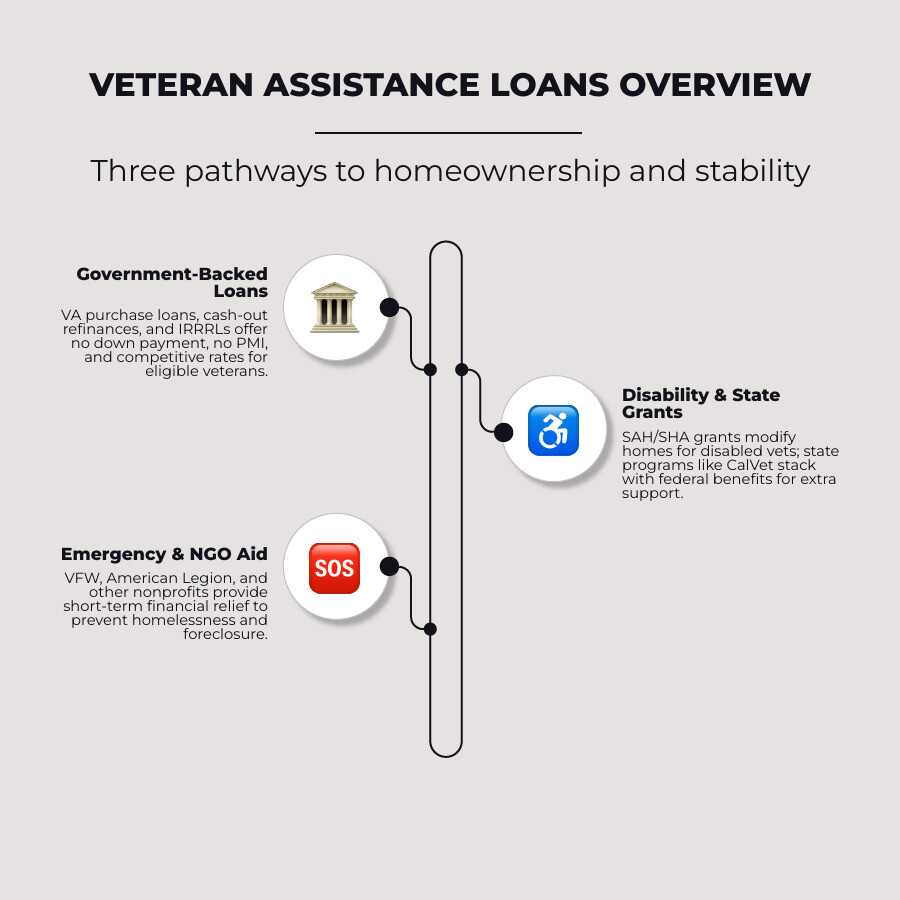
Veteran assistance loans are government-backed and nonprofit-supported financing options that help eligible veterans, service members, and surviving spouses buy, build, or improve a home — often with no down payment required.
Here is a quick overview of the main options:
- VA Purchase Loan — Buy a home with no down payment and no private mortgage insurance (PMI)
- Cash-Out Refinance — Tap your home equity for cash while refinancing your existing mortgage
- Interest Rate Reduction Refinance Loan (IRRRL) — Lower your interest rate on an existing VA loan
- Native American Direct Loan (NADL) — Finance a home on Federal Trust Land directly through the VA
- Specially Adapted Housing (SAH) Grant — Modify your home if you have a service-connected disability
- State Programs (e.g., CalVet) — California-specific loan programs that may stack with federal VA benefits
- NGO Emergency Grants — Short-term financial relief from organizations like the VFW or American Legion
Life after active duty brings real challenges. Housing insecurity and financial instability are among the most common. The good news: veterans have earned access to a powerful set of tools to build stability — and this guide walks through all of them.
Veteran assistance loans word list:
Understanding VA Home Loans and Veteran Assistance Loans
When we talk about securing a stable foundation, the federal VA home loan program is often the most powerful tool in a veteran’s financial toolkit. Established in 1944 under the Servicemen’s Readjustment Act, this program was designed to serve as a long-term readjustment benefit rather than a standard commercial mortgage. Since then, it has helped millions of military families transition into homeownership.
At its core, the VA loan is not a direct loan from the government (with a few unique exceptions). Instead, the Department of Veterans Affairs provides a VA loan guaranty to private lenders. By guaranteeing a portion of the loan (typically up to 25%), the VA reduces the risk for lenders, which allows them to offer highly competitive terms to borrowers.
One of the most remarkable aspects of this program is that it is a lifetime benefit. You do not lose your entitlement once you use it; you can use it multiple times to purchase subsequent homes or refinance existing mortgages. For veterans aiming to secure their piece of the American dream, our guide on buying your castle a guide to veteran home buying assistance provides excellent strategies for leveraging these benefits.
To understand the widespread impact of these programs, consider that as of the 2023 American Housing Survey, approximately 7.4% of owner-occupied units across the nation had VA-insured loans. This statistic highlights just how vital federal support is in keeping our military community housed.
Types of VA-Backed Veteran Assistance Loans
There is no one-size-fits-all solution when it comes to housing. The VA offers several distinct loan products tailored to different financial situations:
- VA Purchase Loans: These are the standard loans used to buy an existing home or build a new one. The primary benefit here is affordability: in FY2024, an incredible 74% of VA home loan purchasers did not make a down payment. Additionally, borrowers are spared the monthly cost of Private Mortgage Insurance (PMI), saving hundreds of dollars each month.
- Cash-Out Refinance Loans: If you already own a home and want to replace your current loan with a new one under better terms, this option allows you to take cash out of your home equity. This cash can be used to pay off high-interest debt, fund home repairs, or cover emergency expenses.
- Interest Rate Reduction Refinance Loans (IRRRL): Also known as a “streamlined refinance,” this option is designed to lower your monthly payment by reducing the interest rate on an existing VA loan. The process is simplified, often requiring no appraisal and minimal paperwork. The popularity of refinancing fluctuates heavily based on market conditions; for instance, in FY2020, the number of VA refinance loans more than tripled compared to FY2019, and then increased again by nearly 22% in FY2021, before falling to its lowest level since FY2008 in FY2023 as interest rates rose.
- Native American Direct Loans (NADL): Unlike standard VA-guaranteed loans, the Native American Direct Loan is a direct loan provided by the VA itself. It allows eligible Native American veterans to finance the purchase, construction, or improvement of homes on Federal Trust Land.
- Manufactured Home Loans: Under 38 USC 3712 manufactured homes, veterans can secure government-backed financing to buy manufactured homes, purchase lots, or prepare a lot with utilities. These loans are capped at 95% of the property’s purchase price and have specific statutory maturity limits (e.g., up to 25 years and 32 days for a double-wide home and lot).

How the VA Loan Entitlement System Works
The engine behind every VA loan is the “entitlement” system. Your entitlement is the specific dollar amount the VA promises to guarantee to your lender.
There are two levels of entitlement:
- Basic Entitlement: This is typically $36,000. For loans under $144,000, the VA guarantees up to this amount.
- Bonus (Secondary) Entitlement: For loans over $144,000, the VA provides additional entitlement. Since the passage of the Blue Water Navy Vietnam Veterans Act, county loan limits no longer cap the maximum loan amount for veterans with full entitlement. This means you can borrow as much as a lender is willing to extend without a down payment.
To access your entitlement, you must obtain a Certificate of Eligibility (COE). If you sell your home and pay off your VA loan in full, you can restore your entitlement to use on another purchase. Under certain circumstances, you can also transfer your remaining entitlement to a qualified buyer who is also a veteran.
Eligibility, Underwriting, and Comparing Loan Programs
To qualify for veteran assistance loans, you must meet specific service duration and character of discharge requirements. Generally, eligibility is extended to active-duty service members, veterans, Selected Reserve members, and certain surviving spouses.
The minimum service requirements vary by era:
- Active Duty: At least 90 continuous days of active service.
- National Guard: At least 90 days of active service, including at least 30 consecutive days under Title 32.
- Selected Reserve: Typically six years of service, unless discharged earlier for a service-connected disability.
For a comprehensive breakdown of legislative history and eligibility criteria, you can review the official VA Home Loan Programs report.
Service Requirements and Character of Discharge Reviews
What happens if your military discharge is not classified as “Honorable”? If you received an Other Than Honorable (OTH) or Bad Conduct discharge, you might assume that your path to homeownership is completely blocked. Fortunately, this is not necessarily the case.
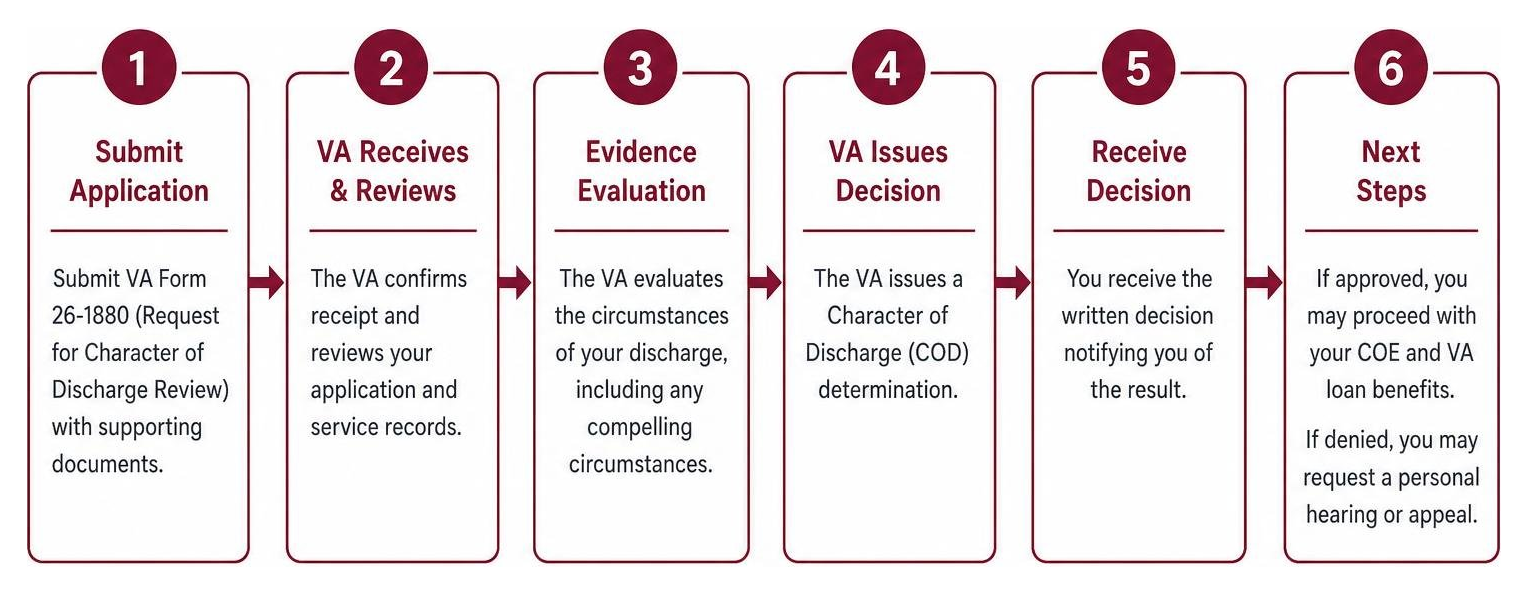
The VA provides a process called a Character of Discharge (COD) determination. This is an administrative review where the VA evaluates your service record, focusing on the circumstances surrounding your discharge. If the VA determines your service was “honorable for VA purposes,” you can unlock your home loan benefits.
To initiate this, you can apply for a COE using VA Form 26-1880. The VA will look for “compelling circumstances” to excuse any minor misconduct, such as undiagnosed PTSD, traumatic brain injuries (TBI), or family hardships.
Financial Underwriting: DTI and Residual Income Standards
While the VA does not set a minimum credit score, private lenders do. Furthermore, lenders must evaluate your financial health using strict underwriting guidelines outlined in 38 CFR 36.4340 underwriting standards.
Underwriting relies on two main pillars:
- Debt-to-Income (DTI) Ratio: The standard DTI threshold is 41% or less. This represents your monthly debt payments divided by your gross monthly income. If your DTI is higher, the loan can still be approved if there are strong compensating factors, such as significant liquid assets or a high residual income.
- Residual Income Analysis: This is the amount of monthly income you have left over after paying taxes, housing expenses, and other debts. The VA uses regional guidelines (based on family size) to ensure you can comfortably cover basic living expenses like food and utilities. Active-duty service members and retirees can receive a 5% reduction in their residual income requirement if they have documented access to nearby military base facilities.
VA Loans vs. FHA Loans
Many veterans wonder whether they should choose a VA loan or a Federal Housing Administration (FHA) loan. While both are excellent government-backed options, they differ significantly in cost and flexibility.
| Feature | VA Loans | FHA Loans |
|---|---|---|
| Down Payment | 0% (for eligible borrowers) | Minimum 3.5% |
| Monthly Mortgage Insurance | None | Required (MIP) for the life of the loan |
| Upfront Fees | Funding Fee (1.25% to 3.3%) | Upfront Mortgage Insurance Premium (1.75%) |
| Credit Score Requirements | Flexible (determined by lender) | Typically stricter than VA |
| Closing Costs | Strictly limited by VA guidelines | Standard closing costs apply |
State-Level Veteran Assistance Loans and CalVet Programs
In addition to federal options, many states offer highly competitive localized benefits. Here in California, the California Department of Veterans Affairs administers the CalVet Home Loans program.
CalVet operates differently than the federal VA program. Instead of guaranteeing a loan from a private lender, CalVet purchases the home directly and sells it back to the veteran under a land contract. This unique structure allows CalVet to offer low interest rates, group insurance coverage (including disaster and flood protection), and flexible underwriting for veterans who might struggle to qualify through traditional channels.
While other states have their own models—such as the North Dakota Veterans Aid Loan Program, which offers small loans up to $8,000 with an 8% interest rate and a 50% interest refund for on-time payments—the CalVet program remains the gold standard for California residents. For a deeper look at local resources, read a complete guide to california veteran housing programs.

Grants, NGO Financial Aid, and Foreclosure Prevention
For veterans who already own homes or are facing unexpected financial hardships, there are several grants and relief programs designed to maintain housing stability. If you are struggling with rent or mortgage payments, we encourage you to explore our resources on housing grants for veterans.
Housing Grants for Veterans with Service-Connected Disabilities
The federal government offers substantial financial assistance to help veterans with service-connected disabilities modify their living spaces. These grants ensure that veterans can live independently in a barrier-free environment:
- Specially Adapted Housing (SAH) Grants: Designed for veterans with severe, permanent disabilities (such as the loss of use of both legs or arms). These grants can be used to build a specially adapted home or modify an existing home.
- Special Housing Adaptation (SHA) Grants: Aimed at veterans with specific mobility or sensory limitations (such as severe burns or blindness). These funds help adapt an existing home to improve safety and accessibility.
Emergency Financial Assistance from Non-Governmental Organizations
When emergency expenses strike, turning to high-interest personal loans can worsen financial distress. Fortunately, several non-governmental organizations (NGOs) provide direct financial assistance:
- VFW Financial Assistance: This program provides emergency grants of up to $2,500 to active-duty service members and their families to cover basic needs. To ease the burden, the VFW pays the creditors directly rather than distributing cash.
- The American Legion Temporary Financial Assistance (TFA): Provides cash grants to minor children of veterans to ensure they have shelter, food, and utilities during times of crisis.
- USAA and Navy Federal: While these are financial institutions rather than charities, they offer tailored personal loans for veterans (up to $50,000) with competitive terms and extended repayment periods to help consolidate debt.
Foreclosure Avoidance and Mortgage Relief Options
If you are a veteran struggling to make your mortgage payments, do not wait until you receive a foreclosure notice. The VA employs dedicated loan technicians who work directly with borrowers and mortgage servicers to find viable solutions.
Through the VA Housing Assistance portal, you can explore several loss mitigation options:
- Repayment Plans: Spreading out missed payments over a set period.
- Special Forbearances: Temporarily suspending or reducing your payments.
- Loan Modifications: Adjusting the interest rate or extending the loan term.
- Partial Claim Program: A program established to assist veterans who defaulted by allowing the VA to pay a portion of the past-due amount directly to the lender, which is then repaid as a zero-interest junior lien.
Under the Servicemembers Civil Relief Act (SCRA), active-duty service members also receive legal protections against foreclosure and high interest rates while deployed.
Frequently Asked Questions About Veteran Assistance Loans
Who is exempt from paying the VA loan funding fee?
The VA loan funding fee is a one-time administrative fee paid at closing. However, the fee is completely waived for:
- Veterans receiving VA compensation for a service-connected disability.
- Active-duty service members who provide a pre-discharge disability rating.
- Surviving spouses of veterans who died in service or from a service-connected disability.
Can I get a VA loan with an Other Than Honorable discharge?
Yes. While an Honorable discharge makes the process seamless, veterans with an OTH discharge can still qualify by undergoing a Character of Discharge (COD) review. Submitting a detailed personal statement on VA Form 21-4138 detailing any compelling circumstances is key to a successful review.
What resources are available for veterans facing immediate homelessness?
Veterans in immediate danger of homelessness can access the HUD-VASH program, which combines HUD housing vouchers with VA supportive services. Additionally, the Supportive Services for Veteran Families (SSVF) program offers rapid rehousing and eviction prevention. For more details, explore our guide on programs that help homeless veterans or contact the national Veterans Crisis Line by dialing 988 (Press 1).
Conclusion
Securing stable housing is the first step toward building a thriving life. At LifeSTEPS, we are dedicated to walking alongside individuals and families as they transition to self-sufficiency. We are proud to maintain a 93% housing retention rate across our supportive housing programs.
Through our collaboration with the CalAIM program, we offer crucial deposit assistance—specifically providing 1 month paid in advance for deposit assistance—to help clients overcome the upfront financial barriers of moving. We also collaborate closely with the Family Self-Sufficiency (FSS) program to help low-income veterans transition from renting to proud homeownership.
Beyond housing, we believe in supporting the entire family. Our Summer Reading program has achieved a 97% literacy improvement among participating children, and we have proudly awarded over $2.1 million in college scholarships to help the next generation reach their full potential.
If you are a veteran in Los Angeles, San Diego, Riverside, Irvine, or the Bay Area looking for a supportive community and hands-on help navigating housing resources, we are here for you. Explore our guide on veterans assistance with housing or learn more about our Supportive Services.
For more information, contact: LifeSTEPS | Phone: (916) 965-2110 | LifeSTEPS
LifeSTEPS currently provides services in California only.


