


How Emergency Rental Assistance Works and How to Get It
When Rent Is Overdue and Options Feel Limited
How emergency rental assistance works is simpler than most people expect: the federal government funds a program, state and local agencies distribute that money, and qualifying households receive help paying rent, utilities, and related costs — often without ever having to repay a cent.
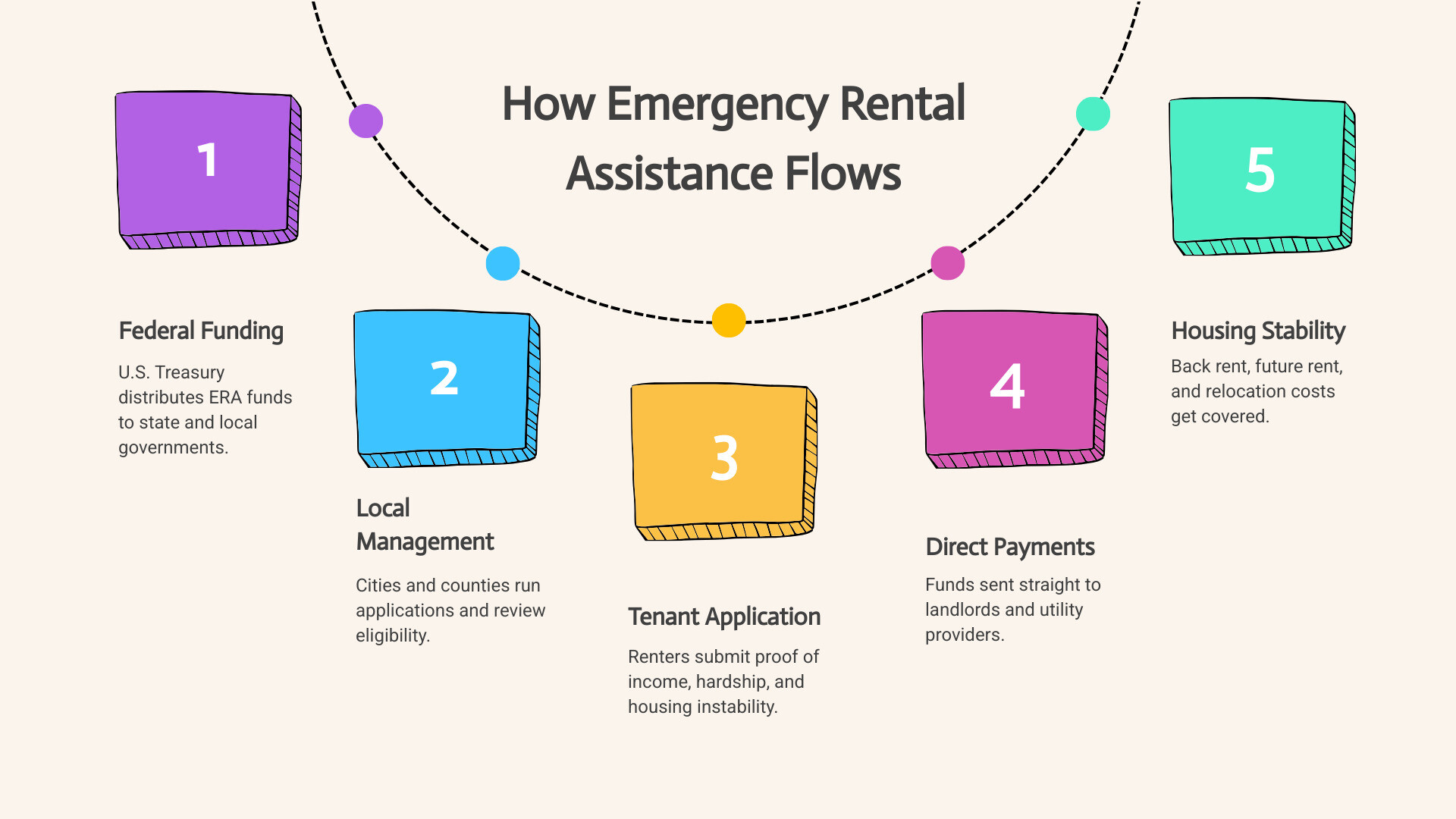
Here is a quick overview of the process:
- Federal funding flows down – The U.S. Treasury distributes ERA funds to state, local, territorial, and Tribal governments.
- Local agencies run the programs – Cities and counties manage applications and eligibility reviews.
- Households apply with documentation – Renters submit proof of income, hardship, and housing instability.
- Payments go to landlords and utilities – Funds are sent directly to landlords or utility providers on the renter’s behalf.
- Households receive housing stability – Covered expenses can include back rent, future rent, utility arrears, and in some cases relocation costs.
For veterans transitioning to civilian life, this kind of support can be the difference between stable housing and a crisis that derails everything else. Housing insecurity is one of the most common challenges veterans face after discharge — and it rarely travels alone. Financial stress, income gaps, and unfamiliar systems make it hard to know where to turn.
The good news: over $46 billion in emergency rental assistance has been distributed across the country since the COVID-19 pandemic, and California continues to have local programs that can help renters who qualify get back on stable ground.
LifeSTEPS currently provides services in California only.
Terms related to how does emergency rental assistance work:
How Does Emergency Rental Assistance Work at the Federal and State Level?
At its core, the federal Emergency Rental Assistance (ERA) program was designed as a rapid-response mechanism to keep families in their homes during severe economic disruptions. Understanding how does emergency rental assistance work at the highest levels of government helps clarify where the money comes from and how it eventually reaches your landlord or utility provider.
The federal initiative was rolled out in two distinct phases, authorized by separate pieces of legislation:
- ERA1: Authorized by the Consolidated Appropriations Act, 2021, this phase provided $25 billion to assist eligible households with financial assistance and housing stability services.
- ERA2: Authorized by the American Rescue Plan Act of 2021, this second wave provided an additional $21.55 billion. This phase expanded the scope to cover financial assistance, housing stability services, and, as applicable, other affordable rental housing and eviction prevention activities.
In total, the Emergency Rental Assistance Program | U.S. Department of the Treasury has collectively provided communities with over $46 billion to support housing stability.
Instead of distributing these billions directly to individual renters, the federal government utilized a decentralized funding model. The U.S. Department of the Treasury distributed the funds to states, U.S. territories, certain local governments with populations exceeding 200,000 residents, and Tribal entities.
Once the state and local governments received their allocations, they established localized programs to accept applications, verify eligibility, and disburse the funds. In California, this meant that while the state managed a massive overarching portal, individual counties and major metropolitan areas also operated their own localized programs. This structure allowed local administrators to tailor their outreach and distribution to the unique cost-of-living realities of their communities.
Who is Eligible for Emergency Rental Assistance in California?
Because the funds are administered locally, eligibility criteria can vary slightly depending on your exact city or county. However, federal guidelines establish a baseline of requirements that all California programs must follow. To qualify for assistance, a household must generally meet the following conditions:
- Rental Obligation: An applicant must be obligated to pay rent on a residential property (usually verified via a lease agreement or alternative proof of residency).
- Financial Hardship: A member of the household must have qualified for unemployment benefits or experienced a reduction in household income, incurred significant costs, or experienced other financial hardships directly or indirectly during or due to the pandemic.
- Housing Instability: The household must demonstrate a risk of experiencing homelessness or housing instability. This can be shown through a past-due utility or rent notice, an eviction notice, or proof of living in unsafe or unhealthy conditions.
- Income Limits: The household’s total income cannot exceed specific local thresholds, which are tied to the Area Median Income (AMI).
You can explore how these guidelines translate to local support by reviewing how California Renters Can Find Emergency Help Right Here.
How Does Emergency Rental Assistance Work for Low-Income Households?
For low-income families, the program is structured with strict prioritization rules to ensure that those in the greatest danger of displacement receive help first. Under federal and state guidelines, programs must prioritize households that meet either of the following criteria:
- Households with incomes at or below 50% of the Area Median Income (AMI).
- Households where one or more members have been unemployed for at least 90 days preceding the date of the application.
To determine eligibility, programs look at the local AMI, which varies significantly across California’s diverse regions. For instance, the income thresholds in high-cost coastal areas differ greatly from those in inland communities.
When Finding Help with Rent Los Angeles Style or seeking assistance in San Diego and Riverside, the 80% AMI limit is adjusted to reflect local economic conditions. If your household income falls below these localized thresholds, you may qualify for substantial assistance. Grantees are encouraged to use flexible income verification methods, including categorical eligibility (such as proving participation in other low-income programs like Medicaid or SNAP) or even self-attestation under specific, documented circumstances.
How Does Emergency Rental Assistance Work for Veterans?
Veterans facing housing instability require dedicated, wrap-around support. Transitioning from military to civilian life can present unexpected financial hurdles, making veterans particularly vulnerable to sudden rent increases or income disruptions.
When exploring Emergency Housing for Veterans Finding Shelter Fast, it becomes clear that rental assistance is most effective when paired with comprehensive housing stability services. Across California, specialized programs work in tandem with federal resources to prevent evictions among former servicemembers.
While organizations like Swords to Plowshares advocate for veteran-centered models of care in the broader social services landscape, we at LifeSTEPS focus on providing direct, human-centered resources. By helping veterans navigate the complex application processes for local ERA resources, we ensure they can access the financial relief they deserve while remaining in their communities.
What Expenses Does Emergency Rental Assistance Cover?
The ERA program goes beyond simply paying a portion of next month’s rent. It was designed to address the entire spectrum of housing-related debts that can accumulate during a financial crisis.

When you apply, you can request coverage for several different types of eligible expenses:
- Rental Arrears: Back rent accrued after March 13, 2020. This is often the most critical need for households facing immediate eviction.
- Prospective Rent: Forward-looking rent payments to help a household maintain stability while recovering financially. Under ERA1, prospective rent is typically limited to three months per application.
- Utility Arrears and Home Energy Costs: Past-due balances for essential services, including electricity, gas, water, sewer, trash removal, and home energy costs like fuel oil.
- Internet Service: Under certain local guidelines, internet service can be covered if it is deemed an “other housing-related expense” necessary for distance learning, remote work, or telehealth.
- Relocation Expenses: Costs associated with moving to a new stable home, which can include security deposits, application fees, moving costs, and late fees.
For a detailed look at how these coverages apply to different scenarios, you can consult the Emergency Rental Assistance California Complete Guide.
Covered Housing Expenses and Assistance Limits
| Expense Type | Description | Assistance Limits / Conditions |
|---|---|---|
| Rental Arrears | Past-due rent accrued after March 13, 2020 | Combined limit of 18 months total assistance (including utility arrears). |
| Prospective Rent | Future rent payments | Typically limited to 3 months at a time; must not exceed the 18-month total cap. |
| Utility Arrears | Electricity, gas, water, sewer, and trash | Must be supported by bills or invoices showing outstanding balances. |
| Relocation Expenses | Security deposits, application fees, and moving costs | Can cover security deposits (often matching standard local limits, such as 1 month paid in advance). |
| Internet Service | Monthly internet connection fees | Allowed if required for housing stability, employment, or education. |
How to Apply for Emergency Rental Assistance
Applying for help can feel overwhelming, especially if you are dealing with a rental assistance with eviction notice scenario. However, breaking the process down into manageable steps can help you secure approval more quickly.

Step 1: Locate Your Local Program Portal
Because there is no single federal application portal, you must apply through the program operating in your specific city or county. In California, regional portals handle applications for residents of their respective jurisdictions.
Step 2: Gather Required Tenant Documentation
To complete your application, you will need to upload several key documents. Having these ready beforehand will prevent processing delays:
- Proof of Identity: Government-issued ID, driver’s license, or passport.
- Proof of Residence and Rent Owed: A current, signed lease agreement. If a formal lease is unavailable, programs may accept utility bills, landlord attestations, or bank statements showing a consistent pattern of rent payments.
- Proof of Income: Tax filings, W-2s, recent paystubs, or documentation of unemployment benefits. If you have no traditional income documentation (for instance, if you are a gig worker or cash earner), many programs permit self-attestation as a flexible alternative.
- Proof of Hardship: A written statement or documentation detailing how your financial hardship occurred.
Step 3: Coordinate with Your Landlord
While tenants can initiate applications on their own, the program works most efficiently when landlords participate. Landlords must provide their own documentation, including a completed W-9 form, proof of ownership, and banking information for direct deposit. If a landlord refuses to participate, some local programs allow direct payments to the tenant, who is then legally obligated to pass the funds to the landlord.
Local California Programs and Resources
Depending on where you live in Southern California or our other service areas, you will need to access specific local resources:
- Los Angeles: The ULA Emergency Renters Assistance Program (ERAP) – LAHD provides critical aid to renters within the city limits of Los Angeles who are facing temporary financial setbacks.
- San Diego: The Rental Assistance – County of San Diego portal serves eligible households throughout the county, helping to prevent displacement in high-cost coastal and inland neighborhoods.
- Riverside: The CARES – RiversideCA.gov program offers localized assistance and resources tailored specifically to residents of Riverside.
Frequently Asked Questions About Emergency Rental Assistance
Navigating the rules of emergency housing aid can raise many questions. Here are the answers to some of the most common inquiries regarding program limits and guidelines.
How long can a household receive rental assistance?
According to the official FAQs | U.S. Department of the Treasury , an eligible household can receive up to 18 months of total assistance. This limit is a combined maximum across both the ERA1 and ERA2 programs.
Prospective rent payments are generally capped at three months per application to ensure that funds are distributed equitably and that households are reassessed for ongoing eligibility. If a household continues to experience deep financial hardship after the initial three-month period, they must re-apply and provide updated documentation or self-attestation of their financial status.
What happens when the federal ERA program ends?
The federal ERA program was designed as a temporary relief measure. The period of performance for ERA2 officially concluded on September 30, 2025, with final program closeout reports submitted by grantees in early 2026.
However, this does not mean that all rental assistance in California has disappeared. As federal funding wound down, many local municipalities transitioned to local funding streams, philanthropic partnerships, and state-backed initiatives. If you are seeking a rent relief near you unlocking city and county assistance strategy, you will find that programs like CalAIM (California Advancing and Innovating Medi-Cal) have stepped in to provide housing transition services. This includes vital deposit assistance, which can cover 1 month paid in advance for eligible participants transitioning into permanent housing.
How can I report fraud or abuse in the program?
To maintain the integrity of housing programs and ensure that funds go to families in genuine need, robust fraud prevention measures are in place. If you suspect that an individual, landlord, or organization is misrepresenting information to obtain funds, you should report it immediately.
Reports can be filed directly with the U.S. Department of the Treasury’s Office of Inspector General (OIG) or through the local disbursing agency running the program in your county. Additionally, if you believe you have faced discrimination during the application process, you can file a civil rights complaint with the Treasury’s Office of Civil Rights and Equal Employment Opportunity.
Conclusion
Securing stable housing is the foundation upon which individuals and families build successful, self-sufficient lives. When temporary setbacks threaten that foundation, knowing how emergency rental assistance programs operate can help you take fast, decisive action to protect your home.
At LifeSTEPS, we are deeply committed to walking alongside Californians as they navigate these housing challenges. Our human-centered support services are designed to help individuals transition to stable housing and long-term self-sufficiency.
Our focus on measurable community impact is reflected in our work:
- We proudly maintain a 93% housing retention rate among the clients we serve in our supportive housing programs.
- Through collaboration with programs like CalAIM, we provide critical deposit assistance, including 1 month paid in advance to help clients secure new homes.
- We invest heavily in the next generation, providing $2.1 million in scholarships to date and achieving a 97% literacy improvement through our Summer Reading programs.
If you are currently facing housing instability or need guidance on securing rental resources in our Southern California or Bay Area service regions, we encourage you to explore the LifeSTEPS Emergency Rental Assistance Services page to learn more about how we can support your journey.
LifeSTEPSusa.org
LifeSTEPS currently provides services in California only.


