


How to Find the Best Senior Apartment Complexes Without the Headache
Finding the Right Senior Apartment Complex Without the Stress
Senior apartment complexes are age-restricted rental communities designed specifically for older adults — typically those 55 or older. They offer low-maintenance living, built-in social opportunities, and amenities tailored to active aging.
Quick Answer: What to Know About Senior Apartment Complexes
| Topic | Key Facts |
|---|---|
| Age requirements | 55+ or 62+, depending on the community |
| Average monthly cost | Around $4,958 nationally; varies widely in California |
| Types available | Affordable/income-restricted, market-rate, luxury |
| Financial help | HUD subsidies, Section 8, CalAIM deposit assistance |
| How to find one | Online directories, virtual tours, housing coordinators |
| Waitlist times | A few weeks to over a year for subsidized units |
For veterans transitioning out of service, finding stable, affordable housing is often the first and most critical step toward rebuilding civilian life. Senior apartment complexes can be a strong option — but with occupancy rates close to 90% nationwide, competition is real. Knowing where to look, what you qualify for, and what questions to ask can make the difference between months of frustration and finding a home that fits.
This guide walks you through exactly that.
LifeSTEPS currently provides services in California only.
Basic senior apartment complexes vocab:
What Are Senior Apartment Complexes and How Do They Differ?
When searching for housing in our later years, the terminology can quickly become a confusing alphabet soup. Many people use the terms “senior apartments,” “independent living,” and “assisted living” interchangeably, but they represent very different levels of care and community structures.
Senior apartment complexes are independent housing units restricted to older adults (usually age 55 or 62 and older). Unlike traditional apartments, they are designed with physical accessibility in mind and foster a community of peers. However, they generally do not provide daily personal care, medical monitoring, or centralized dining plans as part of the base rent.
To help you evaluate the best options for senior living, here is how senior apartments compare to other common care models:
Senior Housing Options Comparison
| Housing Type | Care Provided | Central Dining | Who It Is Best For |
|---|---|---|---|
| Senior Apartments | None (independent) | No | Active seniors wanting a maintenance-free, peer-filled environment. |
| Independent Living | Minimal (optional add-ons) | Yes (often 1-3 meals/day) | Active seniors who want community events and dining services. |
| Assisted Living | Moderate (ADL assistance, meds) | Yes (all meals included) | Seniors needing help with daily tasks like bathing or dressing. |
| Memory Care | Specialized (24/7 supervision) | Yes (all meals included) | Individuals living with Alzheimer’s, dementia, or cognitive decline. |
Understanding Eligibility and Age Requirements
Before falling in love with a specific community, it is essential to understand the rules governing who can live there. Because these properties receive specific tax designations and legal exemptions, they enforce strict age limits, income guidelines, and background screenings.
Age Restrictions in Senior Apartment Complexes
Under the federal Fair Housing Act, housing communities can legally discriminate based on age if they qualify as “housing for older persons.” This is governed primarily by the 80/20 rule: at least 80 percent of the occupied units in a 55+ community must have at least one occupant who is 55 years of age or older.
In California, you will typically find two types of age-restricted properties:
- 55+ Communities: These focus on active adults. They often feature resort-style amenities and require at least one leaseholder to meet the age threshold. If you are searching in Southern California, checking out 55+ communities in Los Angeles is a great place to start.
- 62+ Communities: These properties are often subsidized by the government (such as HUD programs). They have a stricter threshold: every resident must usually be 62 or older, or have a qualifying disability.
Income Restrictions and Financial Eligibility
With more than 17 million economically insecure older adults nationwide living with incomes below 200 percent of the federal poverty level, affordable housing is a critical necessity. Many senior apartments are designated as “income-restricted” or “affordable housing.”
To qualify for these units, your household income must fall below a certain percentage of the Area Median Income (AMI)—typically 30%, 50%, or 60% of the local median. Properties participating in the Low-Income Housing Tax Credit (LIHTC) program or HUD Section 8 programs will require thorough income verification, asset audits, and background screenings before approving your application. For those navigating this process, our guide on low-income elderly housing offers step-by-step support.
Evaluating Amenities, Costs, and Pricing Tiers
The amenities and monthly rent of senior apartments vary dramatically depending on whether the community is affordable, market-rate, or luxury.
Standard vs. Luxury Senior Apartment Complexes
In basic, affordable senior apartments, amenities focus on safety and community. You can expect standard features like emergency call systems, elevators, community rooms for social gatherings, and basic maintenance-free living (handling all plumbing, electrical, and landscaping work).
In contrast, luxury senior apartments function more like high-end resorts. For instance, at luxury 55+ apartments in Fremont, residents enjoy premium amenities such as:
- Heated swimming pools and spas
- State-of-the-art fitness centers and yoga studios
- Epicurean kitchens, wine bars, and movie theaters
- On-site salons, spas, and manicured herb gardens
- Pet-friendly policies featuring dedicated dog parks and grooming stations
These properties offer the ultimate worry-free lifestyle, blending independent living with high-end convenience.

Average Costs and Financial Assistance in California
Nationally, the average monthly asking rent for senior housing sits at $4,958. However, in California’s high-cost metropolitan areas, pricing can fluctuate wildly.
To give you a realistic picture of the market:
- Market-Rate and Luxury Units: Can range from $2,500 to well over $6,000 per month in areas like San Diego, Los Angeles, and Irvine.
- Affordable and Subsidized Units: Rent is typically capped at 30% of your adjusted gross income (AGI) if you qualify for HUD programs.
For those searching in specific regions, exploring affordable senior housing in Thousand Oaks reveals how local programs help keep costs manageable.
When transitioning into stable housing, upfront costs like security deposits can be a massive hurdle. Through programs like CalAIM, we work to provide critical transition support, including deposit assistance of up to 1 month paid in advance to help qualifying seniors secure their new homes.
How to Find and Tour Senior Apartments in California
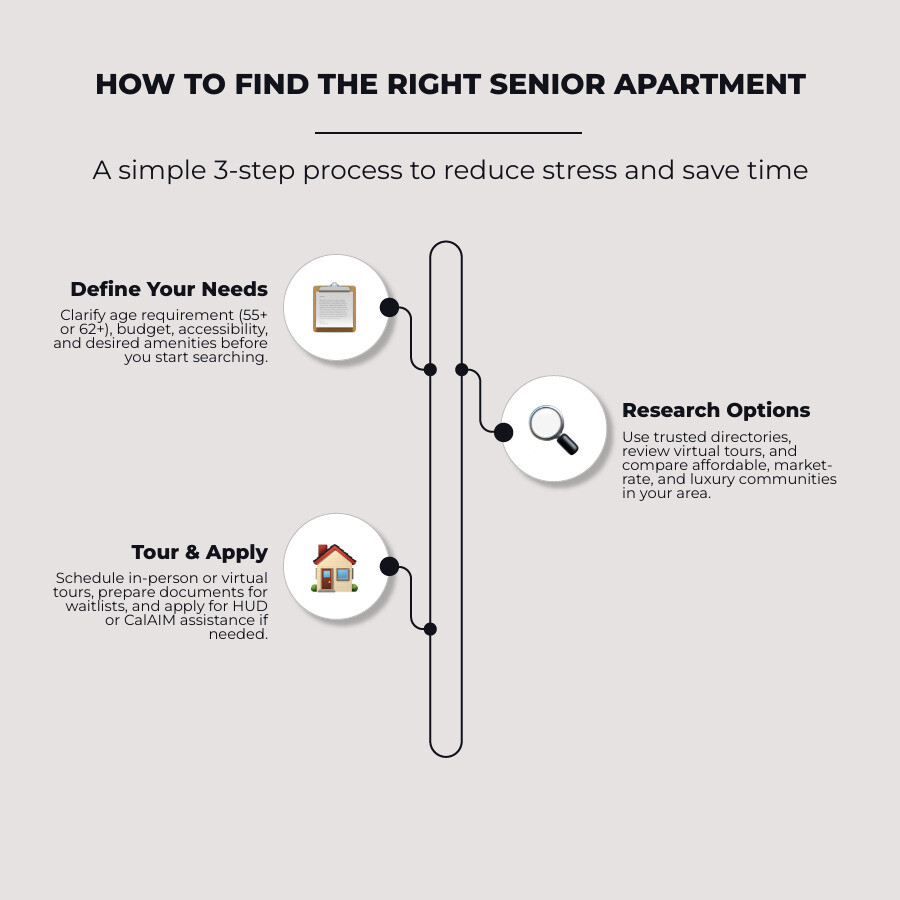
The search for the perfect apartment does not have to be overwhelming. Modern tools allow you to narrow down your options before ever setting foot on a property.
We recommend utilizing online directories that offer custom map tools to draw search boundaries around your preferred neighborhoods. Virtual walkthroughs, such as Matterport 3D tours, are also highly valuable, allowing you to measure doorways and visualize furniture layouts remotely. You can begin browsing verified listings using resources like senior housing apartments for rent in California.
When you are ready to tour a community in person, bring a physical checklist to evaluate safety and accessibility.

The Ultimate Senior Apartment Tour Checklist
- Accessibility: Are there zero-step entries, wide doorways for wheelchairs, and elevators?
- Bathroom Safety: Are there grab bars in the shower and slip-resistant flooring?
- Security: Is there 24-hour on-site security, secure key fob entry, and a reliable emergency alert system?
- Social Life: Is there an active calendar of events, workshops, or community outings?
- Policies: What is the guest policy for family members? Are pets allowed, and what are the associated fees?
Frequently Asked Questions About Senior Apartments
Can younger family members or spouses live in a senior apartment?
It depends on the community’s specific guidelines and the Fair Housing Act rules. Under the 80/20 rule, as long as 80% of the units have a resident aged 55 or older, the remaining 20% can sometimes accommodate younger adult residents. However, many communities enforce their own strict covenants requiring all residents to be over a certain age (e.g., 40 or 50).
Children under 18 are rarely allowed as permanent residents in senior apartments, though they are always welcome for temporary family visits. If you are looking in Southern California, check the specific guest and co-habitation rules for 55+ communities in San Diego to see how different properties manage age-gap couples.
Does Medicare pay for senior apartment rent?
No, Medicare does not pay for senior apartment rent, independent living, or any other form of long-term residential housing. Medicare is health insurance and only covers medically necessary clinical care.
Seniors must pay for rent out-of-pocket using retirement savings, Social Security, pensions, or through government housing assistance programs. For a deeper look at financial planning and navigating these costs, consult our senior living Thousand Oaks guide.
How long is the waitlist for affordable senior apartments?
Wait times for affordable, subsidized senior apartments can range from a few weeks to several years, depending on the demand in your specific California county. Because occupancy rates hover around 90%, it is vital to apply to multiple properties simultaneously to increase your chances.
To help jumpstart your search and find properties with shorter waitlists, keep our ultimate affordable senior housing list bookmarked as you plan your move.
Conclusion
Finding the right senior apartment complex is about more than just finding a roof over your head — it is about securing a community where you can thrive with dignity, security, and connection.
At LifeSTEPS, we are dedicated to helping older adults navigate these transitions. Through our supportive services, we proudly maintain a 93% housing retention rate among the clients we serve, keeping seniors stably housed. We work alongside programs like CalAIM to provide vital deposit assistance (up to 1 month paid in advance) to ensure financial barriers do not stand in the way of a safe home.
Our commitment to building strong, vibrant communities extends across generations. From helping children succeed through our Summer Reading program — which boasts a 97% literacy improvement rate — to awarding $2.1 million in higher education scholarships to help families achieve upward mobility, we believe in holistic, human-centered support.
To learn more about how we help seniors and families build stable, successful lives, explore our programs and services.
LifeSTEPS currently provides services in California only.


