


Navigating HUD: Your Guide to Disability Income Based Apartments
When Housing Feels Out of Reach: What Disability Income Based Apartments Actually Are
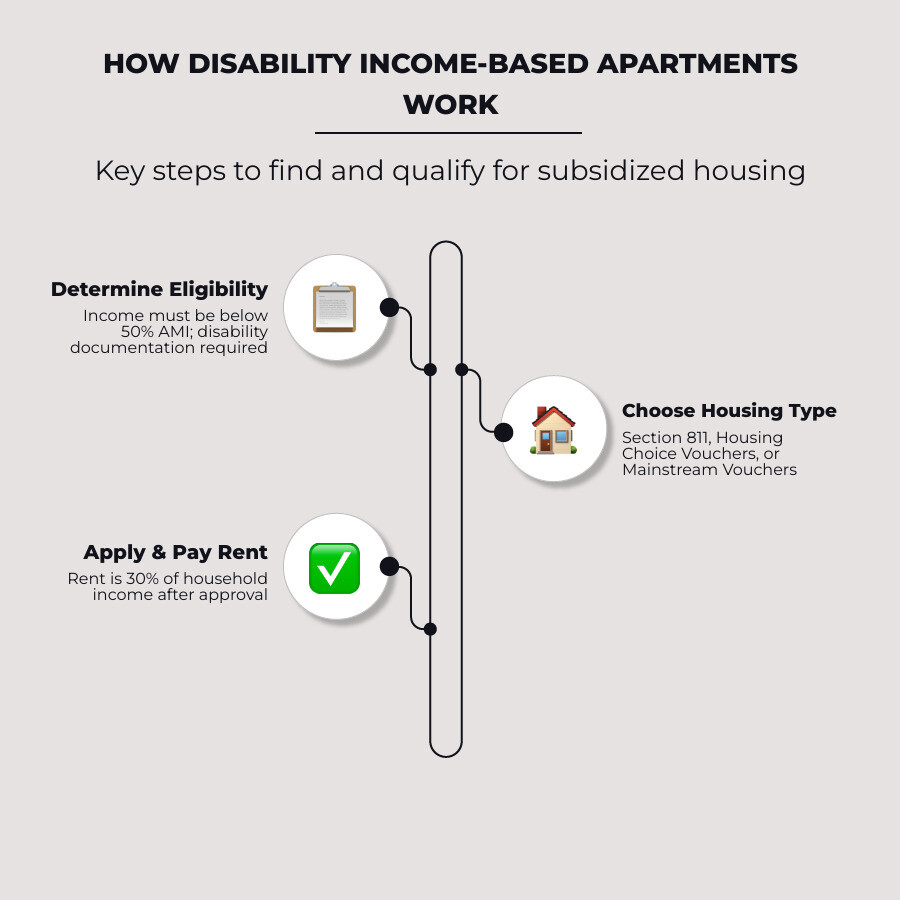
Disability income-based apartments are rental units where your rent is calculated as a percentage of your income — not set at a fixed market rate. For most federal programs, that percentage is 30% of your monthly household income.
Here is a quick overview of the main options available:
- Section 811 — Supportive rental housing for adults aged 18–61 with disabilities; rent is 30% of household income
- Housing Choice Vouchers (HCV) — Portable vouchers covering the gap between 30% of your income and the actual rent
- Mainstream Vouchers — Specifically for households with a disabled adult under 62 who are homeless or at risk
- Project-Based Vouchers — Tied to a specific property; you must live there to receive the subsidy
- Low-Income Housing Tax Credit (LIHTC) properties — Income-restricted apartments serving households at 30–80% of the Area Median Income (AMI)
To qualify for most of these programs, your household income generally needs to be below 50% of the Area Median Income — and for some programs, below 30%.
For recently discharged veterans, navigating this system while also adjusting to civilian life can feel overwhelming. The programs exist, the funding exists, and the housing exists — but knowing where to start is the hard part.
This guide breaks it all down clearly, so you can find the right program, understand what you qualify for, and take the next step toward stable housing.
Related content about disability income based apartments:
Understanding Disability Income Based Apartments and Subsidized Housing
When searching for affordable housing, it is easy to get lost in the alphabet soup of government terms. However, there is a fundamental difference between standard affordable housing and disability-specific subsidized housing. Standard affordable housing programs, such as general Low-Income Housing Tax Credit (LIHTC) properties, cap rents based on set percentages of the Area Median Income (AMI). In these units, the rent is fixed. If your income drops, your rent does not automatically adjust.
In contrast, true disability income based apartments utilize a dynamic rent calculation. Under federal guidelines, your rent is tied directly to what you actually bring in each month. If your primary source of income is Supplemental Security Income (SSI) or Social Security Disability Insurance (SSDI), your housing program ensures you are not priced out of shelter.
The baseline standard for these programs is the “30% of income rule.” This means your monthly rent contribution is capped at exactly 30% of your adjusted monthly household income. If your only income is an SSI check of $1,000 per month, your rent contribution will be approximately $300, with federal subsidies covering the remaining balance of the market-rate rent. This safety net provides unmatched financial stability.
Navigating these differences is the first step toward securing a safe home. For a deeper dive into how these programs compare, you can read our guide on Navigating the Maze of Disability Income Based Housing. Additionally, for those requiring a higher level of daily assistance, exploring Assisted Living for Low Income Disabled Adults and Low Income Housing for Elderly and Disabled options can clarify which path fits your physical and financial needs.
Key HUD Programs for Individuals with Disabilities
The U.S. Department of Housing and Urban Development (HUD) administers several programs designed to help low-income individuals with disabilities secure stable, accessible homes. These programs operate through partnerships with local housing authorities, non-profit developers, and private landlords.
To find the right fit, it is essential to understand the primary branches of HUD assistance:
- Section 811 Supportive Housing for Persons with Disabilities: This program is specifically designed to expand the supply of accessible, affordable homes that offer integrated supportive services.
- Section 202 Supportive Housing for the Elderly: While Section 811 targets non-elderly disabled adults, Section 202 serves low-income seniors aged 62 and older, many of whom also live with age-related disabilities.
- Housing Choice Vouchers (HCV): Often referred to as “Section 8,” this program provides rental assistance that can be used in the private market.
For more details on how these federal structures support vulnerable populations, you can check out the official HUD Multifamily Housing Resources. If your care needs go beyond independent living, you may also benefit from reviewing Low Income Assisted Living for Disabled structures to see how healthcare and housing assistance merge.
Section 811 Supportive Housing for Disability Income Based Apartments
The Section 811 program is unique because it combines affordable housing with voluntary, community-based supportive services. The program operates through two primary funding mechanisms:
- Traditional Capital Advances: HUD provides interest-free capital advances to non-profit developers to build or rehabilitate accessible housing. These properties must remain dedicated to very low-income individuals with disabilities for at least 40 years.
- Project Rental Assistance (PRA): Under the Section 811 PRA model, HUD awards funds directly to state housing agencies (like the California Housing Finance Agency). These state agencies then partner with local property owners to set aside a specific number of units for extremely low-income individuals with disabilities.
Under the Section 811 PRA model, property owners cannot accept direct referrals from the public. Instead, applicants must be referred through designated state health and human services pathways, ensuring that those with the highest need and those transitioning out of institutional care are prioritized. For property managers and housing specialists, the administrative rules governing these properties are detailed in the HUD Section 811 Operations Manual.
Housing Choice Vouchers and Mainstream Vouchers
The Housing Choice Voucher (HCV) program is the nation’s largest rental assistance initiative. While standard HCVs are open to all low-income families, HUD has established specialized voucher categories to assist individuals with disabilities:
- Tenant-Based Vouchers: These vouchers are “portable.” If you receive a tenant-based voucher, you can search for an apartment in the private rental market. As long as the landlord accepts the voucher and the unit meets federal safety standards, you can use it there. If you choose to move, the voucher goes with you.
- Project-Based Vouchers (PBVs): Unlike tenant-based vouchers, PBVs are tied directly to a specific apartment unit within a designated property. If you move out of a project-based unit, the rental assistance stays with the unit for the next qualifying tenant.
- Mainstream Vouchers: These vouchers are specifically set aside for non-elderly persons with disabilities (ages 18 to 61) who are transitioning out of institutional settings, experiencing homelessness, or at risk of homelessness.
To qualify for tenant-based and mainstream vouchers, a household’s income must generally fall below 50% of the Area Median Income (AMI). Local housing authorities, such as those managing San Diego Public Housing Options, administer these voucher programs locally and maintain the associated waiting lists.
Eligibility and Rent Calculations for Subsidized Housing
To qualify for disability income based apartments, applicants must meet strict income thresholds set annually by HUD. These thresholds are calculated as a percentage of the median income of the county or metropolitan area where you wish to live.
HUD categorizes low-income households into three tiers:
- Low Income: Households earning at or below 80% of the Area Median Income.
- Very Low Income: Households earning at or below 50% of the Area Median Income (the primary threshold for standard Section 8 vouchers).
- Extremely Low Income (ELI): Households earning below the federal poverty line or less than 30% of the Area Median Income. Section 811 PRA programs specifically target ELI households.
The table below highlights the key operational differences between the primary voucher types available to individuals with disabilities:
| Voucher Type | Portability | Target Population | Typical Income Limit |
|---|---|---|---|
| Tenant-Based Voucher (HCV) | Fully portable; moves with the tenant | General low-income households | 50% of Area Median Income (AMI) |
| Project-Based Voucher (PBV) | Tied to the specific housing unit | Low-income households matching property criteria | 50% of Area Median Income (AMI) |
| Mainstream Voucher | Fully portable; moves with the tenant | Non-elderly disabled adults (18–61) | 50% of Area Median Income (AMI) |
| Section 811 PRA | Tied to the specific housing unit | Extremely low-income disabled adults (18–61) | 30% of Area Median Income (AMI) |
Qualifying for Disability Income Based Apartments in California
To qualify for disability-targeted housing programs in California, applicants must provide documented verification of their disability. This requirement is typically met if you already receive SSI or SSDI benefits. If you do not receive federal disability benefits but have a physical, developmental, or mental health condition that substantially limits one or more major life activities, a certified healthcare professional can complete a third-party verification form.
In addition to disability verification, applicants must meet the following criteria:
- Age Requirements: For Section 811 and Mainstream Voucher programs, the qualifying disabled adult must be between the ages of 18 and 61.
- Asset and Income Limits: All sources of household income, including child support, pensions, and interest from assets, are counted. However, certain assets and specific income sources—such as the income of a registered live-in caregiver—are excluded from the rent calculation.
- Citizenship or Eligible Immigration Status: Applicants must be U.S. citizens or have eligible non-citizen immigration status.
For residents navigating these requirements in Southern California, local agencies provide tailored support. You can explore Los Angeles Disability Services for local county resources, and check out our insights on Accessible Living: Unlocking the Secrets to Disability Friendly Apartments to learn how to request reasonable accommodations during the leasing process.
Navigating the Application Process and Overcoming Barriers
Applying for subsidized housing requires patience, organization, and persistence. Because the demand for affordable housing far exceeds the supply, waitlists for Section 8 vouchers and Section 811 units are frequently long or temporarily closed.

When applying, you will face several hurdles:
- Waitlist Management: Check the status of local housing authority waitlists regularly. When a waitlist opens, submit your application immediately. Ensure that you notify the housing authority of any change in your mailing address or contact information, as failing to respond to a waitlist update will result in your application being removed.
- Background and Credit Checks: While federal housing programs are designed to assist those in need, private landlords participating in these programs still conduct standard background and credit checks. If you have a poor credit history or a past eviction, you can request a “reasonable accommodation” if these issues were directly related to your disability (for example, past medical debt).
- Compiling Documentation: You will need to provide Social Security cards for all household members, birth certificates, proof of all income sources, and bank statements.
Staying organized is your best defense against administrative delays. To help you prepare for the application journey, read our guide on Affordable Homes for Disabled Adults.
California-Specific Housing Initiatives and Support
California has introduced innovative programs to bridge the gap between healthcare and housing. One of the most significant initiatives is the California Advancing and Innovating Medi-Cal (CalAIM) program. Through CalAIM, qualifying Medi-Cal members can access “Enhanced Care Management” and “Community Supports,” which include housing transition services and tenancy sustaining services.
Under CalAIM, eligible participants can receive critical financial assistance to overcome the initial cost barrier of moving into an apartment. This includes deposit assistance, where the program can cover up to 1 month paid in advance for deposit assistance, helping individuals secure a lease without depleting their limited monthly disability income.
If you are looking for properties in specific Southern California markets, you can explore regional listings such as Riverside Low Income Rentals or search for master-planned affordable communities through regional affordable housing search tools. For additional state-funded options and municipal programs, you can also consult other local housing authority resources.
Frequently Asked Questions about Disability Housing
What percentage of my income goes toward rent in these programs?
Under federal guidelines for Section 811 and Housing Choice Vouchers, your rent contribution is set at exactly 30% of your adjusted monthly household income. Your adjusted income is calculated by taking your gross income and subtracting specific deductions, such as allowances for dependents or ongoing medical expenses that are not covered by insurance.
Additionally, if your lease requires you to pay for your own utilities (such as electricity or gas), the housing authority will apply a “utility allowance” deduction to your rent, lowering the amount you pay directly to your landlord to ensure your total housing costs do not exceed the 30% threshold.
Can I keep my Section 8 voucher if I move into a Section 811 property?
Generally, no. Section 811 properties utilize project-based rental assistance, meaning the housing subsidy is tied directly to the physical apartment unit. Because federal regulations prohibit “duplicate assistance” (receiving more than one housing subsidy at the same time), you cannot use a portable Housing Choice Voucher while living in a Section 811 unit. If you choose to move into a Section 811 property, you will typically have to relinquish your portable voucher.
What supportive services are available to residents?
Residents of Section 811 and other supportive housing properties often have access to an on-site service coordinator. These coordinators do not provide direct medical care, but they help residents connect with community-based services, such as:
- Home health aides and personal care assistants
- Medicaid waiver programs (such as the Assisted Living Waiver or Home and Community-Based Services)
- Transportation assistance and meal delivery programs
- Independent living skills training and vocational support
To learn more about how these supportive networks operate, you can read our comprehensive guide on Housing Resources for Disabled.
Conclusion
Securing a safe, affordable, and accessible home is the foundation of independence and self-sufficiency. While navigating federal programs like Section 811 and Housing Choice Vouchers can be challenging, understanding the eligibility rules, rent calculations, and application steps is the key to unlocking these vital resources.
At LifeSTEPS, we are committed to walking alongside individuals as they transition to stable housing. Our professional team works in partnership with housing programs and initiatives like CalAIM to provide human-centered, measurable support. Through these collaborations, we help our clients—including veterans and individuals with disabilities—achieve long-term housing security.
We are proud of our community impact, which includes maintaining a 93% housing retention rate for the individuals we serve. Beyond housing, we believe in nurturing the next generation, supporting a 97% literacy improvement through our Summer Reading programs, and providing over $2.1M in scholarships to help low-income students achieve their higher education dreams.

If you or a loved one are searching for housing resources, we encourage you to explore our LifeSTEPS Programs and Services to learn more about how we can support your journey toward stability and self-sufficiency.
Contact: LifeSTEPS | Phone: (916) 965-2110
LifeSTEPS currently provides services in California only.


