


Securing the Bag: How to Find Help with Deposit for Section 8
When Your Voucher Is Ready but Your Wallet Isn’t: Getting Help with Deposit for Section 8
Finding help with deposit for section 8 housing is one of the most common barriers veterans and low-income renters face after receiving a Housing Choice Voucher. You’ve done the hard work of getting approved — but then comes the security deposit, often equal to one full month’s rent, due before you can move in.
Here are the main ways to get help with a Section 8 security deposit:
- Ask your local Public Housing Authority (PHA) — Some PHAs offer direct deposit assistance or can refer you to local programs.
- Apply for Tenant-Based Rental Assistance (TBRA) — Funded through HUD’s HOME program, TBRA can cover security and utility deposits for households at or below 80% of Area Median Income.
- Look into Security Deposit Guarantee programs — These guarantee up to two months’ rent to landlords on behalf of eligible renters, including those exiting shelters or experiencing chronic homelessness.
- Contact a Community Action Agency or nonprofit — Organizations can provide one-time emergency grants or loans for move-in costs.
- Dial 2-1-1 — This free helpline connects California renters to local deposit assistance resources fast.
The key detail to know upfront: Section 8 vouchers cover ongoing rent, but they do not automatically cover your security deposit. That cost — typically one month’s approved contract rent — falls on the tenant unless outside assistance is secured.
The good news is that real programs exist to bridge that gap, and you don’t have to figure it out alone.
Help with deposit for section 8 terms to learn:
- help with security deposit and 1st months rent
- places that help you pay your security deposit
- rental and deposit assistance
Understanding the Section 8 Voucher and Security Deposit Rules
Navigating the intersection of federal regulations and local housing rules can feel like trying to solve a Rubik’s Cube in the dark. To start, we must look at the rules set by the U.S. Department of Housing and Urban Development (HUD). Under HUD guidelines, the Housing Choice Voucher program pays a portion of your monthly rent directly to the landlord. However, HUD explicitly states that the security deposit remains the tenant’s responsibility.
Local Public Housing Authorities (PHAs)—such as those operating in Los Angeles, San Diego, and Riverside—administer these vouchers locally but do not automatically provide the funds for move-in deposits. Instead, they require landlords to follow state laws regarding what they can charge.
In California, state law places strict limits on security deposits to protect renters. As of June 2026, the maximum security deposit a landlord can charge for a residential rental unit cannot exceed one month’s approved contract rent for the unit. This is a massive win for affordability, but coming up with even one month’s rent upfront can still be a steep mountain to climb.
Furthermore, landlords cannot discriminate against voucher holders by charging them higher security deposits than unassisted tenants. The deposit amount must be reasonable and comparable to the market rate for similar units in the area. If you are searching for your next home, understanding these protections is crucial. You can explore more about finding voucher-friendly properties in our guide to Section 8 Housing Rentals: What You Need to Know and How to Find Them.
If you find yourself struggling to meet the upfront requirements, there are specialized Section 8 security deposit assistance programs designed to step in and cover these costs so you do not lose your voucher.
Government Programs That Offer Help with Deposit for Section 8

When federal and state resources align, they create a powerful safety net for Californians. Several government-backed initiatives offer direct help with deposit for section 8 renters.
Tenant-Based Rental Assistance (TBRA)
The TBRA program is funded through HUD’s HOME Investment Partnerships Program. TBRA is highly flexible and allows local jurisdictions to provide essential move-in assistance. Eligible households can receive funding specifically allocated for:
- Security deposits (often covering up to the equivalent of 1 month paid in advance)
- Utility startup deposits
- Short-term rental subsidies for up to 24 months while participating in self-sufficiency programs
To qualify, households must typically have an income that does not exceed 80% of the Area Median Family Income (AMFI).
Emergency Housing Vouchers (EHV)
For those experiencing homelessness or fleeing domestic violence, Emergency Housing Vouchers have been a vital resource. Administered by local PHAs in areas like Los Angeles and San Diego, EHVs often come with dedicated “add-on” funding. This funding can cover application fees, utility connections, and full security deposits, removing the immediate financial pressure of moving.
The CalAIM Program
In California, we utilize the California Advancing and Innovating Medi-Cal (CalAIM) initiative to address the social determinants of health—including housing instability. Through CalAIM’s Housing Transition Navigation Services and Housing Deposits services, eligible Medi-Cal members can get their security deposits, first month’s rent, and utility setup fees covered. This program is a game-changer for individuals transitioning from unstable conditions into permanent housing, providing up to 1 month paid in advance to secure a safe place to live.
If you are trying to piece together your move-in costs, you can read our comprehensive breakdown of First Month Rent and Security Deposit Assistance to see how these public programs can work for you.
Local Guarantees, Loans, and Grants for California Renters
To help you compare your options, we have outlined the three primary types of financial support available for security deposits in California:
| Program Type | How It Works | Repayment Terms | Target Population |
|---|---|---|---|
| Grants | Direct payment made to the landlord on your behalf. | None. The funds do not have to be repaid. | Very low-income families, veterans, and individuals with disabilities. |
| Loans | Temporary funds provided to secure the unit. | Must be repaid to the agency, often when you vacate the unit. | Low-to-moderate-income renters who can sustain monthly payments. |
| Guarantees | A written contract promising to pay the landlord for damages or unpaid rent. | No cash is exchanged upfront; claims are paid to the landlord if needed. | Chronically homeless individuals and those transitioning from shelters. |
Security Deposit Guarantee (SDG) Programs
An SDG program acts as an insurance policy for landlords. Instead of requiring cash upfront, the program provides a written guarantee to the landlord for up to two months’ rent. If the tenant moves out and there are documented damages or unpaid rent, the landlord can submit a claim for payment within 45 days after the tenant vacates. These claims are verified and processed sequentially, typically taking 4-6 weeks to resolve. This approach encourages landlords to accept Section 8 tenants who might otherwise lack the cash for a deposit.
Real-World Impact: Maria’s Story
To see these programs in action, consider the journey of Maria, whose first name has been changed to protect her privacy. Maria was living in temporary shelter housing in Southern California with her school-aged child. She successfully secured a Section 8 voucher but faced a $1,800 security deposit barrier for a modest apartment in Irvine.
Through our collaboration with local housing navigators and CalAIM funding, we helped Maria secure a one-time security deposit grant. This covered her full deposit, allowing her to move into her new home without sacrificing her limited savings. Today, Maria is stably housed, and her child is thriving in our local afterschool programs.
If you find yourself in a similar situation, you don’t have to let upfront costs stand in your way. Explore how you can navigate these hurdles in our guide on what to do when you Can’t Afford a Security Deposit? These Programs Could Pay It for You or read about Help with Deposit Private Renting for private market solutions.
How to Apply for Security Deposit Assistance
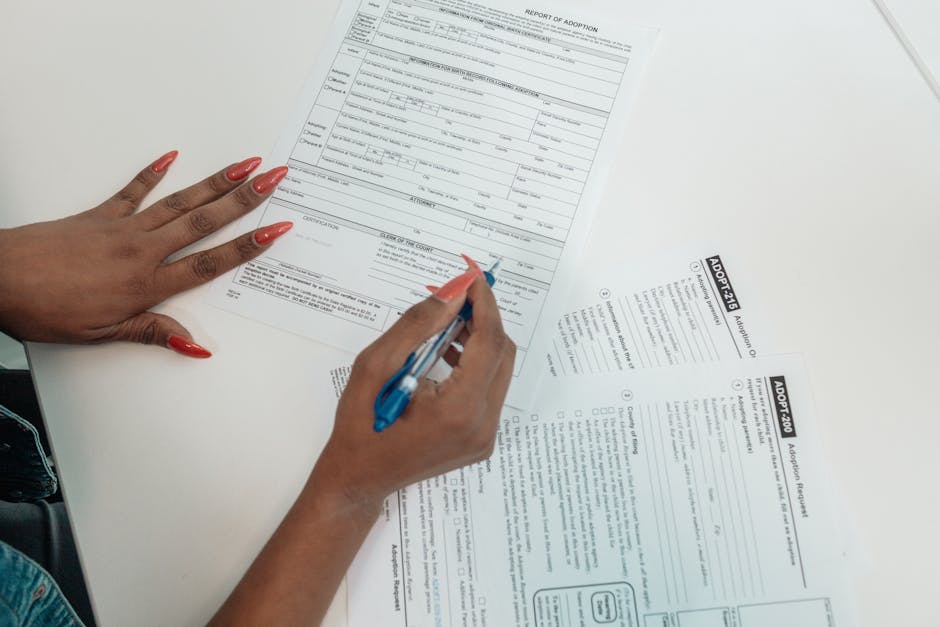
Applying for assistance requires preparation, organization, and a clear understanding of the steps involved. Because funding is often processed on a first-come, first-served basis, being proactive is your best strategy.
For a complete overview of the preparation process, refer to our First Month Security Deposit Assistance Guide.
Step-by-Step Guide to Get Help with Deposit for Section 8
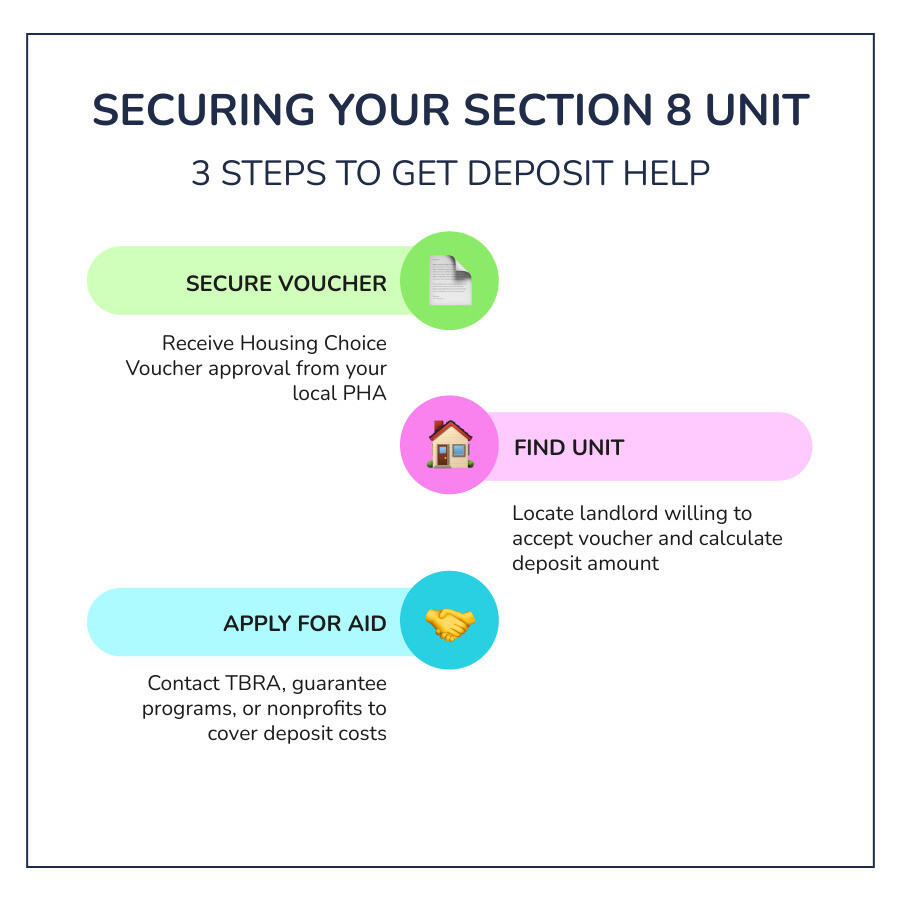
- Find an Approved Unit First: You must have an approved rental unit lined up before most programs will accept your application for deposit help. Landlords must be willing to accept the Section 8 voucher.
- Submit the RFTA: Work with your landlord to complete and submit the Request for Tenancy Approval (RFTA) form to your local PHA.
- Request Deposit Help Early: As soon as the RFTA is submitted, contact your local program administrator (such as a community action agency or a CalAIM housing navigator) to request deposit assistance. Fill out the proposed security deposit amount on your application forms.
- Coordinate the Inspection: The PHA will conduct an inspection to ensure the unit meets Housing Quality Standards (HQS).
- Sign the Lease and HAP Contract: Once the unit passes inspection, the lease and the Housing Assistance Payments (HAP) contract are signed. The security deposit assistance is typically disbursed directly to the landlord alongside the first monthly rental payment.
For additional strategies and templates, check out Your Guide to First Month Rent Security Deposit Help Programs Resources.
Eligibility Requirements for Receiving Help with Deposit for Section 8
To qualify for most California-based security deposit assistance programs, households must meet specific criteria:
- Income Limits: Program assistance is primarily limited to low-income households at or below 60% of the Area Median Income (AMI). However, some programs allow up to 10% of their participants to have incomes up to 80% of the county median family income.
- Voucher Status: You must hold an active, federally funded Housing Choice Voucher and be in good standing with your housing authority.
- One-Time Benefit Restrictions: Many local programs limit security deposit assistance to a one-time benefit per household.
- Hardship Documentation: You may need to provide proof of housing instability, a recent financial hardship (such as medical expenses or income loss), and identification documents for all household members.
Learn more about managing these financial requirements in our resource, Don’t Let Deposits Drain You: A Guide to Income Assistance.
Frequently Asked Questions About Section 8 Deposits
Do Public Housing Authorities pay security deposits directly?
No, PHAs themselves do not typically pay or charge security deposits directly to landlords as part of the standard Housing Choice Voucher program. The security deposit remains a private contractual matter between the tenant and the landlord. However, PHAs can refer tenants to local partner organizations, CalAIM navigators, or county-funded discretionary funds that specialize in covering these upfront costs.
What happens to the security deposit when a Section 8 tenant moves out?
What happens to the deposit depends on whether the assistance was structured as a grant or a loan:
- If it was a loan: You are generally required to return the full amount of the security deposit assistance to the administering agency (in the form of a check) when you vacate the unit.
- If it was a grant: Under California law, the landlord must return the security deposit to the tenant (minus any lawful deductions for damages beyond normal wear and tear) within 21 days of move-out. If the grant program does not require repayment, you can use those returned funds to secure your next home.
How does portability affect security deposit assistance?
Portability allows you to move with your Section 8 voucher from one PHA’s jurisdiction to another (for example, moving from Riverside to Los Angeles). However, security deposit assistance programs are highly localized. The program that helped you in your original city will not transfer to your new location. You must apply for new deposit assistance through the receiving PHA’s local partners and local nonprofit networks once you arrive.
Conclusion: Building Long-Term Stability in California
Securing a safe, affordable home is the first step on the journey toward self-sufficiency. At LifeSTEPS, we are committed to helping California residents bridge the gap between receiving a voucher and successfully moving into their new homes. Through our extensive housing support services and integration with programs like CalAIM, we walk alongside our clients to ensure they achieve lasting stability.
Our evidence-based approach works: we proudly maintain a 93% housing retention rate among the participants we serve, helping them stay housed year after year.
We believe in supporting the whole person and the entire community. In addition to housing and deposit navigation, we offer:
- The Family Self-Sufficiency (FSS) Program: Partnering with local housing authorities to help clients build financial assets and transition toward homeownership.
- Veteran Housing Support: Dedicated resources to help veterans who have served our country find the stability and dignity they deserve in permanent homes.
- Education & Youth Services: Empowering the next generation through our Summer Reading program—which has achieved a 97% literacy improvement among participating children—and providing over $2.1 million in academic scholarships to date.
If you are a voucher holder ready to take the next step toward securing your home, we are here to help you navigate the process. Explore how our team can support your journey by visiting the LifeSTEPS Programs and Services page today.
LifeSTEPSusa.org
LifeSTEPS currently provides services in California only.


