


Independent Living: Don’t Let Your Rent Retire Your Savings
Independent Living: Don’t Let Your Rent Retire Your Savings
Why Affordable Rentals for Seniors Are Harder to Find Than Ever
Affordable rentals for seniors are housing units where eligible older adults pay no more than 30% of their income on rent, often through government programs, income-based subsidies, or nonprofit housing developments.
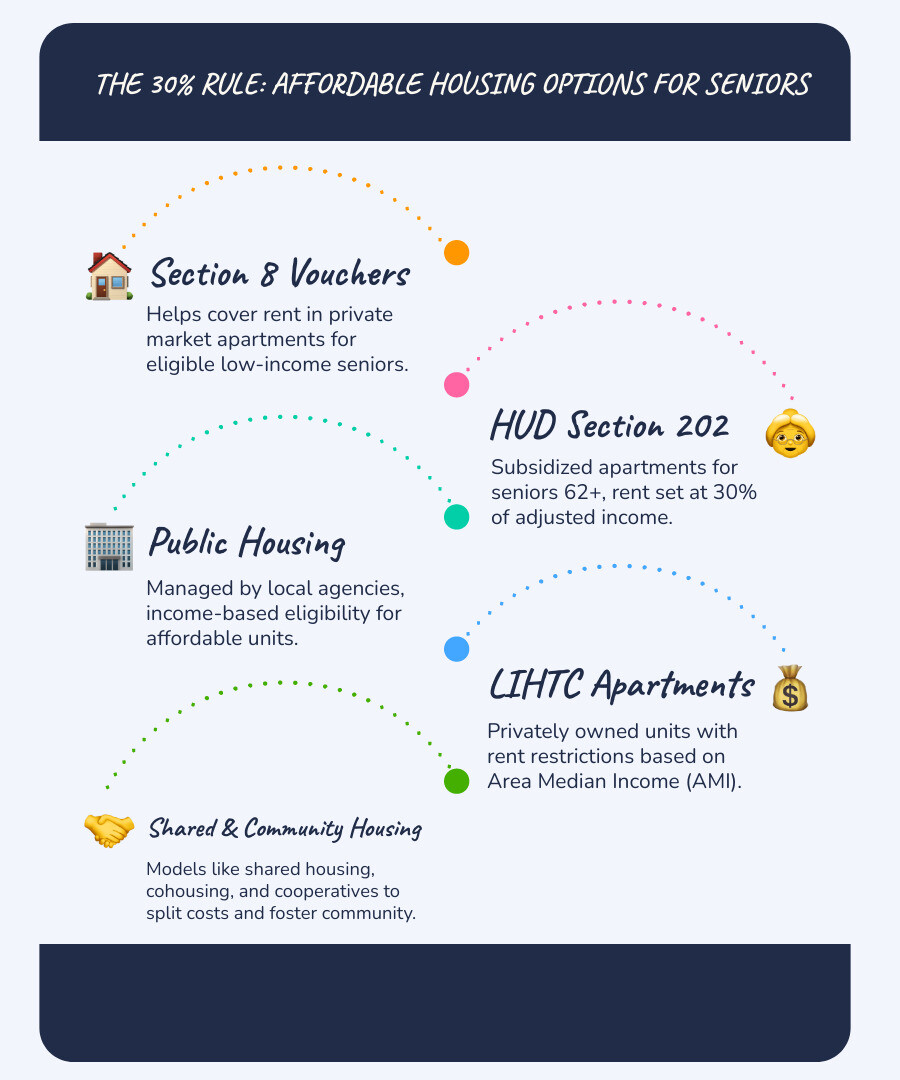
Here are the most common options available:
- Section 8 Housing Choice Vouchers – help cover rent in private-market apartments
- HUD Section 202 – subsidized apartments for seniors 62+, rent set at 30% of adjusted income
- Public Housing – managed by local agencies, income-based eligibility
- Low-Income Tax Credit (LIHTC) Apartments – privately owned but rent-restricted based on Area Median Income (AMI)
- Shared Housing – roommate matching to split costs and reduce isolation
- Cohousing and Cooperatives – community-based models with shared spaces and lower overhead
Rent is rising. Fixed incomes are not.
More than 58% of senior renters are cost-burdened, meaning they spend 30% or more of their monthly income on housing. For many older adults living on Social Security — with an average benefit of around $2,071 per month in 2026 — that leaves very little for food, healthcare, or unexpected expenses.
The 30% rule is simple: your housing costs should not exceed 30% of your income. Spending beyond that is called a housing cost burden, and it forces seniors to make painful tradeoffs every month.
The good news is that options exist. From federal voucher programs to innovative shared housing models, there are real pathways to stable, affordable housing — especially across California.
Similar topics to affordable rentals for seniors:
- Elderly rent assistance
- affordable housing for disabled seniors
- low-income housing with no waiting list
Understanding Affordable Rentals for Seniors
Finding a place to call home shouldn’t mean draining your life savings. When we talk about affordable rentals for seniors, we are referring to housing specifically designed or subsidized to remain within reach for those on a fixed income. Unfortunately, the current landscape is challenging. One In Three Older Households Is Cost Burdened, a statistic that highlights the urgent need for accessible housing solutions.

Many seniors find themselves in a “silver squeeze.” As property taxes and market rents climb, Social Security checks often stay the same or see only modest cost-of-living adjustments. This is why understanding the low-income senior housing guide is essential for anyone looking to maintain their independence without financial fear.
Eligibility for Affordable Rentals for Seniors
Eligibility isn’t one-size-fits-all; it usually depends on your age and your income relative to your neighbors. Generally, “senior” housing starts at age 55 or 62, depending on the specific program.
The most critical factor is the Area Median Income (AMI). HUD (the U.S. Department of Housing and Urban Development) sets current HUD income limits every year based on where you live.
- Very-low income: Households earning 50% or less of the AMI.
- Lower income: Households earning 80% or less of the AMI.
In high-cost areas like San Francisco or Los Angeles, these income thresholds might actually be higher than you expect, so it is always worth checking the latest data for your specific county.
Finding Affordable Rentals for Seniors in California
California presents a unique set of hurdles due to high demand, but there are dedicated resources for those in our service areas. Whether you are looking in the bustling neighborhoods of Los Angeles, the scenic coasts of San Diego and Irvine, or the vibrant Bay Area and Riverside, there are communities designed for you.
We focus on helping residents navigate affordable senior housing in California by connecting them with stable environments. In places like Natomas or Thousand Oaks, specialized developments offer age-restricted living that prioritizes safety and community.
Government Subsidies and HUD Programs
The federal government is the largest provider of housing assistance. Most programs are administered through local Public Housing Agencies (PHAs). These agencies manage housing choice payment vouchers, commonly known as Section 8. With a voucher, you can find your own apartment in the private market, and the government pays a portion of the rent directly to the landlord.
If you are searching for low-income elderly housing near me, you will likely encounter two main paths: tenant-based vouchers (which follow you) and project-based rental assistance (where the subsidy stays with the specific apartment building).
Section 202 Supportive Housing for the Elderly
The Section 202 Supportive Housing for the Elderly Program is a “gold standard” for many. This program is specifically for very low-income households with at least one person aged 62 or older.
The beauty of Section 202 is its simplicity: your rent is strictly capped at 30% of your adjusted gross income. If your income goes down, your rent goes down. Furthermore, these communities often provide supportive services—like help with cleaning, cooking, or transportation—to help you age in place safely.
Navigating Waitlists and Applications
We won’t sugarcoat it: waitlists can be long. In popular California cities, the wait for a Section 8 voucher or a subsidized apartment can range from several months to several years. This is why we recommend applying as early as possible, even if you don’t need to move today.
To get started:
- Contact your local PHA to see which lists are open.
- Dial 211 or visit their website to find local housing navigators.
- Check our low-income senior housing no waiting list guide for tips on finding immediate openings.
Creative Housing Models for Independent Living
If government-subsidized lofts aren’t the right fit, many seniors are turning to collaborative models. These options often provide a stronger sense of community and can be significantly more low-cost than senior independent living in a traditional facility.
- Cohousing: You own or rent a private home but share large common areas, like a kitchen or garden, with neighbors. Residents manage the community themselves.
- Shared Housing: Matching seniors with roommates. Services like Silvernest help facilitate these matches, often saving renters an average of $750 per month.
- Cooperatives: Residents buy “shares” in a corporation that owns the building. It’s like owning without the full burden of maintenance, and it fosters a deep sense of democratic participation.
Aging in Place and Virtual Villages
Many of us want to stay in the homes we’ve lived in for decades. The Village to Village Network makes this easier. These “virtual villages” are membership-based nonprofits where neighbors help neighbors. For a small annual fee (often around $1,200 or less), members get access to volunteer transportation, grocery delivery, and social outings. It’s a way to get the benefits of a retirement community without actually moving.
Continuing Care and Cooperative Options
For those looking for a “forever” solution, Continuing Care Retirement Communities (CCRCs) offer a tiered approach. You might start in independent living, move to assisted living if needed, and eventually transition to skilled nursing—all on the same campus. While these often require a hefty entry fee, they provide peace of mind. You can search for a CCRC to compare their long-term value against traditional homeownership costs.
| Feature | CCRC | Independent Living |
|---|---|---|
| Entry Fee | High (Thousands) | Usually None |
| Monthly Rent | Variable | Market Rate or Subsidized |
| Medical Care | Included/Available | Usually Extra |
| Stability | High (Lifetime) | Depends on Lease |
Financial Stability and Support Services
Budgeting on a fixed income is an art form. With the average Social Security benefit for retired workers projected at $2,071 per month in 2026, every dollar counts. We encourage seniors to use the BenefitsCheckUp® tool to see if they qualify for extra help with food (SNAP), utilities (LIHEAP), or medications.
Accessing rent subsidies for seniors can prevent the “bill collector” from winning the battle for your savings.
Rent Relief and Eviction Prevention
If you are facing an immediate housing crisis, don’t wait. Programs like CalAIM can provide critical support. For those transitioning into stable housing, we may be able to assist with deposit assistance—typically covering one month paid in advance to help you secure a lease. Emergency rent relief and free legal services are also available through local 211 resources to help prevent evictions and keep you in your home.
Amenities and Pet Policies
Affordable doesn’t have to mean “bare bones.” Modern affordable rentals for seniors often include:
- Community rooms for social events
- On-site laundry and fitness centers
- Service coordinators who help connect you to healthcare
And yes, your furry friends are usually welcome! Under the Fair Housing Act, many senior communities must allow pets, though they may have breed or size restrictions. Emotional support animals (ESAs) are also protected, provided you have the proper documentation.
Frequently Asked Questions about Affordable Rentals for Seniors
Does Medicare or Medicaid cover rent?
Generally, no. Medicare does not cover “room and board” for independent living or assisted living. However, some Medicaid waivers in California may help pay for the services provided in a residential setting, which can free up your personal funds to cover the rent itself.
How is rent calculated in subsidized housing?
In HUD-funded programs like Section 202, rent is typically 30% of your adjusted gross income. This means certain expenses, like high out-of-pocket medical bills, can be deducted from your total income before the 30% is calculated, potentially lowering your rent even further.
Are pets allowed in low-income senior apartments?
Most of the time, yes. Federal law generally allows residents of federally assisted housing for the elderly to own common household pets. Be prepared to pay a small pet deposit (often around $150–$250) and follow community rules regarding leashing and cleanup.
Conclusion
At LifeSTEPS, we believe that everyone deserves a stable place to call home. Our mission is to provide human-centered support to help you achieve long-term independence. We are proud of our 93% housing retention rate, which proves that with the right resources, seniors can remain securely housed even in high-cost areas.
Beyond housing, we are committed to the whole community, celebrating a 97% literacy improvement in our youth programs and awarding over $2.1M in scholarships to help the next generation thrive. Whether you are looking for low-income elderly housing or need help navigating the complexities of California’s rental market, we are here to walk alongside you.
For more information on LifeSTEPS programs visit our website: LifeSTEPS
LifeSTEPS currently provides services in California only.


