


A Comprehensive Guide to First-Time Land Buyer Loans in California
A Comprehensive Guide to First-Time Land Buyer Loans in California
Understanding Land Loans and Property Classifications in California
A land loan is a financing tool designed specifically to purchase a plot of vacant real estate where no residential home or habitable structure currently exists. Unlike a traditional mortgage—where the physical house serves as tangible collateral that can be readily appraised, insured, and sold on the secondary market—a land loan carries elevated collateral risk for lenders. If a borrower defaults on a vacant lot, the lender is left with an undeveloped piece of earth that is significantly harder to liquidate quickly.
Because of this heightened risk profile, standard land loans do not adhere to conventional Fannie Mae or Freddie Mac secondary mortgage market guidelines. Instead, lenders set stricter underwriting criteria and adhere to baseline guidance provided by federal regulators. The Federal Deposit Insurance Corporation (FDIC) establishes minimum supervisory loan-to-value limits, which directly shape down payment requirements across different stages of parcel development.
Understanding where a specific property falls on the development spectrum is the first step toward securing viable financing.
| Property Type | Infrastructure & Utility Status | FDIC Minimum Down Payment | Typical Repayment Structure | Relative Lender Risk |
|---|---|---|---|---|
| Raw Land | Completely undeveloped; no utilities, no road access, no water or sewer. | 35% (Often 35%–50%) | 2 to 5 years (often with balloon payment) | Highest |
| Unimproved Land | Partially developed; basic road access, meter nearby, but lacks full utility hookups. | 25% (Often 25%–35%) | 2 to 5 years or variable portfolio terms | Moderate |
| Improved Lot | Fully developed; paved road access, on-site water/sewer/power connections, build-ready. | 15% (Often 15%–25%) | 5 to 20 years or rolled into construction loans | Lowest |
Raw Land vs. Unimproved Land vs. Improved Lots
The physical state of a parcel directly governs your financing terms, interest rates, and required upfront capital.
- Raw Land: This is entirely untouched property. It lacks water wells, municipal sewer lines, electrical connections, and paved road access. Financing raw land presents the highest hurdle: lenders frequently demand a minimum 35% down payment (and sometimes up to 50%), charge elevated interest rates, and require shorter payback terms.
- Unimproved Land: This classification sits in the middle. The parcel may have legal access via an established easement or gravel road, and utility lines might run along the street frontage, but meters, septic systems, and site-specific connections have not yet been installed. Minimum down payments typically start around 25%.
- Improved Lots: These parcels are essentially turnkey building sites. An improved lot features direct paved road access, permitted municipal utility hookups (or an existing functioning well and septic system), and clear building envelopes. Lenders view these as lower risk, allowing down payments as low as 15% to 20%.
Core Requirements for a First Time Land Buyer Loan
Qualifying for vacant land financing requires stronger financial credentials than standard residential borrowing. Because vacant land is considered non-essential shelter, lenders assume borrowers facing financial distress might walk away from a vacant parcel before abandoning a primary residence.
- Credit Score Standards: Most conventional lenders require a credit score of at least 700 to approve a standalone land loan.
- Debt-to-Income (DTI) Ratios: Underwriters strictly limit total monthly debt obligations—including prospective land payments, property taxes, and existing housing costs—typically capping DTI between 35% and 43%.
- Loan Term and Balloon Payments: Standalone land loans are rarely structured as 30-year fixed mortgages. They commonly feature short loan terms spanning 2 to 5 years. Many are structured with balloon payments, requiring the borrower to pay off the remaining balance in full, refinance into a new facility, or transition into a construction loan once building permits are approved.
- Specialized Rural Programs: In designated rural sectors of California, borrowers exploring community-focused pathways can review specialized programs such as Rural Housing Site Loans in California or structured solutions for broader home financing.
Best Financing Options for Buying Land in California
Navigating the land lending marketplace requires exploring several distinct financing pathways. While large national banks often shy away from raw ground, several viable financing vehicles exist for first-time purchasers.
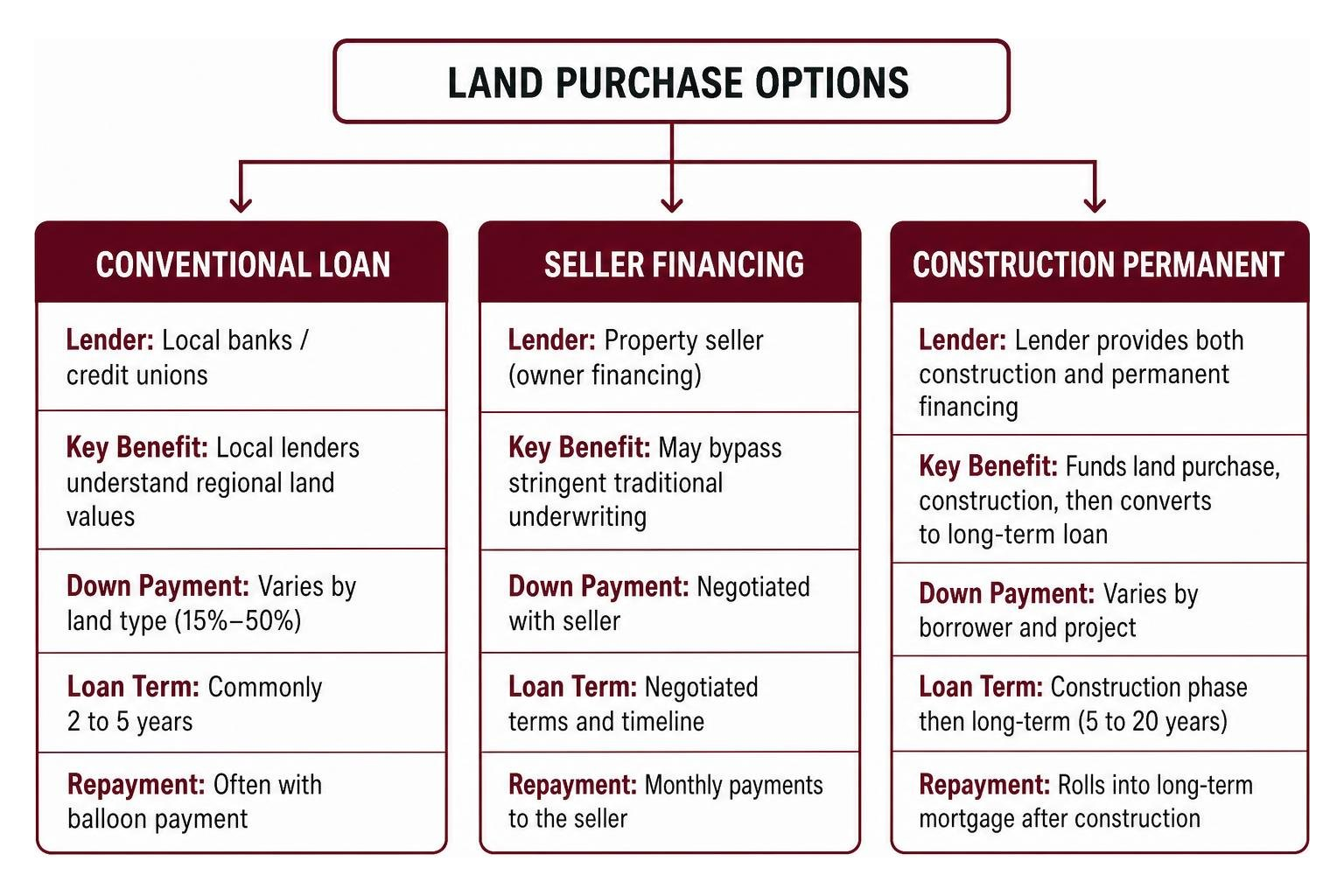
- Conventional Land Loans via Local Portfolio Lenders: Community banks and credit unions across California often maintain localized portfolio loan programs. Because local institutions understand regional land values and growth corridors in areas like Riverside, Irvine, or San Diego County, they are often more comfortable financing vacant parcels that they keep on their own balance sheets.
- Seller Financing: Also known as owner financing, this arrangement involves making monthly payments directly to the property seller under agreed-upon terms, interest rates, and timelines. This can bypass stringent traditional underwriting, though buyers must ensure a clear title is conveyed via an experienced escrow and title company.
- Land Contracts: In a land contract (or contract for deed), the seller retains legal title to the property until the final payment is made, while the buyer gains equitable title. While accessible, buyers must exercise extreme caution: missing payments under poorly structured contracts can risk the forfeiture of accumulated equity.
- Home Equity Loans and HELOCs: If you currently own a primary home or have access to family resources with substantial real estate equity, a home equity loan or line of credit can provide the cash needed to purchase land unencumbered, bypassing vacant parcel lending restrictions entirely.
Prospective property buyers can explore foundational structures outlined in our beginners guide to home buyer programs to understand how initial financing decisions impact long-term housing stability.
Government Programs and First Time Land Buyer Loan Alternatives
For first-time buyers committed to constructing a primary home rather than simply holding vacant acreage, federal government programs offer substantial advantages.
- USDA Section 502 Direct and Guaranteed Construction Loans: For low- to moderate-income buyers in designated rural zones, the USDA Construction Loan to Buy Land Requirements provide up to 100% financing (zero down payment). This program allows qualified applicants to combine the land purchase and home construction into a single mortgage. Requirements include a 640 minimum credit score for automated underwriting, strict household income caps (generally at or below 115% of the Area Median Income), and a total debt-to-income ratio below 41%. Applicants can review guidelines on navigating USDA home loans: eligibility, benefits, and how to apply.
- USDA FSA Beginning Farmer Loans: If the land is intended for agricultural production, the USDA Farm Service Agency offers targeted financing. The Direct Farm Ownership Down Payment Loan requires only a 5% cash down payment from the buyer, with the FSA financing 45% (up to $300,150) and a third-party commercial lender or seller financing covering the remaining balance. A beginning farmer is defined as an operator with 10 or fewer years of experience who does not own acreage exceeding 30% of the county’s average farm size.
One-Time Close vs. Two-Time Close Construction Loans
When pairing a land purchase with immediate residential construction, borrowers must choose between two distinct structural pathways:
- One-Time Close (Single-Close Loan): This construction-to-permanent loan finances the parcel acquisition, site development, and home build in a single transaction with one set of closing costs. The lender locks the permanent mortgage interest rate before ground is broken. During construction, the borrower pays interest only on funds disbursed according to an approved draw schedule. Once the home passes final inspection, the loan automatically converts into a standard 30-year amortized housing loan.
- Two-Time Close (Separate Loans): In this model, the buyer uses a standalone land loan to secure the dirt first, secures a separate short-term construction loan to build, and finally applies for a permanent mortgage upon completion. This requires paying closing costs twice and subjects the borrower to secondary underwriting risk—if interest rates rise, income drops, or credit scores change during construction, securing the final mortgage can become difficult.
- Appraisal Mechanics: Construction appraisals are completed “subject to completion” based on architectural plans, site engineering, and builder spec sheets. Lenders mandate that all work be performed by a licensed, insured general contractor carrying at least $500,000 in commercial liability coverage.
Navigating the First Time Land Buyer Loan Application and Process
Purchasing vacant land requires a meticulous due diligence process. Unlike an existing home with documented utility connections and certificates of occupancy, raw and unimproved parcels present hidden developmental variables that can derail budgets.

Critical Due Diligence Checklist Before Purchasing Land
Before signing a purchase contract or finalizing loan underwriting, investigate the following elements:
- Zoning and Permitted Uses: Verify with county planning departments that the parcel is zoned for single-family residential use. Confirm local setback requirements, allowable building envelopes, and square-footage minimums.
- Percolation (Perc) and Soil Testing: If municipal sewer lines are unavailable, an engineered percolation test is mandatory. A perc test measures how rapidly water absorbs into the soil to ensure the ground can support a permitted septic drain field. Unsuitable soil can require engineered mound systems costing tens of thousands of dollars extra.
- Utility Infrastructure and Hookup Fees: Determine the exact physical location of power lines, municipal water mains, and natural gas lines. Bringing power lines across multiple parcels or drilling a deep residential water well can dramatically increase site-preparation expenses.
- Legal Access and Easements: Ensure the parcel borders a dedicated public road or has an irrevocable, recorded private access easement. Title companies will not insure, and lenders will not finance, landlocked parcels lacking verified ingress and egress.
- Flood Zones and Environmental Hazards: Check FEMA flood plain maps, local wetland designations, and wildfire hazard severity zones. Properties situated in high-risk flood or fire zones face mandatory, costly insurance premiums and specialized building code standards.
- Assistance and Community Programs: Buyers navigating broader regional purchasing dynamics can review regional pathways like cracking the Bay Area housing market with first time buyer assistance and resources in the ultimate guide to affordable homeownership programs and grants.
Pros and Cons of Purchasing Land as a First-Time Buyer
Advantages:
- Complete Design Freedom: Custom builds allow you to tailor the home’s layout, energy efficiency, and footprint to your exact preferences.
- Long-Term Equity Growth: Securing raw land in expanding suburban or rural corridors can generate substantial capital appreciation over time.
- Staged Development: Purchasing an improved lot now locks in land prices before values rise, allowing time to finalize floor plans and savings before breaking ground.
Disadvantages:
- Substantial Upfront Capital: Down payment benchmarks (15% to 50%) and out-of-pocket engineering costs require significant liquid reserves.
- Ongoing Carrying Costs: Owners must pay local property taxes, liability insurance, and brush-clearing maintenance fees on vacant ground without receiving immediate housing utility.
- Development Delays: Permitting timelines, environmental impact reviews, and utility hookups can take months or years before construction commences.
Frequently Asked Questions About California Land Financing
Can I get a first-time land buyer loan with zero down payment?
Yes, eligible buyers can access zero down payment financing by utilizing a USDA Section 502 construction-to-permanent loan. This program allows up to 100% financing to purchase an eligible lot and build a primary residence simultaneously in designated rural areas. Standalone vacant land held without immediate construction plans cannot be purchased with 0% down.
What credit score is needed to qualify for a land loan in California?
Conventional standalone land loans typically require a minimum credit score of 700 due to elevated collateral risk. However, if you are utilizing a government-backed single-close construction program like a USDA construction loan, automated approvals generally begin at a 640 credit score, with manual underwriting options available down to 580 for borrowers with strong compensating factors.
How does buying land first and building later work?
Buying land first involves securing a standalone lot or unimproved land loan, which typically features a 2- to 5-year term and requires a 15% to 35% down payment. While holding the land, you work with architects and engineers to finalize plans, permits, and contractor bids. Once ready to build, your accumulated land equity can be credited toward the down payment requirement of a new residential construction loan.
Conclusion
Securing land to build a custom residence or establish long-term property ownership is a significant milestone that requires clear financial planning, comprehensive site due diligence, and the right loan program. Whether utilizing portfolio financing through local institutions or leveraging zero-down rural construction programs, evaluating development costs upfront protects your investment from inception to completion.
For California individuals and families seeking pathways toward lasting stability, LifeSTEPS provides housing support services dedicated to sustainable community outcomes. LifeSTEPS maintains an accomplished 93% housing retention rate across its supported communities. Through the CalAIM program, LifeSTEPS delivers vital deposit assistance, covering 1 month paid in advance to help participants establish secure living environments.
Beyond housing stability, LifeSTEPS empowers future generations through education, achieving a 97% literacy improvement for Summer Reading participants and awarding $2.1M in scholarships to support higher education goals. Whether you are exploring options outlined in our low income homeownership programs or building your foundational financial footing in Southern California and the Bay Area, dedicated community support makes long-term independence attainable.
For media inquiries, contact: bex@lifestepsusa.org
LifeSTEPS currently provides services in California only.


