


The Ultimate Guide to Affordable Homeownership Programs and Grants
The Ultimate Guide to Affordable Homeownership Programs and Grants
Why a Homeownership Grant Program Could Be Your Path to Owning a Home
A homeownership grant program can be one of the most powerful tools available to help first-time buyers cover the upfront costs of purchasing a home — especially down payments and closing costs that often feel out of reach.
Here are the most common types of assistance available:
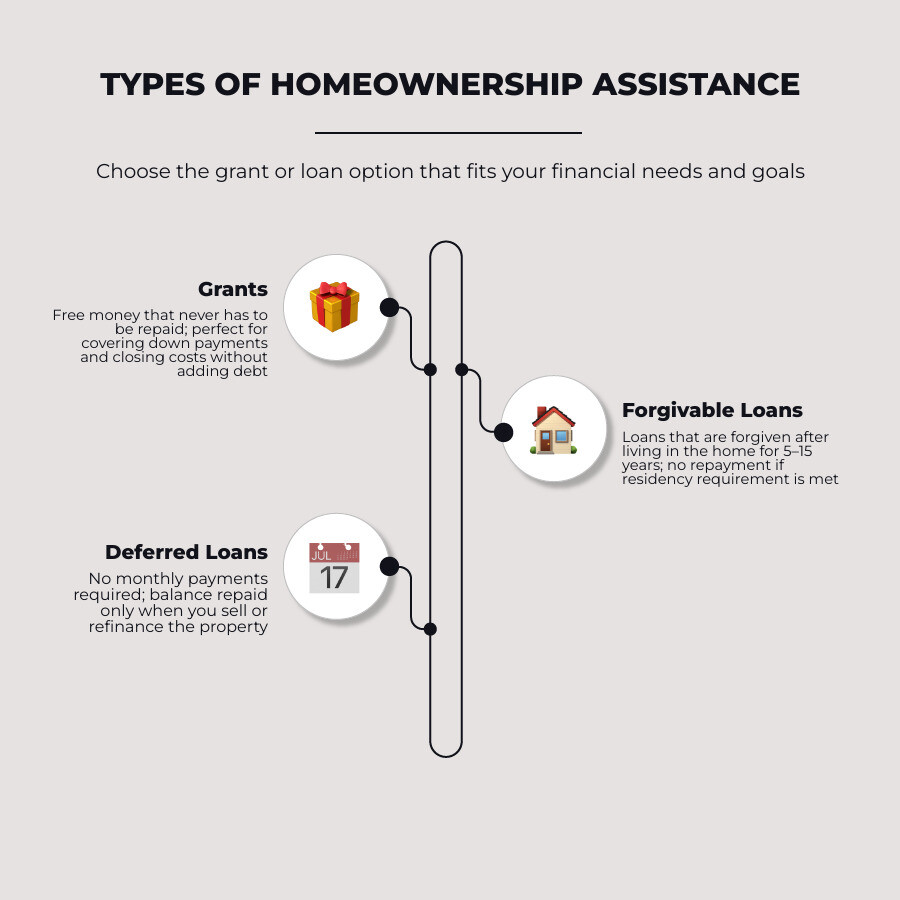
- Grants – Free money that never has to be repaid
- Forgivable loans – Loans forgiven after you live in the home for a set period (typically 5–15 years)
- Deferred-payment loans – No monthly payments required; balance is repaid when you sell or refinance
- Down payment assistance – Covers part or all of your required down payment, sometimes up to $100,000 depending on location and income
For many people — including veterans transitioning to civilian life — the dream of homeownership stalls not because of income, but because of that large upfront barrier. Saving tens of thousands of dollars while also managing rent, daily expenses, and rebuilding stability after service is genuinely hard.
The good news: federal, state, and local programs exist specifically to close that gap. Eligibility is typically based on household income (often at or below 80%–120% of Area Median Income), first-time buyer status, and a willingness to complete a homebuyer education course.
This guide breaks down what’s available, who qualifies, and how to apply — with a focus on California programs and how they compare to assistance available elsewhere.
LifeSTEPS currently provides services in California only.
Homeownership grant program terms to remember:
Navigating the Homeownership Grant Program Landscape

When starting your journey toward buying a home, the sheer volume of financial terminology can feel overwhelming. Understanding the differences between a direct grant, a deferred loan, and a forgivable loan is crucial to choosing the right strategy.
A true grant does not require repayment under any standard circumstances. However, many programs that are marketed as a “grant” are actually structured as second mortgages. These secondary loans can be deferred—meaning you make no monthly payments, but you must repay the balance when you sell or refinance—or they can be forgivable, where a portion of the debt is erased for every year you remain in the home as your primary residence.
Navigating these differences requires a solid foundation. If you are new to this process, we recommend starting with our Beginners Guide to Home Buyer Programs to understand how these layered financial structures work together.
Finding a Local Homeownership Grant Program
Many buyers assume that financial assistance only comes from massive federal agencies. In reality, some of the most generous and flexible programs are administered right in your backyard by local municipal governments and housing authorities.
These regional programs are tailored to the unique economic realities of their communities. For example, a housing authority in Southern California might offer larger assistance amounts to match the local market’s higher home prices. To learn how regional agencies operate and how to connect with them, you can explore our guide on Housing Authority Programs Your Pathway to Affordable Homeownership.
How to Qualify for a Homeownership Grant Program
While every program has its own specific guidelines, most share a core set of qualifying criteria:
- First-Time Homebuyer Status: Most programs define this as someone who has not owned a primary residence within the last three years.
- Income Limits: Program eligibility is almost always tied to the Area Median Income (AMI), often capping household income at 80% to 120% of the AMI.
- Credit and Debt Ratios: Buyers generally need to meet minimum credit score requirements (often around 620 to 660) and maintain a reasonable debt-to-income (DTI) ratio.
- Education: Nearly all programs require applicants to complete a homebuyer education course.
For a deeper dive into programs specifically designed for buyers with limited financial resources, check out our resource on Low Income Homeownership Programs.
Comparing Top State and Local Down Payment Assistance Programs
To give you an idea of how these programs look in practice, let’s examine the specific offerings available across some of our primary California service areas as of July 2026.
| Jurisdiction / Program | Maximum Assistance Amount | Structure | Target Income Limit |
|---|---|---|---|
| San Diego (SDHC Low-Income) | Up to 17% of purchase price (max $125,000) + $10,000 grant | Deferred loan + non-repayable grant | Up to 80% AMI |
| San Diego (SDHC Middle-Income) | $40,000 deferred loan + $10,000 grant | Deferred loan + non-repayable grant | 80% to 150% AMI |
| Riverside County (HWS FTHB) | Up to 20% of sales price | Deferred loan (converts to grant after 15 years) | Up to 80% or 120% AMI (based on funding) |
| Los Angeles County (Greenline) | Varies by funding cycle | Deferred second mortgage | Low-to-moderate income |
California-Specific Down Payment Assistance
In California, local housing departments work in tandem with state resources like the CalHOME Program to make homeownership a reality. Let’s look at how these local programs operate in our key service regions:
- San Diego: The San Diego Housing Commission (SDHC) has helped more than 6,100 families buy their first homes since 1988. Their low-income program provides up to 17% of the purchase price (up to $125,000) as a deferred-payment loan, plus a $10,000 grant for closing costs. For middle-income earners making between 80% and 150% AMI, SDHC offers a $40,000 deferred loan paired with a $10,000 grant. For details, see the San Diego Housing Commission First-Time Homebuyer Programs.
- Riverside County: The Housing and Workforce Solutions (HWS) agency administers a powerful First-Time Homebuyer Program. It provides up to 20% of the home’s purchase price to cover the down payment. The best part? The second mortgage requires no monthly payments and completely converts into a non-repayable grant after a 15-year occupancy period. Learn more via Down Payment Assistance Programs.
- Los Angeles County: Programs like the Greenline Home Program focus on historically underserved neighborhoods, offering deferred loans to help families build generational wealth. Discover these initiatives through the Greenline Home Program – Consumer and Business Affairs.
Out-of-State Program Comparisons
While our services at LifeSTEPS are exclusively focused on helping California residents, comparing local programs to national models highlights how competitive and generous California’s assistance options truly are.
For instance, Chicago’s Homegrown Purchase Assistance Program | The Resurrection Project offers tiered assistance ranging from $10,000 to $70,000 based on income and specific neighborhood zones. Meanwhile, the Downpayment-Assistance – Covenant Homeownership Program | Here to Home in Washington state utilizes a unique Special Purpose Credit Program to address historical housing discrimination by offering substantial down payment support to eligible buyers with pre-1968 family roots in the state.
While these out-of-state programs are excellent models, California buyers have access to equally robust, localized support designed for our state’s unique real estate landscape.
Eligibility and Application Steps for Homeownership Grants
Achieving homeownership through an assistance program requires following a structured, step-by-step process.
Income Limits and First-Time Buyer Status
Your eligibility is largely determined by your household size and your annual income relative to your county’s Area Median Income (AMI). Programs funded by federal HOME grants generally target buyers at or below 80% AMI, while state and local programs may extend eligibility up to 120% or even 150% AMI to assist moderate-income households. If you fall into this middle tier, our A Practical Guide to Homeownership Assistance for Moderate Income provides tailored advice on finding suitable programs. For lower-income brackets, the Low Income First Time Home Guide outlines the most supportive options available.
Property and Occupancy Restrictions
Assistance programs are designed to support stable communities, which means the home you buy must meet specific standards:
- Eligible Properties: Single-family homes, condominiums, townhomes, and sometimes manufactured homes on permanent foundations are allowed. Multi-unit properties (like triplexes) are often restricted or prohibited.
- Primary Residence: You must occupy the property as your primary residence. Renting out the home, or even a portion of it, is a violation of program rules and can trigger immediate repayment of the funds.
- Deed Restrictions: Some programs place a deed restriction on the property, enforcing affordability requirements for a set period (such as 10 to 20 years).
The Role of Housing Counseling and Education
Almost every homeownership grant program requires applicants to complete a homebuyer education course from a HUD-approved housing counseling agency. These classes cover budgeting, understanding mortgage terms, and maintaining a home.
For participants in the Family Self-Sufficiency (FSS) program, these educational pathways serve as a vital stepping stone toward financial independence. You can learn more about how these classes prepare you for the responsibilities of owning a home by reading about how to Unlock Your Front Door with FSS Homebuyer Education.
Working with Participating Lenders
You cannot apply for down payment assistance in a vacuum; it must be paired with a primary mortgage. You must work with a participating lender who is certified to package these specialized grants and deferred loans alongside your primary FHA, VA, USDA, or conventional loan.
Layering multiple programs (such as combining a local city grant with a state-level deferred loan) is highly effective, but it requires an experienced loan officer to coordinate. To understand how to align your primary mortgage with these grants, refer to The 2026 Guide to Every First Home Loan Grant.
Frequently Asked Questions about Homeownership Grants
Do homeownership grants have to be repaid?
True grants do not have to be repaid. However, many “grants” are actually structured as forgivable second mortgages. If you live in the home for the required affordability period (typically 5 to 15 years), the loan is fully forgiven. If you move, sell, or refinance before that period ends, you will have to repay the remaining balance, often on a pro-rated basis.
Can I combine multiple down payment assistance programs?
Yes, this is known as program layering. Many buyers successfully combine a county-level down payment assistance loan with a city-level closing cost grant, alongside their primary mortgage. Your participating lender will need to verify that each program allows layering and that the combined loan-to-value ratio meets underwriting guidelines.
What happens if I sell my home before the residency period ends?
If you sell the property before the required occupancy period expires, a “recapture” provision is triggered. You will be required to repay the outstanding balance of the deferred or forgivable loan from the net proceeds of the sale.
Conclusion
At LifeSTEPS, we believe that stable housing is the foundation of a thriving life. We are proud of our 93% housing retention rate and our commitment to helping individuals and families transition to self-sufficiency. Through our educational support and youth programs—including our summer reading program which has driven a 97% literacy improvement, and our $2.1M in academic scholarships—we work to build stronger, highly resilient communities.
For those navigating the transition to stable housing, we also offer deposit assistance—specifically tied to the CalAIM program—covering one month paid in advance to help secure a safe place to live. By partnering with programs like the Family Self-Sufficiency (FSS) initiative, we help clients, including veterans, build the financial stability necessary to step confidently into homeownership.
If you are ready to take the next step toward securing your housing future and exploring the educational and supportive resources available to you, we invite you to Learn more about LifeSTEPS programs and services.
LifeSTEPS currently provides services in California only.


