


Navigating the Maze of Disability Income Based Housing
Navigating the Maze of Disability Income Based Housing
Why Finding Apartments Based on Disability Income Feels So Hard — And Where to Start
Apartments based on disability income are more accessible than most people realize — but knowing where to look makes all the difference. Here is a quick overview of your main options:
- Section 8 (Housing Choice Voucher): You pay roughly 30% of your income toward rent; a Public Housing Authority (PHA) covers the rest. Use it in the private rental market.
- Section 811: Federally funded supportive housing built specifically for low-income adults with disabilities, aged 18–61.
- Public Housing: Government-owned units for low-income individuals and families, including those with disabilities.
- Project-Based Rental Assistance: Subsidy is tied to a specific property rather than following you as a tenant.
- Supportive Housing: Combines an affordable unit with voluntary on-site services to help you live independently.
For many veterans transitioning to civilian life, disability income — whether through SSI or SSDI — feels like a barrier to renting. Landlords may seem hesitant. Waitlists can stretch for years. The paperwork is dense.
But federal and California state programs exist specifically to bridge that gap. Knowing which program fits your situation, and how to apply, is the first step toward stable housing.
LifeSTEPS currently provides services in California only.
Similar topics to apartments based on disability income:
Understanding Apartments Based on Disability Income
When your primary source of income is Supplemental Security Income (SSI) or Social Security Disability Insurance (SSDI), finding a market-rate apartment in California can feel nearly impossible. Fortunately, federal, state, and local programs are designed to establish rent structures that adjust to your financial reality.
The foundation of most subsidized housing is the “30% rule.” Under this guideline, a household should pay no more than 30% of its monthly gross income toward rent and basic utilities. For someone receiving SSI, this means rent is kept proportional to their monthly benefit.
To determine who qualifies for these programs, government agencies look at the Area Median Income (AMI) of each county. Subsidized housing programs generally target households categorized as:
- Low-Income: Households earning 80% or less of the AMI.
- Very Low-Income: Households earning 50% or less of the AMI.
- Extremely Low-Income: Households earning 30% or less of the AMI.
Because disability benefits often place individuals in the extremely low-income category, they receive high priority for housing assistance. For more details on finding these units, you can explore our guide on Affordable Housing for Disabled.
In California, the state government works closely with federal agencies to expand these opportunities. The California Department of Housing and Community Development collaborates with local housing authorities to ensure that developers allocate a portion of new multi-family buildings to individuals with physical, developmental, or mental health disabilities.
Key Housing Programs and Eligibility in California
Navigating the landscape of rental assistance requires understanding the different types of programs available. In Southern California and key Bay Area locations, housing programs generally fall into three categories: tenant-based vouchers, project-based subsidies, and traditional public housing.

Comparing Key Housing Assistance Programs
| Program Type | How It Works | Who It Serves | Key Advantage |
|---|---|---|---|
| Housing Choice Vouchers (Section 8) | Voucher is tied to the tenant; can be used with any private landlord who accepts it. | Low-income families, seniors, and people with disabilities. | Portability; you can choose where to live in the private market. |
| Section 811 Supportive Housing | Subsidy is tied directly to the property; cannot be transferred to another building. | Extremely low-income adults with disabilities (ages 18–61). | Integrated on-site supportive services for independent living. |
| Public Housing | Government-owned and operated apartment complexes. | Low-income families, seniors, and individuals with disabilities. | Highly stable, structured community-oriented housing. |
Section 8 Vouchers for Apartments Based on Disability Income
The Housing Choice Voucher program, widely known as Section 8, is the largest rental assistance program in the country. It is administered locally by Public Housing Authorities (PHAs). By law, a PHA must target at least 75% of its vouchers to applicants whose incomes do not exceed 30% of the area median income, making it a vital resource for individuals living on disability benefits.
For individuals with disabilities, there are specialized voucher types within Section 8:
- Mainstream Vouchers: These are specifically designated for non-elderly persons with disabilities (ages 18–61) who are transitioning out of institutional settings, rapid rehousing programs, or experiencing homelessness.
- Designated Housing Vouchers: These help non-elderly disabled families who would otherwise face challenges finding housing when certain public housing properties are designated exclusively for seniors.
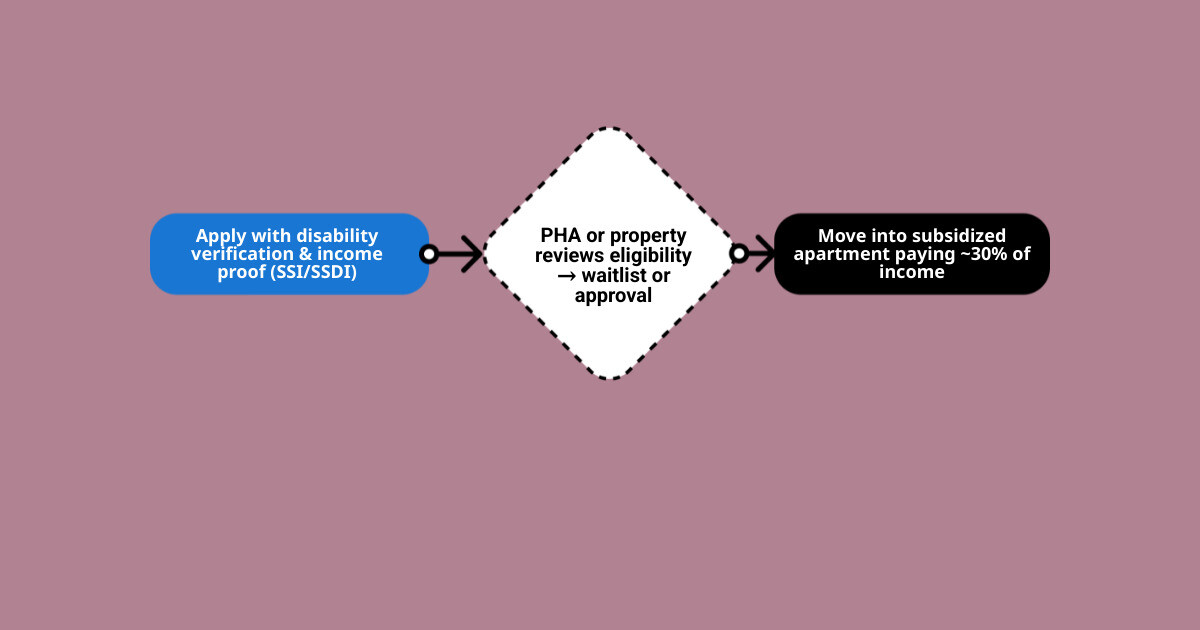
To apply for these vouchers, you must contact your local housing authority, such as the agency managing San Diego County Public Housing. That waitlists can be long, but many PHAs offer priority preferences for local residents, veterans, and individuals with documented disabilities. To learn more about how these vouchers fit into the larger housing landscape, refer to our resource on Low Income Housing for Elderly and Disabled.
Section 811 and Project-Based Rental Assistance
Unlike Section 8 vouchers, which move with you if you decide to change apartments, project-based assistance is anchored to a specific property. If you move out of a project-based unit, the rental subsidy stays with the apartment for the next eligible tenant.
The primary federal program for this model is Section 811 Supportive Housing for Persons with Disabilities. This program funds the development of subsidized rental housing that is deeply integrated with supportive services. Section 811 properties are designed to foster independent living in a community-integrated setting, steering away from institutional group homes.
These properties utilize universal design elements, such as roll-in showers, lower countertops, and wide hallways to ensure full physical accessibility. If you are interested in learning how these communities operate, take a look at our detailed breakdown of Low Income Housing for Adults with Disabilities.
Eligibility Criteria for Apartments Based on Disability Income
To qualify for disability-based housing programs in California, applicants must meet several strict federal and state criteria:
- Income Limits: Household income must fall below the limits established by HUD for your specific county. For example, the City of Irvine Affordable Housing Guide outlines specific income tiers for Orange County, where high median incomes can dramatically shift what qualifies as “low-income.”
- Disability Verification: Programs like Section 811 require official documentation of a physical, developmental, or mental health disability. This can be verified through an award letter from the Social Security Administration (for SSI/SSDI) or a professional certification from a licensed medical provider.
- Citizenship Status: Applicants must be U.S. citizens or non-citizens with eligible immigration status. However, “mixed households” (where some members have eligible status and others do not) may still receive prorated assistance.
For a comprehensive checklist of what documents you need to gather before submitting an application, you can read our guide on Housing Resources for Disabled.
Supportive Housing, Accessibility, and Tenant Rights
Finding an affordable apartment is only half the battle; the unit must also be physically accessible and offer the right environment for you to thrive.

Reasonable Accommodations and Modifications
Under the federal Fair Housing Act, tenants with disabilities have the legal right to request reasonable accommodations and reasonable modifications:
- Reasonable Accommodations: These are changes to rules, policies, or services. Examples include requesting a designated parking space close to your front door, asking for a waiver of a “no pets” policy for a service or emotional support animal, or requesting application documents in large print.
- Reasonable Modifications: These are physical changes to the structure of the apartment or common areas. Examples include installing grab bars in the bathroom, adding a wheelchair ramp to the entryway, or lowering kitchen countertops.
In public housing and federally funded properties, the landlord is generally responsible for the cost of these physical modifications. In private market rentals, the tenant may need to cover the cost, though landlords cannot refuse to let you make these changes. For a deeper look into your rights and design tips, read our article on Accessible Living: Unlocking the Secrets to Disability Friendly Apartments.
Integrated Services for Independent Living
Modern disability housing focuses heavily on the “Supportive Housing” model. This approach combines deeply affordable rent with voluntary, wrap-around services. On-site service coordinators work directly with residents to coordinate:
- Transportation to medical appointments
- In-home supportive services (IHSS) coordination
- Independent living skills training (such as budgeting and meal planning)
- Peer support groups and community activities
These services are designed to be entirely voluntary, ensuring that residents maintain full self-determination and autonomy over their lives. For more information on finding communities that offer these programs, check out our guide on Affordable Homes for Disabled Adults or visit the official Los Angeles Housing Department Services portal for local Southern California programs.
Frequently Asked Questions about Disability Income Based Housing
Applying for housing assistance can spark many questions. Here are some of the most common inquiries we receive from individuals navigating this process.
How is rent calculated when living on disability income?
For the vast majority of subsidized programs, your rent is calculated at exactly 30% of your adjusted monthly gross income.
- Gross Income: This includes your monthly SSI or SSDI payments, along with any other income sources.
- Deductions: Housing authorities apply specific deductions, such as an annual deduction for elderly or disabled households, and deductions for ongoing medical expenses that are not covered by insurance.
- Utility Allowance: If utilities are not included in your rent, the housing authority will subtract a “utility allowance” from your monthly rent portion to ensure your total housing costs do not exceed the 30% threshold.
You can view local rental guidelines and estimated utility calculations through resources like the Riverside Affordable Rentals portal.
Can I use a Housing Choice Voucher in the private rental market?
Yes. In California, state law (Senate Bill 329) explicitly prohibits landlords from discriminating against applicants based on their source of income, which includes Section 8 vouchers.
When you find a private apartment, the housing authority must inspect the unit to ensure it meets basic health and safety standards. Additionally, the rent charged by the landlord must be deemed reasonable compared to similar unassisted units in the area, and it must fall within the PHA’s Fair Market Rent (FMR) guidelines.
What is the difference between Section 8 and Section 811?
The simplest way to remember the difference is:
- Section 8 (Housing Choice Voucher) is tenant-based. The subsidy belongs to you. If you move, the voucher moves with you to your new home.
- Section 811 is project-based. The subsidy belongs to the building. If you move out, the assistance remains with the unit, and you will need to re-apply for assistance elsewhere. Furthermore, Section 811 is reserved strictly for non-elderly adults with verified disabilities, whereas Section 8 serves a broader low-income demographic.
Securing Long-Term Stability
Finding apartments based on disability income requires patience, organization, and a clear understanding of your legal rights. While waitlists can be long, taking the time to apply to multiple programs across different housing authorities can significantly improve your chances of securing a safe, affordable, and accessible home.
At LifeSTEPS, we are deeply committed to helping individuals achieve long-term housing security and self-sufficiency. Through our dedicated housing support services, we proudly maintain a 93% housing retention rate among the clients we serve.
We work closely with programs like the CalAIM initiative to provide vital financial support, including deposit assistance of up to 1 month paid in advance to help clients transition into permanent housing. We also collaborate with the Family Self-Sufficiency (FSS) program to help veterans and low-income families build assets, transition away from public assistance, and move toward homeownership.
Our commitment to communities goes beyond housing. We believe that true stability starts with empowering the next generation. Our youth programs have achieved a 97% literacy improvement through our Summer Reading initiatives, and we have awarded over $2.1 million in higher education scholarships to help students in affordable housing communities achieve their academic dreams.
If you are ready to take the next step toward finding a stable, supportive place to call home, we encourage you to learn more about our work and discover how we can assist you on your journey by exploring LifeSTEPS Programs and Services.
Contact: LifeSTEPS | Phone: (916) 965-2110 | LifeSTEPS
LifeSTEPS currently provides services in California only.


