


How to Secure Safe and Affordable Housing Programs for Elderly Relatives
How to Secure Safe and Affordable Housing Programs for Elderly Relatives
Why Finding the Right Housing Programs for Elderly Relatives Matters More Than Ever
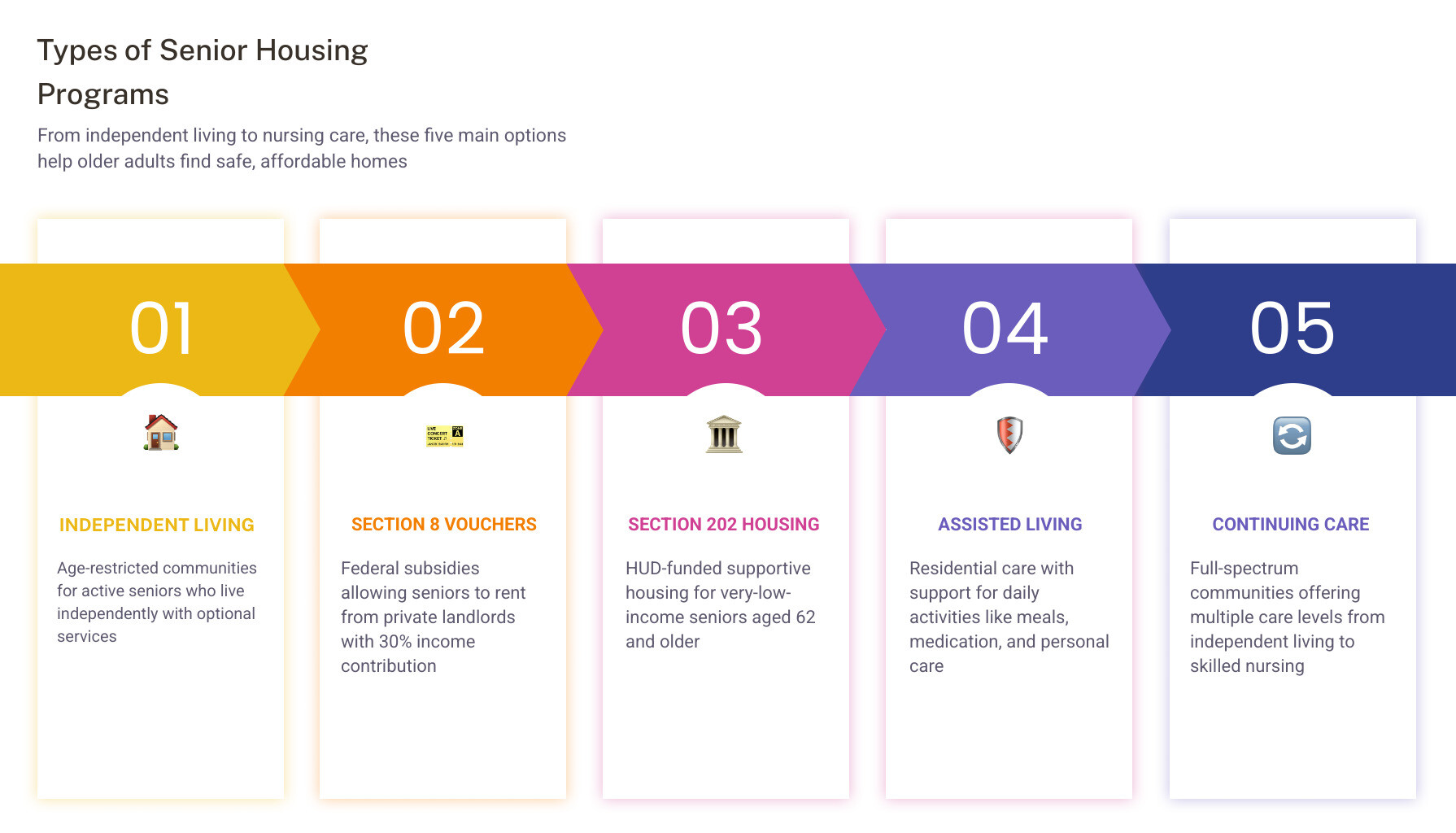
The main types of housing programs for elderly adults in the U.S. include:
- Section 202 Supportive Housing – HUD-funded rental housing for very-low-income seniors age 62+
- Section 8 Housing Choice Vouchers – Subsidies that help seniors rent from private landlords
- Public Housing – Government-owned units with income-based rent
- Assisted Living – Residential care with daily living support
- Independent Living Communities – Age-restricted housing for active, self-sufficient older adults
- Continuing Care Retirement Communities (CCRCs) – Multi-level communities offering a full spectrum of care
- Congregate Housing – Private rooms with shared spaces and built-in supportive services
- Nursing Homes – Skilled nursing and medical care for higher-need residents
Right now, nearly 10 million older adults in the U.S. are struggling to pay for housing. And that number is only going to grow. The population of Americans aged 65 and older is expected to nearly double — from 40 million to almost 86 million — by 2050.
For veterans transitioning to civilian life, this issue often hits close to home. You may be helping an aging parent, grandparent, or other relative figure out their next step — while managing your own housing challenges at the same time.
The good news: there are real programs designed to help. Federal, state, and local resources exist to make safe, stable housing more accessible for older adults. Knowing what those options are — and how to navigate them — can make all the difference.
This guide walks you through everything you need to know, with a focus on what’s available in California.
LifeSTEPS currently provides services in California only.
Easy Housing programs for elderly glossary:
Understanding the Main Types of Senior Living and Housing Programs for Elderly
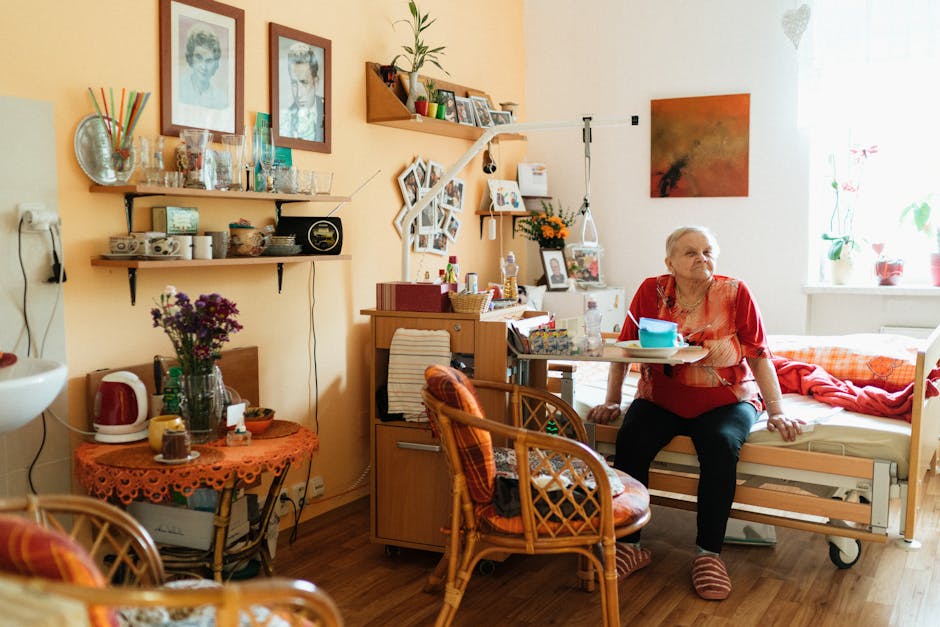
As our loved ones age, their physical, social, and medical needs change. Finding the right living arrangement is not just about finding a roof over their heads; it is about matching their lifestyle and physical abilities with the appropriate level of care.
In California, from Los Angeles to San Diego, older adults have access to several distinct residential formats. Deciding which path to take is easier when you understand the primary models:
- Independent Living Communities: Designed for active older adults who do not require medical supervision or assistance with daily activities. These age-restricted properties (typically 55+ or 62+) offer private apartments, social activities, and freedom from yard work and home maintenance.
- Congregate Housing: A middle ground between completely independent living and assisted care. Residents live in private apartments but share communal spaces, such as dining halls, living rooms, and recreational areas. These communities typically provide at least one shared daily meal, housekeeping, and organized social events to prevent isolation.
- Assisted Living: For seniors who need help with activities of daily living (ADLs) — such as bathing, dressing, medication management, and transportation — but do not require intensive, 24/7 medical care.
- Nursing Homes (Skilled Nursing Facilities): These facilities provide high-level, round-the-clock medical care, rehabilitation services, and chronic disease management under the supervision of licensed medical professionals.
- Continuing Care Retirement Communities (CCRCs): These campuses offer a complete spectrum of care in one location. A senior can enter as an independent resident and transition to assisted living or skilled nursing as their health needs evolve over time. CCRCs typically require a long-term contract and a significant financial entrance fee.
Navigating these choices can feel overwhelming, but you do not have to guess which model fits your family. State tools like the California Department of Aging’s guide to Determine the Best Housing Option For Me can help you assess your relative’s physical needs, lifestyle preferences, and financial situation. For those seeking active, budget-friendly options, exploring Low-Cost Senior Independent Living is an excellent starting point to secure a comfortable home without high monthly costs.
Federal and State Assistance: Navigating Low-Income Rental Programs
When market-rate senior housing is out of reach, government-funded affordable housing programs provide a vital lifeline. The federal government, through the Department of Housing and Urban Development (HUD), partners with local housing authorities across California to lower housing costs for low-income seniors.
To help you compare the primary federal rental assistance options, we have compiled a quick-reference table:
| Program | Target Audience | How Rent is Calculated | Key Feature |
|---|---|---|---|
| Section 202 Supportive Housing | Very-low-income seniors aged 62+ | 30% of adjusted monthly income | Includes on-site service coordinators |
| Section 8 Housing Choice Vouchers | Very-low-income households (all ages) | 30% of adjusted monthly income | Voucher is mobile; can be used with private landlords |
| Project-Based Section 8 | Low-income households | 30% of adjusted monthly income | Subsidy is tied to the specific building/unit |
| Public Housing | Low-income families, seniors, and disabled | 30% of adjusted monthly income | Managed directly by local housing authorities |
Understanding these programs is the first step toward securing stable housing. For a broader look at the programs available in your local area, check out our Ultimate Affordable Senior Housing List.
Section 202 and HUD Housing Programs for Elderly Families
The Section 202 Supportive Housing for the Elderly program is the only federal housing program dedicated exclusively to older adults. Established under the Housing Act of 1959, Section 202 provides capital advances to non-profit organizations to finance the construction, rehabilitation, or acquisition of very-low-income senior housing.
Because these funds function as interest-free capital advances, developers do not have to pay them back as long as the housing remains occupied by very-low-income seniors for at least 40 years. To keep monthly costs affordable, HUD pairs these properties with Project Rental Assistance Contracts (PRACs), which cover the difference between what the resident can afford (30% of their adjusted income) and the actual operating cost of the unit.
To qualify for Section 202 housing, at least one member of the household must be 62 years of age or older, and the household income must fall below “very-low-income” limits (50% of the Area Median Income).
For a deep dive into the legislative history, funding mechanisms, and long-term preservation of these properties, you can read the Congressional Research Service report on Section 202 and Other HUD Rental Housing Programs for Low-Income Elderly Residents. If you are looking for a practical, step-by-step roadmap to finding and applying for these communities, check out The Golden Guide to Senior HUD Housing.
Section 8 Vouchers and Public Housing Options
For seniors who prefer more flexibility in where they live, the Section 8 Housing Choice Voucher program is an invaluable resource. Managed by local public housing agencies (PHAs), Section 8 allows eligible seniors to select their own rental units on the private market, provided the landlord agrees to participate in the program and the rent meets HUD’s fair market standards.
Under this system:
- The senior tenant pays approximately 30% of their adjusted monthly income toward rent.
- The local housing authority pays the remaining balance directly to the landlord.
- Vouchers are “tenant-based,” meaning if the senior needs to move to a different apartment or city, the voucher travels with them.
Alternatively, project-based Section 8 housing ties the rental assistance directly to a specific apartment complex. If a senior moves out of a project-based unit, the subsidy remains with the building, and the next eligible applicant on the waitlist takes over the subsidized rent.
Traditional Public Housing is another option. These are properties owned and managed directly by local housing authorities. Many public housing complexes are designated specifically for elderly and disabled residents, providing secure communities with rent scaled strictly to the tenant’s income.
To learn more about how to secure these vouchers and navigate local housing authorities, read Senior Housing Assistance: Your Roadmap to a New Home.
Eligibility, Income Limits, and How to Apply for Senior Housing

Securing a spot in an affordable senior housing development requires careful preparation. Eligibility for federal and state housing assistance is primarily determined by age and household income relative to the local Area Median Income (AMI).
AMI is calculated annually by HUD for every county and metropolitan area in the United States. Income limits are categorized as follows:
- Low-Income: 80% of local AMI
- Very-Low-Income: 50% of local AMI (the threshold for Section 202 eligibility)
- Extremely-Low-Income: 30% of local AMI
Because income limits vary widely by geography, an older adult qualifying for assistance in Los Angeles County might have a very different income ceiling than one applying in Riverside County.
The Application Process Step-by-Step
- Gather Documentation: Before applying, gather essential documents, including government-issued IDs, Social Security award letters, bank statements, tax returns, and medical expense records (which can sometimes be deducted from gross income to lower calculated rent).
- Contact the Local Housing Authority: You must apply through the public housing agency serving the specific city or county where your relative wants to live.
- Submit Applications to Multiple Waitlists: Because demand far exceeds supply, waitlists for Section 8 and public housing are often years long. It is wise to apply to multiple housing authorities and individual Section 202 properties simultaneously.
- Keep Contact Information Updated: If a housing authority attempts to contact you and receives no response, or if mail is returned as undeliverable, your relative will be removed from the waitlist. Always update your application if your phone number or mailing address changes.
For a comprehensive breakdown of how to prepare your paperwork and increase your chances of approval, refer to our Low-Income Senior Housing Guide.
Supportive Services and Resources to Help Seniors Age in Place
For many older adults, moving into a specialized senior community is not the preferred choice. Most seniors prefer to “age in place” — remaining in their familiar homes and neighborhoods for as long as possible. To make this safe and sustainable, several supportive services are available to bridge the gap between complete independence and institutional care.
On-site service coordinators play a major role in affordable senior housing. These professionals help residents arrange home health aides, coordinate transportation to medical appointments, set up meal delivery services, and apply for public benefits.
Additionally, physical home modifications — such as installing grab bars in bathrooms, wheelchair ramps, and improved lighting — can prevent falls and significantly extend a senior’s independence.
In California, the CalAIM (California Advancing and Innovating Medi-Cal) initiative offers innovative support to help seniors transition from nursing facilities back into the community or prevent institutionalization in the first place. Through CalAIM, eligible seniors can access critical housing transition navigation services and housing deposits.
To ease the financial burden of moving into a stable home, this program can provide deposit assistance, including 1 month paid in advance to secure a safe apartment.
To learn more about how to coordinate these services and support your loved one’s independence, explore how Lifesteps Helps Older Adults Age in Place and discover our specialized Resident Services Aging in Place programs.
California-Specific Resources and Housing Programs for Elderly Residents
California offers unique regional programs to help seniors secure affordable housing. In Southern California, local housing authorities and community organizations work together to expand the supply of dedicated senior units.
For instance, in San Diego County, the opening of a new affordable housing development in Linda Vista provides 126 units designed specifically for low-income seniors. You can read more about this community-oriented development in the press release on Senior Community: 126 Affordable Housing Units Open in Linda Vista.
In Riverside County, local initiatives offer direct rental aid and housing support to prevent senior displacement. To learn more about local voucher programs and emergency rental help in this area, visit the Rental Assistance Programs | Housing & Human … – RiversideCA.gov portal.
For a statewide directory of affordable living options, community programs, and local housing resources, check out our guide to Affordable Senior Housing California.
Overcoming Challenges: Waitlists, Eviction Prevention, and Emergency Aid
The journey to securing affordable housing is rarely without obstacles. The most prominent challenge is the reality of long waitlists. Many Section 8 programs and subsidized senior buildings have waitlists that span several years, and some housing authorities close their waitlists entirely when the volume of applicants becomes unmanageable.
To navigate this, families should look for properties that offer “preference points” for seniors who are currently unhoused, veterans, or facing displacement due to natural disasters.
If an older relative is at risk of losing their current home, eviction prevention resources are critical. Many California cities offer free or low-cost legal aid for seniors facing eviction, helping to mediate landlord disputes and ensure tenant rights are respected.
Additionally, protective services are available to intervene in cases of elder abuse — including financial exploitation, which often directly threatens a senior’s housing stability.
At LifeSTEPS, we understand that securing a home is only half the battle; maintaining it is what truly builds a stable life. Through intensive, human-centered case management and proactive tenant support, we are proud to maintain a 93% housing retention rate among the clients we serve. This means that nearly every individual we help place in stable housing successfully remains in their home, avoiding the trauma of returning to housing insecurity.
Conclusion
Securing safe, comfortable, and affordable housing for an elderly relative is a profound act of care. While the landscape of housing programs for elderly adults can seem complex, utilizing federal programs like Section 202, state-level initiatives like CalAIM, and local housing authority vouchers can open doors to stable living environments.
At LifeSTEPS, we believe in the power of community and human-centered support. Our mission is to walk alongside individuals and families as they navigate these systems, ensuring that older adults can age with dignity, security, and peace of mind.
Beyond housing, we believe in fostering thriving communities for all generations. That is why we also invest in our youth and families through powerful educational initiatives. Our afterschool programs have achieved a remarkable 97% literacy improvement through our Summer Reading program, and we have helped students achieve their dreams by awarding over $2.1 million in scholarships for higher education. By supporting both seniors and youth, we build stronger, more resilient communities across California.
If you are ready to explore your options, begin by researching local Low-Cost Senior Independent Living opportunities to find the perfect fit for your loved one.
LifeSTEPS currently provides services in California only.


