


Know Your Rights and Keep Your Keys Under California Eviction Law
When the Clock Is Ticking: What Every California Renter Needs to Know
California tenant eviction laws give renters important rights — but only if you know them and act fast. Here is a quick overview:
California Eviction Law: Key Facts at a Glance
- Landlords must go through a court process called an unlawful detainer to legally remove a tenant
- Tenants have 10 business days to respond to an eviction lawsuit (doubled from 5 under AB 2347)
- Most tenants who have lived in a rental for 12 months or more are protected by just cause eviction rules under AB 1482
- Landlords cannot change your locks, shut off utilities, or remove your belongings to force you out
- About 40% of California tenants lose eviction cases by default — often simply because they did not respond in time
- Free and low-cost legal help is available, even if you cannot afford a private attorney
Facing an eviction notice is stressful, especially if you are working to rebuild stability after a major life transition. The legal process moves quickly, and the gap between landlords and tenants when it comes to legal representation is stark — more than 80% of landlords have attorneys in eviction cases, compared to fewer than 5% of tenants nationwide. Knowing your rights before you need them can make all the difference.
LifeSTEPS currently provides services in California only.
Glossary for California tenant eviction laws:
Understanding California Tenant Eviction Laws and the Legal Process
When a landlord wants a tenant to move out, they cannot simply demand the keys or throw suitcases on the sidewalk. Under California law, the only lawful way to evict a tenant is to file a formal lawsuit in court. This lawsuit is legally known as an unlawful detainer.
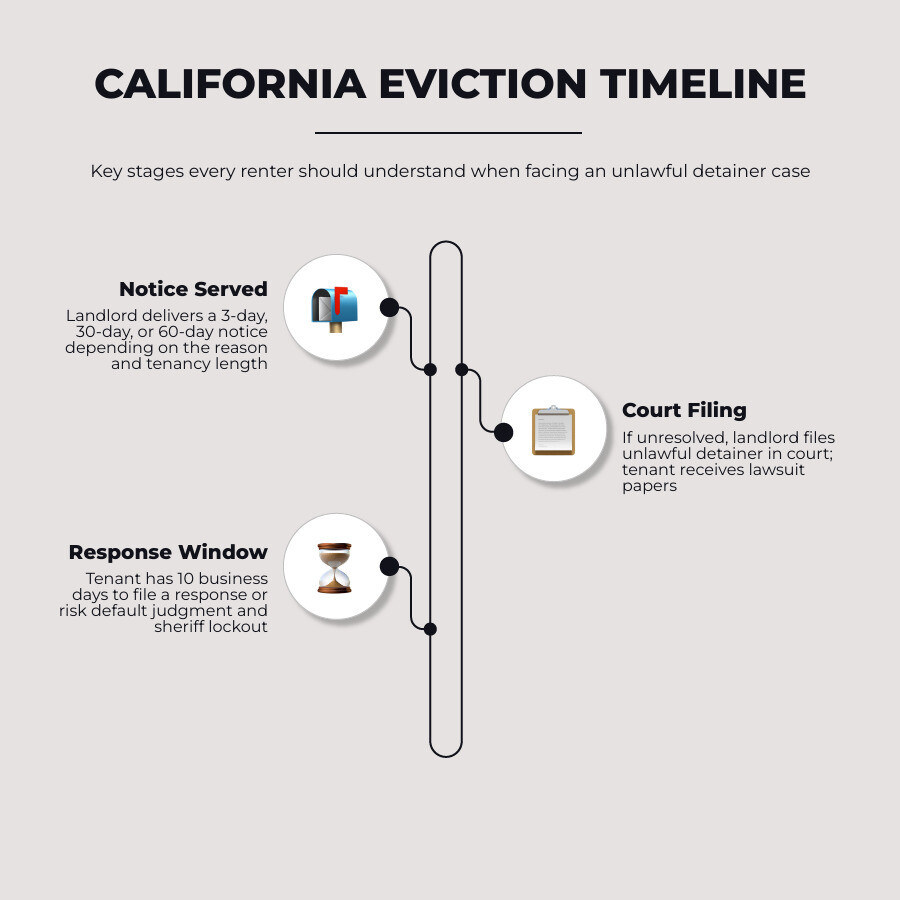
The legal process follows a strict chain of events. It begins when the landlord serves the tenant with a written notice. If the tenant does not comply or move out by the deadline, the landlord can file an unlawful detainer lawsuit in the local superior court. Once served with the court summons, the tenant must file a written response with the court.
If a tenant fails to respond to the summons within the legal timeframe, they face a default judgment. About 40% of California renters lose their eviction cases by default simply because they do not file a response on time. When a default judgment occurs, the landlord wins automatically, and the tenant loses their opportunity to present defenses—such as unsafe living conditions or improper notice.
If the landlord wins the court case (either by default or after a trial), the judge will issue a Writ of Possession. This is a legal document that authorizes local law enforcement—specifically the Sheriff or Marshal—to carry out the physical eviction. The Sheriff will post a five-day Notice to Vacate on the tenant’s door. If the tenant is still there after five days, the Sheriff will physically remove them and lock them out. Landlords, property managers, and private security guards have absolutely no authority to perform a lockout themselves.
To understand the full lifecycle of a tenancy and avoid costly court battles, renters and housing providers should consult the comprehensive California Tenants – A Guide to Residential Tenants’ and Landlords’ Rights and Responsibilities. Additionally, a visual breakdown of this courtroom journey is available in THE EVICTION PROCESS . Navigating these rules can be overwhelming, which is why learning about Eviction Prevention 101: Expert Help to Avoid Eviction Today is a vital first step for anyone facing housing instability.
Types of Eviction Notices and Proper Service Requirements
An eviction cannot start without a written notice. Landlords must use specific notices depending on the reason they want to end the tenancy. These notices are governed strictly by state statutes, including California Code, CCP 1161 .
The primary types of eviction notices include:
- Notice to Pay Rent or Quit: Used when rent is overdue. This gives the tenant a specific number of days to pay the full amount or move out.
- Notice to Cure or Quit: Served when a tenant violates a term of the lease (such as keeping an unauthorized pet or creating excessive noise). The tenant must fix the problem or vacate.
- Unconditional Quit Notice: Reserved for severe violations where the landlord does not give the tenant a chance to fix the issue. This applies to illegal activities on the property, severe property damage, or creating a major public nuisance.
For a notice to be legally valid, it must be served properly. Landlords cannot simply text, email, or verbally tell a tenant to leave. Proper service methods include personal delivery, leaving a copy with a responsible person at the home and mailing a backup copy, or posting the notice on the property and mailing a copy (known as “nail and mail”). Furthermore, landlords are strictly prohibited from charging tenants any fees for serving or delivering these notices.
If you receive one of these notices, do not panic. Seeking immediate resources like Rental Assistance with Eviction Notice can help you resolve rent arrears before the landlord files a court case.
| Notice Type | Common Reasons | Standard Timeline | Tenant Action Required |
|---|---|---|---|
| Notice to Pay Rent or Quit | Unpaid rent | 3 Days (excluding weekends/holidays) | Pay the full rent amount or vacate the property. |
| Notice to Cure or Quit | Minor lease violation (e.g., unauthorized pet) | 3 Days (excluding weekends/holidays) | Correct the violation or move out. |
| Unconditional Quit Notice | Criminal activity, severe damage, or nuisance | 3 Days | Vacate immediately; no option to cure. |
| Notice to Terminate Tenancy | No-fault termination (periodic tenancy) | 30 or 60 Days | Move out by the end of the notice period. |
Notice Periods Under California Tenant Eviction Laws
The timeline required for a notice depends heavily on the reason for the eviction and how long the tenant has lived in the home. For rent nonpayment or lease violations, the law requires a three-day notice (excluding weekends and court holidays).
For periodic tenancies (such as month-to-month leases) where the landlord is terminating the agreement without an “at-fault” reason, the timelines are longer:
- 30-Day Notice: If the tenant has lived in the property for less than one year.
- 60-Day Notice: If the tenant has lived in the property for one year or more.
If you find yourself struggling to make ends meet but have not yet received a formal notice, proactively exploring a Rental Assistance Without Eviction Notice Guide can help you secure the funding needed to stay current on your rent and keep your housing secure.
Just Cause Protections and Local Ordinances
The Tenant Protection Act of 2019 (AB 1482) fundamentally changed California tenant eviction laws by introducing statewide “just cause” protections. Under this law, landlords must have a valid, legally recognized reason to evict renters who have lived in their housing for at least 12 months. If a new adult tenant is added to the lease before the original tenant hits their 12-month mark, the protection kicks in after 24 months of collective occupancy.
These protections apply to most multi-family apartment buildings and duplexes built at least 15 years ago. However, some properties are exempt, such as single-family homes owned by individual landlords (provided the landlord gave the tenant a specific legal disclosure of the exemption) and newer constructions.

Local cities often have their own local ordinances that provide even stronger protections. For example, the Los Angeles Just Cause Ordinance (JCO) covers residential properties not regulated by the city’s Rent Stabilization Ordinance (RSO). Under the JCO, protections can kick in after just six months of occupancy or upon the expiration of an initial lease. It also requires landlords to file copies of all eviction notices with the Los Angeles Housing Department (LAHD) within three business days of service.
If you are facing local housing disputes in Southern California, organizations like Landlord/Tenant | Fair Housing – Orange County provide invaluable guidance on how local rules interact with state legislation. Understanding these rules is a core part of Staying Put: How Community Programs Can Prevent Eviction, helping families maintain stability in their neighborhoods.
At-Fault vs. No-Fault Evictions Under California Tenant Eviction Laws
Under just cause rules, evictions are split into two categories:
- At-Fault Evictions: These occur because the tenant did something wrong. Examples include nonpayment of rent, breaching a lease covenant, committing waste (substantial damage), creating a nuisance, or using the property for unlawful activities. No relocation assistance is required for at-fault evictions.
- No-Fault Evictions: These happen through no fault of the tenant. Common reasons include the owner or their immediate family moving into the unit, demolishing the property, permanently removing the unit from the rental market, or performing a substantial remodel that requires the tenant to vacate for safety.
For no-fault evictions, landlords must provide relocation assistance equal to one month’s rent (either as a direct payment or by waiving the final month’s rent). If you are facing a sudden move due to a no-fault notice, navigating the transition can be challenging. Accessing an Emergency Rental Assistance California Complete Guide can connect you with emergency funds to help cover moving costs or deposits for a new home.
Tenant Rights, New Timelines, and Legal Protections
Navigating an eviction lawsuit can feel like a race against time, but recent legislation has thrown a lifeline to California renters. Effective January 1, AB 2347 changed the timeline for responding to eviction lawsuits. Previously, tenants had a mere 5 business days to file a written response to an unlawful detainer summons. Now, California tenants have 10 business days to respond. This doubling of the response window gives families crucial extra time to seek legal counsel, gather evidence, and file their paperwork correctly to avoid a default judgment.

Beyond timelines, California law provides strict protections against “self-help” evictions. Landlords are legally prohibited from trying to force tenants out by:
- Changing locks
- Shutting off utilities (water, gas, electricity)
- Removing doors or windows
- Taking the tenant’s personal property from the unit
Landlords who engage in these illegal actions face severe penalties, including civil liabilities of up to $100 per day of violation and potential lawsuits for damages.
Special protections also exist for vulnerable populations. For instance, landlords cannot evict tenants who are victims of domestic violence, sexual assault, elder abuse, human trafficking, or stalking based on acts of abuse committed against them, provided the tenant has a recent restraining order or police report and the abuser does not reside in the same unit.
If you are served with court papers, you must act quickly. Resources like Know Your Rights: Eviction | California Rural Legal Assistance, Inc. and the Unlawful Detainer Research Guide – Riverside County Law Library offer step-by-step guidance on how to navigate the court system. For a comprehensive catalog of financial and legal help, refer to The Ultimate List of Eviction Prevention Grants and Legal Aid.
Frequently Asked Questions About California Evictions
Can a landlord lock me out or shut off my utilities?
No. Under California tenant eviction laws, “self-help” evictions are completely illegal. A landlord cannot change your locks, turn off your utilities, or remove your belongings to force you to leave. The only legal way to evict a tenant is to obtain a court order through the unlawful detainer process and have the local Sheriff execute the eviction. Landlords who violate this rule can face steep financial penalties in court.
How much time do I have to respond to an eviction lawsuit?
Thanks to AB 2347, tenants now have 10 business days (excluding weekends and court holidays) from the date they are formally served with the summons and complaint to file a written response with the court. Filing this response is critical to preventing a default judgment, which would result in an automatic win for the landlord.
What resources are available if I cannot afford rent?
If you are struggling to pay rent, do not wait until you receive an eviction notice to seek help. There are numerous state, local, and nonprofit programs designed to keep families in their homes. You can find immediate local resources by exploring how California Renters Can Find Emergency Help Right Here, which outlines financial aid and emergency services.
Conclusion
Understanding California tenant eviction laws is the first step toward protecting your home and keeping your keys. The legal landscape moves quickly, but knowing your rights—from the new 10-day response timeline to just cause protections—gives you the power to stand on solid ground.
At LifeSTEPS, we are dedicated to helping Californians maintain stable housing and build pathways to self-sufficiency. Through our holistic support services, we achieve a 93% housing retention rate for the individuals and families we serve. We work directly with programs like CalAIM to offer deposit assistance—providing 1 month paid in advance to help clients transition smoothly into secure, permanent homes.
Beyond housing stability, we believe in supporting the entire community. Our programs include summer reading initiatives that have driven a 97% literacy improvement among participating youth, as well as over $2.1 million in higher education scholarships awarded to help the next generation thrive. From Southern California hubs like Los Angeles, San Diego, and Riverside, to Irvine, we are here to walk alongside you.
If you or someone you know is facing housing insecurity, learn more about how we can help through the LifeSTEPS Eviction Prevention Program.
LifeSTEPS | Phone: (916) 965-2110 | lifestepsusa.org
LifeSTEPS currently provides services in California only.


