


Riverside County Housing Assistance and Self-Sufficiency Programs Explained
Riverside County Housing Assistance and Self-Sufficiency Programs Explained
What Riverside County Housing Assistance Programs Are Available?
Riverside County housing assistance covers a wide range of programs — from rental support and emergency vouchers to down payment help for first-time buyers. Here is a quick look at the main options:
- Section 8 / Housing Choice Vouchers — Tenant-based and project-based vouchers for low-income renters, administered by the Housing Authority of the County of Riverside
- First-Time Homebuyer Down Payment Assistance — Up to $100,000 or 20% of the purchase price through the HOME and PLHA programs
- CalWORKs Housing Support — Rental assistance and hotel/motel vouchers (up to 30 days) for families receiving cash aid
- Emergency Rental Assistance — Programs like United Lift and CARES Act-funded initiatives to help renters avoid eviction
- Homelessness Prevention Services — Outreach, temporary housing, and case management for at-risk individuals and families
Finding the right program can feel overwhelming, especially if you are navigating civilian life after military service. Riverside County has a layered system of support, and knowing where to start makes all the difference. Today, more than 17,600 families are being served through county housing programs — including over 10,000 active vouchers — so real help is available.
This guide breaks down every major program, who qualifies, and exactly how to apply.
Riverside County housing assistance helpful reading:
Overview of Riverside County Housing Assistance Programs
Riverside County relies on two primary agencies to develop, manage, and distribute housing resources: the Housing Authority of the County of Riverside (HACR) and the Department of Housing and Workforce Solutions (HWS). Established in 1942, the Housing Authority has spent decades building a robust network of affordable housing options to support low-to-moderate-income families, veterans, seniors, and disabled individuals.
Navigating these programs is much easier when you understand the sheer scale of the county’s infrastructure. Currently, the Housing Authority administers 10,290 Tenant-Based and Project-Based Vouchers, helping over 17,627 families and individual customers secure stable housing. To expand the physical inventory of affordable apartments, the county also manages 950 Project-Based Voucher units, with an additional 306 units currently under construction as of July 2026.
For residents trying to understand their options, learning how to navigate the Riverside low-income housing market is the first step toward long-term stability. Whether you need immediate rental relief or are planning to transition into homeownership, these county agencies provide the structural foundation for your housing goals.
Rental Assistance and Homelessness Prevention Services

For households struggling to keep up with monthly payments, rental assistance and homelessness prevention programs act as a critical safety net. Riverside County offers several pathways to help residents stay housed, ranging from long-term voucher programs to emergency, short-term relief.
A major element of our support network involves connecting eligible residents to the CalAIM (California Advancing and Innovating Medi-Cal) program. Through CalAIM, qualified individuals transitioning to stable housing can access deposit assistance, which typically includes 1 month paid in advance for security deposits, alongside intensive housing navigation services. This program ensures that the initial financial barrier of moving into a new apartment does not stand in the way of a family’s stability.
If you are facing an immediate housing emergency, reviewing a California emergency rental assistance guide can help you identify local resources before an eviction notice is filed.
Emergency Rental Support and Riverside County Housing Assistance
When unexpected financial hardships strike, emergency programs step in to fill the gap. Riverside County residents can access localized rental support through initiatives like United Lift, a collaborative partnership designed to keep families in their homes. Additionally, the Housing Help | Riverside County Department of Public Social Services portal connects residents directly to emergency county funds.
Over the years, emergency funding has played a massive role in stabilizing local neighborhoods. For example, the City of Riverside allocated nearly $28 million in CARES Act funding to address pandemic-related impacts. Within this allocation:
- Approximately $10.5 million was dedicated specifically to housing and homelessness initiatives, including direct rental assistance.
- Over 1,240 applications were processed for local business grants, resulting in more than $3.4 million awarded to over 350 small businesses to keep the local economy afloat.
- Around $1.5 million was distributed to nonprofits, and $320,000 went directly to food pantries, securing over 50,000 food boxes for families in need.
These funds helped establish the Riverside Residential Rental Assistance Program, which provided up to three months of rent for low-income households facing sudden income loss. To explore similar local protections, you can read more about eviction prevention programs operating throughout Southern California.
CalWORKs Housing Support and Temporary Vouchers
For families already participating in the California Work Opportunity and Responsibility to Kids (CalWORKs) program, the Housing Support Program (HSP) offers rapid rehousing and financial assistance. HSP is designed to help CalWORKs recipients who are experiencing or are at immediate risk of homelessness.
Available resources under this program include:
- Temporary Hotel/Motel Vouchers: Providing up to 30 days of emergency shelter for families with children while they work with a case manager to find permanent housing.
- Rental Assistance: Financial aid to cover back rent, ongoing rent, or move-in costs.
- Security Deposit Assistance: Help with move-in deposits, including 1 month paid in advance to secure a lease.
By combining cash aid with wrap-around case management, the county helps families meet their basic living needs while building a path toward self-sufficiency. If you are preparing to sign a new lease and need help with upfront costs, our guide on first month’s rent and security deposit assistance offers practical tips for securing these funds.
First-Time Homebuyer Down Payment Assistance Programs
Transitioning from renting to owning a home is one of the most effective ways to build generational wealth and long-term stability. To make this dream a reality for low- and moderate-income residents, Riverside County administers several first-time homebuyer down payment assistance programs.
These programs are structured as a silent second mortgage (a deferred loan). This means that the county provides the down payment funds as a secondary loan with 0% interest and no monthly payments. The loan does not require repayment until you sell the home, transfer the title, refinance for cash-out, or reach the end of the designated affordability period, at which point the entire balance converts into a grant and is fully forgiven.
To qualify, you must meet the county’s definition of a first-time homebuyer. This generally means you have not owned a home or held a mortgage interest in the past three years. However, there are exceptions; for example, owning a mobile home that is not permanently affixed to a foundation does not count against your first-time buyer status.
Comparing HOME and PLHA Riverside County Housing Assistance
The two primary down payment assistance options in the county are the HOME First Time Home Buyer (FTHB) program and the Permanent Local Housing Allocation (PLHA) program. While both offer up to $100,000 or 20% of the purchase price (whichever is less), they serve different income brackets and carry different terms.
The HOME program is federally funded and targets lower-income households earning at or below 80% of the Area Median Income (AMI). In contrast, the PLHA program is state-funded and accommodates moderate-income buyers earning up to 120% of the AMI.
To understand the differences, review the details in the PLHA First Time Home Buyer Borrower Information Packet and the HOME First Time Home Buyer Program Guidelines.
| Program Feature | HOME FTHB Program | PLHA FTHB Program |
|---|---|---|
| Funding Source | Federal (HUD) | State of California (PLHA) |
| Max Assistance | Lesser of $100,000 or 20% of purchase price | Lesser of $100,000 or 20% of purchase price |
| Minimum Assistance | $1,500 | $1,500 |
| Income Limit | Up to 80% AMI (e.g., $68,900 for 1 person) | Up to 120% AMI (e.g., $87,300 for 1 person) |
| Affordability Period | 15 Years (Converts to a forgiven grant) | 30 Years (Converts to a forgiven grant) |
| Eligible Areas | Unincorporated areas & cooperating cities | Unincorporated areas & cooperating cities |
| Pools/Spas | Ineligible if the property has an in-ground pool | Ineligible if the property has an in-ground pool |
Property Eligibility and Purchase Price Limits
Not every property qualifies for county down payment assistance. To ensure the home is a safe and affordable investment, Riverside County enforces strict property standards:
- Eligible Property Types: Single-family detached homes, condominiums, townhomes, or manufactured homes (which must be no older than 10 years, permanently affixed to a foundation, and located on land owned or leased long-term by the buyer).
- Maximum Purchase Prices:
- Single-Family Homes: $564,205
- Condominiums/Townhouses: $513,000
- Manufactured Homes: $361,000
- Size and Occupancy: The home must have a minimum of 2 bedrooms to prevent overcrowding.
- Ineligible Features: Single-family homes with in-ground swimming pools or spas are strictly ineligible for funding.
Additionally, the home must be located within unincorporated Riverside County or one of the cooperating cities. Specific cities that run their own independent housing programs are excluded from county-administered FTHB funds, so it is vital to verify the property’s address before making an offer.
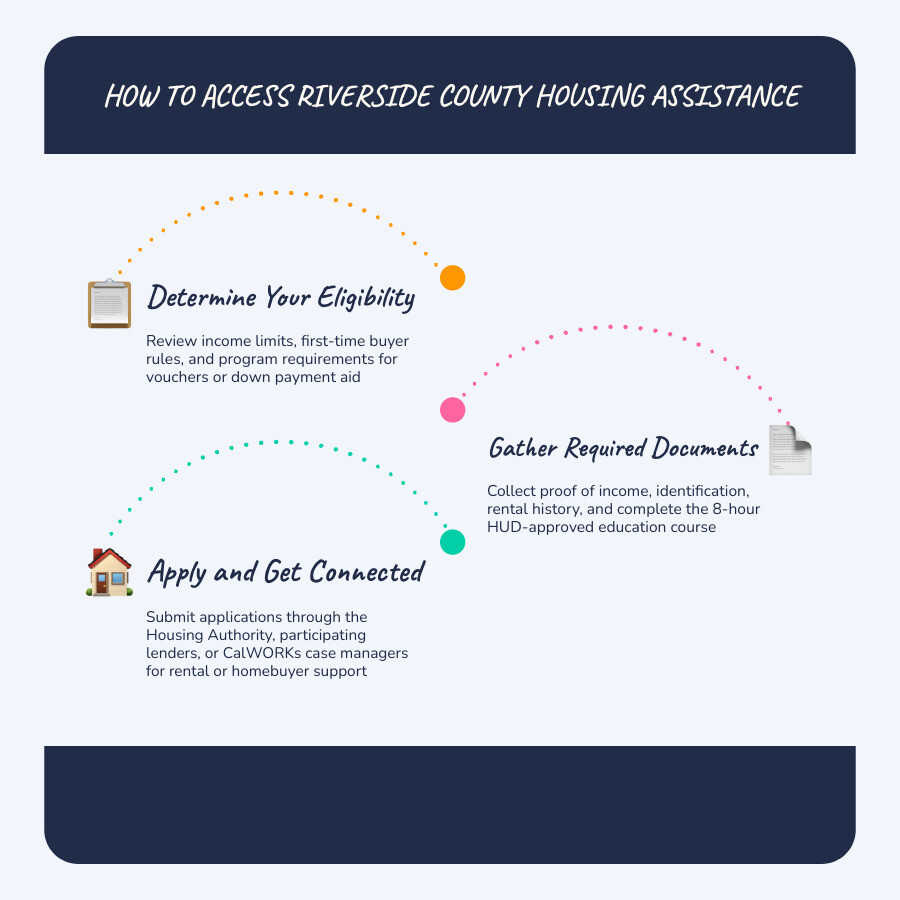
Application Steps and Education Requirements
Applying for down payment assistance requires working closely with an approved, participating lender. Because these are specialized loans, you cannot use just any bank; you must choose a lender certified by the county to handle HOME, PLHA, or ARPA funds.
Here is the step-by-step process:
- Pre-Qualification: Contact an approved lender to evaluate your credit, assets, and income. Your back-end debt-to-income (DTI) ratio should generally not exceed 45%.
- Homebuyer Education: Complete a minimum 8-hour, in-person homebuyer education seminar provided by a HUD-approved housing counseling agency. Online classes are not accepted for the PLHA program.
- Find a Home: Work with a real estate agent to locate an eligible property. When you make an offer, you must include the county’s official Homeownership Notice as a contract addendum.
- Open Escrow: Once your offer is accepted, your lender will submit a reservation request and upload your documentation to the county.
- Inspections & Disclosures: The property must pass a licensed home inspection and meet basic habitability standards. For homes built before 1978, lead-based paint disclosures and inspections are mandatory, as outlined in the ARPA First Time Home Buyer Lender Guidelines.
- Closing: You will sign the loan documents for both your first mortgage (a standard 30-year fixed loan) and the county’s silent second mortgage.
Frequently Asked Questions About Riverside Housing Programs
Navigating public housing programs often brings up highly specific questions. Here are the answers to some of the most common inquiries we receive regarding Riverside County housing assistance.
What is the maximum purchase price for first-time buyers?
The maximum purchase price depends on the property type. For single-family detached homes, the price cap is $564,205. For condominiums and townhomes, the limit is $513,000, and for qualifying manufactured homes, the limit is $361,000. These caps are periodically adjusted by the county to reflect broader shifts in the Southern California real estate market.
Who qualifies as a first-time homebuyer in Riverside County?
A first-time homebuyer is defined as someone who has not held an ownership interest in a principal residence, or claimed mortgage interest tax deductions, at any point during the three years immediately preceding the purchase.
Exceptions are made for displaced homemakers, parents who previously owned a home with a spouse, or individuals who have only owned a mobile home that was not permanently attached to a structural foundation.
How does the 15-year or 30-year affordability period work?
The affordability period is the timeframe during which you must occupy the home as your primary residence.
- For the HOME FTHB program, the affordability period is 15 years.
- For the PLHA FTHB program, the period is 30 years.
During this time, the county’s assistance remains a zero-interest, zero-payment second loan. If you live in the home for the entire duration of the affordability period without selling, transferring the title, or taking cash out during a refinance, the entire loan converts into a grant and is completely forgiven. If you sell the home early, you must repay the loan out of the sale’s net proceeds.
Conclusion
Whether you are looking for immediate rental relief, searching for emergency security deposit assistance, or taking your first steps toward buying a home, Riverside County housing assistance programs offer a pathway to long-term peace of mind.
At LifeSTEPS, we are dedicated to helping Californians transition from housing instability to self-sufficiency. As a nonprofit organization in the social services industry, we provide hands-on support, case management, and resource navigation. Our work delivers real, measurable outcomes across California:
- We maintain a 93% housing retention rate for clients in our supportive housing programs.
- We connect eligible participants to vital CalAIM deposit assistance, helping cover move-in costs with 1 month paid in advance.
- Our youth and education programs make a lifelong impact, achieving a 97% literacy improvement through our Summer Reading programs and awarding over $2.1 million in academic scholarships.
If you are ready to explore your options, learn more about our LifeSTEPS low-income homeownership programs and see how we can help you build a more secure future.
LifeSTEPS currently provides services in California only.


