


How to Find Places That Help You Pay Your Security Deposit Without the Stress
How to Find Places That Help You Pay Your Security Deposit Without the Stress
Why Finding Places That Help You Pay Your Security Deposit Can Make or Break Your Move
Finding places that help you pay your security deposit is easier than most renters think — here are the main options:
| Type of Help | Examples | Best For |
|---|---|---|
| Government programs | CalAIM, municipal housing agencies | Low-income renters, Medi-Cal recipients |
| Nonprofit organizations | Salvation Army, St. Vincent de Paul | Emergency housing crises |
| Rent banks | Local grant programs | Temporary financial hardship |
| Veteran-specific programs | VA-linked housing support | Recently discharged veterans |
| Deposit alternatives | Rhino, Obligo, FlexDeposit | Renters with steady income |
| Negotiation with landlord | Direct renter-landlord agreement | Strong rental history applicants |
Moving into a new home is expensive. Between the first month’s rent paid in advance and a security deposit on top of that, the upfront costs can feel impossible — especially if you’re transitioning out of military service and rebuilding financial stability from scratch.
For many veterans, this financial wall is one of the biggest barriers to settling into civilian life. The good news is that real help exists — from government programs and local nonprofits to modern deposit alternatives that let you skip the large lump sum entirely.
This guide walks you through every major option available in California, so you can move forward with confidence.
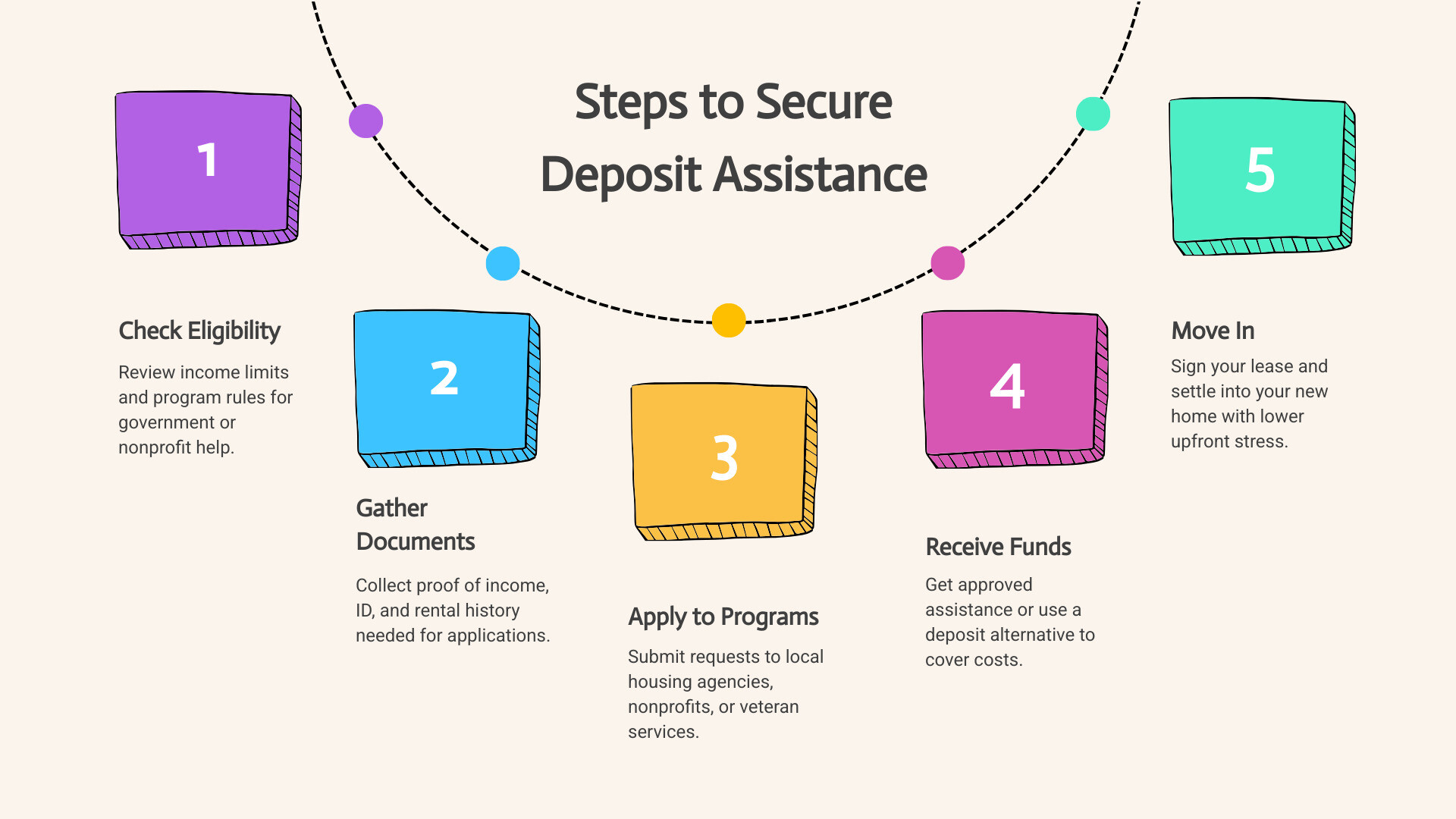
LifeSTEPS currently provides services in California only.
Simple places that help you pay your security deposit glossary:
Government Programs and Local Agencies: Places That Help You Pay Your Security Deposit
When looking for places that help you pay your security deposit, municipal and state government programs are often the best starting point. In California, several structured initiatives exist to help low-income households, veterans, and individuals transitioning to stable housing overcome upfront moving barriers.
One of the most significant resources in our state is the CalAIM (California Advancing and Innovating Medi-Cal) program. Through CalAIM’s Community Supports, eligible Medi-Cal managed care members can access direct funding for housing deposits. This program covers security deposits required to obtain a lease, utility set-up fees, and even first-month rent if necessary to secure the unit.
For example, in Southern California, eligible residents can access these benefits through regional health plans like the Housing Deposits | L.A. Care Health Plan. This initiative helps bridge the gap for families and individuals in Los Angeles County who need a helping hand to get into a permanent home.
Further south and inland, the City of Riverside provides critical community support through programs like CARES – RiversideCA.gov, which connects residents with emergency resources, housing stabilization services, and utility assistance.
At LifeSTEPS, we work alongside these public benefits to ensure our clients achieve long-term self-sufficiency. Our holistic approach to housing transition has helped us maintain a 93% housing retention rate among our clients. By pairing financial resources with case management, we help families stay housed long after the initial move-in costs are paid.
If you are exploring state-specific regulations on what landlords can legally charge, or how public programs operate under local guidelines, you can read our comprehensive ultimate guide to rental and deposit assistance as well as our detailed guide to California security deposit laws.
County and Municipal Places That Help You Pay Your Security Deposit
Local county housing authorities are also excellent places that help you pay your security deposit. Many California counties run localized programs funded by federal grants (such as the Emergency Solutions Grant or HOME program) to prevent homelessness and promote community stability.
- Orange County: The Orange County Housing Authority offers targeted move-in support through initiatives like the [PDF] Landlord Signing Bonus and Tenant Move-in Assistance Program. This program provides financial incentives to landlords and direct move-in assistance—including security deposits—to help voucher holders secure housing quickly in competitive markets like Irvine and surrounding cities.
- San Diego County: In coastal communities like Imperial Beach, local tenant assistance programs help low-income renters cover unexpected housing transitions. You can learn more about these localized resources via the Tenant Assistance | Imperial Beach, CA portal, which outlines local rental support, tenant protections, and emergency funding opportunities.
When applying for county-level assistance, you will typically need to show proof of income, a signed intent-to-rent agreement from a landlord, and verification that you reside within the county’s service boundaries. For a step-by-step breakdown of how to prepare your paperwork for these local agencies, check out our guide to first month rent security deposit help programs.
Nonprofit and Faith-Based Organizations Offering Move-In Support
If you do not qualify for government-sponsored programs, or if you need assistance faster than a public agency can process your application, nonprofit organizations and faith-based charities are vital places that help you pay your security deposit.
Charitable organizations often have flexible funding pools designed to address immediate housing crises. Some of the most active national organizations with local chapters in Southern California, San Diego, and the Bay Area include:
- The Salvation Army: Known for its “Housing Now” and emergency assistance programs, local chapters frequently provide one-time grants to cover security deposits or utility hookups for families facing eviction or transitioning from temporary shelters.
- St. Vincent de Paul: Operating through local parish conferences, this organization provides highly personalized “home visits” where volunteers assess a household’s needs and can issue direct financial assistance for security deposits, furniture, or back rent.
- Saint John’s Program: Organizations like Saint John’s Housing Assistance Program focus on helping individuals transition from crisis to stability by offering structured housing placement services, case management, and move-in cost assistance.
These organizations prioritize veterans, families with young children, and individuals experiencing sudden emergencies. For veterans transitioning to civilian life, specialized programs work in tandem with the Department of Veterans Affairs to cover move-in costs.
At LifeSTEPS, we collaborate with programs like the Family Self-Sufficiency (FSS) initiative to help veterans and low-income families build assets, transition to stable rental housing, and eventually achieve homeownership. To find out how to access veteran-specific move-in grants, read our guide on veterans help with security deposit or view our general first month security deposit assistance guide.

Charitable Places That Help You Pay Your Security Deposit
Local Community Action Agencies (CAAs) are another excellent nonprofit resource. CAAs are federally mandated, locally run organizations dedicated to fighting poverty. They administer Community Services Block Grants (CSBG) which are frequently used to fund local “rent banks” or emergency move-in funds.
These agencies understand that paying one month of rent in advance, plus an equivalent security deposit, can wipe out a family’s savings. To help, they may offer direct grants paid directly to your new landlord.
To explore how these community funds operate and how you can position your application for success, read our guide on first month rent and security deposit assistance. If you are currently receiving state benefits or income assistance and want to know how that impacts your eligibility, our guide to income assistance provides excellent clarity.
Modern Security Deposit Alternatives and Guarantees
In the modern rental market, you do not always need a traditional cash deposit to secure an apartment. Many landlords now accept security deposit alternatives—often referred to as deposit guarantees or lease bonds—which allow renters to keep their cash in their pockets in exchange for a small, non-refundable fee or a low monthly payment.
These services act as a guarantee to the landlord that any damages or unpaid rent will be covered up to a certain amount, while allowing the tenant to move in for a fraction of the upfront cost.
Several prominent deposit alternative platforms operate throughout California:
- Obligo: This platform offers a “no-deposit” rental solution by securely connecting to your bank account and pre-authorizing a payment method. If there are no damages at move-out, you pay nothing. Learn more at Obligo – No Deposit Rental Solutions | Simplified Renting for Renters & Properties.
- Rhino: Instead of paying a large upfront cash deposit, renters can purchase a low-cost insurance policy through Rhino that protects the property owner. You can explore this option via the Rhino Security Deposit Alternative | Maymont Homes portal.
- Assurant FlexDeposit: Based on a soft credit inquiry that does not impact your credit score, FlexDeposit allows renters to pay a one-time, non-refundable fee to satisfy the security deposit requirement. Discover more at Assurant FlexDeposit – Home.
- RoostEasy: This service offers monthly payment options and rewards responsible renters who leave their apartments in good condition. Check out The Most Affordable Way to Remove Security Deposits.
- SwiftDeposit: Another digital solution that replaces upfront cash with flexible, secure payment structures to make moving affordable. Read more at Deposit-free Renting Made Easy – Flexible & Secure Solutions | SwiftDeposit.
Comparing Cash Deposits vs. Deposit Alternatives
| Feature | Traditional Cash Deposit | Deposit Alternative (e.g., Rhino, Obligo) |
|---|---|---|
| Upfront Cost | High (usually equivalent to 1 month’s rent) | Very low (small monthly fee or one-time premium) |
| Refundability | Fully refundable (minus legitimate damages) | Non-refundable (fees paid to the provider are not returned) |
| Credit Impact | None | Soft inquiry only (no score impact) |
| Move-out Responsibility | Landlord deducts damages from your cash | Tenant must still pay the provider for any damages caused |
While these alternatives are incredibly convenient, it is important to remember that they are not standard insurance for the tenant. If you cause damage to the property, the provider will pay the landlord, but they will eventually collect that debt from you.
For a complete breakdown of how these private renting deposit structures differ from traditional security deposits, read our guide on help with deposit private renting.
Frequently Asked Questions About Security Deposit Assistance
Navigating the rules around rental assistance can be confusing. Here are answers to some of the most common questions California renters ask when searching for places that help you pay your security deposit.
How do I qualify for security deposit assistance in California?
To qualify for public security deposit assistance in California, you generally must meet low-to-moderate income thresholds (often defined as earning less than 50% to 80% of your county’s Area Median Income).
If you are applying through the CalAIM program, you must be an active Medi-Cal member enrolled in a participating managed care plan and meet specific criteria, such as transitioning out of a nursing facility, experiencing homelessness, or being at risk of housing instability.
For most programs, you will need to provide:
- Proof of income (such as pay stubs, tax returns, or benefit letters)
- Government-issued identification
- A copy of the proposed lease or an “intent to rent” form signed by your future landlord
- Bank statements showing your current financial assets
If you are trying to figure out how to gather these documents and structure your household budget to qualify, read our guide on help for house deposit.
Are there limits on how many times I can receive deposit help?
Yes. Most government and nonprofit programs view security deposit assistance as a “once-in-a-lifetime” or emergency intervention. For example, many municipal programs will only assist a household once every 12 to 24 months to ensure that limited community funds are distributed fairly.
Additionally, some programs require you to sign a repayment agreement, where you agree to pay back the assistance interest-free over time so that the funds can be recycled to help another family in need.
If you find yourself in a sudden housing emergency due to a natural disaster, domestic safety issue, or sudden job loss, exceptions can sometimes be made. To understand your options during a sudden move, read our first and last month rent assistance resource.
What happens to the security deposit when I move out?
Under California law, a security deposit belongs to the tenant. When you move out, the landlord has 21 calendar days to return your deposit in full, or provide an itemized statement showing any deductions for unpaid rent, cleaning, or repairs beyond normal wear and tear.
If your security deposit was paid for by a government grant or a nonprofit agency, the refund process depends on the program’s rules:
- Direct Grants: Some programs require the landlord to return the deposit directly to the agency or “rent bank” at the end of the tenancy.
- Tenant Loans: If you are repaying the assistance, the refund may go directly to you so you can use it for your next move or complete your repayment.
Always check the agreement you signed with the assisting organization to ensure you handle the move-out process correctly and protect your tenant rights.
Conclusion
Securing a safe, stable place to live should not be prevented by a single upfront financial hurdle. Whether you utilize state-funded programs like CalAIM, partner with local community action agencies, or opt for modern deposit alternatives like Obligo or Rhino, there are numerous places that help you pay your security deposit across California.
At LifeSTEPS, we are committed to providing the human-centered support and resources individuals need to transition to stable housing and long-term self-sufficiency. Our collaboration with programs like the Family Self-Sufficiency (FSS) initiative empowers clients—including veterans—to achieve permanent housing stability and even pathways to homeownership.
Through our dedicated housing programs, we are proud of our 93% housing retention rate. Beyond housing, we invest deeply in our communities through educational and youth development programs, celebrating a 97% literacy improvement through our Summer Reading program and over $2.1 million in scholarships awarded to help the next generation thrive.
To learn more about how we support communities across Southern California, San Diego, and the Bay Area, visit our LifeSTEPS Programs and Services page.
LifeSTEPS | Phone: (916) 965-2110 | LifeSTEPS
LifeSTEPS currently provides services in California only.


