


Social Housing Secrets: Your Roadmap to Affordable Living
The Real Cost of Finding Affordable Housing After Service
Finding low income housing apartments for rent is one of the biggest challenges facing veterans transitioning back to civilian life. The rental market has never been more competitive, and without the right knowledge, it’s easy to feel lost — or worse, fall victim to a scam.
Here’s a quick snapshot of your main options:
| Option | How It Works | Best For |
|---|---|---|
| Section 8 / Housing Choice Voucher | Federal subsidy paid directly to landlord | Very low income households |
| LIHTC (Tax Credit) Properties | Rent capped at 60% AMI or below | Moderate low-income renters |
| Public Housing | Government-owned units at reduced rent | Lowest income households |
| Project-Based Vouchers | Subsidy tied to a specific unit | Stable long-term housing |
| Emergency/Veteran Housing | Specialized units with on-site support | Veterans, seniors, disabled individuals |
Affordable housing is not one single program. It is a network of federal, state, and local options — each with its own income limits, application steps, and wait times. Some properties have immediate availability. Others have waitlists measured in months or years.
The good news? California has more affordable housing resources than almost any other state. And organizations like LifeSTEPS work directly inside these communities — achieving a 93% housing retention rate — helping residents not just find a home, but keep it.
This guide walks you through everything: how programs work, how to qualify, where to search in California, and how to avoid costly mistakes along the way.
LifeSTEPS currently provides services in California only.
Basic low income housing apartments for rent glossary:
- affordable housing for low income families
- income restricted housing near me
- section 8 housing rentals
Understanding Low Income Housing Apartments for Rent
To find the right home, we first need to understand how affordable housing differs from market-rate housing. Market-rate housing is priced entirely by supply and demand. If a neighborhood becomes popular, rents skyrocket, often pricing out the people who make the community run.
Affordable housing, on the other hand, uses government guidelines to keep rents stable. The foundation of all affordable housing programs is the Area Median Income (AMI). Every year, the U.S. Department of Housing and Urban Development (HUD) calculates the AMI for every county in the nation. Rents and eligibility are then tied directly to these numbers.
Generally, programs target households earning:
- Extremely Low Income: 30% of the local AMI or lower.
- Very Low Income: 50% of the local AMI or lower.
- Low Income: 80% of the local AMI or lower.
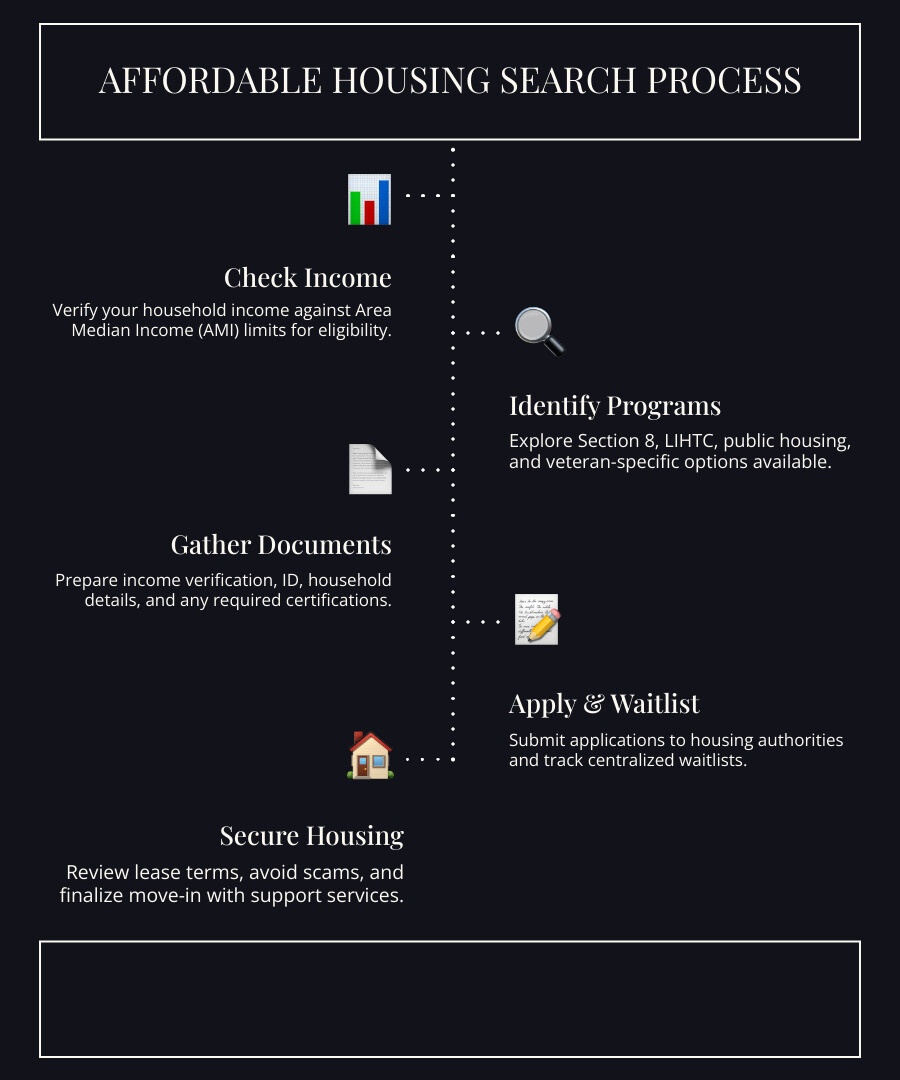
When searching for Income Restricted Rentals, you are looking at properties where rents are capped based on these AMI percentages. Navigating this landscape in California requires a clear strategy: you must know your household’s exact annual income, understand how your local county’s AMI affects your budget, and gather your paperwork before you start applying.
Key Affordable Housing Programs in California
California offers several major programs designed to help individuals and families secure stable housing. While they all aim to make rent affordable, they operate very differently.
Finding Low Income Housing Apartments for Rent via Section 8
The Housing Choice Voucher program, commonly known as Section 8, is the federal government’s primary program for assisting very low-income families, the elderly, and disabled individuals.
Under this program, the tenant pays roughly 30% of their monthly adjusted income toward rent, and the government pays the remaining balance directly to the landlord. There are two main types of vouchers:
- Tenant-Based Vouchers (Housing Choice Vouchers): These belong to you. If you move, the voucher moves with you to any privately owned property that accepts it.
- Project-Based Vouchers: These are tied to a specific apartment unit. If you move out of the unit, the assistance stays with the property.
These programs are administered locally by Public Housing Authorities (PHAs). Because demand is incredibly high, waitlists can be long, making it crucial to understand the application timeline. To learn more about how to secure and use these vouchers, check out our guide on Section 8 Housing Rentals What You Need to Know and How to Find Them.
Navigating LIHTC and Income-Restricted Communities
The Low-Income Housing Tax Credit (LIHTC) is a program that gives tax incentives to private developers to build or rehabilitate affordable rental housing. In exchange for the tax credits, developers agree to keep rents affordable for a set number of years.
Unlike Section 8, where your rent is a direct percentage of your personal income, LIHTC properties have fixed rents capped at a percentage of the AMI (usually 50% or 60%). For example, a studio in a newly constructed building might have a flat rent of $950 per month, reserved exclusively for households earning no more than 60% of the local AMI.
These properties are run by private property management companies rather than government housing authorities. This means you apply directly to the leasing office of the property itself. Best of all, LIHTC properties are legally required to accept Section 8 vouchers, allowing you to combine programs for maximum affordability. If you are new to this process, we recommend reading The Best Income Based Apartments for Beginners to help you get started.
How to Qualify and Apply for Affordable Housing
Qualifying for low income housing apartments for rent requires proving that your household meets the strict eligibility guidelines set by HUD and local administrators.
Your eligibility is determined by:
- Annual Gross Income: The total income earned by all adults in the household before taxes.
- Household Size: Income limits increase with the number of people living in the home.
- Documentation: You will need to provide tax returns, recent pay stubs, bank statements, social security letters, and identification for every household member.
Once you confirm your eligibility, the next step is navigating the waitlist. Because demand heavily outweighs supply, housing authorities and properties use waitlists to manage applicants. Some waitlists operate on a first-come, first-served basis, while others use a lottery system to ensure fairness.
Applying for Low Income Housing Apartments for Rent with No Waiting List
While waiting lists can feel discouraging, there are ways to find immediate openings. Some housing authorities utilize centralized waitlists, allowing you to submit a single application that places you on multiple property waitlists simultaneously. This simplifies the process and increases your chances of finding a home quickly.
Additionally, new LIHTC developments often open their application windows via public lotteries before construction is finished, giving proactive applicants a chance to secure a unit with minimal wait times. For practical strategies on finding these rare openings, read our resource on Low-Income Housing with No Waiting List.
Regional Resources and Search Portals in California

California has robust, localized search portals designed to connect you directly with available affordable units. Knowing where to look in your specific region can save you weeks of aimless searching.
Southern California Housing Opportunities
Southern California has some of the most active affordable housing networks in the state, supported by local housing authorities and dedicated nonprofits.
- Los Angeles: The Los Angeles Housing Department (LAHD) provides excellent resources for locating affordable units. To search for available, accessible, and income-restricted properties across the county, utilize the LA County Housing Resource Portal.
- San Diego: The San Diego Housing Commission (SDHC) owns or manages over 4,100 rental housing units at below-market rates. You can search their active listings and apply directly through the San Diego Housing Commission Affordable Rentals page. For a deeper dive into navigating this local market, see our Buyers Guide Low Income Apartments San Diego.
- Riverside: The local housing authority manages a wide range of affordable units. You can find active rental listings by visiting the Riverside Housing Authority Rentals portal. To understand the unique aspects of renting in this county, read our guide on How to Navigate the Riverside Low-Income Housing Market.
- Irvine: If you are searching in Orange County, you can find high-quality, master-planned income-restricted apartments by exploring affordable housing options in Irvine.
- Statewide Search: For broader searches across these regions, you can filter specifically for income-restricted properties using the California low-income apartment search portal.
Protecting Yourself from Rental Scams and Accessing Legal Aid

High demand for affordable housing unfortunately attracts scammers who target vulnerable renters. Protecting yourself requires vigilance and an understanding of tenant rights.
Always watch out for these major red flags:
- Upfront Fees: Never pay a security deposit or holding fee before you have physically toured the apartment and signed a formal lease.
- Wire Transfers or Cash Apps: Scammers often demand payments via wire transfers, cryptocurrency, or mobile cash apps because these transactions cannot be reversed.
- Hidden Addresses: If a landlord refuses to give you the exact address of the property or claims they cannot show it to you because they are out of the country, walk away.
- Unrealistic Prices: If a rent price seems too good to be true for the neighborhood, verify the listing on other trusted housing portals.
If you encounter a scam or face unfair treatment, California has strong tenant protection laws. If you are facing eviction, discrimination, or uninhabitable living conditions, reach out to local legal aid organizations. Many legal aid societies offer free services to low-income renters to help them stay securely housed.
Frequently Asked Questions about Affordable Housing
What is the difference between income-restricted and income-based housing?
Income-restricted housing (such as LIHTC properties) has a set, flat rent based on a percentage of the Area Median Income. Your rent stays the same even if your personal income fluctuates. Income-based housing (such as Section 8 or public housing) calculates your rent as a direct percentage of your actual household income (typically 30%), meaning your rent will decrease if your income drops.
How do I check my eligibility for California housing programs?
To check your eligibility, find your county’s current Area Median Income (AMI) chart on your local housing authority’s website. Compare your total household annual gross income against the household size limits (1-person, 2-person, etc.) listed for the 30%, 50%, or 80% AMI thresholds.
What should I do if I am facing immediate housing instability?
If you are at risk of losing your home, contact local emergency housing services immediately by calling 211. You can also reach out to local legal aid groups for eviction defense, and inquire about temporary rental or deposit assistance programs in your community.
Conclusion
Finding low income housing apartments for rent requires patience, organization, and the right resources, but a stable home is entirely within your reach.
At LifeSTEPS, we believe that housing is only the first step toward a thriving life. Through our human-centered support and dedicated case management, we help residents maintain their housing, achieving an incredible 93% housing retention rate.
We partner with key programs to offer robust support, including deposit assistance through the CalAIM program (providing 1 month paid in advance to help you move in). We also collaborate with initiatives like the Family Self-Sufficiency (FSS) program to help clients, including veterans, transition from rental stability to proud homeownership.
Our commitment to communities goes beyond housing. We support families through our afterschool educational programs — which have driven a 97% literacy improvement in our Summer Reading program — and we have awarded over $2.1M in scholarships to help residents achieve their higher education dreams.
We are here to walk alongside you on your journey to stability and self-sufficiency. To learn more about how we can support you, explore the LifeSTEPS Programs and Services page.
LifeSTEPS currently provides services in California only.


