


Based on Income Apartments Downtown: Yes, You Can Live in the City Center!
Based on Income Apartments Downtown: Yes, You Can Live in the City Center!
Yes, You Can Live Downtown on a Limited Income
Based on income apartments downtown are real, available, and more accessible than most people think — especially in California cities like Los Angeles, Oakland, San Jose, and San Diego.
Here is a quick overview of how they work:
- What they are: Rental apartments where your rent is tied to your household income, not a fixed market rate
- Who qualifies: Generally households earning at or below 60% of the Area Median Income (AMI) for their city
- How much you pay: Typically around 30% of your gross income toward rent, with utility allowances factored in
- Where to look: City housing portals, local housing authorities, and nonprofit organizations like LifeSTEPS
- How to apply: Submit an application to individual properties, join a waitlist, and gather income verification documents
For veterans transitioning to civilian life, affordable downtown housing can be a critical first step toward stability. Living close to transit, services, and employment makes a real difference — and programs exist specifically to help you get there.
The sections below walk you through exactly how to find, qualify for, and apply to income-based apartments in California’s urban centers.
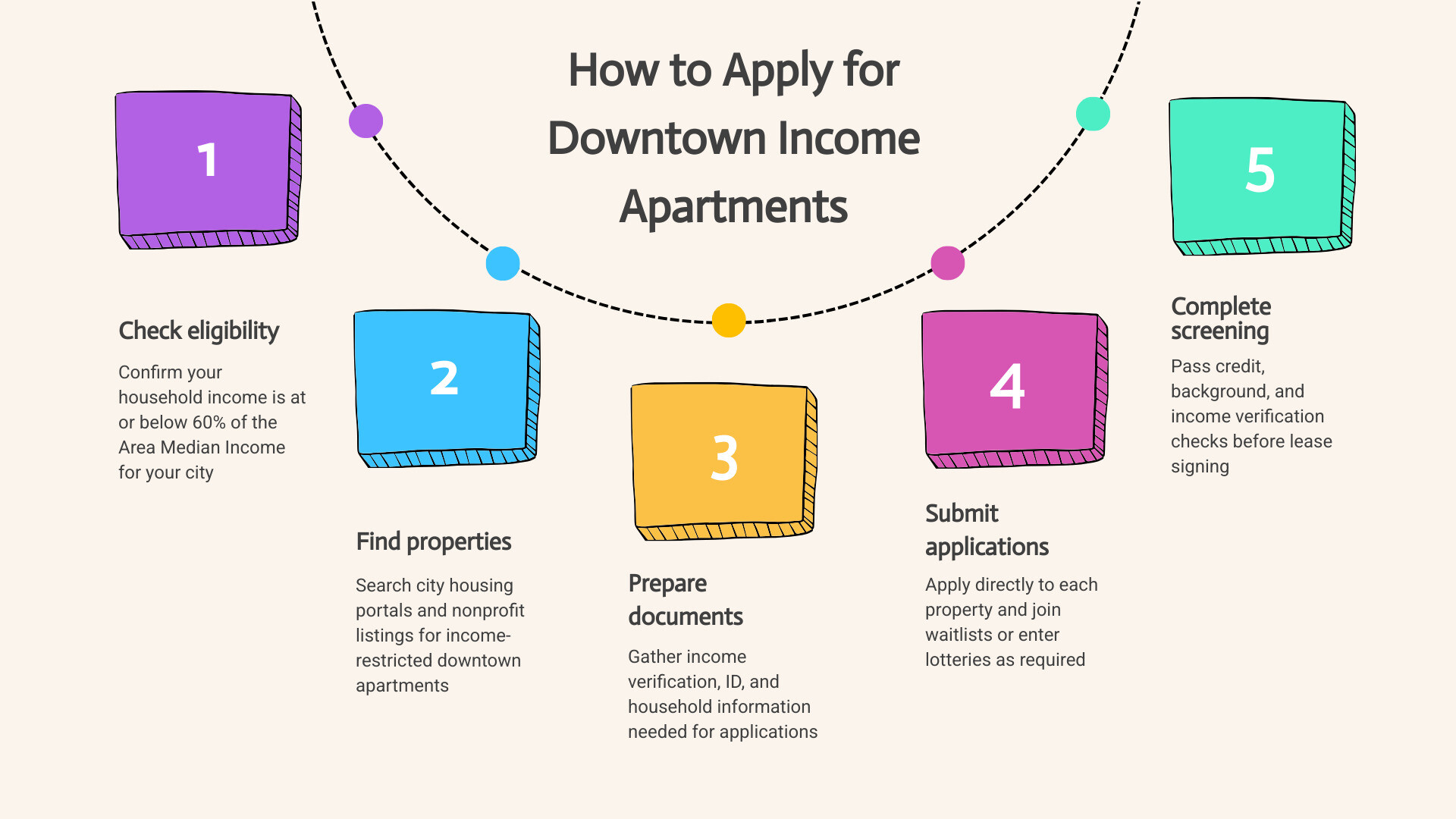
Quick based on income apartments downtown definitions:
Understanding Based on Income Apartments Downtown
To successfully secure an apartment in a bustling city center, it helps to understand how the government and developers define “affordable.” Affordable housing programs do not use a one-size-fits-all number. Instead, they rely on a metric called the Area Median Income (AMI).
The AMI is calculated every year by the federal government for different regions. It serves as the baseline for determining who qualifies for housing assistance. For most programs, eligibility is divided into specific tiers:
- Moderate Income: Households earning between 80% and 120% of the AMI.
- Low Income: Households earning at or below 80% of the AMI.
- Very Low Income: Households earning at or below 50% of the AMI.
- Extremely Low Income: Households earning at or below 30% of the AMI.
Because median incomes are much higher in metropolitan areas, the actual dollar limits can vary significantly by location and household size. For example, a single person applying for housing in a high-cost area will have a lower income limit than a family of four in the same city.
Once your eligibility is established, your rent is calculated using specific rent limits. In programs that are strictly “income-based,” your rent is capped at exactly 30% of your household’s adjusted gross monthly income. If your income drops, your rent drops. In other “income-restricted” properties, the rent is fixed at a below-market rate designated for a specific AMI tier (such as a flat rent set for households at the 60% AMI level).
To keep housing truly affordable, programs also factor in utility allowances. If you are responsible for paying your own electricity or gas, the property management team must deduct a standardized utility allowance from your monthly rent payment. This ensures that your combined housing and utility costs do not exceed your budget.
If you are looking for opportunities in Southern California, you can explore the official portal for affordable housing programs in Los Angeles to see how these limits are applied in real-time. For a broader look at how these properties operate, check out our comprehensive guide on income-restricted rentals.
Key Differences: Section 8, Public Housing, and Private Income-Restricted Units
As you begin your search for based on income apartments downtown, you will quickly realize there are three primary paths to securing an affordable unit. While they all aim to make city living affordable, they operate very differently.
1. Section 8 (Housing Choice Vouchers)
The Section 8 program provides tenant-based vouchers. This means the assistance is tied to you, not a specific building. If you receive a voucher from your local housing authority, you can choose any privately owned apartment that meets HUD safety standards and falls within the payment standard. You will pay roughly 30% of your income toward rent, and the government pays the rest directly to your landlord. The major benefit is portability; you can move and take your voucher with you.
2. Public Housing
Public housing consists of communities owned and managed directly by local public housing authorities. The rent is also based on 30% of your income, but the assistance is tied to the building. If you move out of a public housing development, you leave the rental assistance behind.
3. Privately Owned, Income-Restricted Units
Many of the newest, most modern downtown apartment buildings are privately owned but offer affordable units. Developers often build these in exchange for federal Low-Income Housing Tax Credits (LIHTC) or local zoning incentives. In these properties, a certain percentage of the units are set aside for households earning 50% to 60% of the AMI. The rent is capped at a fixed, predictable rate rather than fluctuating with your personal income month-to-month.
To explore options across the state, you can browse low-income rentals in California to see what private and subsidized units are currently on the market. If you are new to this process, we recommend starting with our resource on income-based apartments for beginners to build your foundational knowledge.
How to Find and Apply for Affordable Housing in California Cities

Finding a home in a highly competitive downtown market requires patience, organization, and a clear strategy. Because affordable units are in high demand, you must actively leverage local resources in the specific city where you want to live.
Here is how to search in key California cities as of June 2026:
- Los Angeles: The City of Los Angeles hosts a centralized affordable housing portal where you can search by neighborhood, budget, and bedroom size.
- San Diego: The San Diego Housing Commission provides a robust directory of affordable housing developments. You can search their updated listings via the Affordable Rentals – SDHC – San Diego Housing Commission page.
- Riverside: Riverside offers several designated low-income properties near its historic downtown center. You can check current listings and property details using Low Income Apartments for Rent in Riverside CA – 5 Rentals.
- Irvine: Known for master-planned communities, Irvine integrates affordable units directly into its modern apartment complexes. To find these options, explore the affordable housing options in Irvine resource.
- Oakland & San Jose: In the Bay Area, local municipal housing portals and regional directories, such as the Doorway Housing Portal, are the best places to track down open waiting lists and active lotteries for downtown properties.
If you are expanding your search, using a localized tool like income-based apartments near me can help you pinpoint complexes offering below-market rents in your preferred zip codes.
Navigating Waitlists for Based on Income Apartments Downtown
Because the demand for affordable housing in California’s urban centers is high, almost every downtown property utilizes a waiting list. These lists generally operate in one of two ways:
- Chronological (First-Come, First-Served): Applicants are placed on the list in the exact order their application is received.
- Lottery Systems: When a new building opens or a waitlist briefly unlocks, the property manager collects basic information from all applicants during a set window and runs a randomized lottery to determine placement.
To improve your chances, apply to as many open waiting lists as possible. Never pay a fee to join a legitimate affordable housing waitlist. Once you are on a list, it is your responsibility to keep your contact information updated. If the property manager tries to contact you for an update and your phone number or email has changed, you may be removed from the list entirely. If your application is rejected, the property is legally required to send you a written rejection notice, which you have the right to appeal.
Screening Criteria for Based on Income Apartments Downtown
Securing a spot on a waitlist is only the first step. Once your name reaches the top, the property management team will conduct a thorough tenant screening process. Knowing what they look for can help you prepare:
- Credit Checks: While property managers of affordable housing are often more lenient than luxury market-rate landlords, they will still review your credit history. They are primarily looking for unpaid utility bills, recent bankruptcies, or debts owed to previous landlords.
- Background Screening: A standard criminal background check and eviction history screening are routine. Having an eviction on your record within the last three to five years can make qualification more difficult.
- Income Verification: You must prove that you earn enough to pay the rent but not so much that you exceed the AMI limits. Property managers typically require your most recent federal tax returns, consecutive paystubs, bank statements, and benefit award letters (such as SSI or VA benefits). All verification documents must be dated within 90 days of your move-in date.
- Rent-to-Income Ratio: Even in affordable housing, landlords want to see that you have stable income. They typically require your gross household income to be at least 2 to 3 times your share of the contract rent.
Frequently Asked Questions About Affordable Downtown Living
What is the difference between income-restricted and income-based housing?
The primary difference lies in how your monthly rent is calculated. In income-based housing, your rent is dynamic and directly tied to your household earnings. If your income changes, your rent is adjusted so that you always pay roughly thirty percent of your income.
In income-restricted housing, the rent is fixed based on predetermined Area Median Income (AMI) limits. For example, a studio apartment might have a flat rent of $1,500 per month, reserved strictly for households earning 60% or less of the AMI. If your income changes, your rent remains the same, provided you still fall within the program’s overall eligibility guidelines.
Do downtown affordable apartments offer the same amenities as market-rate units?
Yes! Many modern affordable units are located within mixed-income buildings. This means affordable units and market-rate units are housed in the same building, sharing the exact same amenities.

These buildings often feature high-end community spaces, fitness centers, rooftop lounges, and shared laundry facilities. Many of these downtown properties are built with LEED energy-saving certifications, which can lower your electricity and water costs by 20% to 45%. Living downtown also provides excellent transit access, allowing you to walk or take public light rail to work, saving hundreds of dollars a month on car expenses. You can see an example of these high-quality urban spaces by exploring affordable housing options in downtown Los Angeles.
How does the annual recertification process work?
To remain in an income-restricted or income-based apartment, you must complete an annual recertification process. Every year, about 60 to 90 days before your lease renewal, the property manager will ask you to submit updated income verification and household size documentation.
This compliance review ensures that your household still meets the program’s requirements. If your income has increased slightly, you will usually be allowed to renew your lease, though your rent may adjust upward to match your new income bracket. If your income has increased significantly beyond the maximum limits, the property manager will work with you on a transition plan, giving you ample notice before you are required to transition to market-rate housing.
Conclusion
Securing one of the many based on income apartments downtown is a highly effective way to build a stable, vibrant life in the heart of the city. While the application and waitlist processes require diligence, the payoff of living in a walkable, resource-rich downtown neighborhood is immense.
At LifeSTEPS, we are dedicated to helping Californians transition to stable housing and long-term self-sufficiency. We are proud of our ninety-three percent housing retention rate, which reflects our commitment to keeping individuals and families securely housed. Through our partnership with the CalAIM program, we are able to offer critical deposit assistance, which can cover up to 1 month paid in advance to help you secure your new home.
Our support does not stop at housing. We collaborate with programs like the Family Self-Sufficiency (FSS) initiative to help our clients, including veterans, build assets and establish clear pathways to homeownership. We also believe in empowering the next generation. Our educational programs have achieved a ninety-seven percent literacy improvement through our Summer Reading initiative, and we have awarded over $2.1M in higher education scholarships to help students reach their academic dreams.
If you are ready to take the next step toward a stable, supportive home in California, we invite you to explore the LifeSTEPS programs and services page to see how we can assist you.
LifeSTEPS | Phone: (916) 965-2110 | LifeSTEPS
LifeSTEPS currently provides services in California only.


