


Top Subsidized Senior Housing Communities You Can Actually Afford
The Real Cost of Finding Affordable Senior Housing in California
Affordable senior housing in California is harder to find than ever — and for recently discharged veterans, the stakes couldn’t be higher.
Here is a quick overview of the main subsidized housing options available to seniors:
| Program | Who It’s For | How Rent Is Set |
|---|---|---|
| HUD Section 202 | Very low-income seniors 62+ | ~30% of adjusted gross income |
| LIHTC Properties | Low-to-moderate income seniors | Capped at 30%-60% of Area Median Income |
| Housing Choice Vouchers (Section 8) | Low-income renters, including seniors | 30% of adjusted gross income |
| Public Housing | Low-income seniors | Income-based |
| Project-Based Vouchers | Seniors at specific communities | Income-based, tied to the unit |
Seniors are currently the fastest-growing homeless population in the United States. Among senior veterans, the situation is especially urgent — 77% live in poverty, and nearly half report feeling socially isolated. For veterans transitioning out of military service, finding stable, affordable housing is not just a preference. It is the foundation that makes everything else possible.
The good news is that real options exist — subsidized communities, rental assistance programs, and supportive services designed specifically for low-income seniors and veterans in California.
This guide cuts through the confusion and lists the top affordable senior housing communities you can actually get into.
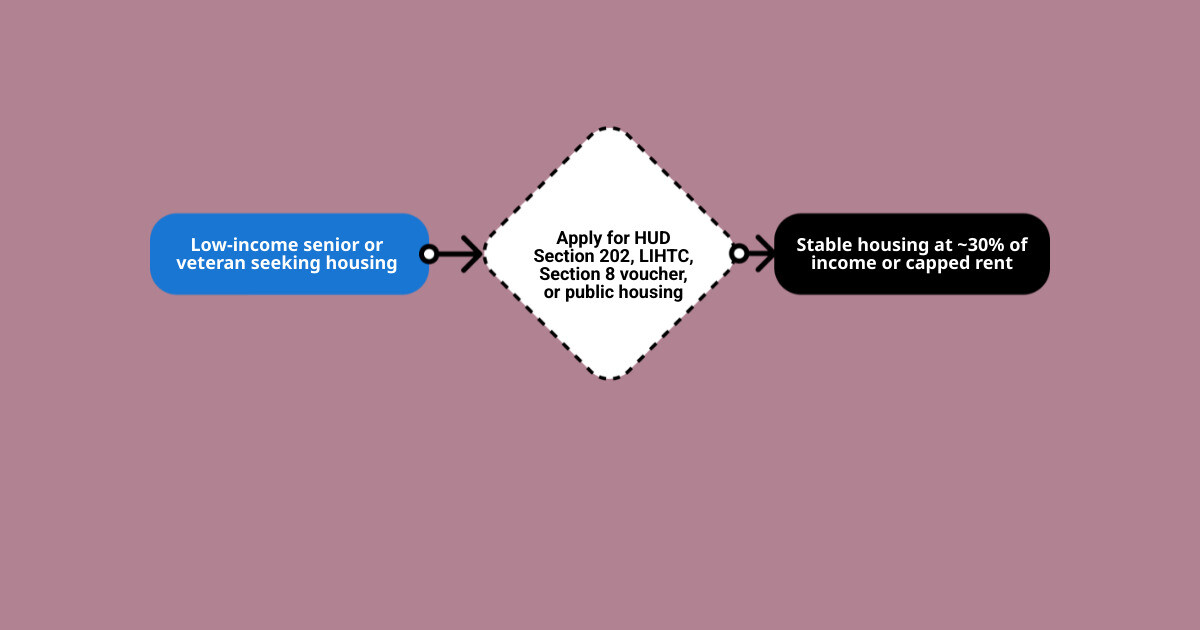
Common affordable senior housing vocab:
Understanding Affordable Senior Housing Options and Programs
Navigating subsidized housing can feel like trying to solve a Rubik’s Cube blindfolded. To find a home that fits your budget, it helps to understand how subsidized housing differs from market-rate options.
Market-rate housing is priced solely on what the local real estate market will bear. Subsidized housing, on the other hand, relies on government funding or tax incentives to keep rents artificially low. This ensures that older adults on fixed incomes are not priced out of their neighborhoods.
The foundation of almost all affordable housing programs is the Area Median Income (AMI). Calculated annually by the U.S. Department of Housing and Urban Development (HUD), the AMI represents the midpoint income for a specific county or metropolitan area.
Eligibility for senior housing programs is typically grouped into income tiers based on this metric:
- Moderate Income: 80% of the AMI.
- Low Income: 50% of the AMI.
- Very Low Income: 30% of the AMI.
If you want to dive deeper into how these metrics shape local housing options, our comprehensive low-income senior housing guide breaks down the numbers county by county.
HUD Section 202 and Affordable Senior Housing
The HUD Section 202 program is specifically designed to help very low-income seniors age in place with dignity. Unlike general public housing, Section 202 funds are used exclusively to build and operate multifamily communities for very low-income elderly households (typically defined as individuals aged 62 or older).
One of the greatest benefits of Section 202 housing is the integration of supportive services. These communities often employ on-site Service Coordinators. These professionals help residents navigate healthcare systems, arrange transportation, organize social activities, and access meal programs.
This model allows seniors to live independently in their own private apartments while enjoying the safety net of a supportive community. If you are looking for localized options in Southern California, you can explore the Los Angeles County senior housing resources directory to find open Section 202 waitlists and local senior services.
LIHTC and Affordable Senior Housing
The Low-Income Housing Tax Credit (LIHTC) is the nation’s primary tool for creating new affordable rental housing. Instead of directly subsidizing rents, the federal government issues tax credits to private developers who commit to keeping a percentage of their units affordable for a set period (usually 30 to 55 years).
LIHTC properties are not strictly “income-based” in the way HUD properties are. Instead, rents are capped based on designated income tiers—usually targeting households earning 30%, 40%, 50%, or 60% of the Area Median Income.
Because rents are set based on these percentages rather than a dynamic 30% of your specific income, many LIHTC properties enforce minimum income guidelines to ensure you can afford the rent. However, exceptions are frequently made. For instance, minimum income requirements are typically waived if you hold a tenant-based rental subsidy like a Section 8 voucher, or if you have cash assets equal to at least six months of rent.
To learn more about how tax credits keep senior living communities within reach, check out our guide on affordable homes for seniors.
Housing Choice Vouchers and Rental Assistance
The Housing Choice Voucher (HCV) program, commonly known as Section 8, is a tenant-based subsidy that allows low-income seniors to find their own housing in the private market. Under this program, the local public housing authority pays a portion of the rent directly to the landlord, and the senior pays the remaining balance.
The beauty of Section 8 is the “30 percent income rule.” No matter how much the market-rate rent is (within reasonable limits set by the housing authority), the senior resident’s share of the rent is strictly capped at approximately 30% of their adjusted gross monthly income. This provides immense financial relief for older adults living on modest Social Security benefits or pensions.
In addition to tenant-based vouchers, some communities offer Project-Based Vouchers. In this setup, the voucher is tied directly to a specific apartment unit rather than the individual tenant. If you move out, the voucher stays with the property.
To understand how to maximize these vouchers and other federal safety nets, read the grandparents’ guide to affordable housing for elderly folks.
Top Subsidized Senior Housing Communities in California

Finding affordable senior housing in California requires knowing where to look. From the quiet suburbs of the East Bay to the bustling neighborhoods of Southern California, communities are utilizing innovative designs to help seniors stay active, connected, and financially stable. Many of the most successful developments emphasize transit-oriented design, placing apartments within walking distance of light rail stations, bus lines, and medical centers to ensure residents maintain their mobility without the expense of owning a car.
If you are looking for a comprehensive directory of properties across the state, our ultimate affordable senior housing list is an excellent place to start your search.
Affordable Senior Apartments in Gilroy
Located in Southern Santa Clara County, Gilroy offers excellent options for active seniors who value walkability and green spaces. By converting older properties or developing new, transit-oriented complexes, housing providers in this region have created thriving communities.
A prime example of this is the renovated senior living model in Gilroy. Originally built in the late 1970s and fully rehabilitated to modern standards, this community offers spacious one-bedroom apartments designed specifically for low-income seniors.
What makes this location stand out is its emphasis on active lifestyle amenities. It features community gardens where residents can grow their own fresh produce and socialize with neighbors. It is also highly walkable, situated directly adjacent to major transit lines and bus stops, making it easy for residents to run errands or attend medical appointments without a car.
Affordable Senior Rentals in San Diego
San Diego is famous for its beautiful coastline, but it is also home to some of the state’s most progressive affordable housing initiatives. The local housing authority plays a direct role in creating and preserving affordable rental units for seniors on fixed incomes.
By partnering with private developers and non-profit organizations, the city offers a variety of senior-dedicated properties where rents are kept well below market rates. These communities frequently feature secured entryways, elevators for easy accessibility, and on-site laundry facilities.
To view active listings, check income limits, and learn how to apply for municipal senior units, visit the San Diego Housing Commission rentals portal.
Income-Restricted Senior Living in Irvine and Riverside
In Orange County and the Inland Empire, cities like Irvine and Riverside have embraced income-restricted senior housing models that prioritize holistic wellness. These properties are designed to help seniors stretch their monthly budgets as far as possible.
In these regions, many affordable senior apartments offer all-inclusive pricing models. This means utilities—and sometimes even Wi-Fi—are included in the monthly rent price, eliminating the stress of fluctuating utility bills during hot California summers. These properties are also strategically located near shopping centers, pharmacies, and public transit hubs.
To explore available options in these Southern California cities, you can browse the Irvine income-restricted senior apartments database or research local municipal programs through the Riverside affordable rentals housing authority page.
How to Apply and Navigate Waitlists Successfully
Applying for affordable senior housing requires patience, organization, and a proactive strategy. Because the demand for subsidized housing in California far exceeds the supply, waitlists are incredibly common. It is not unusual for a waitlist to extend from one to three years, making early planning essential.
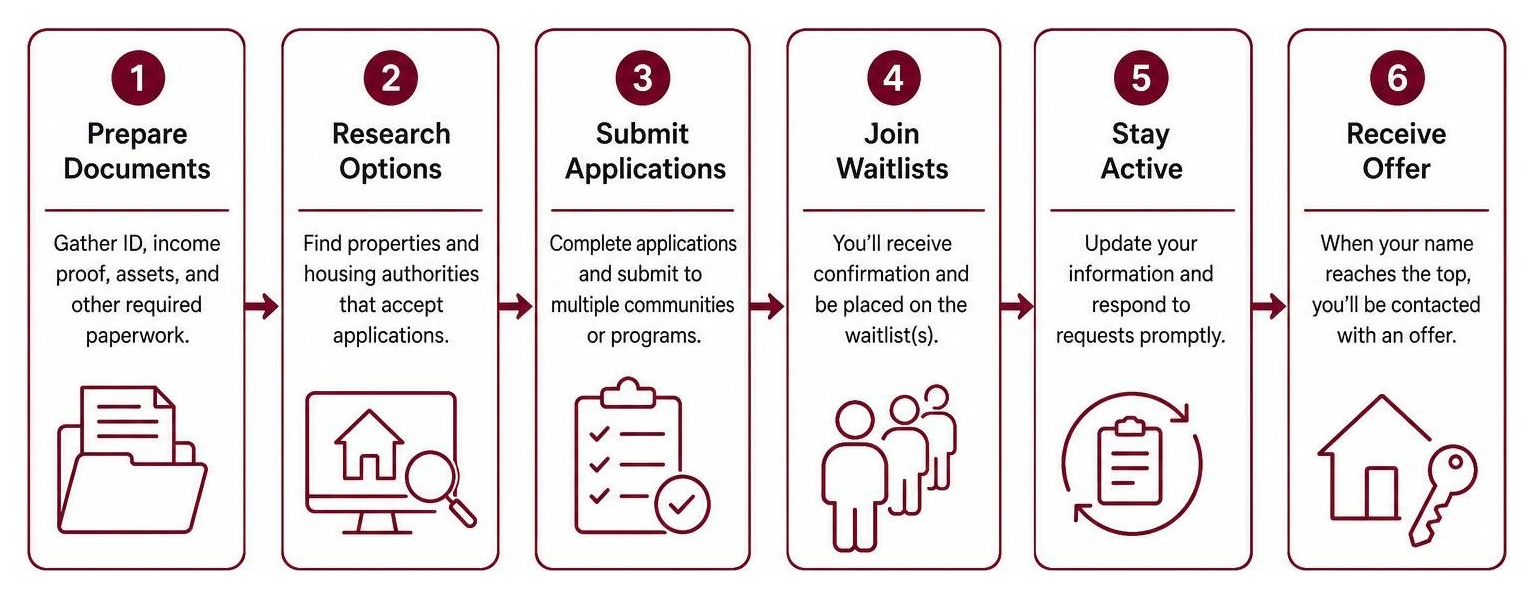
To navigate this process successfully, we recommend taking the following steps:
- Gather Your Documentation: Before you apply, compile all necessary paperwork. This includes government-issued ID, Social Security cards, proof of income (such as Social Security award letters, pension statements, or tax returns), and asset verification (bank statements).
- Consult a HUD-Approved Housing Counselor: These counselors provide free or low-cost advice on renting, budgeting, and navigating public housing programs. They can help you identify open waitlists and ensure your application is filled out correctly.
- Apply to Multiple Properties: Don’t put all your eggs in one basket. Apply to multiple communities and housing authorities simultaneously to increase your chances of securing a unit.
- Keep Your Contact Information Updated: If a housing authority or property manager tries to contact you and your phone number or address has changed, you will be removed from the waitlist. Update your information immediately if you move or change numbers.
- Understand the Screening Process: Once you reach the top of a waitlist, you will undergo a thorough screening process. This includes income verification, credit checks, and background checks.
For a detailed walkthrough on how to support an aging family member through this transition, read our guide on how to secure safe and affordable housing programs for elderly relatives.
Frequently Asked Questions About Subsidized Senior Housing
Who qualifies for subsidized senior housing in California?
In California, eligibility is primarily determined by age and income. Most senior-dedicated housing communities require the head of household to be at least 62 years old, though some LIHTC properties lower this requirement to 55.
Additionally, some communities extend eligibility to adults aged 18 or older who require barrier-free, accessible housing due to physical or mobility disabilities. Economically, your household income must fall below the limits established by HUD for your county—typically capped at 50% or 60% of the Area Median Income (AMI), with many programs prioritizing those at or below 30% AMI.
Are there housing options specifically for veterans or seniors with disabilities?
Yes. Older veterans and seniors with disabilities have access to dedicated housing resources. The HUD-VASH program combines Housing Choice Vouchers with case management and clinical services provided by the Department of Veterans Affairs (VA) to help homeless veterans find permanent housing.
Furthermore, community-based supportive housing models exist throughout California. These programs often feature a low case manager-to-resident ratio (such as 1:25) to provide intensive, personalized care. They also offer specialized services like legal clinics for VA benefits, wellness workshops, and social activities designed to combat isolation and support cognitive health.
What is the difference between independent living and assisted living?
The primary difference lies in the level of daily care provided. Subsidized senior housing is almost always designed for independent living. This means residents live in their own private apartments and must be capable of fulfilling standard lease requirements on their own or with the help of outside, self-arranged personal care.
Assisted living facilities, by contrast, provide hands-on help with daily activities such as bathing, dressing, medication management, and meals. While some municipal programs offer subsidized assisted living on a limited basis, standard HUD and LIHTC properties do not provide medical or personal care services as part of the rent.
Conclusion: Securing Stability and Peace of Mind
Finding safe, affordable senior housing is about more than just securing a roof over your head; it is about reclaiming your independence, health, and peace of mind.
At LifeSTEPS, we believe that stable housing is the absolute foundation of a healthy, fulfilling life. Without a secure place to call home, it is nearly impossible to focus on personal wellness, education, or long-term goals.
Our human-centered supportive services are designed to walk alongside individuals and families as they build pathways to self-sufficiency. We are proud of our measurable community impact, including:
- An outstanding 93% housing retention rate for the vulnerable populations we serve.
- Direct financial support through the CalAIM program, which can provide critical deposit assistance (including paying 1 month of rent in advance) to help seniors transition into stable homes.
- A strong commitment to education and youth development, achieving a 97% literacy improvement in our Summer Reading programs and awarding over $2.1 million in scholarships to help the next generation thrive.
By combining physical housing stability with wrap-around social services, we help seniors, veterans, and families across California build strong, resilient communities.
To learn more about how we can support you or your loved ones during this transition, explore our ultimate affordable senior housing list.
Please visit our website for more information: LifeSTEPS
LifeSTEPS currently provides services in California only.


