


Emergency Rental Assistance Legit? Step-by-Step Guide to CalAIM Program
Is Emergency Rental Assistance Legit or a Scam?
When facing back rent or a sudden loss of income, it is natural to wonder: is emergency rental assistance legit? The answer is an absolute yes. Authorized federally under Section 501 of the Consolidated Appropriations Act, 2021 (ERA1) and Section 3201 of the American Rescue Plan Act of 2021 (ERA2), the federal Emergency Rental Assistance initiative delivered more than $46 billion nationwide to prevent evictions and stabilize vulnerable households.
Under federal guidelines provided in the U.S. Department of the Treasury Emergency Rental Assistance Frequently Asked Questions, these funds were disbursed directly to states, territories, and local governments with populations exceeding 200,000 residents. Rather than operating through a single national clearinghouse, legitimate relief is managed locally by county departments of social services, municipal housing authorities, and certified nonprofit service organizations.
Because official programs operate under strict statutory mandates, authentic relief efforts will never charge an application fee, screening charge, or administrative cost. For households navigating urgent financial barriers, our free rent assistance near me guide highlights trusted community entry points that connect families directly to legitimate resources without hidden costs.
How to Verify Is Emergency Rental Assistance Legit Across California
To determine if an emergency housing assistance opportunity is authentic in California, always check the source domain and municipal program backing. Legitimate initiatives are hosted on official .gov portals, established public housing authority platforms, or vetted community resource networks.
Across California communities—from Los Angeles and Irvine to San Diego, Riverside, and the greater Bay Area—local jurisdictions established dedicated rent relief pathways. Exploring rent relief near you unlocking city and county assistance ensures you are interfacing directly with approved administrative bodies rather than suspicious third parties.
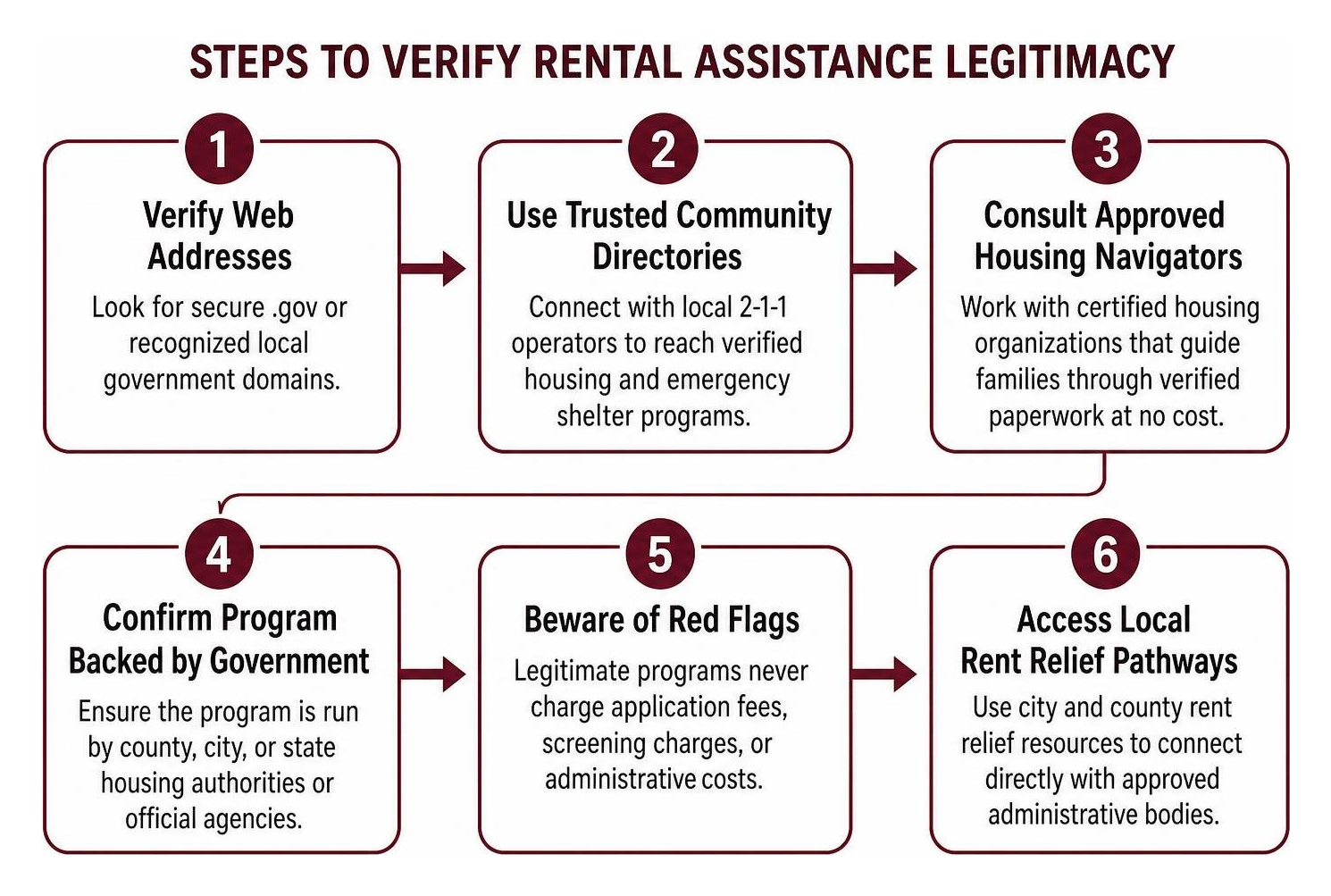
When reviewing local housing programs:
- Verify Web Addresses: Look for secure
.govor recognized local government domains. - Use Trusted Community Directories: Connect with local 2-1-1 operators, who facilitate millions of connections to verified housing and emergency shelter programs annually.
- Consult Approved Housing Navigators: Connect with certified housing organizations that guide families through verified paperwork without charging service fees.
Common Red Flags and Imposter Scams to Avoid
Fraudulent operators routinely target individuals in severe housing distress by mimicking official agency branding. Protecting your personal information starts with identifying clear red flags:
- Demands for Upfront Fees: Scammers often promise to “expedite” or “guarantee” your relief funds if you pay an application fee via wire transfer, gift cards, cash apps, or cryptocurrency. Legitimate government programs are prohibited by law from charging fees.
- Unsolicited Communications: Federal and state agencies do not send direct text messages, social media direct messages, or automated phone calls demanding sensitive banking credentials or Social Security numbers.
- Spoofed Websites: Fraudulent websites often copy government logos but use suspicious non-governmental URLs. Always check for legitimate administrative contact points.
If you encounter a suspicious website or message, report it immediately to the Federal Trade Commission (FTC) and your local consumer protection office. Recognizing these warning signs is an essential step in staying put how community programs can prevent eviction safely.
Eligibility Requirements and Covered Housing Costs
To qualify for government-backed rental relief, applicants must satisfy clear statutory criteria established by the Treasury and local housing agencies. These guidelines prioritize households experiencing severe financial hardship and imminent displacement:
- Income Thresholds: Household gross income must be at or below 80% of the Area Median Income (AMI) for the local county, with statutory prioritization given to households earning at or below 50% AMI.
- Financial Hardship: A member of the household must have qualified for unemployment benefits or experienced significant financial hardship (such as substantial medical debt, reduction in work hours, or unexpected living expenses).
- Risk of Housing Instability: The applicant must demonstrate a clear risk of experiencing homelessness or housing instability, typically shown through a past-due rent notice, utility shutoff warning, or eviction notice.
Applicants can navigate these criteria through established financial hardship assistance programs designed to help households establish categorical eligibility.
Eligible Expenses: Rent, Utilities, and Arrears
Legitimate emergency assistance covers a wide range of housing-related debts to secure total housing stabilization.
| Expense Category | Covered by Emergency Relief | Not Covered by Emergency Relief |
|---|---|---|
| Past-Due Rent (Arrears) | Yes (accrued back rent) | Rent debt accrued prior to March 13, 2020 |
| Prospective Rent | Yes (in forward increments) | Mortgage payments on owned real estate |
| Home Utilities | Yes (electric, gas, water, sewer, trash) | Personal loans, credit cards, or car payments |
| Energy & Heating Debt | Yes (fuel oil and home energy arrears) | Discretionary entertainment subscriptions |
| Housing Stability Costs | Yes (security deposits, screening fees) | Unapproved personal property repairs |
According to the Emergency Rental Assistance Frequently Asked Questions | Internal Revenue Service, assistance payments made to cover rent and home utilities are completely excluded from the tenant’s gross income and do not trigger tax liabilities for the renter.
Understanding Why Landlord Participation in Emergency Rental Assistance Is Legit
Property owners have clear statutory incentives to participate in emergency rental assistance programs. When a landlord participates:
- Direct disbursements clear accumulated rental arrears from tenant ledgers.
- Program conditions require landlords to waive late fees accrued during the covered assistance months.
- Landlords agree to standard eviction protections, preventing no-fault lease terminations while assistance is active.
Even if a property owner initially hesitates to participate, Treasury regulations permit distributing agencies to disburse payments directly to qualified tenants after documented outreach attempts. Understanding these built-in protections is detailed in our eviction prevention programs complete guide.
Step-by-Step Application Process and Required Documentation

Applying for legitimate rental relief requires organized documentation. Having your paperwork prepared in advance ensures your application moves smoothly through administrative verification pathways. Reviewing how emergency rental assistance works and how to get it can help streamline this preparation.
Essential Documents for Tenants and Housing Providers
Gather the following items before submitting your application:
- Proof of Identity: Government-issued photo identification, driver’s license, or municipal ID.
- Proof of Residence & Lease Agreement: A signed formal residential lease, or alternate verification such as recent utility bills, bank statements showing regular rent withdrawals, or a written property owner attestation.
- Income Verification: Recent pay stubs, W-2 forms, 1099 tax statements, or unemployment benefit determination letters. If formal wage documentation is unavailable (such as for gig workers), written self-attestation pathways are permitted under federal and local guidelines.
- Proof of Housing Instability: Past-due rent ledgers, formal 3-day or 30-day notices to pay rent or quit, utility disconnect notices, or documentation used when seeking rental assistance with eviction notice.
- Housing Provider Details: Landlord contact information, completed IRS Form W-9, and direct deposit routing details for direct disbursement.
CalAIM Housing Support and Security Deposit Assistance
For California residents transitioning from housing insecurity or navigating major life transitions, the state’s CalAIM (California Advancing and Innovating Medi-Cal) program provides a powerful framework of Community Supports.
Through CalAIM, eligible participants can receive comprehensive housing transition navigation, tenancy sustaining services, and housing deposit assistance. For eligible households entering a new home, deposit assistance through CalAIM includes 1 month paid in advance for deposit assistance, helping eliminate the upfront financial barriers of relocation.
Discover more about leveraging these resources through your guide to rental aid securing help for deposits and initial rent payments.
For example, when a veteran client, Marcus (name changed to protect privacy), faced sudden displacement after unexpected medical costs, our team connected him with housing stability services. Through comprehensive case navigation and CalAIM deposit support, Marcus secured permanent housing and maintained his tenancy with ongoing wraparound support.
Long-Term Housing Stability and Educational Support
Resolving immediate rent arrears is the first step toward lifelong independence. Long-term housing security requires connecting immediate housing relief with multi-generational support systems, including educational enrichment and career advancement.
LifeSTEPS provides housing support across California that achieves an outstanding 93% housing retention rate, keeping families stably housed year after year. Beyond direct housing stability, empowering communities requires investing in the next generation. Our comprehensive educational programs deliver measurable outcomes, including a 97% literacy improvement for youth participating in Summer Reading programs and $2.1M in scholarships awarded to support residents pursuing higher education.
Building these foundational pillars ensures that families not only retain their front doors today, but also build self-sufficiency for tomorrow, as detailed in the ultimate guide to rental and deposit assistance.
Frequently Asked Questions About Emergency Rental Assistance
Is Emergency Rental Assistance Still Available in California?
While broad, pandemic-era federal programs (such as ERA1 and ERA2) completed their main disbursement cycles, emergency rental assistance remains available across California through localized municipal funds, county housing stability initiatives, and state healthcare integration programs like CalAIM. Renters can learn more about active regional relief channels in our emergency rental assistance california complete guide.
Are There Any Fees to Apply for Emergency Rent Relief?
No. There are never any fees to apply for or receive legitimate emergency rental assistance. Charging an application fee, screening fee, or fee to “speed up” approval is illegal under program guidelines and is an immediate sign of a scam. You can read more about consumer protections in dont pack your bags yet the ultimate guide to rental assistance programs.
Are Rental Assistance Payments Considered Taxable Income for Renters?
No. The Internal Revenue Service (IRS) has confirmed that emergency rental and utility assistance payments are excluded from gross income for eligible renter households. However, property owners and utility companies who receive payments on behalf of tenants must report those disbursements as taxable business revenue, as outlined in the complete guide to government rental subsidy and erap assistance.
Conclusion
Emergency rental assistance is a fully legitimate, government-authorized safety net designed to protect individuals and families from displacement during financial crises. By verifying programs through official channels, preparing your application documentation in advance, and watching out for imposter scams, you can safely secure the relief you need.
LifeSTEPS provides comprehensive housing navigation, afterschool programs, and higher education support to help California communities achieve permanent self-sufficiency. If you or a family member need guidance navigating housing stability pathways, explore our emergency rental assistance services to connect with trusted support.
For media inquiries, contact: bex@lifestepsusa.org
LifeSTEPS currently provides services in California only.


