


The Complete Guide to Government Rental Subsidy and ERAP Assistance
The Complete Guide to Government Rental Subsidy and ERAP Assistance
What Is a Government Rental Subsidy — and Who Qualifies?
A government rental subsidy is a form of financial assistance that helps low-income renters afford safe, stable housing by covering part of their monthly rent — either paid directly to landlords or built into reduced rents at specific properties.
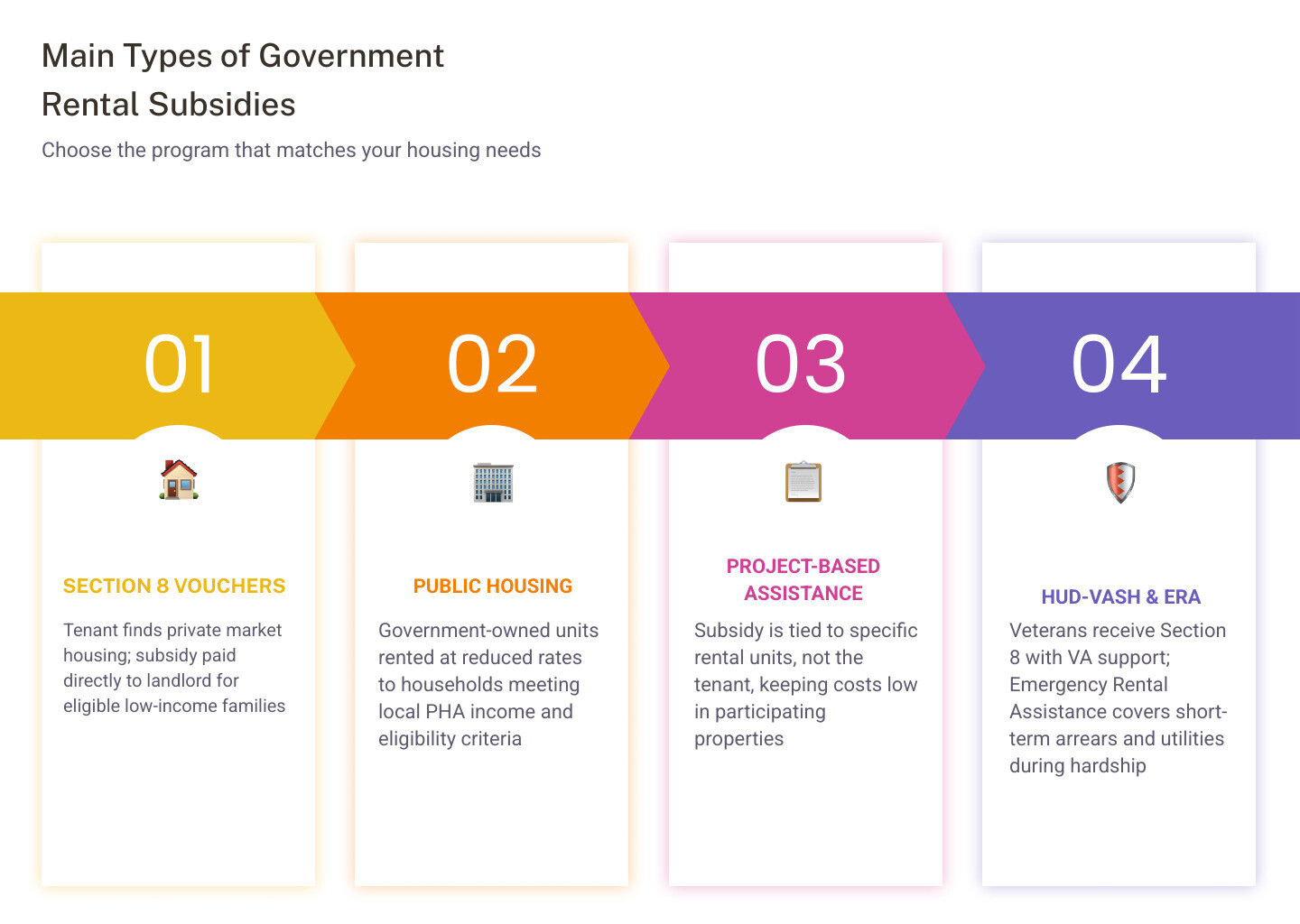
Quick Answer: The main types of government rental subsidies are:
| Program | How It Works | Who It’s For |
|---|---|---|
| Section 8 / Housing Choice Voucher | Tenant finds private housing; subsidy paid to landlord | Low-income individuals and families |
| Public Housing | Government-owned units at reduced rent | Low-income households meeting local PHA criteria |
| Project-Based Rental Assistance | Subsidy tied to specific units, not the tenant | Low-income renters in participating properties |
| HUD-VASH | Section 8 voucher paired with VA case management | Veterans experiencing homelessness |
| Emergency Rental Assistance (ERA) | Short-term help for rent arrears and utilities | Renters facing COVID-related hardship |
For recently discharged veterans navigating civilian life, these programs can be the difference between stable housing and homelessness. Yet the landscape is complex — different programs have different eligibility rules, waiting lists, and application processes.
This guide breaks it all down clearly, so you know exactly what’s available, whether you qualify, and how to take your next step in California.
LifeSTEPS currently provides services in California only.
Quick government rental subsidy definitions:
Understanding the Government Rental Subsidy Landscape
Navigating housing affordability in California can feel overwhelming. With rents rising faster than average household incomes, securing a government rental subsidy is one of the most effective ways to establish long-term housing stability.
The U.S. Department of Housing and Urban Development (HUD) funds these programs at the federal level, but they are administered locally by Public Housing Agencies (PHAs). Because resources are finite, programs are designed to assist those with the greatest financial need. Understanding how these programs differ is the first step toward finding the right fit for your household. For more details on how these initiatives operate, explore our comprehensive overview of rental subsidy programs.
How a Government Rental Subsidy Works via Section 8 Vouchers
The Housing Choice Voucher (HCV) program, commonly known as Section 8, is the federal government’s major initiative for assisting very low-income families, the elderly, and people with disabilities.
Unlike traditional public housing, Section 8 is a tenant-based program. This means the subsidy belongs to you, the tenant, rather than the physical apartment. Once you are issued a voucher, you are free to choose any housing in the private market that meets the program’s health and safety standards.
When you find a qualifying rental, you sign a lease with a private landlord. You will generally pay around 30 percent of your monthly adjusted income toward rent, while the local PHA pays the remaining balance directly to the landlord. This model gives you the flexibility to choose where you live, allowing you to stay close to job opportunities, schools, and supportive community networks. To learn more about navigating this program, read our guide to Section 8 housing rentals.
Public Housing and Project-Based Subsidies
While Section 8 vouchers offer portability, project-based subsidies and public housing operate under a different model. In these programs, the financial assistance is tied directly to the physical rental unit.
- Public Housing: These are properties owned and managed directly by local housing authorities. If you qualify, you move into a designated public housing community, and your rent is calculated based on your household income.
- Project-Based Rental Assistance (PBRA): Under this model, HUD contracts with private multifamily housing owners to provide affordable units. The subsidy stays with the building. If you move out of a project-based unit, you do not take the rental subsidy with you; it remains with the unit for the next qualifying tenant.
These project-based developments represent a massive portion of the housing safety net. According to federal Project-Based Rental Assistance budget data, PBRA programs support approximately 1.3 million safe, decent, and affordable housing units nationwide, serving highly vulnerable populations, including seniors, people with disabilities, and families.
Eligibility, Rent Calculation, and Application Steps
To access a government rental subsidy, you must meet specific federal and state criteria. Eligibility is primarily determined by your annual gross income and household size, though housing authorities also prioritize specific vulnerable populations.
| Program Type | Primary Eligibility Focus | Portability (Can You Move with It?) | Average Tenant Rent Contribution |
|---|---|---|---|
| Housing Choice Voucher (Section 8) | Extremely & Very Low-Income | Yes (Within USA and participating PHAs) | 30% of adjusted monthly income |
| Public Housing | Low-Income (up to 80% AMI) | No (Tied to PHA property) | 30% of adjusted monthly income |
| Project-Based Rental Assistance | Low-Income / Senior / Disabled | No (Tied to specific private unit) | 30% of adjusted monthly income |
| HUD-VASH | Homeless Veterans | Yes (With continuing VA case management) | 30% of adjusted monthly income |
Income Limits and Household Determinations
Income limits are set by HUD and are calculated as a percentage of the Area Median Income (AMI) for your specific county. Because living costs vary wildly across California, an eligible income in Los Angeles or Orange County will look different than in Riverside or San Diego.
HUD categorizes income eligibility into three tiers:
- Low-Income: Households earning 80% or less of the county’s AMI.
- Very Low-Income: Households earning 50% or less of the county’s AMI.
- Extremely Low-Income: Households earning 30% or less of the county’s AMI (or the federal poverty guideline, whichever is higher).
Most Section 8 vouchers are legally targeted toward extremely low-income households to ensure aid reaches those in deepest need. When determining your household income, HUD rules require the inclusion of all wages, social security payments, business income, and regular cash contributions. However, certain exclusions apply, such as the earned income of minors under 18. For a detailed breakdown of what counts, consult the HUD guidelines on determining annual income. If you are looking for immediate pathways to qualify, check out our resource on low-income rental assistance options.
Calculating Your Portion of the Government Rental Subsidy
Once approved, your actual rent payment is determined using a precise formula established by federal law. Under federal statutory rent limits, a subsidized household’s rent is typically set at the highest of:
- 30% of their monthly adjusted income (gross income minus allowable deductions, such as medical expenses for seniors or childcare costs).
- 10% of their gross monthly income.
- The welfare rent allowance (if receiving public assistance designed for housing).
Local housing authorities also factor in a utility allowance. If your rented apartment does not include utilities in the rent, the PHA subtracts a designated utility allowance from your rent portion, ensuring your combined rent and utility costs do not exceed the 30% threshold.
Finding Local Housing Agencies and Required Documents

Because federal housing programs are managed locally, you must apply directly through the Public Housing Agency (PHA) serving your city or county. To begin, use the official directory of HUD California resources to locate the office nearest you.
When applying, preparation is key. You will need to provide extensive documentation for every member of your household, including:
- Proof of Income: Recent pay stubs, tax returns, W-2s, or benefit letters (such as SSI, SSDI, or veteran pensions).
- Identification: Government-issued photo IDs, birth certificates, and Social Security cards for all household members.
- Housing Status: Verification of your current living situation, such as utility bills, a current lease, or an official notice of eviction.
Portability and Finding Voucher-Friendly Landlords
One of the greatest features of the Housing Choice Voucher program is “portability.” This rule allows you to transfer your voucher to another jurisdiction, provided you lived in the area of the issuing PHA when you first applied, or if you meet specific transfer criteria. This means you can move to other parts of California or even out of state without losing your government rental subsidy, as long as a local housing authority is available to administer it.
Finding a landlord who accepts vouchers can sometimes be challenging, but California law protects voucher holders. State fair housing laws prohibit landlords from discriminating against applicants based on their source of income, which legally includes Section 8 vouchers. When searching for a home, look for properties that advertise voucher acceptance, or use our guide on how to find housing voucher apartments to streamline your search.
California State and Local Rental Assistance Programs
While federal programs provide the foundation of rental aid, California state and local initiatives offer crucial supplementary resources. These programs are especially vital for households waiting on multi-year Section 8 waitlists or facing immediate housing crises.

In Southern California and the Bay Area, local counties have developed targeted programs to prevent homelessness. For example, the General Relief (GR) Housing Subsidy and Case Management Program provides emergency rental subsidies to adults without children who are experiencing or at risk of homelessness. This program offers up to $475 per month for a single person and up to $950 for a couple, with participants contributing a small portion from their monthly GR grant. Additionally, approved participants can access up to $500 in once-in-a-lifetime move-in assistance to cover security deposits or utility hookups.
For a broader look at statewide resources, read our guide on emergency rental assistance in California.
County-Specific Programs in Southern California
If you live in Southern California, several county-specific agencies provide direct rental relief, voucher administration, and emergency assistance:
- Los Angeles County: The LA County Rent Relief Program provides critical financial assistance to landlords on behalf of low-income tenants facing rent arrears, helping stabilize families and prevent evictions.
- San Diego County: The Housing Authority of the County of San Diego administers extensive local programs. You can explore their local voucher listings and emergency housing resources on the San Diego County Rental Assistance page.
- Riverside County: Local initiatives like the Riverside CARES program coordinate local funding to assist residents with emergency utility payments, rental relief, and housing-related support services.
- Orange County: The Orange County Housing Authority manages Section 8 vouchers and specialized supportive housing programs across the county, offering a vital resource for local families and seniors.
Frequently Asked Questions about Rental Subsidies
What is the difference between tenant-based and project-based subsidies?
The primary difference lies in portability. A tenant-based subsidy (such as a standard Section 8 voucher) is assigned to you as an individual. You can use it to rent any qualifying private apartment, and if you choose to move, the subsidy moves with you.
A project-based subsidy is tied directly to a specific rental unit within an affordable housing community. If you move out of that unit, the subsidy stays behind to help the next tenant, and you must pay market rate at your new home unless you secure another voucher.
Additionally, these subsidies can interact with other government benefits. For instance, if you receive Supplemental Security Income (SSI) and rent a home from a relative at a discount, the Social Security Administration evaluates this arrangement. Under the Social Security Administration rules on rental subsidies, a rental discount from a family member may be considered “in-kind support and maintenance,” which can sometimes reduce your monthly SSI payment.
How did the Emergency Rental Assistance Program (ERAP) impact housing stability?
The federal Emergency Rental Assistance (ERA) program, funded by the U.S. Department of the Treasury, was a historic intervention during the COVID-19 pandemic. Distributed across two phases — ERA1 ($25 billion) and ERA2 ($21.55 billion) — the program provided over $46 billion nationwide to keep families in their homes.
Unlike traditional long-term subsidies, ERAP focused on rapid, short-term relief, covering up to 18 months of rent arrears, utility bills, and prospective rent. It proved that direct, flexible funding could successfully prevent a wave of evictions. While the federal ERA2 performance period concluded, its lessons continue to shape local emergency rental programs. To understand how to access current, localized emergency funds, read the ultimate guide to rental and deposit assistance.
What are my rights and responsibilities as a subsidized tenant?
As a subsidized tenant, you have both protections and clear obligations:
- NSPIRE Inspections: Your rental unit must meet HUD’s National Standards for the Physical Inspection of Real Estate (NSPIRE). If a landlord fails to maintain safe, sanitary conditions, you have the right to report these issues to your PHA, which can pause subsidy payments until repairs are made.
- Reporting Income Changes: You must report any changes in household income or composition to your PHA within their designated timeframe (usually 10 to 30 days). If your income goes down, your rent portion will be adjusted downward.
- Lease Compliance: You must abide by all terms of your private lease, including paying your designated portion of the rent on time and avoiding property damage. Violating your lease can result in eviction and the loss of your housing voucher.
Conclusion
Securing a government rental subsidy is a life-changing step toward long-term stability. While navigating the application steps and county waiting lists requires patience, these programs provide the safety net necessary for families, seniors, and veterans to thrive.
At LifeSTEPS, we walk alongside individuals transitioning to stable housing and self-sufficiency. We are proud of our 93% housing retention rate among the clients we serve. Through our participation in the CalAIM program, we offer vital deposit assistance — helping eligible clients secure their new homes by providing up to 1 month paid in advance for deposit assistance.
Our mission extends beyond housing; we believe in building strong, vibrant communities. Through our youth and educational programs, we have celebrated a 97% literacy improvement in our Summer Reading program and have awarded over $2.1 million in scholarships to help the next generation achieve their dreams.
If you are facing an immediate housing crisis or need guidance on securing a rental subsidy, take action today. Explore how to get emergency rental assistance and connect with resources in your area.
For inquiries, contact: LifeSTEPS | Phone: (916) 965-2110 | LifeSTEPS
LifeSTEPS currently provides services in California only.


