


How to Find Affordable Housing Management Companies Near You
Find Affordable Housing Management Companies That Put Residents First
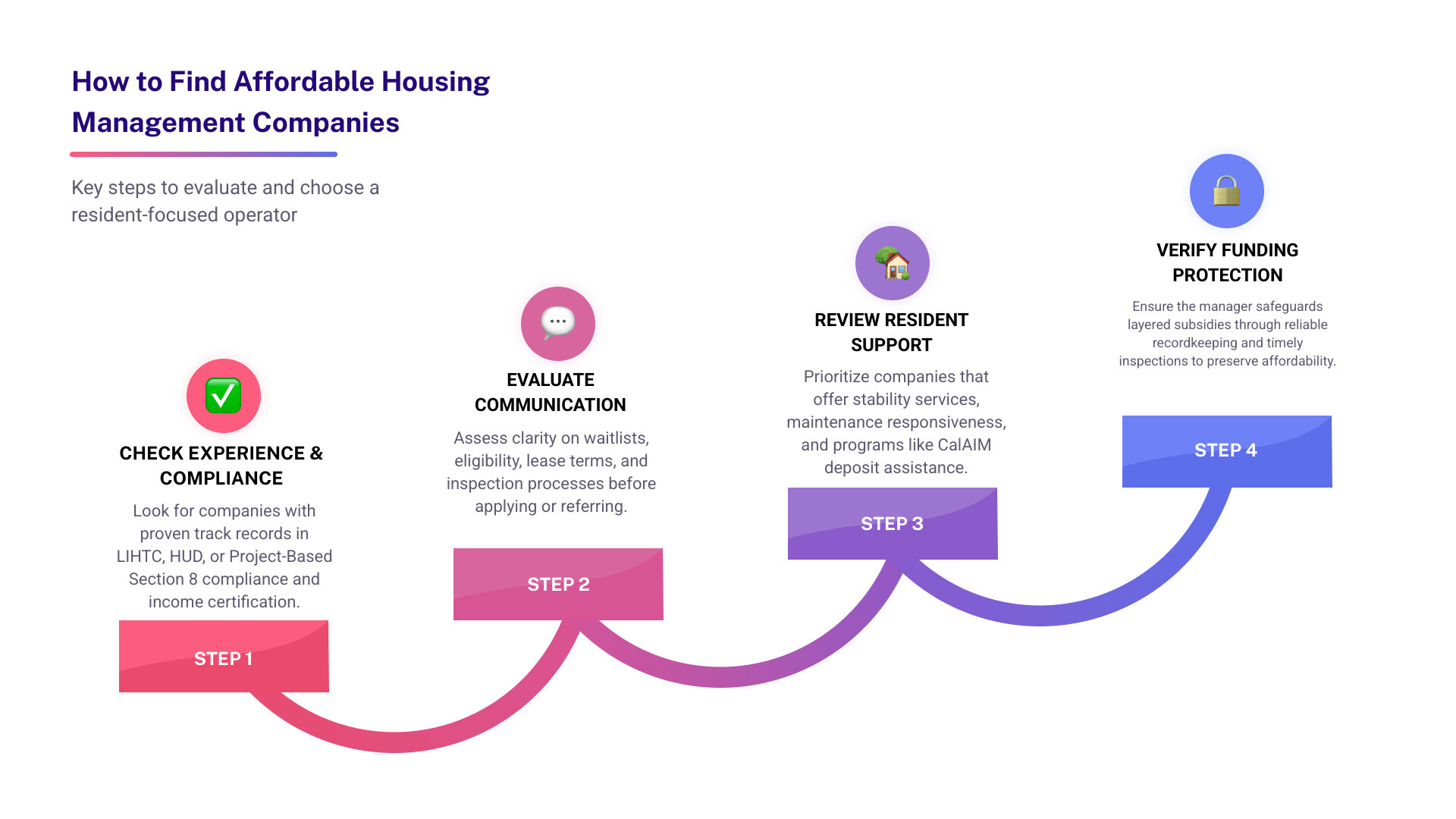
To find affordable housing management companies near you, start with properties in your area and compare each manager’s experience with your housing program, compliance record, maintenance response, resident services, and leasing performance. For veterans seeking stable housing in Los Angeles, San Diego, Riverside, or the Bay Area, a strong manager should make the process clear, keep homes safe, and connect residents with practical support.
Look for these signs before you apply or recommend a property:
- Experience with affordable housing rules, including income certifications and HUD or tax-credit requirements.
- Clear communication about waitlists, eligibility, inspections, repairs, and lease terms.
- A resident-support approach that helps people stay housed, not just fill units.
- Reliable maintenance, safety planning, and fair follow-up when problems arise.
The right management partner does more than collect rent. It protects the property’s funding and physical condition while helping residents build stability. This matters when a community navigates government subsidized housing, layered programs such as LIHTC, or broader public housing assistance options like hud affordable housing, where missed paperwork or failed inspections can put affordability at risk.
LifeSTEPS provides resident-centered housing support in California communities, with a 93% housing retention rate. For eligible residents, CalAIM deposit assistance may cover 1 month paid in advance, helping remove one common barrier to securing a home.
Key Types of Affordable Housing Management Companies

Operating subsidized residential real estate requires specialized organizational structures. Unlike standard multifamily assets, affordable developments operate under strict regulatory agreements that tie financing to household income limits, rent caps, and physical property standards.
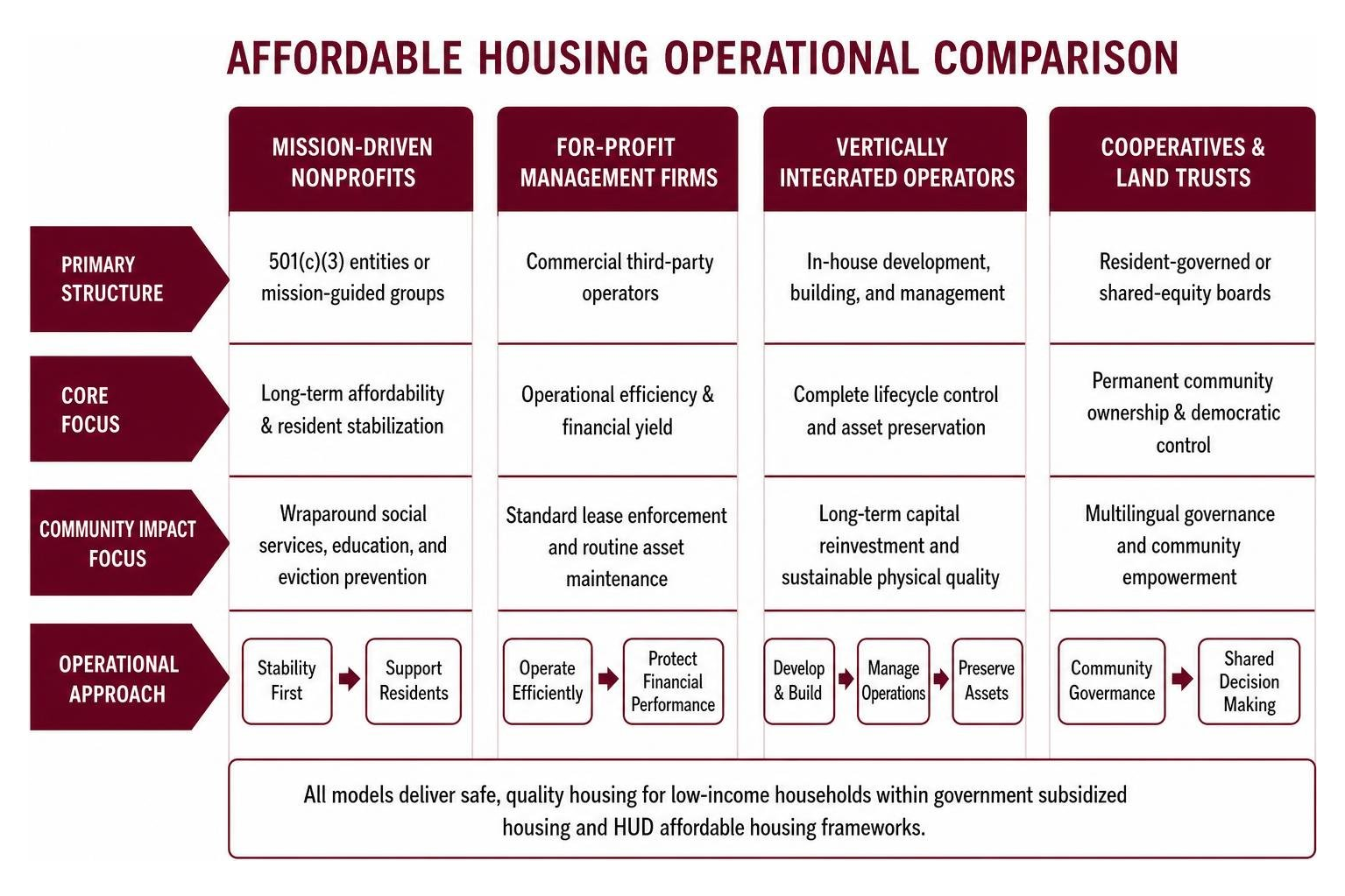
Organizations managing these properties generally fall into distinct operating models:
| Management Model | Primary Structure | Core Focus | Community Impact Focus |
|---|---|---|---|
| Mission-Driven Nonprofits | 501(c)(3) entities or mission-guided groups | Long-term affordability & resident stabilization | Wraparound social services, education, and eviction prevention |
| For-Profit Management Firms | Commercial third-party operators | Operational efficiency & financial yield | Standard lease enforcement and routine asset maintenance |
| Vertically Integrated Operators | In-house development, building, and management | Complete lifecycle control and asset preservation | Long-term capital reinvestment and sustainable physical quality |
| Cooperatives & Land Trusts | Resident-governed or shared-equity boards | Permanent community ownership & democratic control | Multilingual governance and community empowerment |
Mission-Driven vs. For-Profit Affordable Housing Management Companies
The operational philosophy of an affordable housing manager directly shapes daily community life. Commercial management companies primarily focus on rent collections, occupancy targets, and physical upkeep to safeguard bottom-line financial performance. While these metrics remain vital for fiscal health, focusing solely on financials can overlook the social complexities vulnerable households face.
Mission-driven operators approach property management with a broader objective: preserving community stability and fostering resident upward mobility. By collaborating with nonprofit housing organizations, properties pair traditional operational oversight with meaningful social support.
When a resident experiences an unexpected emergency, mission-driven teams coordinate relief resources rather than initiating immediate legal actions. For example, Marcus, whose name has been changed, faced a sudden job transition that threatened his tenancy. On-site service coordinators helped him establish a workable payment arrangement while connecting him with workforce development tools, preventing eviction and preserving stable housing.
Vertically Integrated and Cooperative Housing Models
Vertically integrated entities oversee the complete property lifecycle—from initial land acquisition and architectural design through construction, lease-up, and daily operations. By managing both the physical build and ongoing operations, these firms eliminate communication gaps between builders and operators. They select durable, energy-efficient building materials that lower long-term maintenance costs and preserve physical quality over multi-decade compliance periods.
Cooperative housing models and community land trusts introduce a distinct, community-led management structure. In these models, residents participate directly in governance decisions. Property managers serving cooperatives provide full financial transparency, localized maintenance oversight, and multilingual administrative communication. This resident-led framework empowers individuals by turning property management into a collaborative tool for permanent neighborhood stability.
Core Criteria for Evaluating Management Partners

Selecting an experienced management partner requires evaluating performance metrics that extend beyond standard physical occupancy. High-quality operators maintain operational balance across compliance, asset protection, and resident well-being.
Key performance indicators to evaluate include:
- Sustained Occupancy and Fast Turnaround: Maintaining high physical occupancy while completing unit turns efficiently to minimize vacancy loss.
- Audit-Ready Regulatory Compliance: Flawless tracking of household income limits, annual certifications, and housing finance regulations.
- Proactive Preventative Maintenance: Routine inspections of building mechanicals, safety systems, and living spaces to prevent deferred maintenance.
- High Tenant Retention: LifeSTEPS achieves a 93% housing retention rate by pairing standard property management with proactive supportive interventions.
Vetting Local Affordable Housing Management Companies for Quality and Compliance
Housing property owners and community advocates must vet prospective management partners across rigorous regulatory baselines. A qualified operator must maintain a verifiable track record with municipal housing authorities and state housing finance agencies.
Staff credentials serve as a vital indicator of competence. Professional teams should hold recognized certifications such as Certified Professional of Occupancy (CPO) or Housing Credit Certified Professional (HCCP). Management partners that benchmark operational metrics against national industry standards by NAHMA demonstrate systematic compliance rigor. Furthermore, working with partners certified as a Woman-Owned Business Enterprise (WBE) supports supplier diversity while ensuring professional excellence.
Balancing Financial Stability with Resident Services
A financially healthy property is essential for maintaining high-quality living environments. However, financial sustainability should complement, not replace, human-centered community care. Subsidized housing operations rely on steady subsidy streams, Low-Income Housing Tax Credits (LIHTC), and accurate accounting.
Integrating resident supportive services directly reinforces financial stability. When on-site teams assist residents in navigating programs like CalAIM—which provides deposit assistance covering 1 month paid in advance—move-in delays decrease significantly.
Proactive service coordination helps vulnerable individuals avoid lease defaults. Dedicated property initiatives, such as supportive housing for individuals with disabilities, ensure that residents access needed resources while maintaining their independent living arrangements. As research demonstrates, improving health outcomes through housing stability creates healthier, more stable neighborhood environments.
How Property Managers Navigate Compliance and Regulatory Programs
Affordable housing compliance requires navigating multi-layered federal, state, and local frameworks. Property management teams must balance the rigorous requirements of Section 42 of the Internal Revenue Code alongside direct HUD subsidy programs and municipal covenants.
Key regulatory frameworks include:
- Low-Income Housing Tax Credit (LIHTC): Governed by Section 42, requiring rigorous initial tenant income eligibility verifications, ongoing rent restrictions, and annual reporting.
- Project-Based Section 8: Requires strict monthly subsidy voucher reconciliation and tenant income calculations according to our HUD subsidy programs guide.
- USDA Rural Development: Involves specialized tenant qualification rules and property preservation standards for rural multifamily communities.
- Physical Inspection Standards: Adhering to National Standards for the Physical Inspection of Real Estate (NSPIRE) and Housing Quality Standards (HQS) enforced through public housing authority oversight.
Managing Income Certifications and Blended Financing
Modern affordable housing developments rarely rely on a single funding stream. Communities frequently blend Low-Income Housing Tax Credits, tax-exempt bond financing, HOME Investment Partnerships Program funds, and Community Development Block Grants (CDBG).
Each funding layer carries its own income caps, reporting deadlines, and compliance rules:
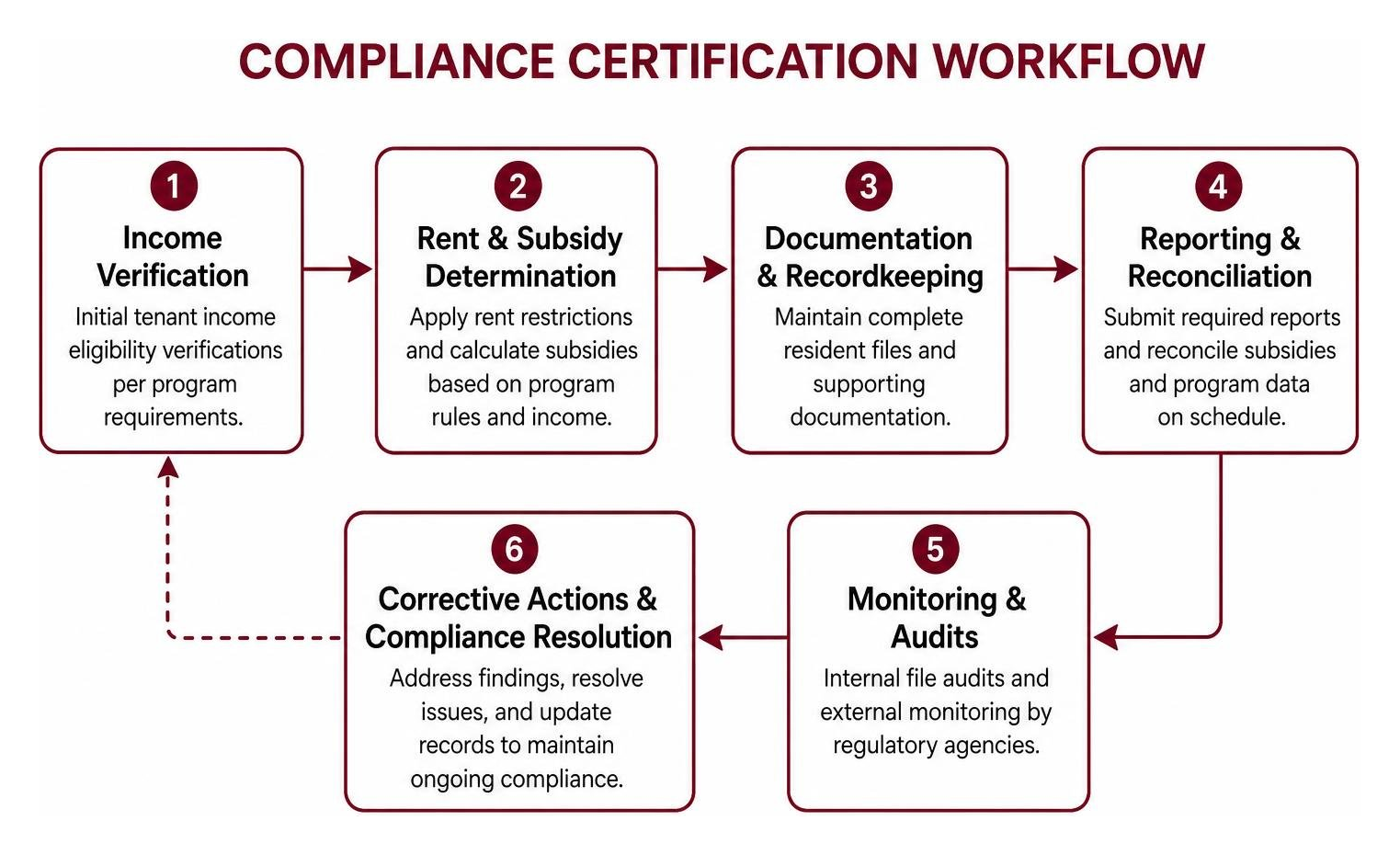
Managing blended portfolios in regions like San Diego affordable developments and subsidized communities in Riverside requires advanced digital tracking systems. Property managers must conduct systematic file audits and variance reporting to prevent non-compliance findings that could jeopardize underlying tax credit allocations.
Specialized Senior and Supportive Housing Standards
Managing communities tailored for older adults or individuals requiring supportive housing involves distinct accessibility and operational protocols. Managers must ensure full compliance with the Americans with Disabilities Act (ADA) and Fair Housing Act standards, maintaining physical modifications that support aging in place.
Effective management teams work alongside service coordinators to activate on-site community rooms with meaningful educational programming and social engagement. Exploring specialized senior housing communities in California shows how tailored property management enhances quality of life. For individuals and families seeking suitable placements, navigating affordable rental options provides a structured pathway toward long-term residential stability.
Innovative Trends Shaping Community Management
The affordable property management landscape continues to evolve through technological and environmental innovations:
- Disaster Resiliency and Energy Efficiency: Forward-thinking management firms are integrating solar arrays, high-efficiency mechanical systems, and emergency preparedness plans into daily operations. These upgrades lower utility expenses for residents while protecting properties against severe weather disruptions.
- Digital Compliance and Streamlined Portals: Cloud-based property management software allows residents to submit maintenance requests, track recertification timelines, and access community notices digitally, improving communication speed.
- Youth Educational Enrichment: High-performing affordable communities integrate structured youth development initiatives. In our educational enrichment initiatives, participating youth achieve a 97% literacy improvement through dedicated Summer Reading programs.
- Higher Education Support: Mission-aligned housing models actively open pathways to academic achievement, helping award $2.1M in scholarships to students pursuing higher education goals.
Frequently Asked Questions About Affordable Housing Operations
How do property managers maintain LIHTC and HUD compliance?
Property managers maintain compliance by conducting thorough initial tenant income verifications and mandated annual recertifications. They perform continuous internal file audits, prepare properties for annual NSPIRE physical inspections, and submit timely occupancy data to state housing finance agencies.
What is the difference between fee-managed and vertically integrated housing companies?
Fee-managed operators are third-party contractors hired strictly to handle day-to-day property operations, leasing, and maintenance under an annual service agreement. Vertically integrated companies handle the entire asset lifecycle in-house—including site development, general contracting, property management, and long-term asset preservation.
How do management companies support long-term resident stability?
Management companies support long-term stability by embedding on-site service coordinators who assist residents with financial literacy, workforce resources, educational youth programs, and emergency assistance navigation. These supportive measures help households maintain their leases and achieve personal self-sufficiency.
Conclusion
Finding the right affordable housing management partner requires evaluating both technical operational expertise and human-centered community commitment. Whether overseeing complex compliance across layered financing programs or maintaining high physical standards, the best management teams recognize that properties thrive when residents are supported.
LifeSTEPS bridges the gap between traditional property management and lasting resident empowerment across California communities. By empowering communities through comprehensive resident supportive services, we help create stable, thriving environments where individuals and families can flourish.
For media inquiries, contact: bex@lifestepsusa.org
LifeSTEPS currently provides services in California only.


