


A Practical Guide to Government Based Apartments: Eligibility & Apply in CA
A Practical Guide to Government Based Apartments: Eligibility & Apply in CA
Find Government Based Apartments in California
To find government based apartments in California, apply through your local housing authority for public housing or a Housing Choice Voucher, and apply directly to affordable apartment properties for project-based or tax-credit units. Check each program’s income limits, join open waiting lists, and keep your contact information current so you do not lose your place.
For a transitioning veteran, it can also help to ask local housing providers about veteran-focused vouchers, supportive housing, and services that can make a move into civilian life more stable.
Government-assisted housing is not one program. A subsidy may stay with a specific apartment, follow a renter through a voucher, or help keep rents below market rates in an income-restricted community. The right option depends on your income, household size, location, and whether you need to move often.
In California, LifeSTEPS supports residents in affordable housing communities with services that help households stay housed and build toward long-term goals. Its outcomes include a 93% housing retention rate. Through CalAIM, LifeSTEPS also provides deposit assistance of 1 month paid in advance for eligible residents. Families can access afterschool support, including Summer Reading programs associated with a 97% literacy improvement, while higher education support has delivered $2.1M in scholarships.
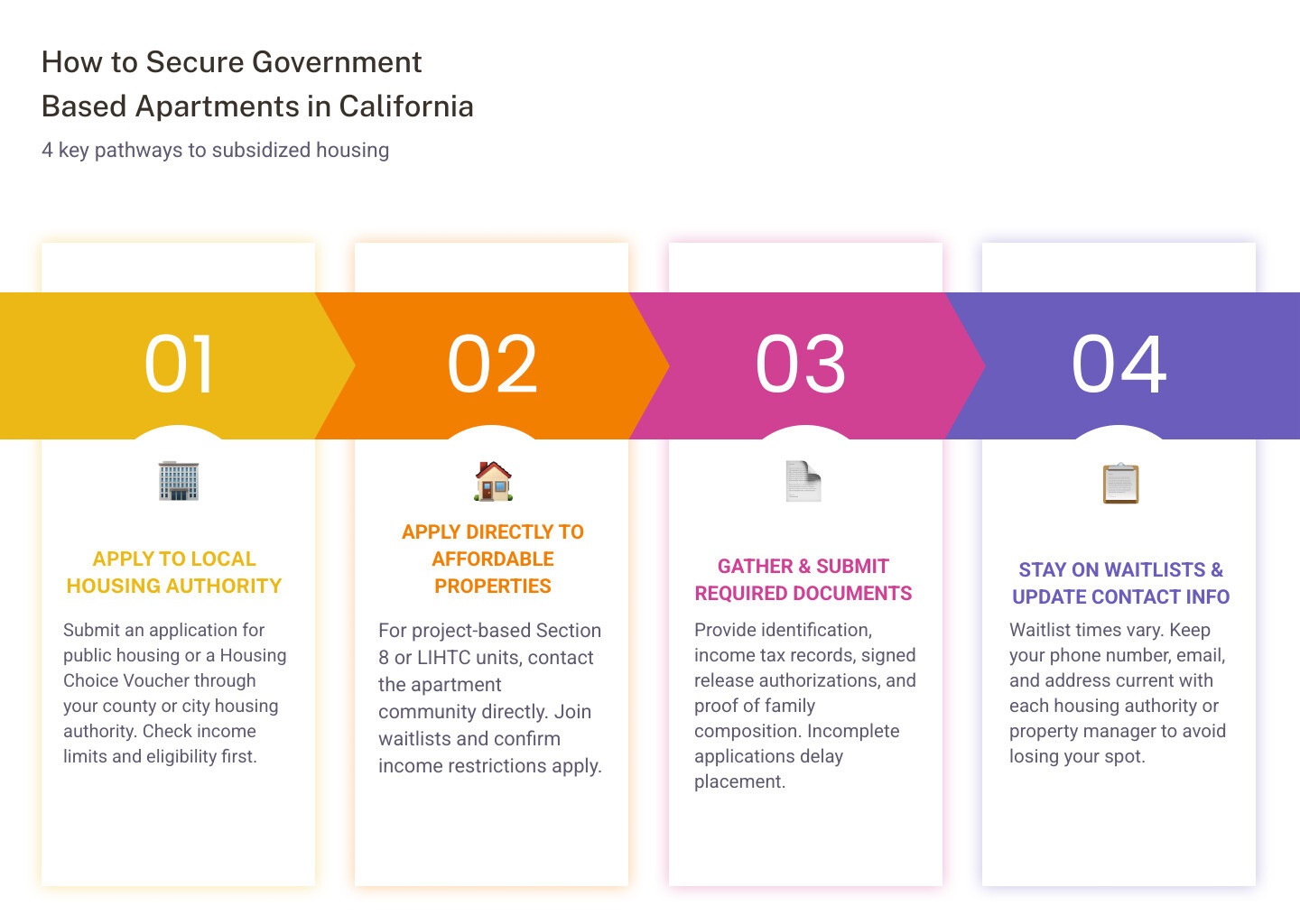
Government based apartments terms to learn:
Understanding the Main Types of Government Based Apartments
Navigating affordable rental programs throughout California begins with recognizing that government subsidies operate through distinct funding pipelines. Across the nation, roughly 970,000 households live in public housing developments managed by approximately 3,300 local housing authorities. In California, these public agencies work alongside private developers and non-profit organizations to maintain a diverse portfolio of affordable living opportunities.
Whether you are looking for municipal resources or exploring California HUD Office Resources, understanding how financial subsidies are structured helps you identify which waiting lists to target. Subsidies can be attached to physical buildings, assigned to individual renters, or built into property financing structures to maintain below-market rents.
Public Housing Programs
Public housing consists of residential properties owned, operated, and maintained directly by local housing agencies. These communities range from scattered single-family houses to multi-story garden apartments and high-rises designed specifically for seniors or individuals with disabilities.
Under baseline eligibility standards, these properties provide safe, decent housing to households earning below established income caps. In these properties, the public housing authority functions as both the administrator and the property manager. Because rent is tied directly to household earnings, these communities serve as some of the best income-based apartments for beginners who need deeply subsidized living arrangements while building financial stability.
Tenant-Based Housing Choice Vouchers vs Project-Based Assistance in Government Based Apartments
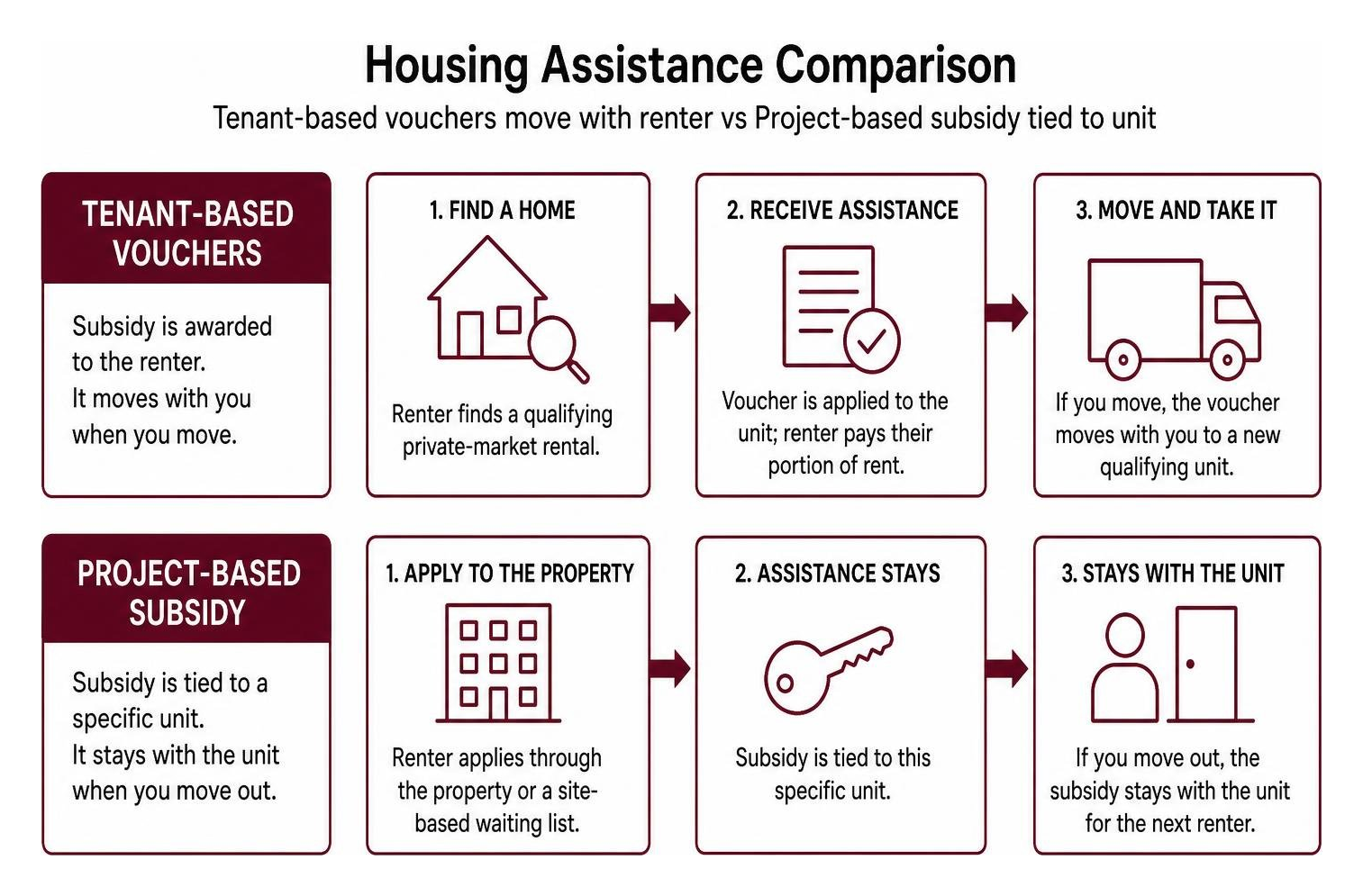
The distinction between tenant-based and project-based subsidies defines where you can live and whether your assistance moves with you:
- Tenant-Based Vouchers (Housing Choice Voucher / Section 8): The subsidy is awarded directly to the individual or household. Voucher holders search for qualifying private-market rentals that meet HUD safety standards and rent limits. If you choose to relocate after your initial 12-month lease, you can take your voucher with you. You can unlock affordable living section 8 rental opportunities across open rental markets in participating jurisdictions.
- Project-Based Vouchers (PBV) / Project-Based Rental Assistance (PBRA): The assistance is tied directly to a specific unit within an apartment complex. You apply directly through the property management office or a site-based housing authority list. If you move out of that specific unit, the rental assistance remains behind for the next qualifying tenant. Learning how project based apartments work is essential when targeting specific communities in your neighborhood.
Low-Income Housing Tax Credit Properties
The Low-Income Housing Tax Credit (LIHTC) program is the largest creator of affordable rental housing in the United States. Rather than relying on direct operating subsidies from housing authorities, LIHTC relies on private developers who receive federal tax credits in exchange for keeping rents restricted to specific Area Median Income (AMI) tiers—most commonly 30%, 50%, or 60% of AMI.
In tax credit developments, rents are capped at set maximum rates rather than fluctuating strictly with 30% of your exact monthly income. Finding income-restricted rentals through LIHTC databases allows working households to secure stable, high-quality housing even when direct voucher waiting lists are closed.
| Program Type | Subsidy Anchor | Application Method | Portability (Moving) | Rent Calculation |
|---|---|---|---|---|
| Public Housing | Publicly owned property | Local Housing Authority | Non-portable (tied to authority property) | ~30% of adjusted monthly income |
| Housing Choice Voucher | Tenant (voucher holder) | Centralized Housing Authority waitlist | Fully portable across jurisdictions after 12 months | ~30% of adjusted monthly income |
| Project-Based Assistance | Specific apartment unit | Individual property management office | Non-portable (remains with apartment) | ~30% of adjusted monthly income |
| LIHTC Properties | Private affordable property | Property leasing office | Non-portable | Capped rent based on AMI percentage tiers |
California Eligibility Criteria for Government Subsidized Housing

Securing subsidized housing in California requires meeting statutory household qualification standards set by federal, state, and local guidelines. Every housing authority and tax credit development screens applicants for income compliance, family composition, and background history.
Income Limits and Area Median Income Calculations
Eligibility for subsidized housing hinges upon local Area Median Income (AMI) figures, which HUD calculates annually for every county and metropolitan statistical area. Income thresholds are classified into distinct brackets:
- Extremely Low Income: 30% or below of AMI
- Very Low Income: 50% or below of AMI
- Low Income: 80% or below of AMI
Because the cost of living varies dramatically across California, income limits change significantly depending on location. For instance, reviewing a buyers guide for low-income apartments in San Diego reveals different baseline income maximums compared to exploring options in the Inland Empire through a guide to the best affordable apartments in Riverside on a budget. Most traditional public housing and voucher programs target households earning 50% AMI or less, while tax credit properties frequently serve families between 50% and 80% AMI.
Family Composition, Citizenship, and Priority Status for Government Based Apartments
In addition to financial limits, housing authorities evaluate household composition and legal eligibility:
- Eligible Status: At least one member of the household must be a U.S. citizen or an eligible non-citizen with qualifying immigration status. Mixed-status families may receive prorated assistance based on the number of eligible members.
- Specialized Definitions: HUD maintains clear definitions for elderly families (head of household or spouse aged 62 or older) and individuals with verified disabilities. Understanding these categories is vital when navigating HUD disability income-based apartments.
- Local Preferences: Housing agencies frequently establish statutory preferences to prioritize vulnerable populations. Local preferences commonly give priority to veterans, households experiencing homelessness, individuals displaced by natural disasters, or residents currently living in substandard conditions. Veterans often qualify for dedicated allocations such as HUD-VASH vouchers, which blend rental assistance with comprehensive case management.
How to Apply for Government Assisted Housing in California

Applying for government-assisted housing requires careful organization, consistent follow-up, and attention to application windows across multiple portals.
Step-by-Step Application and Documentation Process
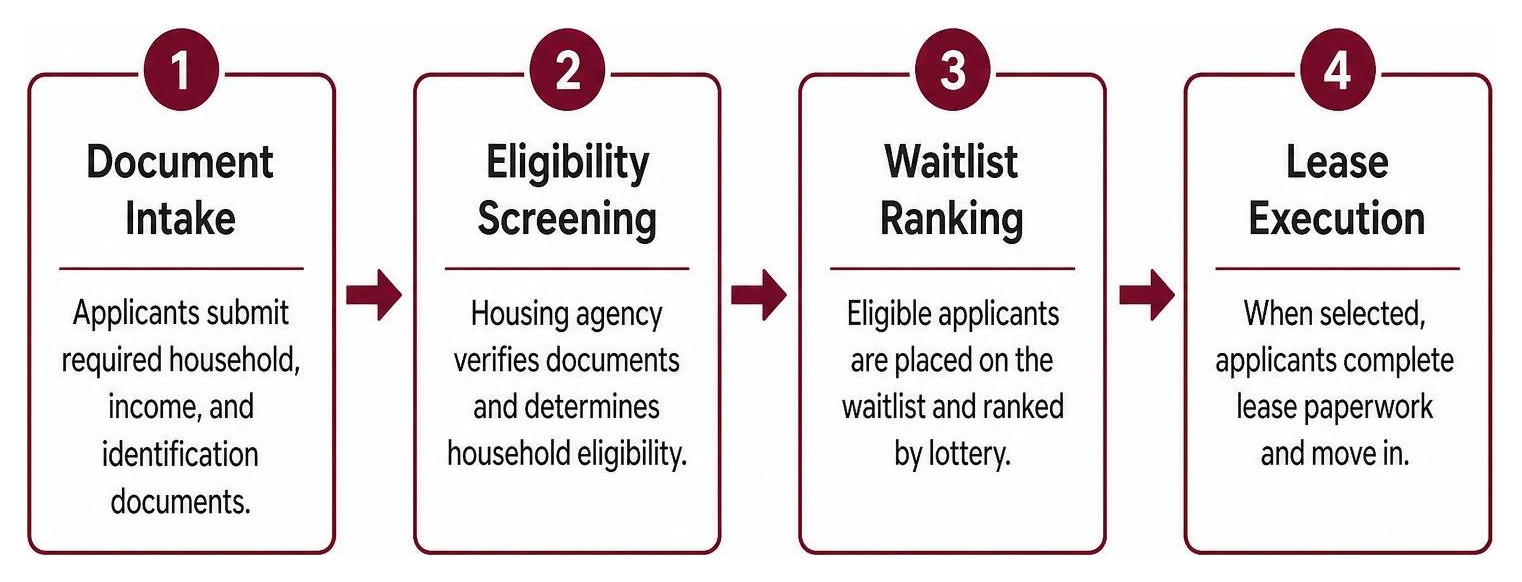
When an application portal opens, housing agencies demand thorough verification of your household background. Utilizing the ultimate HUD low-income housing application guide can help you prepare your paperwork well before deadlines arrive.
To ensure your intake packet is processed without delays, assemble the following documents:
- Government-issued photo identification (driver’s licenses, state IDs, passports) for all adult household members.
- Certified birth certificates and Social Security cards for every member of the family.
- Proof of income, including the last two years of federal tax returns, W-2s, 1099s, and consecutive pay stubs covering at least 60–90 days.
- Documentation of unearned income, including award letters for SSI, SSDI, CalWORKs, pensions, or child support.
- Complete bank statements (checking, savings, investment accounts) for the last three to six consecutive months.
- Signed third-party release authorizations allowing the housing authority to verify employment, banking, and rental history directly.
Navigating Regional Waitlists and Local Housing Authorities
Because demand for affordable housing in California remains high, waitlists open periodically and often close quickly. Many housing agencies use computerized lotteries to place applicants on waiting lists rather than serving them on a first-come, first-served basis.
To maximize your opportunities, register across multiple regional portals:
- In Southern California, monitor the centralized Los Angeles County housing portal for countywide listings.
- Track municipal openings directly via resources for Affordable Rentals in San Diego.
- Explore city-specific municipal programs through the directory for Affordable Housing in Irvine.
A crucial rule of waitlist management: always update your contact information immediately if you move or change your phone number. Housing authorities regularly send audit notices via postal mail. If an agency letter is returned as undeliverable, your application will be removed from the waitlist immediately.
Rent Calculations, Tenant Rights, and Housing Transitions
Living in government-subsidized housing provides formal legal protections and predictable rental calculations designed to keep housing affordable over the long term.
Total Tenant Payment and Allowable Deductions
In public housing and voucher programs, your tenant rent contribution is determined by the federal Total Tenant Payment (TTP) formula. The TTP is calculated as the highest of the following amounts:
- 30% of your household’s monthly adjusted gross income.
- 10% of your household’s monthly gross income.
- The designated welfare rent in applicable jurisdictions.
- A statutory minimum rent established by the housing authority (typically between $25 and $50).
To determine your adjusted income, housing authorities apply specific annual deductions:
- Dependent Allowance: A standard statutory deduction of $480 per dependent child or full-time student.
- Elderly/Disabled Allowance: A standard $400 deduction for any elderly family or household headed by a person with a disability.
- Medical Expense Deductions: Unreimbursed out-of-pocket medical expenses exceeding 3% of gross annual income for elderly or disabled households.
- Child Care Expenses: Reasonable child care expenses necessary to enable a household member to work or attend school.
When housing authorities adjust for utility allowances, your out-of-pocket rent may be reduced further if you pay your own utilities directly.
Reasonable Accommodations and Mixed-Income Redevelopment Protections
Under the Fair Housing Act and Section 504 of the Rehabilitation Act, residents with disabilities have the legal right to request reasonable accommodations and modifications. Learning about accessible living and disability-friendly apartments helps tenants request necessary changes—such as grab bar installations, lowered counters, or service animal approvals—without incurring extra fees.
Additionally, as older public housing properties across California undergo transformation into modern mixed-income communities, federal regulations protect existing tenants. Under initiatives like the Rental Assistance Demonstration (RAD), residents living in complexes slated for redevelopment receive robust protections:
- Right to Return: Residents relocated during construction hold a legal right to return to a newly constructed unit once redevelopment finishes.
- Relocation Assistance: Housing authorities must provide advisory services, cover moving expenses, and provide replacement voucher subsidies or bridge rent differentials during construction.
For example, when a resident we assisted, David (name changed for privacy), faced property modernization, our on-site team coordinated his temporary relocation and guided him through the right-to-return paperwork, ensuring he transitioned smoothly into his renovated home without losing his rental subsidy.
Frequently Asked Questions About Subsidized Housing in California
How is monthly rent calculated in income-restricted housing?
In programs using direct subsidies (such as Public Housing or Housing Choice Vouchers), monthly rent is generally set at 30% of your monthly adjusted income after accounting for standard dependent, elderly, disability, and medical deductions.
In LIHTC income-restricted apartments, rent is not based on your exact monthly paycheck. Instead, the rent is fixed at a flat, below-market rate tied to the specific Area Median Income (AMI) tier of that unit. In both program models, annual income reexaminations ensure your household remains eligible.
Can voucher recipients move across different California housing authorities?
Yes. Tenant-based Housing Choice Vouchers feature “portability” rights allowing voucher holders to transfer their subsidy to another jurisdiction anywhere in California.
Under standard HUD rules, you must generally fulfill an initial 12-month lease term in the jurisdiction of the housing authority that issued your voucher. After that first year, you can request a voucher transfer to a receiving housing agency in your desired city.
What emergency resources are available for immediate housing stability in California?
Households facing immediate housing vulnerability should connect with local Coordinated Entry Systems (CES) to access regional rapid rehousing pipelines and emergency shelter resources.
For low-income residents securing an apartment, upfront moving costs often present a major hurdle. Through the CalAIM program, LifeSTEPS provides security deposit assistance of 1 month paid in advance to help eligible individuals and families transition into permanent housing smoothly.
Conclusion
Finding and maintaining a home in government-assisted housing requires persistence, thorough preparation, and an understanding of how local waiting lists operate. Securing stable housing transforms lives, creating the foundation necessary for personal growth, educational achievement, and long-term financial stability.
LifeSTEPS works alongside residents in affordable communities throughout California to provide the wraparound resources necessary to sustain permanent housing. Our evidence-based model achieves an exceptional 93% housing retention rate, demonstrating the power of comprehensive on-site resident support.
Our programs invest deeply in the next generation. Through our afterschool educational enrichment programs, we deliver Summer Reading initiatives that have generated a 97% literacy improvement among participating youth. Furthermore, our dedication to higher education pathways has awarded $2.1M in scholarships to help students pursue undergraduate degrees and vocational training.
Whether you are currently exploring subsidized properties or looking to build new skills in an affordable community, dedicated support makes all the difference. Explore how LifeSTEPS supportive programs and services empower individuals and families to thrive.
For media inquiries, contact: bex@lifestepsusa.org
LifeSTEPS currently provides services in California only.


