


The Amazing Guide to No Criminal Background Check Apartments in California
The Amazing Guide to No Criminal Background Check Apartments in California
Find Flexible-Screening Apartments in California
No criminal background check apartments are uncommon, but flexible-screening housing does exist in California. Start by looking for private landlords, second-chance housing providers, and affordable communities that use individualized reviews instead of automatic bans. Before paying an application fee, ask for the written tenant-screening policy and whether it considers arrests, old convictions, rehabilitation, rental history, and current income.
A criminal record does not automatically make someone an unsafe or unreliable renter. Federal fair housing guidance warns that blanket criminal-record bans may create unlawful discrimination, especially when they disproportionately harm protected groups. A landlord should not treat an arrest as proof of wrongdoing.
For veterans and other renters rebuilding stability, preparation matters. Bring proof of income, positive references, a short explanation of any record, and documents showing progress since the incident. LifeSTEPS provides California housing support and navigation designed to help residents move toward stable, long-term housing. Through the CalAIM program, eligible participants may receive deposit assistance with 1 month paid in advance for deposit assistance. LifeSTEPS reports a 93% housing retention rate.
Stable housing also supports broader goals. LifeSTEPS connects California communities with afterschool programs, including Summer Reading with a 97% literacy improvement rate, and higher education support totaling $2.1M in scholarships.
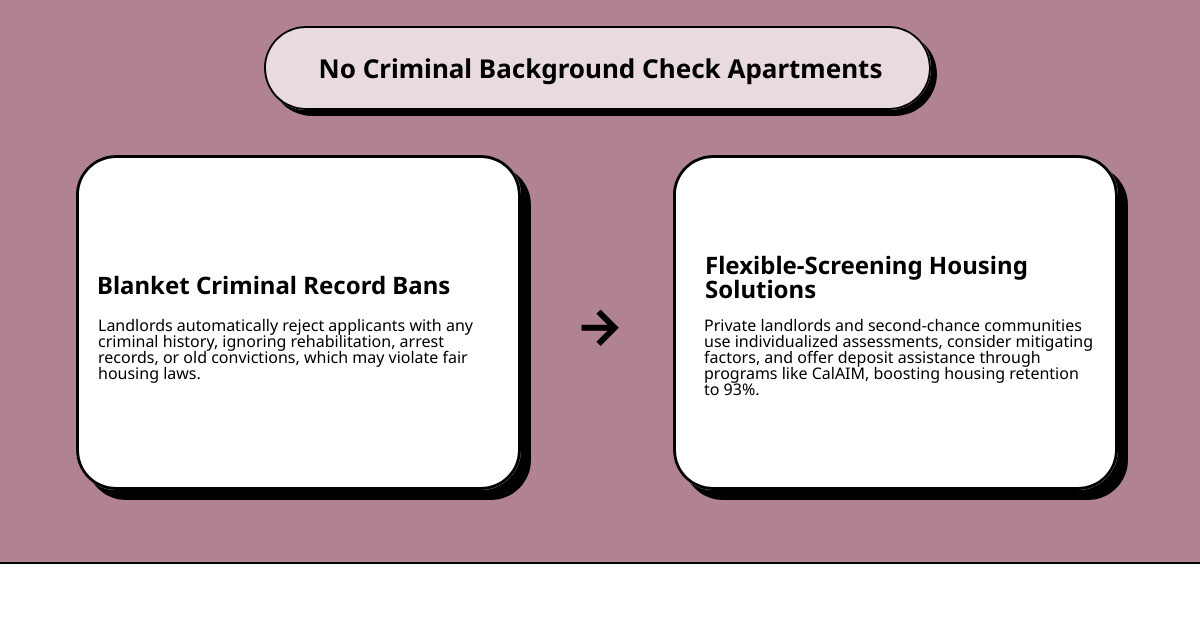
Simple guide to no criminal background check apartments terms:
Understanding California Tenant Screening and Fair Chance Protections
Navigating the rental market when you have a criminal record can feel like facing a brick wall. However, finding a home in California does not mean you are out of options. In recent years, tenant screening regulations have shifted significantly to promote fair access to housing, ensuring that people are evaluated fairly rather than dismissed immediately.
Nearly one-third of the U.S. population has some form of criminal record. Across the country, African Americans and Hispanics are arrested, convicted, and incarcerated at rates disproportionate to their share of the general population. Specifically, the imprisonment rate for African American males is almost six times greater than for White males, while the rate for Hispanic males is more than twice that of non-Hispanic White males. Because of these deep systemic disparities, restrictive rental policies create a disparate impact, shutting qualified renters out of the housing market without improving community safety.
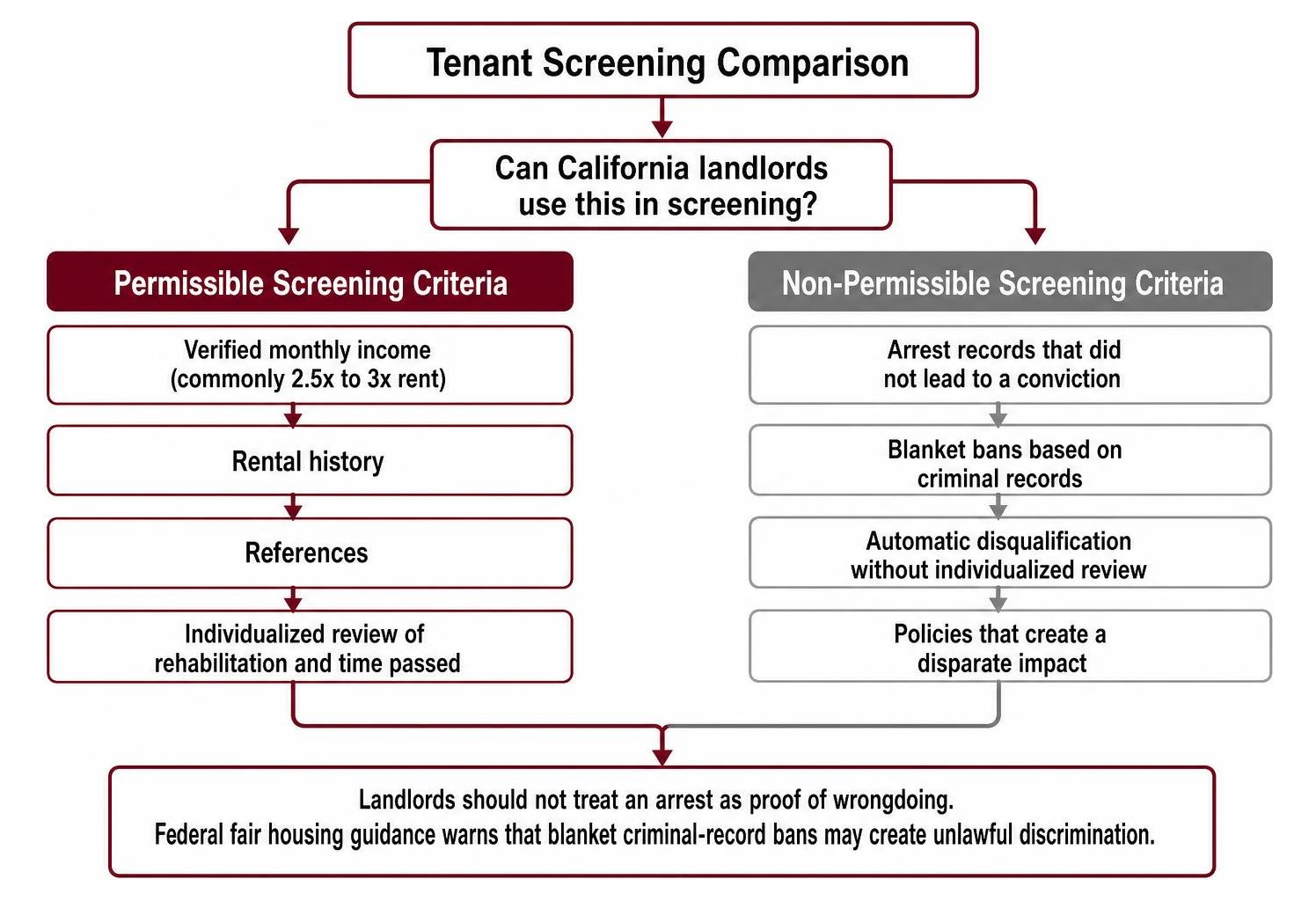
To protect prospective renters, state and federal guidelines restrict what housing providers can evaluate. Knowing the difference between permissible and non-permissible screening criteria allows you to identify unfair barriers before paying non-refundable screening fees, which typically range from $25 to $55 per application.
| Permissible Screening Criteria | Non-Permissible Screening Criteria |
|---|---|
| Verified monthly income (commonly 2.5x to 3x rent) | Arrest records that did not lead to a conviction |
| Credit payment history within the past 7 years | Blanket bans on any and all criminal records |
| Formal convictions directly related to resident safety | Sealed, expunged, or juvenile records |
| Past landlord references regarding lease compliance | Offenses resulting from domestic violence survival |
| Tiered lookback periods (e.g., 3 to 7 years) | Mandatory screening checks applied inconsistently |
Fair Housing Act and HUD Guidance on Criminal Records
The U.S. Department of Housing and Urban Development issued groundbreaking guidance making it clear that denying applicants based solely on criminal history can violate the Fair Housing Act. Because criminal records do not automatically indicate that someone will be an irresponsible or disruptive tenant, automatic exclusions fail to serve a legitimate business interest.
Under these standards, housing providers cannot legally reject an applicant solely because of an arrest record. An arrest merely indicates suspicion—not guilt. Landlords who operate in compliance with fair housing principles must distinguish between mere arrests and actual convictions. Furthermore, policies that implement blanket bans against anyone with a past record are considered discriminatory under civil rights laws.
Lookback Periods and Individualized Assessments
In California, standard background checks are generally constrained by lookback windows that restrict commercial reporting agencies from reporting older records, typically capping reviewable information at seven years. Instead of issuing automated rejections, compliant property managers perform individualized assessments that examine:
- The exact nature and severity of the past conviction.
- The amount of time that has passed since the offense occurred.
- Direct evidence of rehabilitation, employment, or stable rental history since the incident.
- Mitigating factors, such as personal or health hardships that contributed to the past record.
When evaluating housing options, exploring income restricted rentals often provides clearer screening criteria than standard corporate properties. If a property manager rejects your application based on a commercial background check, the Fair Credit Reporting Act (FCRA) mandates that they provide an adverse action notice detailing the screening agency used and your right to dispute inaccurate records.
Top Housing Options for No Criminal Background Check Apartments

Finding housing with flexible screening requires expanding your search beyond conventional corporate rental complexes. While very few properties advertise zero screening, several reliable pathways allow justice-impacted individuals to secure stable leases.
- Direct Private Owners: Independent property owners often bypass third-party screening platforms entirely and rely on face-to-face conversations.
- Affordable and Regulated Communities: Regulated properties utilize transparent selection plans with tiered lookback periods and clear appeal processes.
- Supportive and Reentry Housing: Nonprofits and community organizations offer housing navigation, master leases, and individualized support services.
- Second-Chance Rental Locators: Specialized resources identify properties willing to work with records, credit challenges, or past evictions.
Finding No Criminal Background Check Apartments Through Private Landlords
Independent landlords who manage single-family homes, duplexes, or smaller multi-unit properties often have significantly more flexibility than institutional property managers. Corporate apartment communities use automated screening software that triggers immediate rejections for any background flag. In contrast, private owners can evaluate you as a whole person.
When searching for private rentals in Southern California—including communities across Los Angeles, San Diego, and Riverside—or throughout the Bay Area, look for listings placed directly by property owners. Useful avenues include local classified platforms such as los angeles apartments / housing for rent “no credit check”, For Rent by Private Owner in San Diego CA – 296 Listings Available, and inland empire apartments / housing for rent “no credit check” – craigslist.
When communicating with private landlords, emphasize your stable income, present reliable references, and offer to sign a standard lease agreement. Meeting an owner directly allows you to build personal trust and discuss your qualifications before any screening occurs.
Second-Chance and Subsidized Affordable Rental Communities
Affordable housing communities regulated by state and federal programs operate under strict compliance rules that prevent arbitrary rejections. These properties must provide their written tenant selection plan upon request, outlining precise lookback periods for past convictions—such as five years for certain non-violent offenses or three years for specific misdemeanors—while completely excluding arrests, juvenile records, or expunged offenses.
Applicants seeking structured, predictable criteria can explore regional affordable housing directories or review public housing authority listings. If you are seeking income-adjusted options, reviewing income-based no credit check apartments do they actually exist or locating income restricted housing near me can help connect you with communities that evaluate applications using holistic criteria.
Qualifying for No Criminal Background Check Apartments with Reentry Support
Reentry organizations and supportive housing networks play an essential role in bridging the gap between past justice involvement and long-term housing stability. Many community programs partner directly with landlords to secure units for program participants, waiving traditional screening hurdles in exchange for ongoing case management and supportive services.
For households experiencing sudden displacement or transitioning from temporary shelter, finding low income housing with no waiting list can provide immediate stability while longer-term arrangements are finalized. Case management programs help ensure stable tenancy by offering budgeting workshops, conflict resolution, and direct advocacy with property owners.
How to Overcome Background Barriers and Strengthen Your Rental Application
Securing an apartment with a background barrier requires taking control of the narrative before a third-party screening report creates an unfavorable impression. Presenting an organized, professional rental application package demonstrates reliability and accountability.

Understanding what property managers look for is crucial. Standard screening packages review credit payment history, verify income at 2.5 to 3 times the rent, and assess rental references. If you are new to the application process, consulting the best income based apartments for beginners can provide valuable foundational guidance on preparing necessary verification documents.
Crafting an Individualized Rehabilitation Portfolio
A well-prepared rehabilitation portfolio provides tangible evidence of your growth and personal responsibility. Instead of waiting for a landlord to find a record during a background check, proactive disclosure accompanied by positive documentation changes the conversation.
Your portfolio should include:
- A Concise Letter of Explanation: A one-page, professional statement taking responsibility for past mistakes without making excuses, briefly explaining the circumstances, and focusing heavily on what you have accomplished since.
- Professional and Community References: Letters of support from employers, mentors, faith leaders, or program case managers vouching for your reliability, character, and integrity.
- Proof of Steady Income: Recent pay stubs, benefits statements, or financial awards demonstrating your ability to consistently pay rent on time.
- Certificates of Completion: Documentation showing completed vocational training, educational degrees, substance use treatment, or community leadership programs.
For example, Marcus (name changed), a California renter with a past non-violent record, experienced repeated denials when submitting standard automated applications. After working with a housing specialist to assemble a complete portfolio featuring his steady employment records, personal references, and training certifications, he presented his application directly to a private housing provider. By reviewing his documented progress and stable income, the owner approved his lease.
Utilizing Security Deposit and Financial Assurance Solutions
Financial uncertainty is often a primary concern for landlords considering applicants with background barriers. Property owners may worry about unpaid rent or property damage. Offering financial assurance or leveraging state assistance programs can overcome this hesitation.
Under the CalAIM program, eligible California participants can receive direct housing transition support, including security deposit assistance with 1 month paid in advance for deposit assistance. This coverage significantly lowers the barrier to move-in costs while assuring property owners that upfront requirements are fully satisfied. Third-party financial assurance programs can also provide property owners with up to $2,000 in risk mitigation coverage, offering a practical alternative to costly double deposits. For additional regional rental strategies, consult your neighborhood guide to income based apts for rent near me.
Frequently Asked Questions about Renting with a Criminal Record
Can California landlords automatically reject applicants with arrest records?
No. Under California regulations and federal Fair Housing guidance, housing providers cannot legally reject applicants based solely on an arrest record that did not lead to a conviction. Because an arrest does not prove guilt, relying on arrest records to deny housing is considered arbitrary and discriminatory. Furthermore, landlords cannot consider sealed, dismissed, juvenile, or expunged records during their review.
How far back can a rental background check go in California?
In California, consumer reporting agencies generally limit the reporting of criminal convictions to a seven-year lookback period under state civil code and FCRA standards. Furthermore, housing providers running background checks must comply with state rules that prohibit evaluating non-conviction records, pre-trial diversion programs, or marijuana-related offenses that are no longer illegal under current law.
What should you do if an apartment application is unfairly denied?
If your rental application is rejected due to a background check:
- Request an Adverse Action Notice: Obtain the written notice identifying the consumer reporting agency that generated the report.
- Get Your Free Report Copy: Request a free copy of the background check within 60 days to inspect it for errors, mistaken identity, or reporting of expired records.
- Submit a Written Appeal: Send an individualized response letter to the landlord providing documentation of rehabilitation, steady income, and character references.
- File a Discrimination Complaint: If the landlord used an unlawful blanket ban or refused to evaluate non-conviction records, you can file a complaint with the California Civil Rights Department (CRD) or HUD.
Conclusion
Overcoming rental barriers requires persistence, accurate legal knowledge, and the right community resources. While standard corporate complexes often rely on rigid automated screening algorithms, exploring private landlords, regulated affordable housing communities, and supportive reentry networks opens reliable doors across California.
LifeSTEPS provides comprehensive supportive services across California designed to empower individuals and families on their journey toward housing stability and self-sufficiency. Our participants achieve an exceptional 93% housing retention rate, demonstrating the power of individualized, compassionate support. Beyond housing stabilization and CalAIM deposit assistance, LifeSTEPS builds stronger communities through afterschool programs—including our Summer Reading initiative, which achieves a 97% literacy improvement—and creates pathways to higher education with over $2.1M in scholarships awarded.
By assembling a complete rehabilitation portfolio, understanding your fair housing rights, and connecting with supportive community networks, you can navigate the rental landscape with confidence and secure a safe, stable home.
For media inquiries, contact: bex@lifestepsusa.org
LifeSTEPS currently provides services in California only.


