disability income based apartments affordable housing accessible building

Navigating HUD: Your Guide to Disability Income Based Apartments

When Housing Feels Out of Reach: What Disability Income Based Apartments Actually Are

Disability income-based apartments are rental units where your rent is calculated as a percentage of your income — not set at a fixed market rate. For most federal programs, that percentage is 30% of your monthly household income.

Here is a quick overview of the main options available:

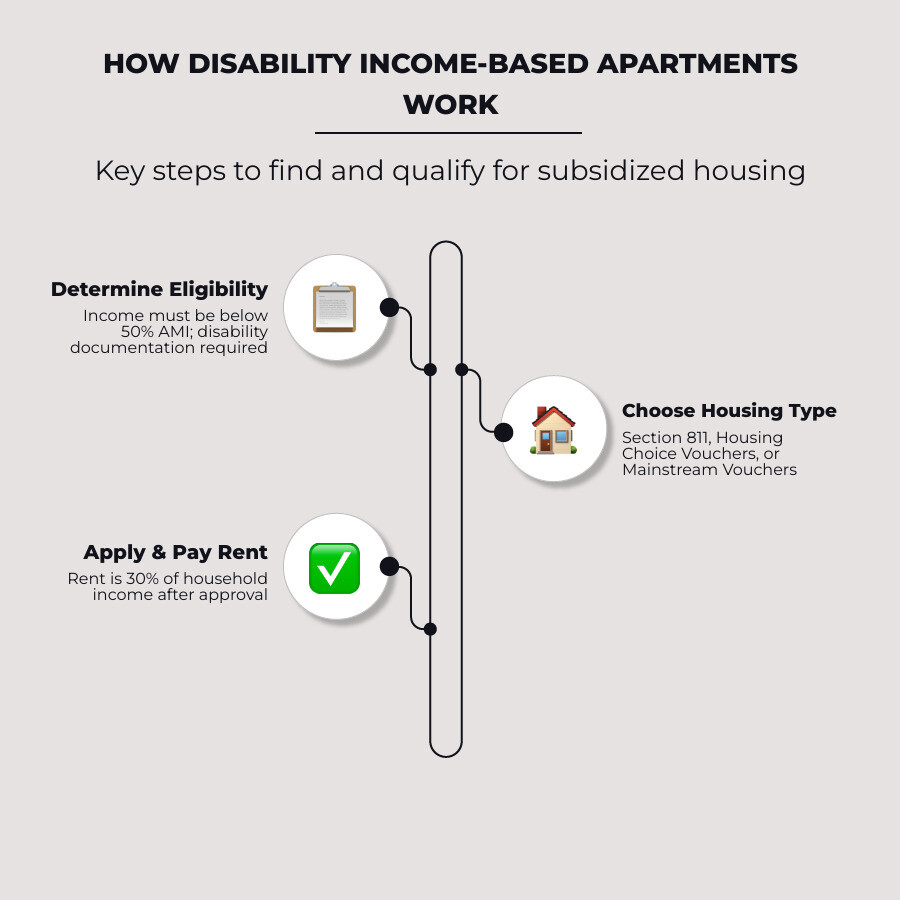
  • Section 811 — Supportive rental housing for adults aged 18–61 with disabilities; rent is 30% of household income
  • Housing Choice Vouchers (HCV) — Portable vouchers covering the gap between 30% of your income and the actual rent
  • Mainstream Vouchers — Specifically for households with a disabled adult under 62 who are homeless or at risk
  • Project-Based Vouchers — Tied to a specific property; you must live there to receive the subsidy
  • Low-Income Housing Tax Credit (LIHTC) properties — Income-restricted apartments serving households at 30–80% of the Area Median Income (AMI)

To qualify for most of these programs, your household income generally needs to be below 50% of the Area Median Income — and for some programs, below 30%.

For recently discharged veterans, navigating this system while also adjusting to civilian life can feel overwhelming. The programs exist, the funding exists, and the housing exists — but knowing where to start is the hard part.

This guide breaks it all down clearly, so you can find the right program, understand what you qualify for, and take the next step toward stable housing.
Infographic comparing disability housing options: Section 811, HCV, Mainstream Vouchers, income limits, rent percentage

Related content about disability income based apartments:

Understanding Disability Income Based Apartments and Subsidized Housing

When searching for affordable housing, it is easy to get lost in the alphabet soup of government terms. However, there is a fundamental difference between standard affordable housing and disability-specific subsidized housing. Standard affordable housing programs, such as general Low-Income Housing Tax Credit (LIHTC) properties, cap rents based on set percentages of the Area Median Income (AMI). In these units, the rent is fixed. If your income drops, your rent does not automatically adjust.

In contrast, true disability income based apartments utilize a dynamic rent calculation. Under federal guidelines, your rent is tied directly to what you actually bring in each month. If your primary source of income is Supplemental Security Income (SSI) or Social Security Disability Insurance (SSDI), your housing program ensures you are not priced out of shelter.

The baseline standard for these programs is the “30% of income rule.” This means your monthly rent contribution is capped at exactly 30% of your adjusted monthly household income. If your only income is an SSI check of $1,000 per month, your rent contribution will be approximately $300, with federal subsidies covering the remaining balance of the market-rate rent. This safety net provides unmatched financial stability.

Navigating these differences is the first step toward securing a safe home. For a deeper dive into how these programs compare, you can read our guide on Navigating the Maze of Disability Income Based Housing. Additionally, for those requiring a higher level of daily assistance, exploring Assisted Living for Low Income Disabled Adults and Low Income Housing for Elderly and Disabled options can clarify which path fits your physical and financial needs.

Key HUD Programs for Individuals with Disabilities

The U.S. Department of Housing and Urban Development (HUD) administers several programs designed to help low-income individuals with disabilities secure stable, accessible homes. These programs operate through partnerships with local housing authorities, non-profit developers, and private landlords.

To find the right fit, it is essential to understand the primary branches of HUD assistance:

  • Section 811 Supportive Housing for Persons with Disabilities: This program is specifically designed to expand the supply of accessible, affordable homes that offer integrated supportive services.
  • Section 202 Supportive Housing for the Elderly: While Section 811 targets non-elderly disabled adults, Section 202 serves low-income seniors aged 62 and older, many of whom also live with age-related disabilities.
  • Housing Choice Vouchers (HCV): Often referred to as “Section 8,” this program provides rental assistance that can be used in the private market.

For more details on how these federal structures support vulnerable populations, you can check out the official HUD Multifamily Housing Resources. If your care needs go beyond independent living, you may also benefit from reviewing Low Income Assisted Living for Disabled structures to see how healthcare and housing assistance merge.

Section 811 Supportive Housing for Disability Income Based Apartments

The Section 811 program is unique because it combines affordable housing with voluntary, community-based supportive services. The program operates through two primary funding mechanisms:

  1. Traditional Capital Advances: HUD provides interest-free capital advances to non-profit developers to build or rehabilitate accessible housing. These properties must remain dedicated to very low-income individuals with disabilities for at least 40 years.
  2. Project Rental Assistance (PRA): Under the Section 811 PRA model, HUD awards funds directly to state housing agencies (like the California Housing Finance Agency). These state agencies then partner with local property owners to set aside a specific number of units for extremely low-income individuals with disabilities.

Under the Section 811 PRA model, property owners cannot accept direct referrals from the public. Instead, applicants must be referred through designated state health and human services pathways, ensuring that those with the highest need and those transitioning out of institutional care are prioritized. For property managers and housing specialists, the administrative rules governing these properties are detailed in the HUD Section 811 Operations Manual.

Housing Choice Vouchers and Mainstream Vouchers

The Housing Choice Voucher (HCV) program is the nation’s largest rental assistance initiative. While standard HCVs are open to all low-income families, HUD has established specialized voucher categories to assist individuals with disabilities:

  • Tenant-Based Vouchers: These vouchers are “portable.” If you receive a tenant-based voucher, you can search for an apartment in the private rental market. As long as the landlord accepts the voucher and the unit meets federal safety standards, you can use it there. If you choose to move, the voucher goes with you.
  • Project-Based Vouchers (PBVs): Unlike tenant-based vouchers, PBVs are tied directly to a specific apartment unit within a designated property. If you move out of a project-based unit, the rental assistance stays with the unit for the next qualifying tenant.
  • Mainstream Vouchers: These vouchers are specifically set aside for non-elderly persons with disabilities (ages 18 to 61) who are transitioning out of institutional settings, experiencing homelessness, or at risk of homelessness.

To qualify for tenant-based and mainstream vouchers, a household’s income must generally fall below 50% of the Area Median Income (AMI). Local housing authorities, such as those managing San Diego Public Housing Options, administer these voucher programs locally and maintain the associated waiting lists.

Eligibility and Rent Calculations for Subsidized Housing

To qualify for disability income based apartments, applicants must meet strict income thresholds set annually by HUD. These thresholds are calculated as a percentage of the median income of the county or metropolitan area where you wish to live.

HUD categorizes low-income households into three tiers:

  • Low Income: Households earning at or below 80% of the Area Median Income.
  • Very Low Income: Households earning at or below 50% of the Area Median Income (the primary threshold for standard Section 8 vouchers).
  • Extremely Low Income (ELI): Households earning below the federal poverty line or less than 30% of the Area Median Income. Section 811 PRA programs specifically target ELI households.

The table below highlights the key operational differences between the primary voucher types available to individuals with disabilities:

Voucher Type Portability Target Population Typical Income Limit
Tenant-Based Voucher (HCV) Fully portable; moves with the tenant General low-income households 50% of Area Median Income (AMI)
Project-Based Voucher (PBV) Tied to the specific housing unit Low-income households matching property criteria 50% of Area Median Income (AMI)
Mainstream Voucher Fully portable; moves with the tenant Non-elderly disabled adults (18–61) 50% of Area Median Income (AMI)
Section 811 PRA Tied to the specific housing unit Extremely low-income disabled adults (18–61) 30% of Area Median Income (AMI)

Qualifying for Disability Income Based Apartments in California

To qualify for disability-targeted housing programs in California, applicants must provide documented verification of their disability. This requirement is typically met if you already receive SSI or SSDI benefits. If you do not receive federal disability benefits but have a physical, developmental, or mental health condition that substantially limits one or more major life activities, a certified healthcare professional can complete a third-party verification form.

In addition to disability verification, applicants must meet the following criteria:

  • Age Requirements: For Section 811 and Mainstream Voucher programs, the qualifying disabled adult must be between the ages of 18 and 61.
  • Asset and Income Limits: All sources of household income, including child support, pensions, and interest from assets, are counted. However, certain assets and specific income sources—such as the income of a registered live-in caregiver—are excluded from the rent calculation.
  • Citizenship or Eligible Immigration Status: Applicants must be U.S. citizens or have eligible non-citizen immigration status.

For residents navigating these requirements in Southern California, local agencies provide tailored support. You can explore Los Angeles Disability Services for local county resources, and check out our insights on Accessible Living: Unlocking the Secrets to Disability Friendly Apartments to learn how to request reasonable accommodations during the leasing process.

Applying for subsidized housing requires patience, organization, and persistence. Because the demand for affordable housing far exceeds the supply, waitlists for Section 8 vouchers and Section 811 units are frequently long or temporarily closed.

adults in a circle of chairs chatting and discussing application requirements

When applying, you will face several hurdles:

  1. Waitlist Management: Check the status of local housing authority waitlists regularly. When a waitlist opens, submit your application immediately. Ensure that you notify the housing authority of any change in your mailing address or contact information, as failing to respond to a waitlist update will result in your application being removed.
  2. Background and Credit Checks: While federal housing programs are designed to assist those in need, private landlords participating in these programs still conduct standard background and credit checks. If you have a poor credit history or a past eviction, you can request a “reasonable accommodation” if these issues were directly related to your disability (for example, past medical debt).
  3. Compiling Documentation: You will need to provide Social Security cards for all household members, birth certificates, proof of all income sources, and bank statements.

Staying organized is your best defense against administrative delays. To help you prepare for the application journey, read our guide on Affordable Homes for Disabled Adults.

California-Specific Housing Initiatives and Support

California has introduced innovative programs to bridge the gap between healthcare and housing. One of the most significant initiatives is the California Advancing and Innovating Medi-Cal (CalAIM) program. Through CalAIM, qualifying Medi-Cal members can access “Enhanced Care Management” and “Community Supports,” which include housing transition services and tenancy sustaining services.

Under CalAIM, eligible participants can receive critical financial assistance to overcome the initial cost barrier of moving into an apartment. This includes deposit assistance, where the program can cover up to 1 month paid in advance for deposit assistance, helping individuals secure a lease without depleting their limited monthly disability income.

If you are looking for properties in specific Southern California markets, you can explore regional listings such as Riverside Low Income Rentals or search for master-planned affordable communities through regional affordable housing search tools. For additional state-funded options and municipal programs, you can also consult other local housing authority resources.

Frequently Asked Questions about Disability Housing

What percentage of my income goes toward rent in these programs?

Under federal guidelines for Section 811 and Housing Choice Vouchers, your rent contribution is set at exactly 30% of your adjusted monthly household income. Your adjusted income is calculated by taking your gross income and subtracting specific deductions, such as allowances for dependents or ongoing medical expenses that are not covered by insurance.

Additionally, if your lease requires you to pay for your own utilities (such as electricity or gas), the housing authority will apply a “utility allowance” deduction to your rent, lowering the amount you pay directly to your landlord to ensure your total housing costs do not exceed the 30% threshold.

Can I keep my Section 8 voucher if I move into a Section 811 property?

Generally, no. Section 811 properties utilize project-based rental assistance, meaning the housing subsidy is tied directly to the physical apartment unit. Because federal regulations prohibit “duplicate assistance” (receiving more than one housing subsidy at the same time), you cannot use a portable Housing Choice Voucher while living in a Section 811 unit. If you choose to move into a Section 811 property, you will typically have to relinquish your portable voucher.

What supportive services are available to residents?

Residents of Section 811 and other supportive housing properties often have access to an on-site service coordinator. These coordinators do not provide direct medical care, but they help residents connect with community-based services, such as:

  • Home health aides and personal care assistants
  • Medicaid waiver programs (such as the Assisted Living Waiver or Home and Community-Based Services)
  • Transportation assistance and meal delivery programs
  • Independent living skills training and vocational support

To learn more about how these supportive networks operate, you can read our comprehensive guide on Housing Resources for Disabled.

Conclusion

Securing a safe, affordable, and accessible home is the foundation of independence and self-sufficiency. While navigating federal programs like Section 811 and Housing Choice Vouchers can be challenging, understanding the eligibility rules, rent calculations, and application steps is the key to unlocking these vital resources.

At LifeSTEPS, we are committed to walking alongside individuals as they transition to stable housing. Our professional team works in partnership with housing programs and initiatives like CalAIM to provide human-centered, measurable support. Through these collaborations, we help our clients—including veterans and individuals with disabilities—achieve long-term housing security.

We are proud of our community impact, which includes maintaining a 93% housing retention rate for the individuals we serve. Beyond housing, we believe in nurturing the next generation, supporting a 97% literacy improvement through our Summer Reading programs, and providing over $2.1M in scholarships to help low-income students achieve their higher education dreams.

white recipient receiving keys to an accessible apartment from a person of color

If you or a loved one are searching for housing resources, we encourage you to explore our LifeSTEPS Programs and Services to learn more about how we can support your journey toward stability and self-sufficiency.

Contact: LifeSTEPS | Phone: (916) 965-2110

LifeSTEPS currently provides services in California only.

accessible apartment building with ramp, affordable housing, independent living, disability advocacy

Social Housing Secrets: Your Roadmap to Affordable Living

The Real Cost of Finding Affordable Housing After Service


Finding low income housing apartments for rent is one of the biggest challenges facing veterans transitioning back to civilian life. The rental market has never been more competitive, and without the right knowledge, it’s easy to feel lost — or worse, fall victim to a scam.

Here’s a quick snapshot of your main options:

Option How It Works Best For
Section 8 / Housing Choice Voucher Federal subsidy paid directly to landlord Very low income households
LIHTC (Tax Credit) Properties Rent capped at 60% AMI or below Moderate low-income renters
Public Housing Government-owned units at reduced rent Lowest income households
Project-Based Vouchers Subsidy tied to a specific unit Stable long-term housing
Emergency/Veteran Housing Specialized units with on-site support Veterans, seniors, disabled individuals

Affordable housing is not one single program. It is a network of federal, state, and local options — each with its own income limits, application steps, and wait times. Some properties have immediate availability. Others have waitlists measured in months or years.

The good news? California has more affordable housing resources than almost any other state. And organizations like LifeSTEPS work directly inside these communities — achieving a 93% housing retention rate — helping residents not just find a home, but keep it.

This guide walks you through everything: how programs work, how to qualify, where to search in California, and how to avoid costly mistakes along the way.

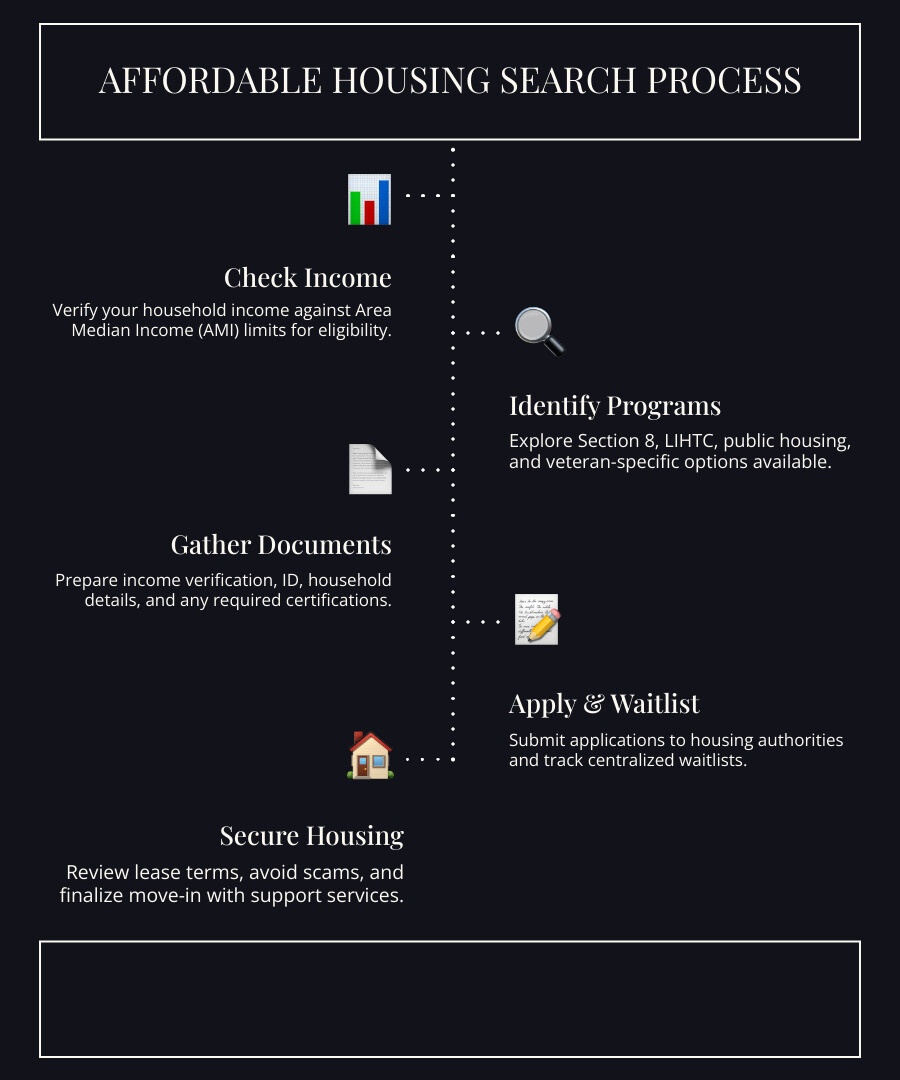
Infographic showing 5-step affordable housing search process from income check to signing lease infographic

LifeSTEPS currently provides services in California only.
Basic low income housing apartments for rent glossary:

Understanding Low Income Housing Apartments for Rent

To find the right home, we first need to understand how affordable housing differs from market-rate housing. Market-rate housing is priced entirely by supply and demand. If a neighborhood becomes popular, rents skyrocket, often pricing out the people who make the community run.

Affordable housing, on the other hand, uses government guidelines to keep rents stable. The foundation of all affordable housing programs is the Area Median Income (AMI). Every year, the U.S. Department of Housing and Urban Development (HUD) calculates the AMI for every county in the nation. Rents and eligibility are then tied directly to these numbers.

Generally, programs target households earning:

  • Extremely Low Income: 30% of the local AMI or lower.
  • Very Low Income: 50% of the local AMI or lower.
  • Low Income: 80% of the local AMI or lower.

When searching for Income Restricted Rentals, you are looking at properties where rents are capped based on these AMI percentages. Navigating this landscape in California requires a clear strategy: you must know your household’s exact annual income, understand how your local county’s AMI affects your budget, and gather your paperwork before you start applying.

Key Affordable Housing Programs in California

California offers several major programs designed to help individuals and families secure stable housing. While they all aim to make rent affordable, they operate very differently.

Finding Low Income Housing Apartments for Rent via Section 8

The Housing Choice Voucher program, commonly known as Section 8, is the federal government’s primary program for assisting very low-income families, the elderly, and disabled individuals.

Under this program, the tenant pays roughly 30% of their monthly adjusted income toward rent, and the government pays the remaining balance directly to the landlord. There are two main types of vouchers:

  1. Tenant-Based Vouchers (Housing Choice Vouchers): These belong to you. If you move, the voucher moves with you to any privately owned property that accepts it.
  2. Project-Based Vouchers: These are tied to a specific apartment unit. If you move out of the unit, the assistance stays with the property.

These programs are administered locally by Public Housing Authorities (PHAs). Because demand is incredibly high, waitlists can be long, making it crucial to understand the application timeline. To learn more about how to secure and use these vouchers, check out our guide on Section 8 Housing Rentals What You Need to Know and How to Find Them.

The Low-Income Housing Tax Credit (LIHTC) is a program that gives tax incentives to private developers to build or rehabilitate affordable rental housing. In exchange for the tax credits, developers agree to keep rents affordable for a set number of years.

Unlike Section 8, where your rent is a direct percentage of your personal income, LIHTC properties have fixed rents capped at a percentage of the AMI (usually 50% or 60%). For example, a studio in a newly constructed building might have a flat rent of $950 per month, reserved exclusively for households earning no more than 60% of the local AMI.

These properties are run by private property management companies rather than government housing authorities. This means you apply directly to the leasing office of the property itself. Best of all, LIHTC properties are legally required to accept Section 8 vouchers, allowing you to combine programs for maximum affordability. If you are new to this process, we recommend reading The Best Income Based Apartments for Beginners to help you get started.

How to Qualify and Apply for Affordable Housing

Qualifying for low income housing apartments for rent requires proving that your household meets the strict eligibility guidelines set by HUD and local administrators.

Your eligibility is determined by:

  • Annual Gross Income: The total income earned by all adults in the household before taxes.
  • Household Size: Income limits increase with the number of people living in the home.
  • Documentation: You will need to provide tax returns, recent pay stubs, bank statements, social security letters, and identification for every household member.

Once you confirm your eligibility, the next step is navigating the waitlist. Because demand heavily outweighs supply, housing authorities and properties use waitlists to manage applicants. Some waitlists operate on a first-come, first-served basis, while others use a lottery system to ensure fairness.

Applying for Low Income Housing Apartments for Rent with No Waiting List

While waiting lists can feel discouraging, there are ways to find immediate openings. Some housing authorities utilize centralized waitlists, allowing you to submit a single application that places you on multiple property waitlists simultaneously. This simplifies the process and increases your chances of finding a home quickly.

Additionally, new LIHTC developments often open their application windows via public lotteries before construction is finished, giving proactive applicants a chance to secure a unit with minimal wait times. For practical strategies on finding these rare openings, read our resource on Low-Income Housing with No Waiting List.

Regional Resources and Search Portals in California

A beautiful, sunlit Southern California residential neighborhood with neat houses and green trees

California has robust, localized search portals designed to connect you directly with available affordable units. Knowing where to look in your specific region can save you weeks of aimless searching.

Southern California Housing Opportunities

Southern California has some of the most active affordable housing networks in the state, supported by local housing authorities and dedicated nonprofits.

An adult receiving keys to a new home from a housing counselor, depicting a white recipient and a person of color counselor

High demand for affordable housing unfortunately attracts scammers who target vulnerable renters. Protecting yourself requires vigilance and an understanding of tenant rights.

Always watch out for these major red flags:

  • Upfront Fees: Never pay a security deposit or holding fee before you have physically toured the apartment and signed a formal lease.
  • Wire Transfers or Cash Apps: Scammers often demand payments via wire transfers, cryptocurrency, or mobile cash apps because these transactions cannot be reversed.
  • Hidden Addresses: If a landlord refuses to give you the exact address of the property or claims they cannot show it to you because they are out of the country, walk away.
  • Unrealistic Prices: If a rent price seems too good to be true for the neighborhood, verify the listing on other trusted housing portals.

If you encounter a scam or face unfair treatment, California has strong tenant protection laws. If you are facing eviction, discrimination, or uninhabitable living conditions, reach out to local legal aid organizations. Many legal aid societies offer free services to low-income renters to help them stay securely housed.

Frequently Asked Questions about Affordable Housing

What is the difference between income-restricted and income-based housing?

Income-restricted housing (such as LIHTC properties) has a set, flat rent based on a percentage of the Area Median Income. Your rent stays the same even if your personal income fluctuates. Income-based housing (such as Section 8 or public housing) calculates your rent as a direct percentage of your actual household income (typically 30%), meaning your rent will decrease if your income drops.

How do I check my eligibility for California housing programs?

To check your eligibility, find your county’s current Area Median Income (AMI) chart on your local housing authority’s website. Compare your total household annual gross income against the household size limits (1-person, 2-person, etc.) listed for the 30%, 50%, or 80% AMI thresholds.

What should I do if I am facing immediate housing instability?

If you are at risk of losing your home, contact local emergency housing services immediately by calling 211. You can also reach out to local legal aid groups for eviction defense, and inquire about temporary rental or deposit assistance programs in your community.

Conclusion

Finding low income housing apartments for rent requires patience, organization, and the right resources, but a stable home is entirely within your reach.

At LifeSTEPS, we believe that housing is only the first step toward a thriving life. Through our human-centered support and dedicated case management, we help residents maintain their housing, achieving an incredible 93% housing retention rate.

We partner with key programs to offer robust support, including deposit assistance through the CalAIM program (providing 1 month paid in advance to help you move in). We also collaborate with initiatives like the Family Self-Sufficiency (FSS) program to help clients, including veterans, transition from rental stability to proud homeownership.

Our commitment to communities goes beyond housing. We support families through our afterschool educational programs — which have driven a 97% literacy improvement in our Summer Reading program — and we have awarded over $2.1M in scholarships to help residents achieve their higher education dreams.

We are here to walk alongside you on your journey to stability and self-sufficiency. To learn more about how we can support you, explore the LifeSTEPS Programs and Services page.

LifeSTEPSusa.org

LifeSTEPS currently provides services in California only.

What It Really Means to Maintain Housing Stability

affordable housing community California

A Simple Guide to HUD Affordable Housing Programs

A Simple Guide to HUD Affordable Housing Programs

What Is HUD Affordable Housing and How Can It Help You?

HUD affordable housing programs are federal programs run by the U.S. Department of Housing and Urban Development that help low-income individuals and families pay for safe, stable housing. If you are a veteran transitioning to civilian life, these programs can be a critical first step toward stability.

Here is a quick overview of the main HUD affordable housing options:

Program How It Works Who It Helps
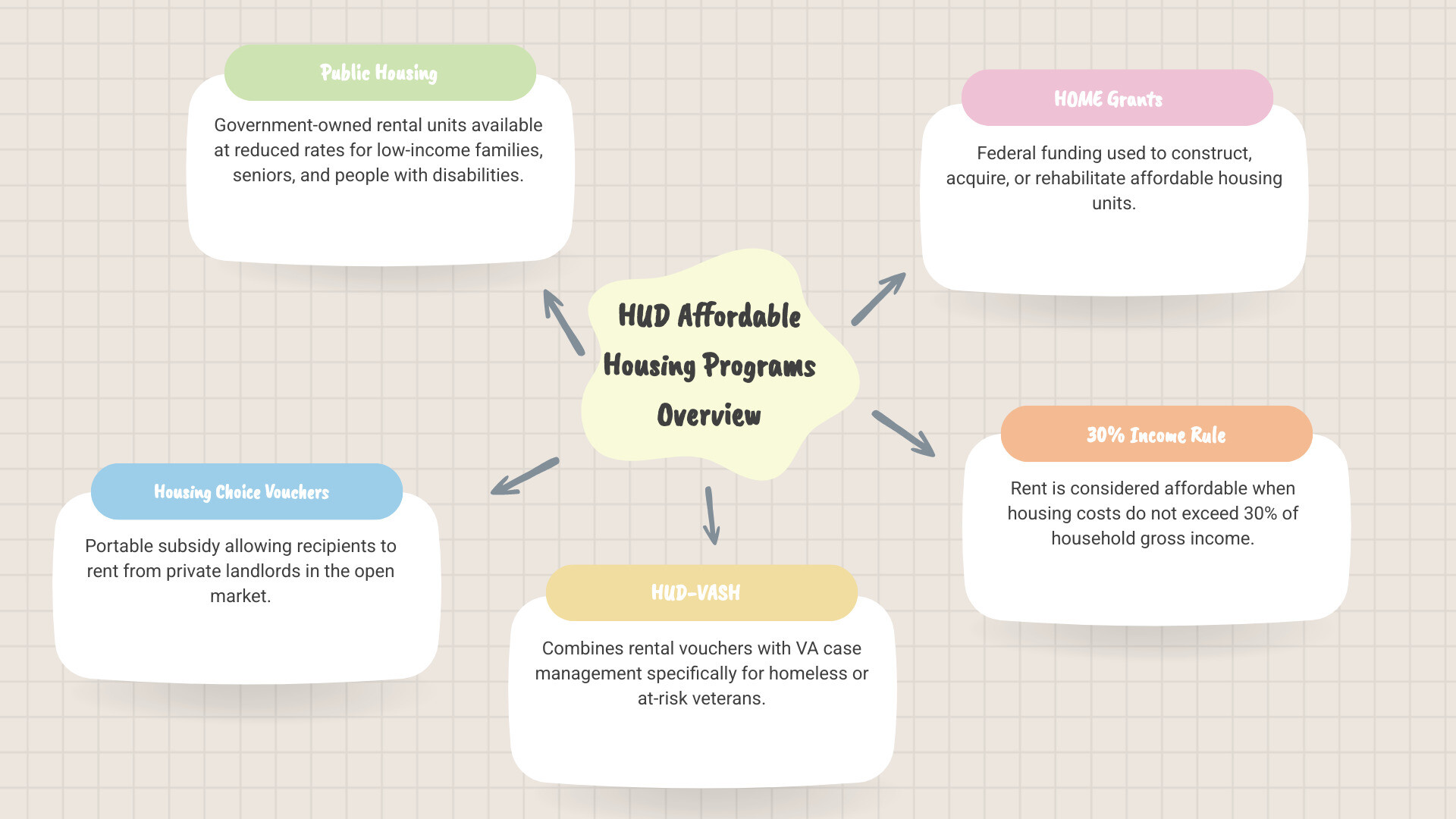
Public Housing Government-owned units rented at reduced rates Low-income families, elderly, people with disabilities
Housing Choice Vouchers (Section 8) Subsidy used to rent in the private market Low-income households who choose their own home
HUD-VASH Combines rental vouchers with VA case management Homeless or at-risk veterans
HOME / HOME-ARP Federal grants to build or rehabilitate affordable units Homeless and vulnerable populations

Affordable housing is generally defined as housing where you spend no more than 30% of your gross income on rent and utilities. For many veterans and low-income households, that threshold is difficult to meet without assistance — and that is exactly the gap these programs are designed to fill.

There are roughly 970,000 households currently living in public housing units across the country, managed by about 3,300 local housing agencies. Millions more receive support through voucher programs. These are not small programs — they are a major part of how Americans access stable housing.

In California, organizations like LifeSTEPS work directly within HUD-assisted communities to help residents not just find housing, but keep it — with a 93% housing retention rate across the people they serve.

Infographic showing HUD affordable housing program types, income thresholds, and who qualifies infographic

LifeSTEPS currently provides services in California only.

Explore more about HUD affordable housing:

Navigating government assistance can sometimes feel like trying to assemble flat-pack furniture without the instruction manual. However, once you understand the basic structure of HUD affordable housing programs, the pieces begin to fit together perfectly.

In California, the demand for affordable rentals is historically high. Whether you are living in Los Angeles, San Diego, Riverside, or Irvine, finding a stable place to call home is essential for your peace of mind and long-term success. HUD programs are designed to make this search easier by lowering your monthly shelter costs so you can focus on other important areas of your life, such as education, employment, and family.

To begin your journey, it is helpful to look at the two primary pathways HUD provides: Public Housing and Housing Choice Vouchers (frequently referred to as Section 8). While both aim to make housing affordable, they operate in very different ways. You can read more about how these options open doors in our guide on how to Unlock Affordable Living: Section 8 Rental Opportunities.

A family happily moving cardboard boxes into their new affordable California apartment

Public Housing vs. Vouchers: Key HUD Affordable Housing Differences

The fundamental difference between public housing and housing choice vouchers comes down to ownership and mobility.

  • Public Housing: Under this program, you rent a unit directly from a local Public Housing Agency (PHA). The housing authority acts as your landlord. The physical buildings—which can range from high-rise apartments in bustling urban centers to scattered single-family homes—are owned and managed by the housing agency itself. If you decide to move out of public housing, your rental assistance stays with the building; it does not move with you.
  • Housing Choice Vouchers (Section 8): This program puts the power of choice in your hands. Instead of moving into a government-owned building, you receive a rental voucher. You can use this voucher to find your own housing in the private rental market, provided the landlord agrees to participate in the program and the unit meets HUD’s safety and rent standards. If you choose to move to a new apartment, your voucher travels with you, allowing for greater geographic flexibility.

Both programs rely heavily on local housing agencies to administer the funds and manage waitlists. For those living in California, you can explore state-specific resources and agency contacts through the California HUD Resources portal.

Eligibility Requirements for HUD Affordable Housing

Who is eligible for these programs? HUD establishes specific income limits based on the Area Median Income (AMI) of your local county or metropolitan area. Because the cost of living varies wildly between regions, an eligible income in Los Angeles CA will look very different from an eligible income in Riverside CA.

HUD categorizes income limits into three main tiers:

  1. Low-Income: Households earning 80% or less of the local Area Median Income.
  2. Very Low-Income: Households earning 50% or less of the local Area Median Income. (Most voucher programs target this group).
  3. Extremely Low-Income: Households earning 30% or less of the local Area Median Income.

In addition to income limits, housing authorities will review:

  • Family Status: Programs are open to families, elderly individuals, and persons with disabilities.
  • Citizenship Status: You must be a U.S. citizen or an eligible noncitizen (such as a lawful permanent resident, refugee, or asylee) to qualify for assistance.
  • Background Screening: PHAs will review references and rental history to ensure you will be a responsible tenant who complies with lease terms.

To better understand the terminology used by HUD officials during the screening process, you can consult the official HUD Glossary.

How Rent is Calculated and Tenant Responsibilities

One of the most common questions applicants ask is: “How much will I actually have to pay each month?”

HUD uses a standardized formula to ensure your rent remains affordable. Generally, your Total Tenant Payment (TTP) is calculated based on your household’s adjusted income.

To make this clear, let’s look at how rent is calculated across different scenarios:

Calculation Method What It Means Example Scenario
30% of Monthly Adjusted Income Your gross income minus HUD-approved deductions, multiplied by 0.30. A household with $1,500 in adjusted monthly income pays**** $450 in rent.
10% of Monthly Gross Income Your total gross income before any deductions, multiplied by 0.10. A household with $1,800 in gross monthly income pays $180 in rent.
Welfare Rent If you receive public assistance, the portion of those welfare benefits designated specifically for housing. Varies based on California state assistance programs.
Minimum Rent A baseline minimum rent established by the local housing authority (typically between $25 and $50). A household with zero income pays a minimum of $25 to $50 as set by the PHA.

Your rent will be set at the highest of the values calculated above.

Income Deductions and Allowances

To make rent calculations fairer, HUD allows specific deductions from your annual gross income before determining your adjusted income:

  • Dependent Deduction: A standard $480 deduction for each dependent (including children under 18, full-time students, or persons with disabilities).
  • Elderly or Disabled Family Deduction: A $400 deduction for any family whose head, co-head, or spouse is elderly (62 or older) or has a disability.
  • Medical and Disability Expenses: For elderly or disabled families, any unreimbursed medical expenses that exceed 3% of your annual gross income can be deducted.

Tenant and Housing Authority Responsibilities

Affordable housing is a two-way street. Both the tenant and the Housing Authority have strict rules to follow to keep the community safe, clean, and functional.

Your Responsibilities as a Tenant:

  • Lease Compliance: You must abide by all terms of your lease, including keeping noise levels reasonable and respecting neighbors.
  • Property Maintenance: You must keep your unit clean, safe, and in sanitary condition.
  • Prompt Reporting: You must immediately report any maintenance issues to your landlord or PHA, and you must report any changes in your household income or family size within the designated timeframe.
  • Honesty: You must provide truthful verification of income and assets during your annual reexamination.

The Housing Authority’s Responsibilities:

  • Regular Inspections: The PHA must inspect units regularly to ensure they meet strict safety and sanitary standards.
  • Property Maintenance: For public housing, the PHA must handle repairs, maintain common areas, and ensure utilities work properly.
  • Fair Administration: The PHA must process applications, manage waitlists, and calculate rent payments accurately and without discrimination.

How to Apply and Find Housing in California

If you are ready to take the next step, applying for HUD affordable housing in California requires preparation, patience, and organization. Because demand is incredibly high, being prepared with the right paperwork can make a massive difference when a waiting list opens up.

A friendly HUD-certified housing counselor sitting with a client, helping them fill out housing applications

Step-by-Step Application Process

  1. Locate Your Local Housing Authority: You must apply directly through the housing agency that manages the area where you want to live.
  2. Gather Your Documentation: Before you apply, gather essential documents for every member of your household. This includes birth certificates, Social Security cards, tax returns, recent pay stubs, bank statements, and photo identification.
  3. Submit the Application: Fill out the application completely. Be honest about your income, family composition, and rental history. Any discrepancies can lead to your application being denied.
  4. Monitor Your Waitlist Status: Once your application is accepted, you will likely be placed on a waiting list. Keep your contact information updated with the housing authority. If they try to reach you and your phone number or address has changed, they may remove you from the list.

Waiting Lists and Local Preferences

Due to high demand, housing authorities often close their waiting lists when the number of applicants exceeds available units. When the lists are open, PHAs use a system of local preferences to determine who gets housing first. Common preferences include:

  • Families or individuals experiencing homelessness.
  • Veterans or families of veterans.
  • Local residents who already live or work in the agency’s jurisdiction.
  • Families paying more than 50% of their income toward rent.

For detailed strategies on how to successfully navigate this system, check out The Ultimate HUD Low Income Housing Application Guide.

If you are looking for affordable rental opportunities in Southern California, you can apply directly through local agencies such as the San Diego Housing Commission or the Housing Authority of the County of Riverside.

Frequently Asked Questions about HUD Housing

What is the difference between public housing and Section 8?

The primary difference is where you live and who manages the property. Public housing is owned, maintained, and operated directly by a local housing authority. You live in a designated housing development.

Section 8 (the Housing Choice Voucher program), on the other hand, allows you to find your own apartment or house in the private market. The housing authority pays a subsidy directly to your private landlord, and you pay the remaining balance. If you are looking for private rentals that accept vouchers, you can search for listings using resources like Housing Voucher Apartments Near Me.

How long is the waitlist for affordable housing?

Wait times vary significantly depending on where you are applying in California. In high-demand metropolitan areas like Los Angeles or San Diego, waitlists can last several years. Some housing authorities utilize a lottery system to randomly select applicants when the waitlist opens briefly.

To shorten your wait, check if you qualify for any local preferences (such as being a veteran or currently residing in the service area) and apply to multiple housing authorities with open lists.

Can HUD programs help me buy a home?

Yes! Many people do not realize that HUD assistance can extend beyond renting. Through programs like the Family Self-Sufficiency (FSS) program, HUD helps low-income families build financial assets.

Under the Section 8 Homeownership Program, eligible families can actually use their rental voucher to help pay a monthly mortgage instead of rent. To learn more about how you can transition from renting to owning, read our comprehensive guide on Housing Authority Programs: Your Pathway to Affordable Homeownership.

Conclusion

Finding a safe, affordable place to live is the foundation of a stable life. HUD affordable housing programs provide the essential support millions of Americans need to secure that foundation. However, getting into housing is only the first step. Staying housed, building financial capability, and achieving long-term self-sufficiency require ongoing support and community resources.

This is where LifeSTEPS steps in. As a nonprofit organization dedicated to helping individuals transition to stable housing and self-sufficiency, we work alongside residents to ensure they have the tools to thrive. Our unique collaboration with programs like the Family Self-Sufficiency (FSS) program helps clients—including veterans—build savings, improve their financial literacy, and even achieve homeownership.

Our impact is clear:

  • We maintain a 93% housing retention rate, helping thousands of Californians stay securely housed.
  • Through our integration with the CalAIM program, we provide vital deposit assistance—including 1 month paid in advance—to help eligible individuals transition smoothly into stable environments.
  • We believe in lifting up the next generation, which is why our youth programs have achieved a 97% literacy improvement through our Summer Reading initiatives.
  • We have awarded over $2.1 million in academic scholarships to help residents pursue higher education and break the cycle of poverty.

Whether you are seeking rental assistance, working toward homeownership, or looking for educational resources for your children, we are here to walk alongside you on your journey.

To discover how we can help you or your community, Learn more about LifeSTEPS programs and services.

LifeSTEPS

LifeSTEPS currently provides services in California only.