


Homework, Growth, and Community: Transforming Lives with Affordable Housing Afterschool Programs
Why Affordable Housing Afterschool Programs Matter
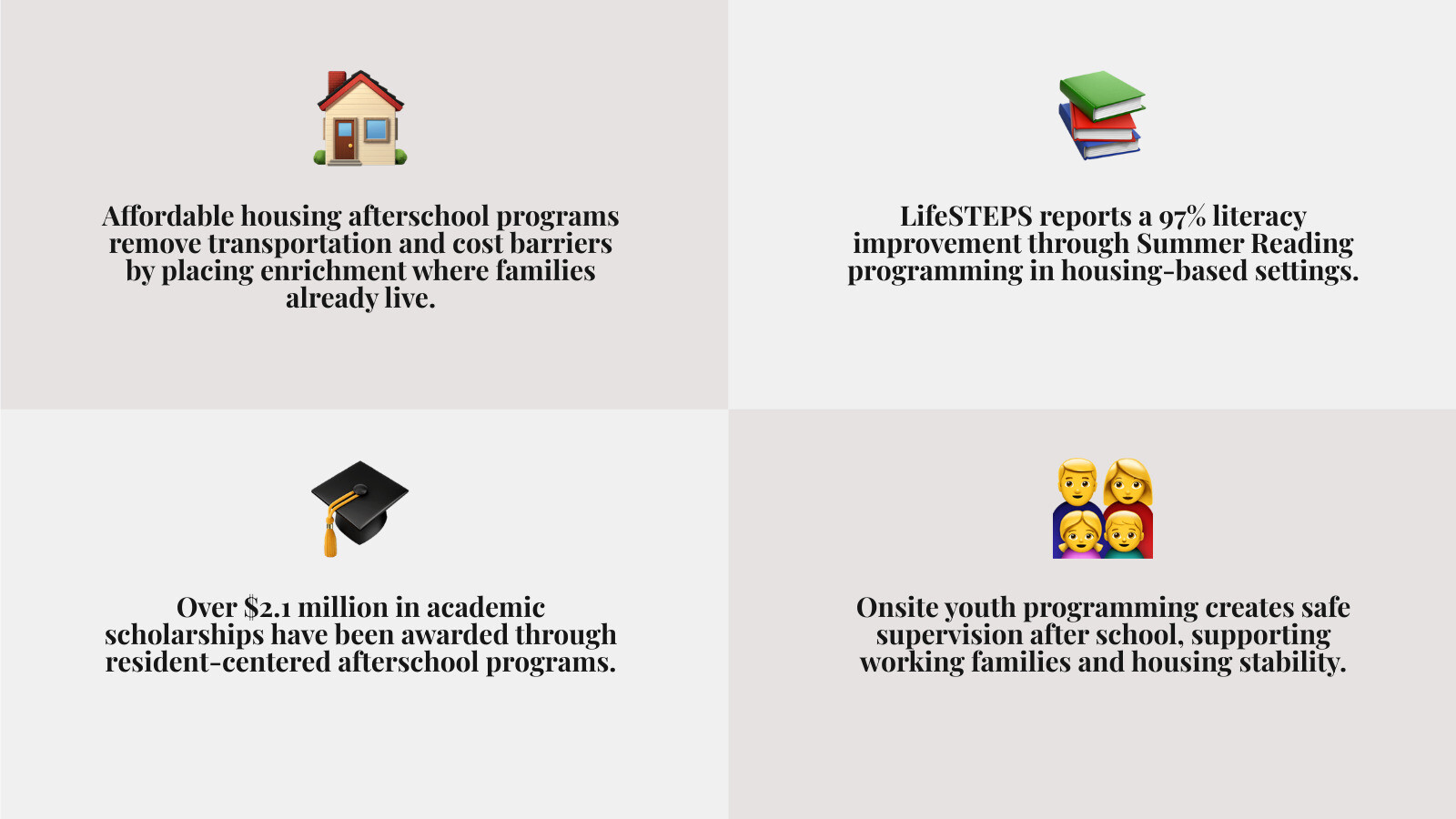
Affordable housing afterschool programs give children a safe, nearby place to get homework help, build friendships, and explore activities while caregivers work or manage daily responsibilities. By placing learning and enrichment where families already live, these programs can remove common barriers such as transportation, cost, and lack of adult supervision after school. For many households, the hours between the final school bell and the end of a parent’s workday are the most vulnerable part of the day. Without structured support, children may fall behind academically or miss out on the social connections that build confidence and resilience.
For families rebuilding stability, including transitioning veterans, this model can make housing feel like more than a place to sleep. It becomes a connected community with practical support for children and a stronger foundation for education. When a child can walk from their front door to a supervised learning center, the entire household benefits. Parents gain peace of mind, students gain consistent academic guidance, and the community gains a shared space where neighbors support one another.
Strong programs combine tutoring, literacy, STEM activities, healthy meals, and social-emotional learning. They also create access to opportunities that may otherwise be out of reach. LifeSTEPS reports a 97% literacy improvement through Summer Reading programming and has awarded more than $2.1 million in scholarships, showing how resident-centered education can support longer-term pathways to higher education. These outcomes reflect a broader commitment to educational equity: when enrichment is embedded within affordable housing, children from all backgrounds can access the same quality of support as their peers in more resourced neighborhoods.
Families working toward lasting stability can also explore broader community housing resources, from qualifying for a first home loan grant to navigating specialized home buyer programs and accessing regional Bay Area home buyer aid.
The Vital Role of Affordable Housing Afterschool Programs in Student Success
Co-locating youth enrichment directly inside residential properties eliminates the daily friction that prevents low-income students from accessing high-quality academic support. For households navigating limited incomes, locating enrichment opportunities within steps of the front door provides crucial affordable housing resident support. When quality care is positioned on-site, children make the safe transition from school to homework help without requiring complex travel arrangements or transit fares.
This proximity allows an onsite after-school program to weave academic retention strategies into the everyday fabric of the neighborhood. Rather than treating education as an isolated classroom activity, housing-based programming provides trauma-informed environments that support the whole child. Dedicated staff and volunteers offer personalized guidance, ensuring homework completion while reinforcing core concepts in math and reading.
| Feature | Traditional Off-Site Childcare | Housing-Based Afterschool Model |
|---|---|---|
| Location & Commute | Requires public transit or vehicle coordination | Steps from resident front doors; zero commute |
| Financial Cost | High monthly tuition, registration fees, and material costs | Free or deeply subsidized for community residents |
| Family Engagement | Limited interaction at brief pick-up windows | Ongoing, direct partnership with parents and caregivers |
| Holistic Support | Focuses narrowly on basic supervision or care | Integrates housing stability, literacy, and social services |
| Attendance Consistency | Vulnerable to transit delays and scheduling conflicts | Highly consistent due to community co-location |
By offering a reliable, supervised environment during critical out-of-school hours, these programs turn residential developments into launchpads for lasting academic achievement.
Overcoming Barriers: How Onsite Learning Spaces Empower Working Families
Unpredictable work shifts and non-traditional schedules often leave working parents struggling to balance professional obligations with their children’s after-school supervision. On-site community centers relieve this pressure by providing safe, structured spaces led by caring mentors. Parents can complete their workdays knowing their children are safe, engaged, and receiving guidance with their assignments.
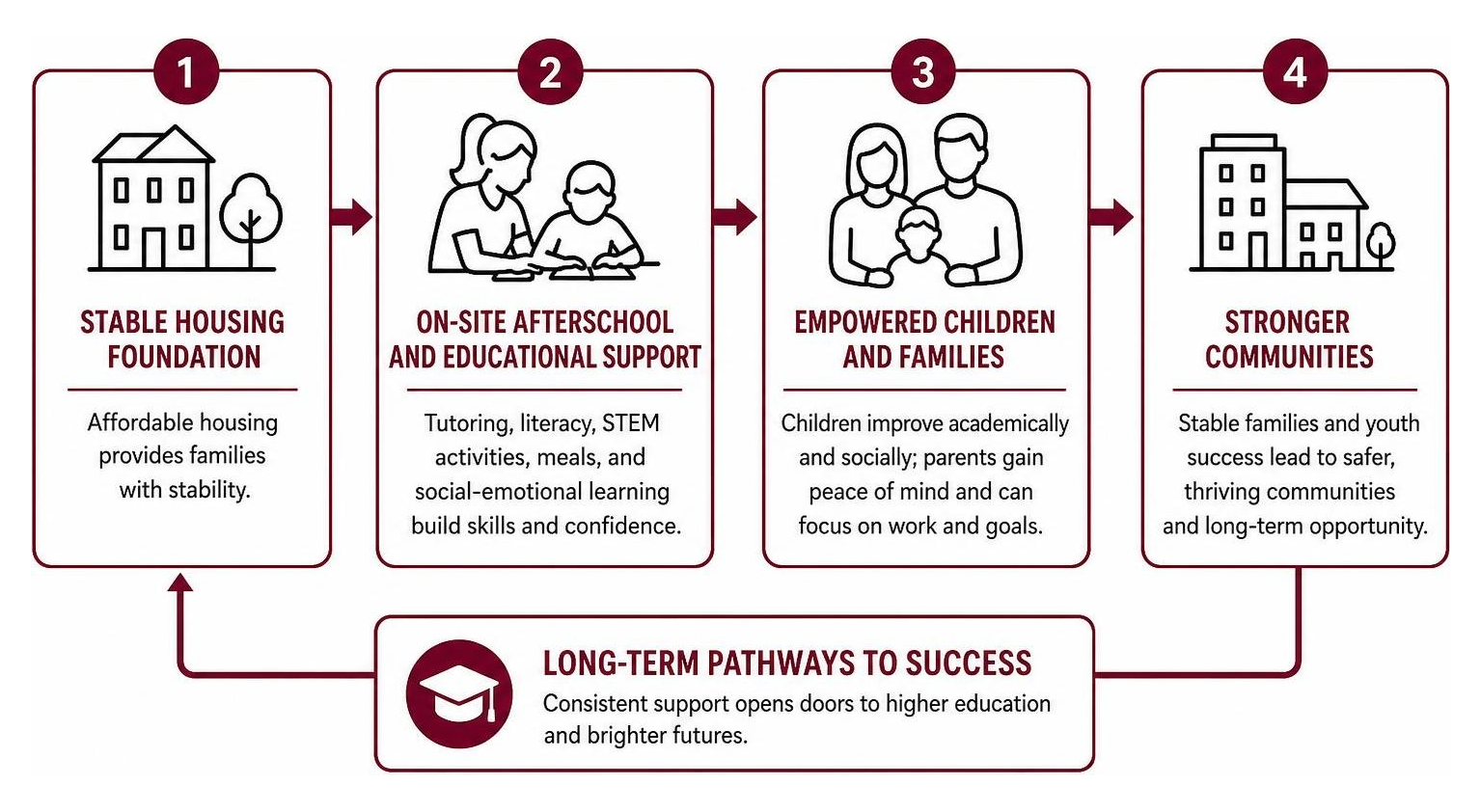
These community spaces help close the educational opportunity gap through positive behavioral interventions, peer collaboration, and comprehensive supportive youth services. For example, consider the experience of Carlos, whose name has been changed to protect his privacy. When his family moved into affordable housing in Southern California, Carlos struggled with reading confidence and spent afternoons isolated while his parents worked late. After joining the on-site learning center, he received daily reading mentorship, caught up to grade-level benchmarks, and built strong friendships within his own neighborhood.
Key Academic and Social Outcomes in Affordable Housing Afterschool Programs
Housing-based enrichment programs consistently yield strong academic and behavioral improvements. Research across community-based youth initiatives demonstrates measurable results:
- 91% of participating students improved their overall grade point average.
- 89% of students advanced their academic performance by at least one full grade level.
- 75% of participants raised their reading comprehension scores.
- 62% of youth achieved measurable gains in mathematics proficiency.
- 76% of program graduates successfully transitioned into higher education.
Beyond grades, structured centers provide robust social-emotional development. Anti-bullying curriculums and peer-mentoring circles help children build self-regulation, empathy, and collaborative skills. For older youth, targeted educational programs for teens cultivate leadership abilities, career exploration, and positive social identities, creating a supportive peer network across the entire complex.
Literacy Initiatives and STEM Enrichment for Underserved Youth

Closing the achievement gap requires year-round engagement, particularly during the summer months when opportunity loss is highest. Co-located programs actively focus on preventing summer learning loss by keeping young minds curious through structured reading clubs and interactive challenges. Across our educational initiatives, LifeSTEPS achieves a 97% literacy improvement during Summer Reading programming, ensuring that students return to school in the fall prepared to excel.
In tandem with literacy, specialized stem programs for underserved youth introduce children to foundational science, technology, engineering, and math concepts. Hands-on robotics kits, guided science experiments, and coding clubs ignite technical curiosity at an early age. Studies show that over 52% of children participating in structured community science activities experience a marked increase in their enthusiasm for STEM topics, demystifying subjects that might otherwise seem out of reach.
Sustainable Models: Partnerships, Funding, and Wraparound Family Support
Delivering free, high-impact youth enrichment within residential communities relies on robust collaborations between housing authorities, nonprofit providers, and forward-thinking developers. By drawing upon community-based afterschool resources and pioneering affordable housing initiatives, communities can create sustainable funding models that blend public programs with private philanthropy.
True community resilience requires addressing the needs of the whole family. Housing stability serves as the absolute baseline for all youth development. LifeSTEPS maintains an exceptional 93% housing retention rate, helping individuals and families maintain permanent, stable homes. In California, qualifying residents receive vital deposit assistance—covering 1 month paid in advance—tied specifically to the CalAIM program. When stable housing is paired with family workshops, financial coaching, and youth enrichment, entire households gain the footing required for long-term self-sufficiency.
Building Lasting Impact Through Affordable Housing Afterschool Programs

High-impact community programs honor the cultural richness of the neighborhoods they serve. In diverse California areas across Los Angeles, San Diego, Riverside, Irvine, and the Bay Area, learning spaces deliver culturally responsive curricula that support first- and second-generation immigrant youth.
Bi-literacy initiatives, multicultural book collections, and inclusive community celebrations ensure every child feels valued. By collaborating with municipal agencies, local school districts, and community partners, these centers offer comprehensive youth education programs that reflect the lived experiences of their participants.
Pathways to Higher Education and College Scholarships
The journey toward breaking intergenerational poverty reaches its pinnacle in postsecondary education. Housing-based programs support adolescents through college readiness workshops, standardized test preparation, career mentorship, and financial aid counseling.
To turn higher education aspirations into reality, LifeSTEPS has awarded more than $2.1 million in academic scholarships to deserving residents. These funds alleviate tuition and book costs, ensuring that economic constraints do not prevent ambitious students from pursuing vocational credentials, associate degrees, or university diplomas.
Frequently Asked Questions About Housing-Based Youth Enrichment
How do housing-based afterschool programs eliminate common childcare barriers?
Housing-based programs remove the two greatest obstacles working families face: high childcare costs and transportation logistics. Because services are located directly inside or immediately adjacent to the residential community, children can walk safely to the center without needing car rides or public transit. Programs are offered free of charge or on an income-subsidized basis, ensuring that every resident child has equal access to high-quality enrichment.
What academic results are typical for participating students?
Students participating in housing-based enrichment consistently show marked academic growth. Across program evaluations, over 90% of regular attendees demonstrate improved grade point averages, while three out of four students raise their reading comprehension levels. Additionally, daily homework assistance ensures high homework completion rates, helping youth stay on track with their classroom expectations.
How can community housing providers incorporate youth enrichment services?
Housing providers and developers can integrate enrichment services by designing dedicated multipurpose community spaces during the architectural planning phase. By partnering with experienced nonprofit service organizations, housing managers can leverage state grants, local educational funding, and philanthropic contributions to staff these centers with trained youth coordinators.
Conclusion
Affordable housing afterschool programs demonstrate that a home is far more than a physical roof—it is the launchpad for a family’s future. By pairing permanent housing stability with high-quality academic tutoring, STEM exploration, and family support, these programs open doors to generational opportunity.
Through holistic, human-centered empowering resident services, LifeSTEPS continues to foster communities where young minds thrive, families remain securely housed, and educational dreams become attainable realities.
For media inquiries, contact: bex@lifestepsusa.org
LifeSTEPS currently provides services in California only.


