


The First-Time Buyer Guide to Los Angeles FSS Home Grants
The First-Time Buyer Guide to Los Angeles FSS Home Grants
How Los Angeles FSS Home Grants Can Put You on the Path to Homeownership
Los Angeles FSS home grants are one of the most underused tools available to Section 8 voucher holders and public housing residents who want to buy a home. Here is a quick look at what they offer:
- What it is: The Family Self-Sufficiency (FSS) Program is a voluntary, HUD-backed program that helps housing assistance recipients build savings and move toward economic independence.
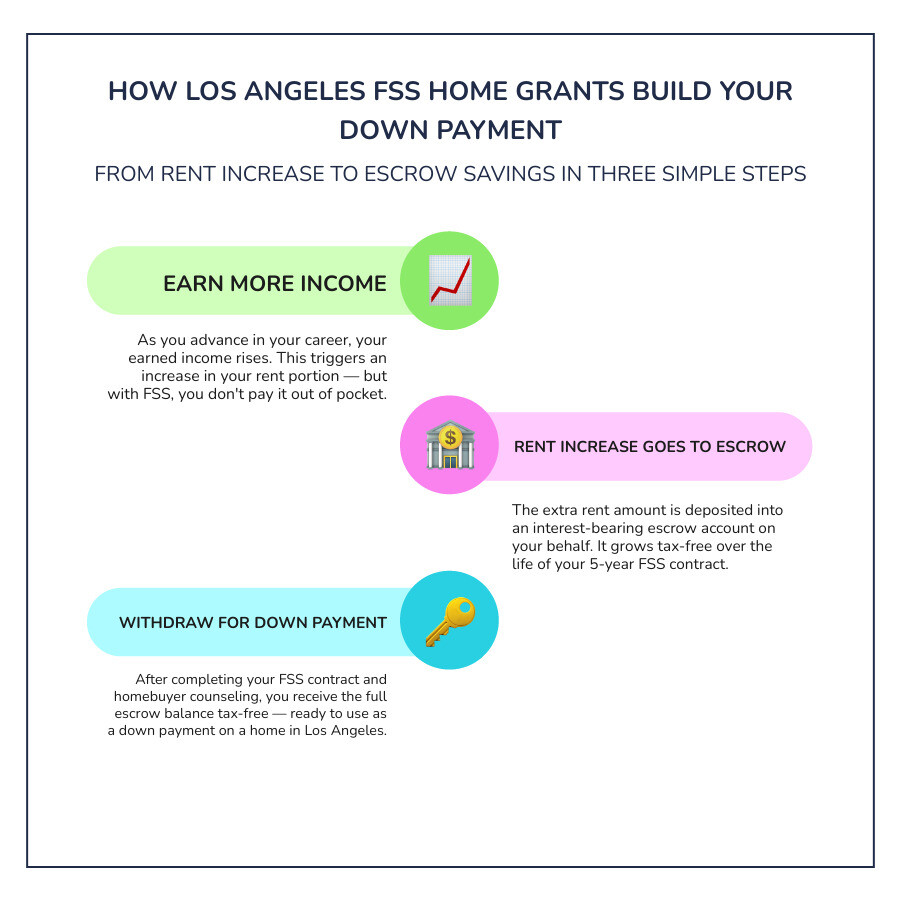
- How it works: As your earned income grows, the rent increase that would normally come out of your pocket is instead deposited into an interest-bearing escrow savings account on your behalf.
- What you can do with it: When you complete your 5-year FSS contract, those funds are yours — tax-free — and can be used as a down payment on a home.
- Who runs it in Los Angeles: Two agencies administer the program locally — the Housing Authority of the City of Los Angeles (HACLA) and the Los Angeles County Development Authority (LACDA).
- Recent funding: HACLA has received the largest HUD FSS grant in California, and LACDA was awarded $1.2 million in HUD renewal funding to keep the program running.
Owning a home after military service can feel out of reach, especially in a high-cost market like Los Angeles. Rents are steep, down payments are steep, and the process is complicated. But the FSS program is designed specifically to turn the housing assistance you already receive into a savings engine — one that quietly builds a down payment while you focus on your career and your goals.
Housing policy researchers have long called FSS “HUD’s best-kept secret.” That reputation is well earned. Many eligible residents simply do not know it exists.
This guide walks you through exactly how to use the FSS program — and how to stack it with other Los Angeles down payment assistance programs — so you can move from renter to homeowner with a clear, step-by-step plan.
LifeSTEPS currently provides services in California only.
Los Angeles FSS home grants basics:
Understanding the Family Self-Sufficiency Program in Los Angeles
What is the FSS Program and How Escrow Savings Work
The Family Self-Sufficiency (FSS) Program operates under strict U.S. Department of Housing and Urban Development (HUD) guidelines set forth in 24 CFR Part 984. It is designed to help low-income households receiving housing assistance transition into long-term economic independence.
When you participate in standard subsidized housing programs, your tenant rent contribution is tied directly to your income — typically set at roughly 30% of your adjusted monthly gross income. Under normal circumstances, when your wages increase, your monthly rent portion goes up automatically. For many families, this dynamic creates an unintentional penalty for earning more money.
The FSS Program changes that equation entirely through its interest-bearing escrow account structure.
When an FSS participant increases their earned wages through promotions, job training, or new employment, the resulting increase in their tenant rent portion is calculated and deposited monthly into a dedicated escrow savings account held by the housing authority. Instead of the extra rent dollars dissolving into the housing authority’s operating revenue, those dollars build assets on your behalf.
Key financial features of the FSS escrow savings model include:
- Tax-Free Savings: The Internal Revenue Service (IRS) has confirmed that escrow disbursements paid out upon successful program graduation are non-taxable income.
- Compound Interest: Escrow balances earn interest over the course of the standard five-year Contract of Participation.
- Interim Disbursements: Under specific guidelines, housing authorities can allow participants to access a portion of their accrued escrow early for critical goal-related barriers, such as educational tuition, work tools, or credit repair services.
- Homeownership Capital: Upon program completion, the accumulated escrow balance can be disbursed directly as cash or routed straight to an escrow closing agent to serve as down payment and closing cost capital for purchasing a home.
To learn more about how federal HUD guidelines govern these accounts and set parameters for local programs, explore our detailed HUD FSS Program Guide.
Housing Authorities: HACLA vs. LACDA
In Los Angeles County, the FSS program is primarily administered by two distinct public housing agencies depending on your municipal location and subsidy type: the Housing Authority of the City of Los Angeles (HACLA) and the Los Angeles County Development Authority (LACDA).
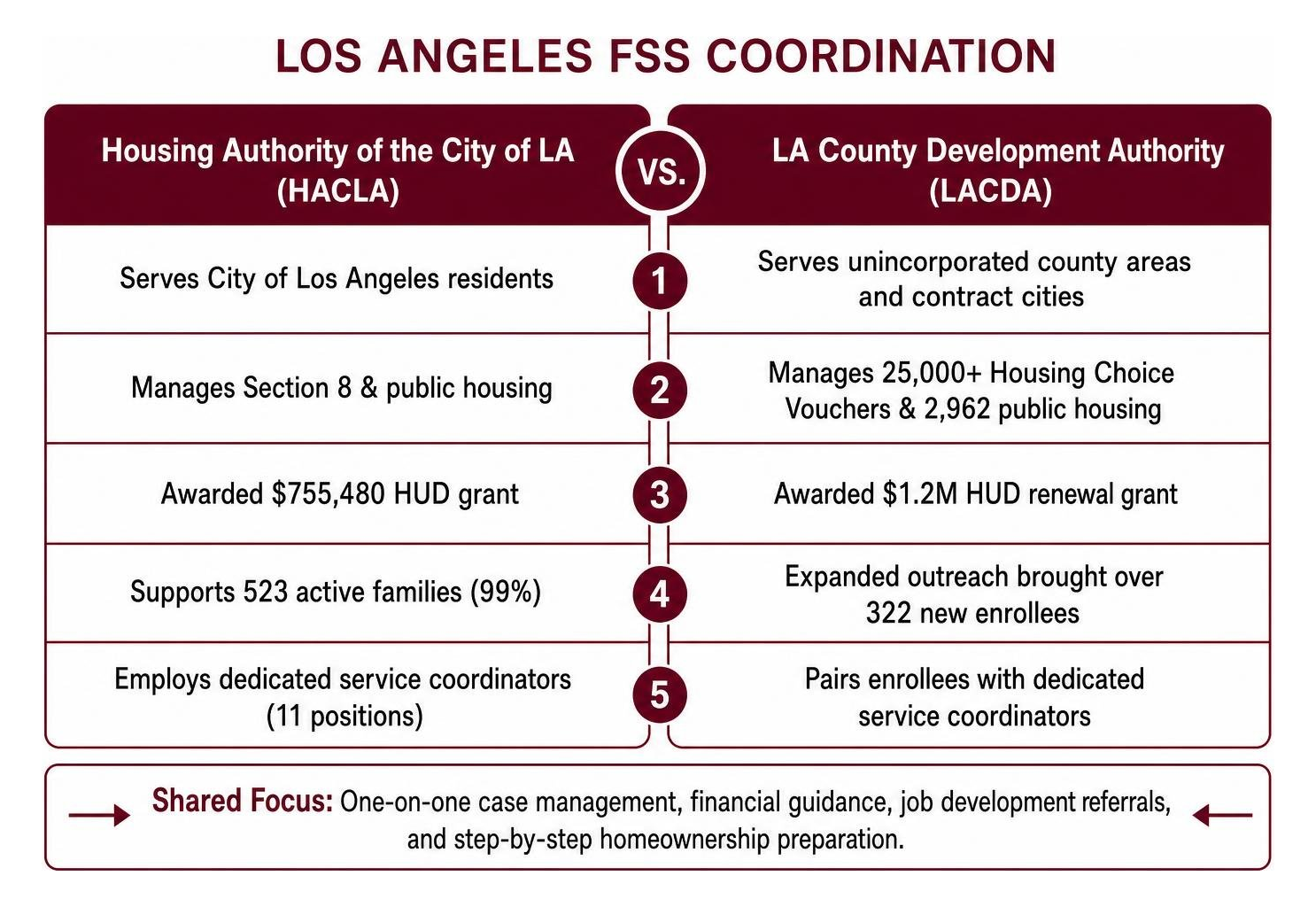
HACLA oversees housing programs within the municipal boundaries of the City of Los Angeles. In recent federal funding distributions, HACLA secured a $755,480 grant from HUD — the largest single FSS award in the state of California — out of a national $75 million HUD grant pool. HACLA utilizes this grant funding to support 11 dedicated service coordinator positions who manage local case management and community support services. Currently, 523 families are enrolled in HACLA’s FSS program, utilizing 99% of all available program slots.
LACDA administers subsidized housing for residents living in unincorporated areas of Los Angeles County as well as dozens of contract cities. LACDA manages more than 25,000 Housing Choice Vouchers and 2,962 public housing units. HUD awarded LACDA $1.2 million in renewal funding from a competitive $105 million national pool. Expanded outreach across Southern California has brought over 322 new enrollees into LACDA’s FSS program.
Both agencies pair enrollees with dedicated FSS Service Coordinators. These coordinators deliver one-on-one case management, personal financial guidance, job development referrals, and step-by-step homeownership preparation.
How to Maximize Los Angeles FSS Home Grants for Your Down Payment
Eligibility Criteria for Los Angeles FSS Home Grants
To participate in the FSS program and access Los Angeles FSS home grants via escrow accumulation, applicants must meet precise administrative requirements set by federal regulations and local housing authority policy:
- Active Housing Assistance: You must be an active participant in either the Housing Choice Voucher (Section 8) program or reside in conventional Public Housing managed by HACLA or LACDA.
- Head of Household Agreement: While any adult household member can participate in supportive activities, the official Head of Household must sign the five-year FSS Contract of Participation.
- Income and Welfare Rules: Participants must commit to becoming fully independent from cash welfare assistance (such as CalWORKs or TANF) for at least 12 consecutive months prior to program graduation.
- Employment Mandate: The Head of Household must seek and maintain suitable full-time employment by the end of the five-year term, based on their skills, abilities, and local labor market conditions.
- Good Standing: The household must maintain lease compliance and remain in good standing with their respective housing authority throughout the contract period.
For a comprehensive review of state-level self-sufficiency frameworks and supportive resources across Southern California, consult The Ultimate Guide to California Family Self-Sufficiency.
Step-by-Step Guide to Applying for Los Angeles FSS Home Grants
Navigating the transition from subsidized rental housing to homeownership requires a clear, methodical approach.

Here is the step-by-step pathway to successfully graduate from the FSS program and deploy your escrow funds toward purchasing a home:
- Step 1: Submit a Pre-Enrollment Application. Contact your housing authority’s FSS department (for LACDA, email fssprogram@lacda.org or call 626-586-1530; for HACLA, reach out directly to your assigned voucher coordinator) to submit an initial application.
- Step 2: Complete the Intake Assessment. Meet with an assigned FSS Coordinator to review your current household finances, employment profile, credit standing, and long-term goals.
- Step 3: Develop Your Individual Training and Services Plan (ITSP). Outline specific short-term and long-term milestones covering education, career growth, financial literacy, credit score enhancement, and homebuyer education.
- Step 4: Execute the Contract of Participation. Sign a formal five-year contract that outlines participant obligations, housing authority commitments, and the exact terms governing escrow account deposits.
- Step 5: Increase Earned Income. Gain employment, increase work hours, or secure higher-paying positions. As your wage growth increases your tenant rent contribution, your escrow balance builds each month.
- Step 6: Attend Required Financial and Homebuyer Counseling. Complete mandatory HUD-approved homeownership education courses to gain foundational skills in mortgage underwriting, purchase contracts, home inspections, and ongoing property maintenance.
- Step 7: Fulfill Graduation Requirements and Claim Escrow. Verify that all ITSP goals are met, maintain suitable employment, ensure zero household dependence on cash welfare for 12 consecutive months, and request your escrow payout for your home purchase closing.
To learn how specialized homebuyer classes help participants transition into escrow closing smoothly, read our guide on how to Unlock Your Front Door with FSS Homebuyer Education.
Combining FSS Escrow Savings with Local Los Angeles Down Payment Assistance
Layering LIPA, MIPA, and Mortgage Credit Certificates
While FSS escrow accounts provide substantial cash reserves, median home values across Los Angeles County often require buyers to layer multiple funding sources. Fortunately, local government agencies explicitly permit buyers to stack FSS escrow funds with municipal soft-second loans and tax credits.
The primary homebuyer assistance programs operating alongside FSS in Los Angeles include:
- Low Income Purchase Assistance (LIPA): Administered by the City of Los Angeles Housing Department (LAHD), LIPA provides low-income households (earning up to 80% Area Median Income) with up to $161,000 in loan assistance ($146,000 in city funds paired with up to $15,000 from private partner grants, such as First Citizens Bank). LIPA operates as a 0% interest, deferred silent-second loan that requires no monthly payments until property transfer, sale, or loan maturity after 30 years.
- Moderate Income Purchase Assistance (MIPA): Designed for buyers earning between 81% and 120% or 150% Area Median Income (AMI), MIPA offers up to $140,000 or $110,000 depending on income tiers, structured as a deferred soft-second loan to bridge the affordability gap on single-family homes, townhomes, or condominiums.
- Mortgage Credit Certificate (MCC): Administered locally by LAHD and LACDA, the MCC program grants first-time buyers a direct federal income tax credit equal to 20% of their total annual mortgage interest paid. Underwriting mortgage lenders can add this tax credit back into the applicant’s qualifying income, significantly increasing total borrowing capacity.
- Southern California Home Financing Authority (SCHFA): Provides first-time homebuyers across Los Angeles and Orange Counties with fixed-rate first mortgages paired with non-repayable down payment grants equal to up to 4% of the principal loan amount.
| Program Name | Target Income Level | Maximum Assistance Amount | Loan Type / Repayment Terms | Key Requirements |
|---|---|---|---|---|
| LAHD LIPA | Up to 80% AMI | Up to $161,000 | 0% Deferred Silent Second (Due in 30 yrs or upon sale) | Min 660 FICO; 1% buyer down payment contribution |
| LAHD MIPA | 81% – 120%/150% AMI | $110,000 – $140,000 | Deferred Silent Second with Shared Appreciation | Primary residence; HUD homebuyer education |
| SCHFA Grant | Up to County Income Caps | Up to 4% of 1st Mortgage | True Grant (No Repayment Required) | Min 640 FICO; Max 45% DTI ratio |
| LACDA HOP | Up to 80%/120% AMI | $85,000 – $100,000 | Deferred Silent Second Mortgage | Non-targeted areas; first-time homebuyer rules |
To explore historical municipal transmittals and official program structures detailing municipal soft-second loans, review the LAHD LIPA Report and visit the official Los Angeles County Affordable Homeownership Program page.
Overcoming Common Barriers to Escrow Fund Release
Although stacking Los Angeles FSS home grants with local down payment assistance offers a powerful pathway to ownership, participants often encounter systemic obstacles during escrow. Understanding these barriers ahead of time ensures you can proactively solve them with your service coordinator.
Common challenges and strategic solutions include:
- Credit Score Requirements: Programs like LIPA require a minimum middle FICO score of 660, whereas standard FHA loans require 580 to 620, and SCHFA requires 640. FSS participants should engage early with HUD-certified credit counseling to eliminate collections, establish positive trade lines, and reduce credit utilization ratios.
- Debt-to-Income (DTI) Ratios: Mortgage underwriters generally enforce strict DTI caps, often restricting total recurring monthly debt payments to 45% or less of gross income. Utilizing MCC tax credits helps boost qualifying income to bring overall DTI within compliant ranges.
- Liquid Contribution Requirements: Most municipal assistance programs mandate that buyers contribute between 1% and 3% of the purchase price from their own personal funds. FSS escrow accounts fulfill this requirement, providing verified personal capital without triggering secondary lender gift-fund restrictions.
- Program Timing and Escrow Release: Aligning the graduation timing of an FSS contract with loan closing dates requires tight coordination. FSS coordinators must verify goal completion and coordinate directly with title officers to ensure escrow funds disburse directly into the closing statement.
For an in-depth strategy guide on combining grants, navigating lender guidelines, and optimizing soft-second loans, read The Ultimate Guide to Affordable Homeownership Programs and Grants.
Frequently Asked Questions About Los Angeles Homebuying Assistance
How do FSS escrow savings differ from traditional down payment grants?
Traditional down payment grants are competitive, discretionary government awards distributed on a first-come, first-served basis that directly cover upfront transaction costs.
In contrast, FSS escrow savings are earned asset-building funds created by your own career advancements and income increases while receiving housing assistance. As your wages increase and your tenant rent portion rises, the housing authority deposits that rent differential into an interest-bearing escrow account on your behalf.
Furthermore, FSS escrow funds are completely tax-exempt under IRS rulings, meaning you retain 100% of accrued interest and contributions upon successful program completion.
Can FSS funds be combined with CalHFA or LIPA assistance?
Yes. FSS escrow funds are considered your personal, earned assets upon program graduation. Because they are not categorized as secondary government debt or gift funds, you can freely stack your FSS escrow payout alongside state programs like CalHFA MyHome, municipal soft-second loans like LIPA or MIPA, and federal Mortgage Credit Certificates.
Working with an experienced mortgage lender who understands public housing authority escrow distributions ensures seamless loan underwriting.
What happens to FSS escrow funds if I change jobs or earn more income?
Earning higher wages or transitioning to a better job is the primary goal of the FSS program. When your earned income increases, your monthly escrow deposit increases proportionally because the gap between your baseline rent and your new adjusted tenant rent grows.
If you temporarily experience job loss, escrow deposits pause, but accumulated funds remain safely in your account while you work with your FSS coordinator to re-establish employment.
Conclusion
At LifeSTEPS, we are deeply committed to empowering individuals and families as they transition to stable housing and long-term self-sufficiency. As a California-focused nonprofit social service provider, our team works hand-in-hand with housing communities, veterans, and residents across Los Angeles, San Diego, Riverside, Irvine, and surrounding regions.
Our programs focus on deliverable, human-centered outcomes that create lasting community stability:
- Housing Retention: We maintain a 93% housing retention rate across our residential communities, helping residents remain stably housed while building pathways toward future asset ownership.
- Deposit Assistance: Through integrated health and social programs like CalAIM, we provide eligible clients with critical deposit assistance, covering up to 1 month paid in advance to ensure smooth housing transitions.
- Youth Education & Empowerment: Our youth programs drive real results, achieving a 97% literacy improvement through our Summer Reading initiative and awarding over $2.1 million in academic scholarships to help the next generation succeed.
- Veteran Homeownership Support: We specialize in helping military veterans leverage housing subsidies, voucher programs, and asset-building initiatives to move from rental housing to homeownership.
If you are currently utilizing rental assistance in Los Angeles, the path to homeownership does not require you to start from scratch. By taking advantage of Los Angeles FSS home grants, building your escrow account, and stacking local down payment grants, you can build the financial foundation needed to unlock your own front door.
To learn more about our housing stabilization services or explore partnership opportunities, contact us: LifeSTEPS | Phone: (916) 965-2110 | LifeSTEPS.
Ready to take your next step toward stable homeownership? Explore Low-Income Homeownership Programs and start building your custom homebuying plan today.
LifeSTEPS currently provides services in California only.


