


The Secret Handshake to Affordable Housing Connect and Workforce Programs
How to Use Affordable Housing Connect Tools in California
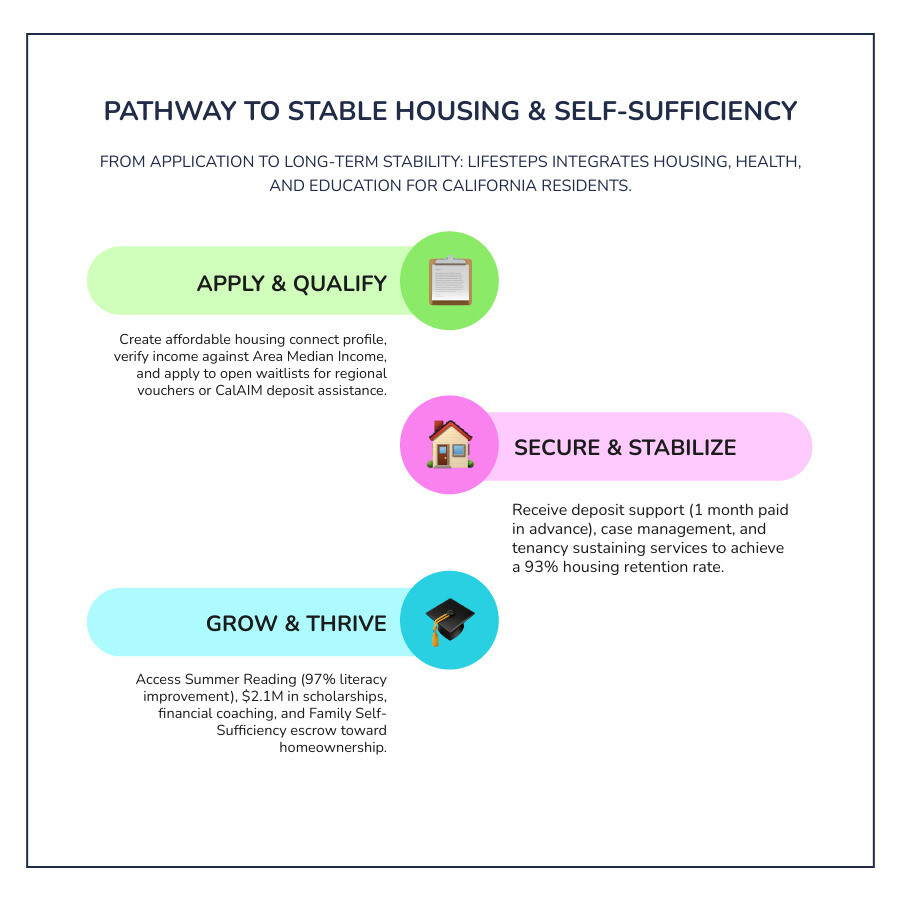
To use affordable housing connect tools, create an applicant profile, check income and household eligibility, apply to open waitlists, and keep your documents and alerts current. Navigating government subsidized housing provides help finding low income housing while securing essential public housing assistance. For transitioning veterans, this creates a clearer path to stable housing while connecting housing goals with education and long-term self-sufficiency.
LifeSTEPS provides California residents with housing-focused support that helps people move from application barriers to stable tenancy. Its services report a 93% housing retention rate. Through CalAIM, eligible residents may also receive deposit assistance of 1 month paid in advance.
Housing stability can support the next steps for a household, too. LifeSTEPS’ Summer Reading work has achieved a 97% literacy improvement, and its higher-education support has helped provide $2.1M in scholarships.
Understanding California Housing Assistance and Supportive Services
Finding an affordable home in California requires understanding how state-level initiatives, public housing agencies, and supportive community organizations coordinate. Across Southern California and neighboring regions, navigating rental subsidies and designated affordable properties often feels like trying to learn a hidden system. However, once you understand how local housing authorities operate alongside community programs, the entire pathway becomes clear.

A solid roof over your head serves as the cornerstone for every other aspect of life. When individuals secure affordable housing, they gain the peace of mind necessary to pursue higher education, build careers, and support their families’ goals. Many state and local agencies work tirelessly to increase housing availability. By consulting resources from the California Department of Housing and Community Development, residents can review state-funded housing initiatives and locate properties that match their household income brackets.
LifeSTEPS recognizes that housing assistance is most effective when paired with wrap-around support. Sustained tenancy requires more than just finding an apartment; it requires ongoing guidance to overcome financial bumps in the road. This comprehensive approach is why LifeSTEPS programs maintain a 93% housing retention rate, ensuring that individuals and families who transition into stable housing remain stably housed year after year.
| Support Category | Core Mechanism | Primary Eligibility Factor | Key Program Benefit |
|---|---|---|---|
| Regional Housing Vouchers | Monthly rental subsidies paid directly to property owners | Household income below 30%–50% Area Median Income (AMI) | Caps tenant rent contribution at roughly 30% of adjusted income |
| CalAIM Deposit Support | Community Supports transition funding for move-in costs | Medi-Cal enrollment and qualifying health or housing transition needs | Security deposit assistance equal to 1 month paid in advance |
| Educational Advancement Tracks | Academic coaching, afterschool programs, and scholarships | Enrollment in supportive housing communities | Access to higher education funding and targeted youth literacy programs |
Essential Qualifications and Housing Assistance Options
Securing an affordable home begins with verifying where your household falls on the income spectrum. Housing programs rely on Area Median Income (AMI) benchmarks, which are updated annually for each county. Most regulated affordable housing developments reserve units for households earning between 30% and 80% of the AMI, with deeper subsidies allocated for extremely low-income households.
For residents exploring options in Southern California, local portals provide tailored access to open lotteries and waitlists. If you are searching in the greater Los Angeles area, you can review current listings and apply for properties through the Los Angeles County housing portal. These registries allow applicants to filter by unit size, rent levels, and specific accessibility features.
Further south, individuals and families seeking housing can access designated housing lists and assistance through Housing Opportunities Through the San Diego Housing Commission. To better understand how federal guidelines shape these municipal opportunities, this guide to HUD affordable housing programs breaks down how project-based vouchers and tenant-based vouchers function in practice.
Deposit Assistance and Healthcare Coordination Through CalAIM
The greatest barrier to moving into an affordable unit is often the upfront cost. Even when a household qualifies for reduced monthly rent, gathering funds for first-month rent and a security deposit can stall the entire move-in process.
In California, this challenge is directly addressed through the CalAIM (California Advancing and Innovating Medi-Cal) program. CalAIM recognizes that housing stability is essential to overall health. Through its Community Supports benefit, eligible Medi-Cal members experiencing housing insecurity can access crucial financial resources. Specifically, deposit assistance tied to the CalAIM program can provide 1 month paid in advance for security deposits, helping residents clear the final financial hurdle into a permanent home.
In inland areas, households can coordinate these services through regional agencies like the Housing Authority of the County of Riverside. By combining healthcare transition navigation with local housing authority resources, residents receive comprehensive support that eases the physical and financial stress of relocating.
How to Use Affordable Housing Connect Portals to Find Local Opportunities
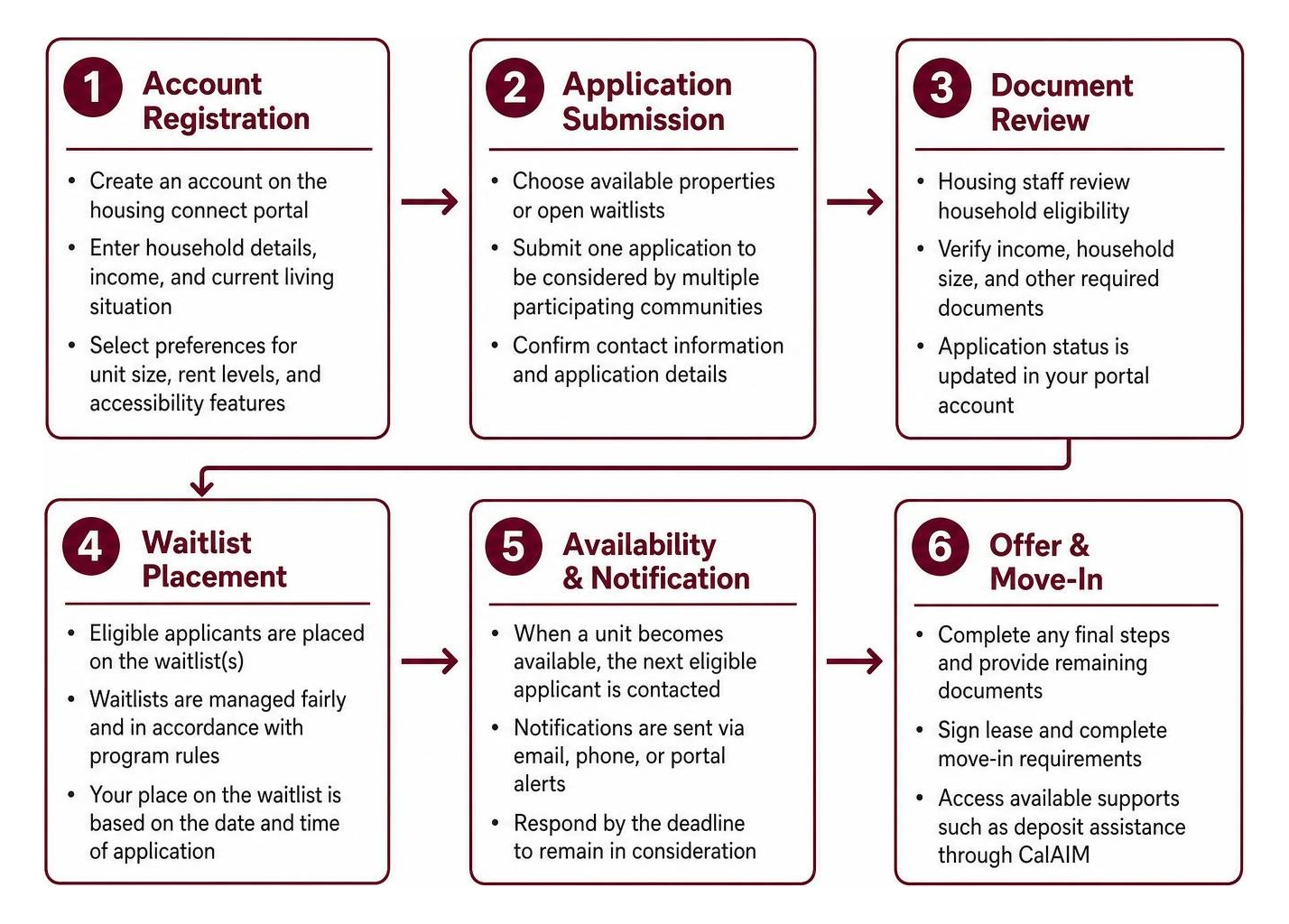
Centralized housing portals and waitlist systems are designed to make the apartment hunt less fragmented. Rather than traveling from one leasing office to another, applicants can register on dedicated portals that distribute applications to multiple participating communities.
Understanding how to navigate an affordable housing connect portal allows low-income families, seniors, and veterans to monitor multiple property waitlists simultaneously. By learning the mechanics of these platforms, you ensure that your household receives timely notifications when new lotteries open or when your name approaches the top of an active registry.
Step 1: Navigating the Affordable Housing Connect Online Registration
The first step in using a centralized housing application platform is setting up a complete, accurate profile. When creating an account, you will be asked to enter detailed information regarding all members of your household, total gross income, current living arrangements, and any specific accommodations you require.
Accurate data entry is vital. Many automated lottery systems evaluate applications based on exact household size and income limits. For instance, in Orange County, applicants looking for stable rental options can research local developments and community initiatives through regional affordable housing resources.
For an in-depth breakdown of available rental tiers and qualification requirements across the state, consult this affordable housing rentals guide. Keeping your account information current ensures you receive instant notifications whenever a new property matching your criteria opens its application window.
Step 2: Preparing Documentation and Managing Open Waitlists
Once your digital profile is established, you must assemble the verification paperwork required by property managers and housing specialists. Having these documents scanned and ready for electronic upload prevents delays that could cause you to lose an offered unit.
Essential documentation to gather includes:
- Government-issued identification: Driver’s licenses, state IDs, or passports for all adult household members.
- Proof of income: The most recent 2 to 3 months of pay stubs, benefits award letters (such as SSI or SSDI), or child support documentation.
- Tax documentation: W-2 forms and signed federal and state tax returns from the previous two years.
- Bank statements: Consecutive statements from checking and savings accounts for the past three months.
- Housing history: Contact details for previous landlords covering at least the past two to five years.
Managing open waitlists requires consistent communication. Most online registries require applicants to complete an annual waitlist confirmation to maintain their spot. If you change your phone number, email address, or household size, update your profile immediately. Utilizing centralized application platforms allows you to update your profile once and push those changes to multiple waitlists simultaneously.
For households navigating complex barriers, reviewing resources on affordable housing for low-income families can provide additional strategies for managing application paperwork and background checks.
Bridging Housing Stability with Afterschool and Higher Education Programs
Securing a safe, affordable apartment is not the end of the journey–it is the launchpad. When a household no longer worries about sudden rent hikes or housing displacement, they can redirect their energy toward personal, educational, and professional growth.
LifeSTEPS builds on this foundation by providing on-site educational support, youth development programs, and long-term financial coaching within affordable housing communities throughout California.
Leveraging Affordable Housing Connect Tools for Family Self-Sufficiency
Long-term stability is strengthened when housing programs are paired with workforce and self-sufficiency initiatives. Many housing developments coordinate with Family Self-Sufficiency (FSS) frameworks. These programs enable residents to establish dedicated escrow savings accounts while working toward career and financial goals. As household earnings increase, a portion of the increased rent payment is deposited into an interest-bearing escrow account that the resident can access upon completing the program.
For transitioning veterans moving into permanent supportive housing after housing instability, coordinated support can connect stable tenancy with future goals. A dedicated support plan may include credit repair, career training, and financial literacy workshops. By participating in structured milestones, residents can build savings and take concrete steps toward long-term housing stability and future homeownership readiness.
Youth Academic Support and Higher Education Pathways
Stable housing also plays a decisive role in childhood education and long-term upward mobility. Children who experience frequent moves often fall behind in reading comprehension and math proficiency. By embedding afterschool academic programs directly within affordable housing developments, LifeSTEPS helps young residents thrive academically.
LifeSTEPS’ Summer Reading initiative has demonstrated a measurable 97% literacy improvement among participating students. These programs provide structured reading interventions, homework assistance, and mentorship in safe, supportive community spaces.
Furthermore, LifeSTEPS is committed to breaking generational poverty through higher education access. Educational initiatives have helped award over $2.1M in scholarships to residents pursuing college degrees and vocational certifications. By combining secure housing with academic funding, these programs empower students to achieve their full potential and build bright, sustainable futures.
Frequently Asked Questions About Affordable Housing Access
How do housing applicants verify income limits for regional programs?
Housing applicants verify their income by submitting documentation of all household earnings to the property manager or housing authority during the application review. The program administrators calculate total gross household income and compare it against the regional Area Median Income (AMI) figures established by the California Department of Housing and Community Development.
Income verification typically requires:
- Pay stubs reflecting earnings over consecutive pay periods.
- Official benefit statements for non-wage income, such as disability or pension benefits.
- Bank verification forms covering asset holdings and interest income.
- Annual recertification reviews to ensure ongoing compliance with program regulations.
What supportive resources exist to help maintain long-term housing stability?
A variety of supportive resources help tenants maintain long-term stability and prevent eviction. Within supportive housing communities, professional case managers provide tenancy sustaining services, conflict resolution support, and budgeting guidance.
Under the CalAIM initiative, eligible Medi-Cal members can receive tenancy sustaining services that assist with lease compliance, connection to community health services, and household management. Additionally, regional organizations provide emergency rental assistance funds and legal aid referrals to help families resolve short-term financial emergencies without losing their homes.
How does family self-sufficiency integration assist in achieving homeownership?
Family Self-Sufficiency (FSS) programs assist households in transitioning from rental assistance to economic independence by combining personalized case management with financial incentives. Participants collaborate with a coordinator to set educational, financial, and employment goals over a five-year period.
As participants increase their earned income, the corresponding increase in their rental contribution is matched and deposited into an escrow savings account. Upon completing their goals—such as clearing debt, establishing steady employment, and finishing homebuyer education courses—participants receive the full escrow balance. These funds can then be used as a down payment on a home, clearing a direct path to sustainable homeownership.
If you are looking for personalized guidance or want to explore how supportive programs can assist your household’s path forward, connect with the team today.
Conclusion
Navigating the landscape of affordable housing requires patience, organization, and the right community tools. By taking advantage of centralized housing portals, gathering your documentation early, and connecting with state resources like CalAIM deposit assistance, you can overcome common barriers and secure an affordable home.
LifeSTEPS remains dedicated to providing California residents with the housing stability, youth literacy programs, and higher education pathways needed to achieve lasting self-sufficiency. When stable housing is combined with educational empowerment, families gain the tools they need to build thriving communities.
For media inquiries, contact: bex@lifestepsusa.org
LifeSTEPS currently provides services in California only.


