


What It Takes to Qualify as an FHA Loan Second Time Home Buyer in California
Can a Second-Time Home Buyer Qualify for an FHA Loan in California?
Yes. A repeat buyer can qualify for an FHA loan in California. FHA financing is not limited to first-time buyers. If you have sold or paid off a prior FHA loan, you can apply again if the new home will be your primary residence and you meet current credit, income, down payment, and property rules.
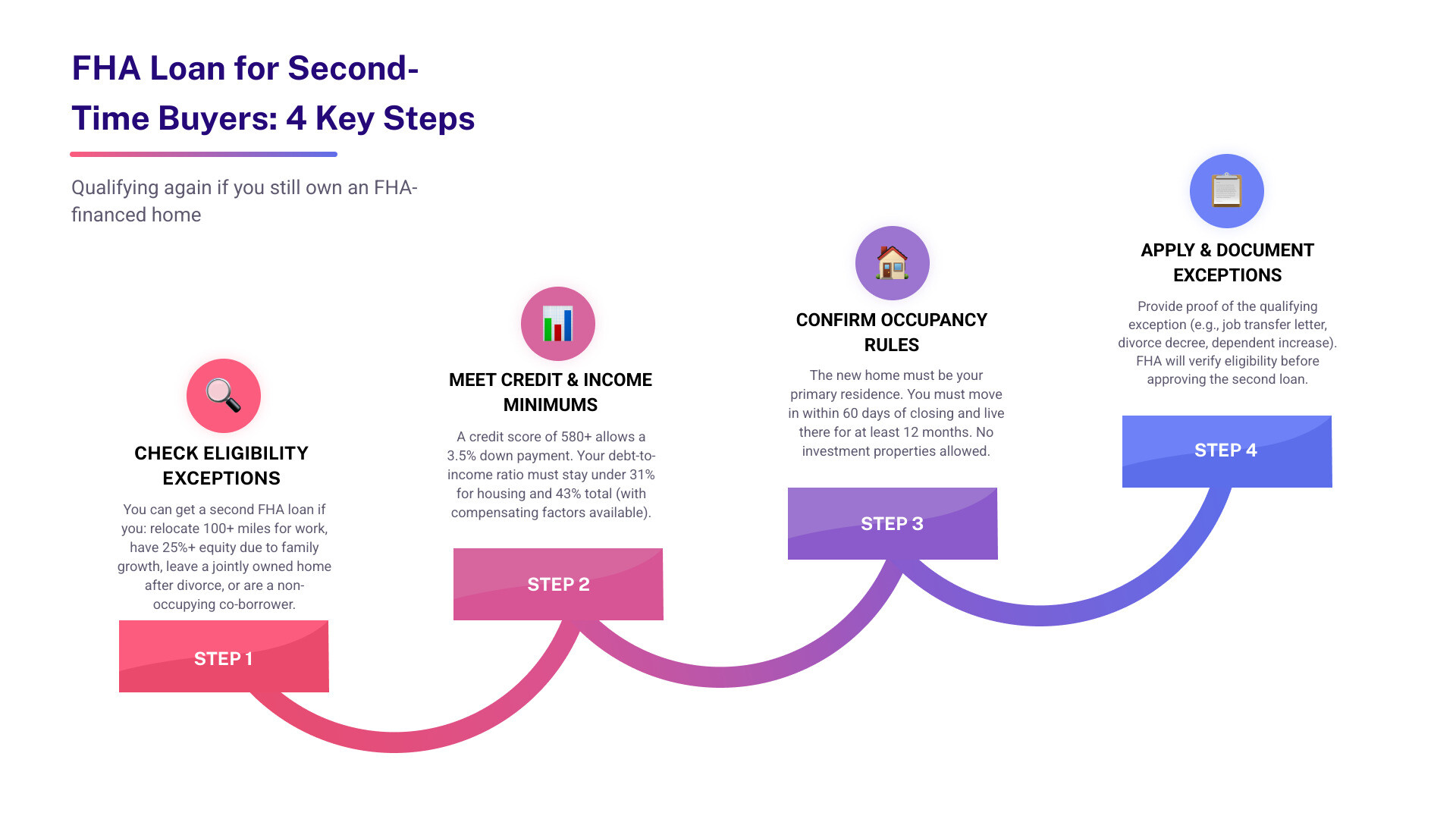
If you still have an FHA mortgage, you may qualify for another one only in limited cases, such as:
- Moving for work more than 100 miles away.
- Outgrowing your current home because your household has increased, with at least 25% equity in the existing home.
- Leaving a jointly owned home after a divorce or other change in ownership.
- Being a non-occupying co-borrower on someone else’s FHA loan.
For most borrowers, a credit score of 580 or higher can support a 3.5% down payment. The new home generally must be occupied within 60 days of closing and used as your main home.
LifeSTEPS supports housing stability in California, with a 93% housing retention rate. Through the CalAIM program, LifeSTEPS also provides deposit assistance with 1 month paid in advance. Repeat buyers can also explore statewide home buyer programs, regional Bay Area home buyer aid, or qualification criteria for a first home loan grant. Its community work also includes afterschool support, including a 97% literacy improvement for Summer Reading, and $2.1M in scholarships for higher education.
Qualifying as an FHA Loan Second Time Home Buyer in California

One of the most persistent myths in real estate is that government-backed mortgages are exclusively reserved for entry-level purchasers. In truth, an fha loan second time home buyer can tap into the exact same Federal Housing Administration backing as someone buying their very first property.
Federal underwriting rules focus on your current financial capacity and occupancy plans rather than your prior homeownership history. Whether you sold a starter property years ago, went through a period of renting, or are looking to upsize, you can access FHA financing repeatedly over your lifetime. For those exploring home financing pathways after an ownership gap, the federal government even recognizes you as a first-time buyer again if you have not held title to a principal residence during the past three years. This 3-year gap rule opens doors to specialized assistance while letting you leverage standard FHA flexibility.
Core Mortgage Requirements for an FHA Loan Second Time Home Buyer
Qualifying for repeat FHA financing requires meeting clear underwriting standards established by the Department of Housing and Urban Development (HUD):
- Credit Score Tiers: A minimum credit score of 580 allows you to put down just 3.5%. Borrowers with credit scores between 500 and 579 can still obtain approval but must provide a 10% down payment.
- Mortgage Insurance Premiums (MIP): Every FHA borrower pays an Upfront Mortgage Insurance Premium (UFMIP) equal to 1.75% of the base loan amount (often rolled into the mortgage balance), alongside an ongoing annual MIP (typically 0.55% for 30-year loans when putting 3.5% down).
- Gift Funds and Reserves: The entire 3.5% down payment may come from documented family gift funds or regional assistance grants, though maintaining 1 to 3 months of cash reserves strengthens your underwriting profile.
Understanding how different home buying options align with your household budget ensures you utilize these loan features effectively.
Occupancy Rules and Primary Residence Mandates
The primary gatekeeper for repeat FHA lending is owner occupancy. FHA loans cannot be used to purchase pure investment properties or vacation getaways. Borrowers must certify that the property will serve as their principal residence:
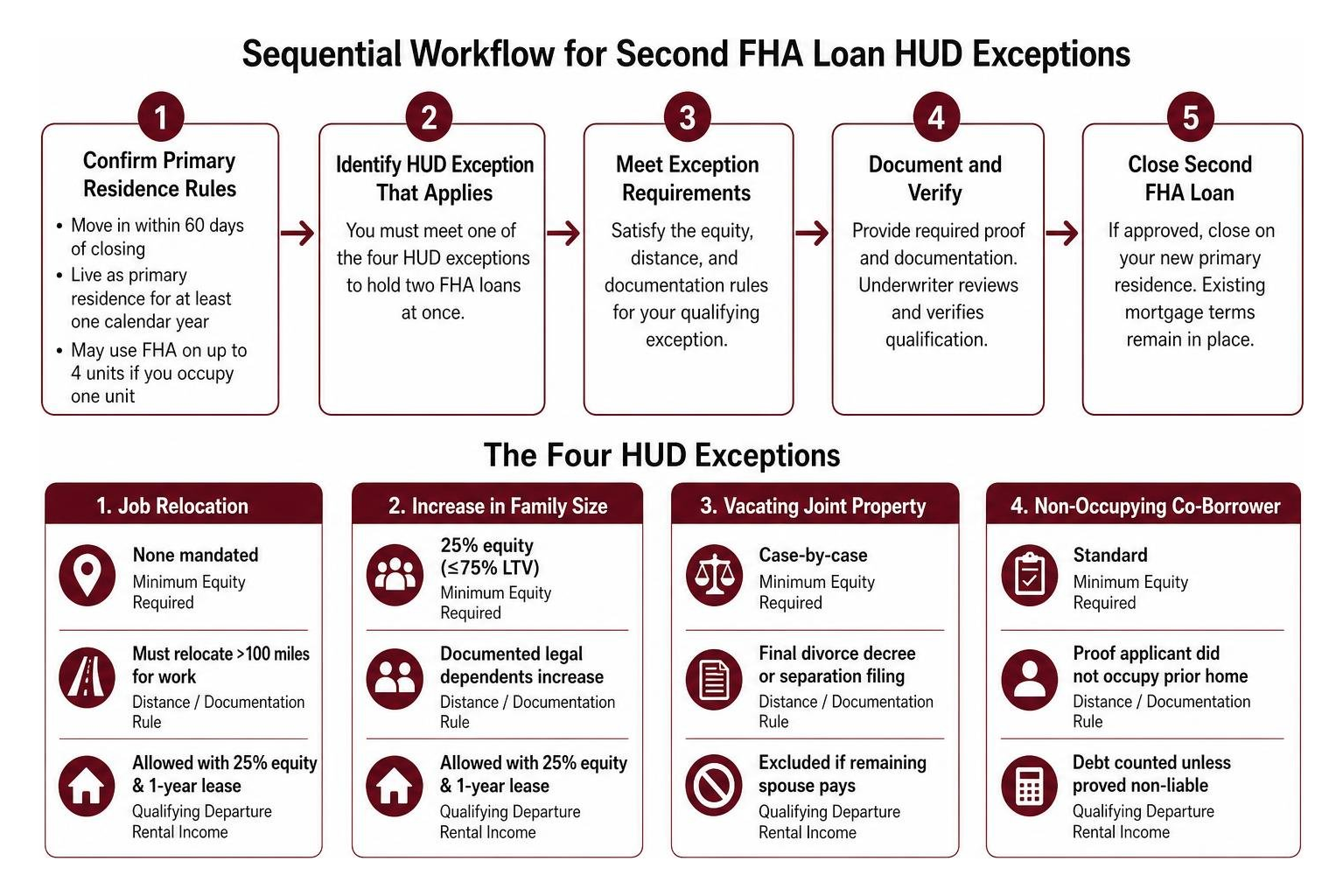
- 60-Day Move-In: You must take physical possession and move into the home within 60 days of loan closing.
- One-Year Occupancy: You must intend to live in the home as your main residence for at least one full calendar year.
- Multi-Unit Flexibility: You may use an FHA loan on properties containing up to 4 residential units, provided you occupy one unit as your primary residence while renting out the remaining spaces.
The Four HUD Exceptions: How to Hold Two FHA Loans at Once

Under standard rules, HUD prohibits holding two active FHA mortgages simultaneously to prevent investors from building rental portfolios using government-insured funds. However, HUD handbook guidelines outline four distinct exceptions that allow qualified borrowers to take out a second FHA loan without selling their existing home.
| HUD Exception Category | Minimum Equity Required | Distance / Documentation Rule | Qualifying Departure Rental Income |
|---|---|---|---|
| Job Relocation | None mandated | Must relocate >100 miles for work | Allowed with 25% equity & 1-yr lease |
| Increase in Family Size | 25% equity (≤75% LTV) | Documented legal dependents increase | Allowed with 25% equity & 1-yr lease |
| Vacating Joint Property | Case-by-case | Final divorce decree or separation filing | Excluded if remaining spouse pays |
| Non-Occupying Co-Borrower | Standard | Proof applicant did not occupy prior home | Debt counted unless proved non-liable |
Job Relocation and the 100-Mile Commute Rule
If you are transferred by your employer or accept a new job position that requires establishing a new primary residence, HUD permits a second active FHA loan under the relocation exception.
The new home must be situated more than 100 miles from your departure residence. Underwriters verify your employment offer letter, relocation agreement, and commute feasibility. If you choose to keep your former home as a rental property, the existing mortgage payment must be factored into your debt-to-income ratio unless you have at least 25% equity documented by a recent appraisal and provide an executed 12-month lease agreement.
Growing Families, Divorce, and Co-Borrower Exceptions for an FHA Loan Second Time Home Buyer
Life changes frequently prompt housing transitions. HUD accommodates these shifts through three additional pathways:
- Growing Family Exception: If your number of legal dependents has increased since purchasing your first home and the property no longer meets your family’s basic functional needs, you can qualify for a larger FHA-financed home. You must prove at least 25% equity (a loan-to-value ratio of 75% or less) in your existing home based on a current appraisal.
- Vacating a Jointly Owned Property: In the event of a divorce or legal separation, if your former spouse remains in the original FHA-insured residence, you may obtain a new FHA mortgage to establish an independent primary home. Submitting a recorded divorce decree or separation agreement awarding the property to the remaining party enables lenders to process your new application.
- Non-Occupying Co-Borrower: If you previously co-signed an FHA loan to help a family member purchase a property without living there yourself, you retain the right to secure your own FHA-insured mortgage for your personal principal residence.
Clients navigating complex housing transitions—such as David (name changed), a veteran who partnered with community housing programs to stabilize his finances—often benefit from pairing structured homeownership assistance with specialized loan exceptions.
Waiting Periods, DTI Limits, and 2026 California Loan Limits
Second-time purchasers often return to the market after resolving past financial hardships. FHA guidelines offer some of the most forgiving recovery timelines in the lending industry.
Underwriting Guidelines: Credit Scores, DTI, and Financial Recovery Timelines
Standard FHA underwriting applies baseline debt-to-income (DTI) benchmarks of 31% for housing expenses (front-end) and 43% for total monthly obligations (back-end). However, automated underwriting systems can approve back-end DTIs up to 45% to 50% when supported by compensating factors such as substantial cash reserves or minimal consumer debt.
For repeat buyers rebuilding credit, FHA waiting periods are notably shorter than conventional mortgage rules:
- Foreclosure or Deed-in-Lieu: 3-year mandatory waiting period from the completion date.
- Chapter 7 Bankruptcy: 2-year waiting period from the official discharge date.
- Chapter 13 Bankruptcy: Eligible after 12 months of verified on-time plan payments with written bankruptcy court approval.
Learning foundational financial mechanics through FSS homebuyer education helps repeat buyers manage these timelines and rebuild solid underwriting profiles.
California County Loan Limits and Down Payment Assistance
In California’s high-cost real estate environment, FHA limits adjust annually by county to reflect median sale prices. For 2026, baseline low-cost county limits start at $541,287, while high-cost metropolitan areas reach the statutory ceiling of $1,249,125:
- Los Angeles County: High-cost ceiling up to $1,249,125 for single-family residences.
- San Diego County: Maximum high-cost limit reaching $1,249,125.
- Riverside County & Irvine Areas: Balanced limits accommodating suburban single-family housing choices.
Repeat buyers needing cash-to-close support can explore regional programs such as the CalHFA Homebuyers Loan Program, alongside targeted low income home buyer programs that offer second-lien down payment assistance. Furthermore, qualifying residents participating in the CalAIM program can receive deposit assistance covering 1 month paid in advance to ensure smooth household transitions. Those seeking comprehensive support can reference homeownership down payment assistance programs for detailed program structures.
Frequently Asked Questions About FHA Financing for Repeat Buyers
Can you get an FHA loan if you currently own another home?
Yes, provided you qualify under one of HUD’s four official exceptions (job relocation over 100 miles, increase in family size with 25% equity, divorce/departure from joint property, or co-borrower status). Otherwise, you must sell your current home or pay off the existing FHA mortgage before closing on your new purchase.
How does mortgage insurance differ for a second-time FHA buyer?
The structure of FHA mortgage insurance is identical for both first-time and repeat buyers. All borrowers pay the 1.75% upfront fee and monthly annual MIP. Unlike conventional private mortgage insurance (PMI), which cancels automatically once you reach 20% equity, FHA MIP remains for the life of the loan when putting down 3.5% (or 11 years if you provide a 10% down payment or more).
Can repeat California buyers qualify for down payment assistance?
Yes. While certain localized grants are restricted to first-time purchasers, many regional initiatives, including homeownership assistance for moderate income frameworks, allow repeat buyers who meet area median income thresholds to participate. Community resources through the San Diego Housing Commission and Riverside County Down Payment Assistance offer viable pathways for qualified applicants.
Conclusion
Securing an FHA mortgage as a repeat homebuyer provides an accessible bridge back into the California property market. By leveraging lower credit score barriers, manageable 3.5% down payments, and clear HUD exception guidelines, you can successfully navigate your next purchase. LifeSTEPS remains committed to strengthening communities through comprehensive housing loan guidance and long-term stability initiatives. Our organization proudly maintains a 93% housing retention rate, delivers CalAIM deposit assistance covering 1 month paid in advance, achieves a 97% literacy improvement for Summer Reading, and has awarded $2.1M in scholarships for higher education.
To learn more about sustainable community resources, explore our low-income homeownership programs or connect with our team. For media inquiries, contact: bex@lifestepsusa.org.
LifeSTEPS currently provides services in California only.


