


Your Ultimate Guide to Assistance with Apartment Deposits and Move-In Fees
When Upfront Costs Stand Between You and a Stable Home
Assistance with apartment deposits is available through government programs, nonprofits, faith-based charities, and deposit alternatives — and many California renters qualify even if they have steady income.
Here are the fastest ways to get help:
- Call 211 — free, 24/7, available across California, connects you to local deposit and move-in programs
- Apply to a local Community Action Agency — administers state and municipal deposit assistance funds
- Contact faith-based charities — organizations like Catholic Charities and St. Vincent de Paul offer one-time emergency grants
- Ask your landlord for an installment plan — many will split the deposit over two or three months to avoid vacancy
- Explore deposit alternatives — services like Rhino or Jetty let you pay a small monthly fee instead of a large lump sum
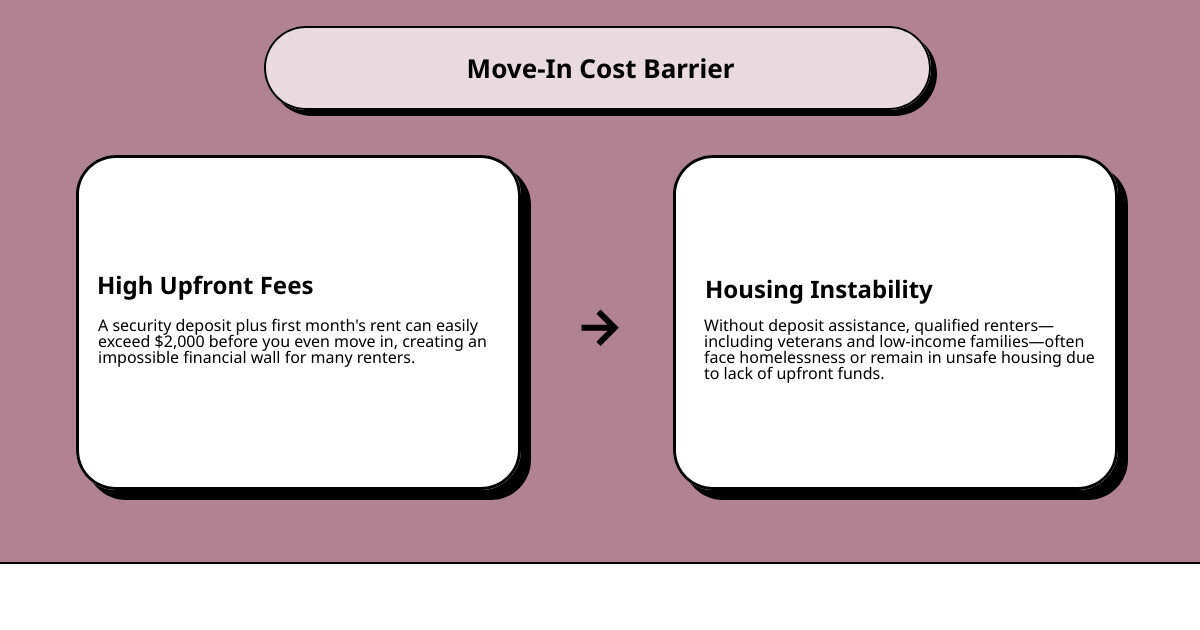
The numbers make the barrier very clear. A security deposit plus first month’s rent can easily exceed $2,000 before you’ve spent a single night in the place. For a veteran transitioning to civilian life — already navigating a new financial reality — that wall can feel impossible to clear.
The good news: there are real, structured programs designed to help you get past it. From federally funded Rapid Re-Housing initiatives to local California-based nonprofits, options exist at nearly every income level and urgency timeline.
This guide walks you through all of them.
LifeSTEPS currently provides services in California only.
Glossary for assistance with apartment deposits:
- help with bond and deposit
- first month rent security deposit assistance
- emergency rental assistance funds
Understanding Assistance with Apartment Deposits and Who Qualifies
When you finally find an apartment that fits your budget, the excitement can quickly turn to stress when you calculate the move-in costs. Landlords routinely request the first month’s rent plus a security deposit equivalent to one or two months of rent. If you are struggling to gather these funds, a security deposit assistance program can bridge the gap, preventing a temporary cash shortage from turning into long-term housing instability.
These programs are designed to provide financial aid specifically targeted at the upfront costs of moving. In California, eligibility criteria are typically tied to your household income relative to the Area Median Income (AMI). Most programs require your household income to be at or below 50% to 60% of the AMI for your county.
Priority is almost always given to individuals experiencing housing insecurity, those transitioning out of temporary shelters, or households facing an immediate threat of displacement. For example, under the state’s CalAIM program (California Advancing and Innovating Medi-Cal), eligible participants can access Enhanced Care Management and Community Supports. This includes housing transition navigation and direct financial support for security deposits, often structured as up to 1 month paid in advance to secure a safe and stable home.
Understanding these eligibility metrics is key to finding the right resource. You can explore a broader overview of how these programs function in The Ultimate Guide To Rental And Deposit Assistance.
At the legislative level, there is ongoing recognition of how high deposits restrict housing access. The Delivering Essential Protection, Opportunity, and Security for Tenants Act, also known as H. R. 1087 (the DEPOSIT Act), was introduced in Congress to authorize federal security deposit and moving cost assistance for low-income households. The bill highlights a growing national movement to treat upfront move-in costs as a critical public policy issue rather than an individual financial failure.
Types of Organizations Offering Move-In Help

When you need assistance with apartment deposits, knowing where to look can save you weeks of fruitless searching. Assistance generally comes from three distinct sectors: government agencies, local non-profit charities, and private financial alternative programs.
Government programs are usually funded through federal grants like the Emergency Solutions Grants (ESG) or the HOME Investment Partnerships Program. These funds are distributed locally through municipal housing authorities and Community Action Agencies. While government programs are highly reliable and offer substantial aid, they often involve rigorous background checks, income verification, and longer processing times.
Local charities and faith-based organizations operate with more flexibility. Groups such as Catholic Charities, the Salvation Army, and the St. Vincent de Paul Society manage emergency funds to help families secure housing. While their individual grants might be smaller, they can process requests much faster than government entities.
Rapid Re-Housing programs, which are often a collaborative effort between government funding and local non-profits, prioritize individuals leaving shelters or unsafe living situations. These programs routinely cover security deposits and initial rent payments to ensure a seamless transition into stable housing.
To help you decide which avenue fits your current situation, here is a quick comparison of the primary options:
| Program Type | Typical Eligibility | Approval Speed | Key Feature |
|---|---|---|---|
| Government Programs (ESG, CalAIM) | Under 50%–60% AMI; must meet specific vulnerability criteria | 2 to 4 weeks | Offers comprehensive, long-term housing transition support |
| Local Nonprofits & Charities | Low-to-moderate income; facing immediate housing crisis | 3 to 7 business days | Flexible guidelines; may offer smaller emergency grants |
| Deposit Alternatives (Rhino, Jetty) | Subject to credit check and steady income verification | Instant to 24 hours | Replaces cash deposit with a small, non-refundable monthly fee |
If you are unsure where to start, dialing the 211 helpline is the most effective first step. This free, confidential service connects you directly to a local specialist who can identify active deposit assistance programs in your specific neighborhood.
How to Find Local Assistance with Apartment Deposits Near You
Finding local programs requires focusing your search on your immediate county or city. Because funds are decentralized, a program operating in one part of California might not be available in another.
For residents in Southern California, including Los Angeles, San Diego, and Riverside, as well as those in Irvine, municipal housing authorities are excellent starting points. These agencies manage local housing stability funds and can direct you to active nonprofit partners in your neighborhood.
When searching, look specifically for local Community Action Partnerships (CAP). These agencies are mandated to administer state and federal community service block grants, which frequently include allocations for security deposit assistance. For a step-by-step strategy on navigating these local resources, check out our guide on How To Find Places That Help You Pay Your Security Deposit Without The Stress.
Section 8 and Voucher-Based Assistance with Apartment Deposits
For households utilizing Housing Choice Vouchers (Section 8), finding an affordable apartment is only half the battle. Many voucher holders mistakenly assume that their voucher automatically covers the security deposit. In reality, Section 8 vouchers only cover a portion of the monthly rent; the tenant is still responsible for the upfront security deposit.
This disconnect is one of the primary reasons why voucher holders struggle to utilize their vouchers before they expire. Fortunately, public housing agencies and local nonprofits offer targeted supplements to help Section 8 tenants. Some jurisdictions allow HOME program funds to be decoupled from ongoing rental assistance, meaning you can receive a one-time security deposit grant even if your monthly rent is already subsidized by a voucher.
Proposed federal legislation like the DEPOSIT Act aims to make security deposit assistance a standard component of the Housing Choice Voucher program. Until such laws are fully implemented, tenants must rely on local discretionary funds. To learn more about securing these specific resources, read our detailed guide on Securing The Bag How To Find Help With Deposit For Section 8.
Landlord Negotiations and Security Deposit Alternatives
If you do not qualify for public assistance or need to move immediately, you can explore direct negotiations with your landlord or utilize modern deposit alternatives.
Many landlords prefer to get a reliable tenant into their property quickly rather than letting the unit sit vacant while searching for someone who can pay the entire deposit upfront. When negotiating, consider proposing a structured installment plan. For instance, you can ask to pay the security deposit in three equal installments over the first three months of your lease. If you have strong references from previous landlords, present them as proof of your reliability. Always ensure that any agreed-upon payment plan is put in writing and signed by both parties as an amendment to your lease.
Another increasingly popular option is the use of security deposit alternatives. Companies like Rhino, Jetty, and Obligo allow tenants to purchase deposit insurance or a surety bond for a fraction of the cost of a traditional deposit.
Instead of paying a $1,500 cash deposit, you might pay a non-refundable fee of $10 to $20 per month. The insurance policy protects the landlord against property damage or unpaid rent up to the value of a traditional deposit.
However, it is vital to understand the fine print. Unlike a traditional security deposit, these monthly fees are non-refundable. Furthermore, if you cause damage to the apartment, the insurance company will pay the landlord, but they will subsequently bill you to recover those costs.
To explore how to navigate these private landlord agreements safely, take a look at Help With Deposit Private Renting and review additional tips on Security Deposit Assistance — How to Get Help With Your Deposit .
Frequently Asked Questions About Apartment Deposit Assistance
Navigating the application process for move-in assistance can feel overwhelming. Below are answers to some of the most common questions renters ask when trying to secure deposit help.
What documents do I need to apply for deposit assistance?
To expedite your application, you should gather all required documentation before contacting an agency. While specific requirements vary, most programs will ask for:
- Valid Photo Identification: For all adult members of the household.
- Proof of Income: Paystubs from the past 30 days, tax returns, or public benefit award letters (such as SSI, SSDI, or TANF).
- A Signed Lease or Intent to Rent Form: Landlords must verify that they are willing to rent the unit to you and participate in the program.
- Proof of Housing Instability: Eviction notices, shelter discharge papers, or utility shut-off notices that demonstrate an immediate need for housing support.
Having these documents organized in a single folder can significantly reduce your processing time.
How long does it take to get approved for deposit help?
Approval timelines depend heavily on the type of organization you apply to. Government-administered programs and large housing authorities typically take two to four weeks to process applications, verify landlord participation, and issue checks.
If you face an immediate crisis, local charities and faith-based groups can often make decisions within three to seven business days. Because funding is limited and usually distributed on a first-come, first-served basis, it is highly recommended to apply the moment you begin your apartment search.
Can deposit assistance cover first month’s rent or moving costs?
Yes, depending on the program. While some municipal grants are strictly limited to security deposits, comprehensive housing stabilization programs like Rapid Re-Housing and CalAIM are designed to cover multiple upfront moving expenses.
These programs can package deposit assistance with first month’s rent, utility connection fees, and even moving truck costs to ensure you transition successfully. If you need help covering both your deposit and your initial rent payment, you can find a comprehensive breakdown of combined programs in our guide on First Month Rent And Security Deposit Assistance.
Conclusion: Securing Your Path to Stable Housing
Overcoming the financial barrier of upfront move-in costs is a critical step toward long-term housing stability. Whether you negotiate an installment plan directly with your landlord, utilize a deposit alternative, or secure a grant through a local community program, taking proactive steps can help you get the keys to your new home without draining your savings.
At LifeSTEPS, we understand that securing an apartment is about more than just paying the initial fees—it is about building a foundation for a stable, thriving life. As a nonprofit organization dedicated to the social services industry, we provide human-centered support and resources to individuals transitioning to stable housing and self-sufficiency.
Our unique strength lies in our collaboration with programs like the Family Self-Sufficiency (FSS) initiative. Through these partnerships, we help our clients—including veterans—navigate housing transitions, build financial capability, and ultimately move toward independent homeownership and long-term stability.
Our commitment to measurable outcomes speaks for itself. We are proud to maintain a 93% housing retention rate among the participants in our housing programs. By integrating our services with statewide initiatives like the CalAIM program, we ensure that eligible individuals receive the targeted deposit assistance and case management they need to remain securely housed.
Our impact extends beyond housing. We believe in supporting the entire community, which is why our youth programs have achieved a 97% literacy improvement through our Summer Reading initiatives, and we have awarded over $2.1M in scholarships to help residents pursue higher education and build brighter futures.
If you or someone you know needs assistance navigating housing resources, we are here to support you every step of the way. Explore our First Month Rent and Security Deposit Assistance resources to learn more about how we can help you build a path to a stable home.
Visit our website for more information: LifeSTEPS
LifeSTEPS currently provides services in California only.


