


Where to Find Low Cost Senior Apartments Without the Stress
Finding Low Cost Housing for Seniors Near Me: What You Need to Know First
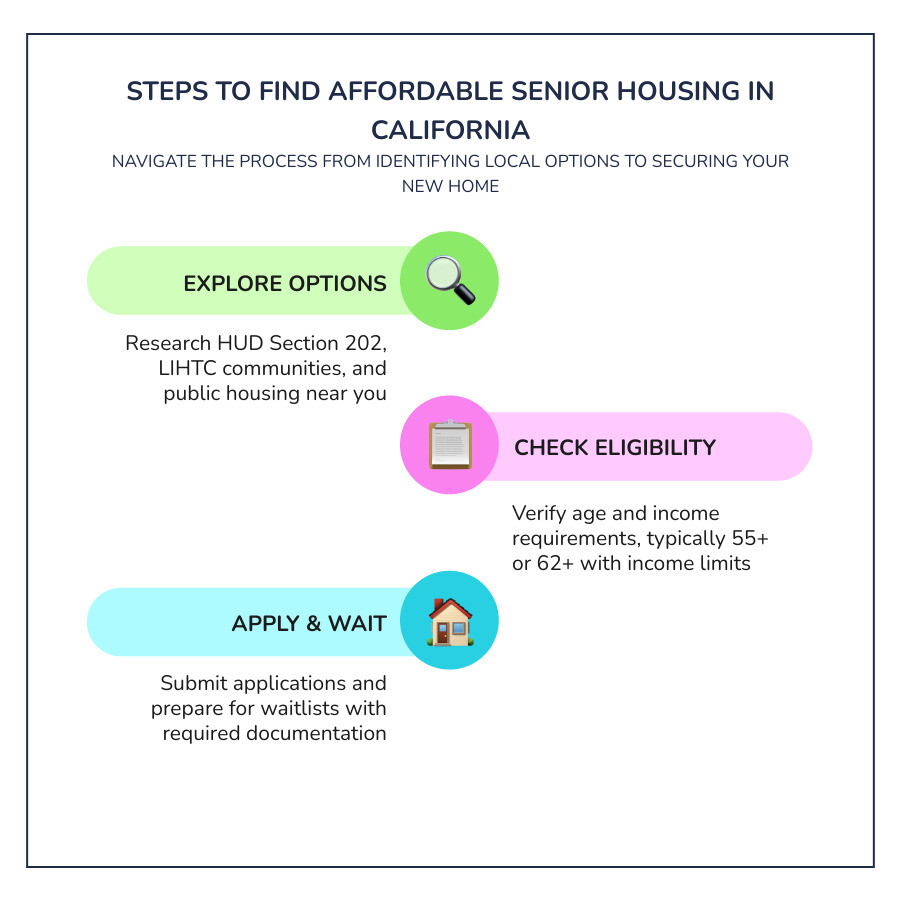
If you’re looking for low cost housing for seniors near me, here are the most common options available in California:
- HUD Section 202 – Federally subsidized housing for adults 62+, rent typically capped at 30% of your income
- Low-Income Housing Tax Credit (LIHTC) apartments – Income-restricted communities for adults 55+ or 62+
- Public housing authority units – City or county-managed affordable apartments with waitlists
- Nonprofit-operated senior housing – Subsidized buildings run by community organizations, often with on-site services
- Permanent supportive housing – For seniors with disabilities or those exiting homelessness, includes wraparound support
Finding stable, affordable housing as a senior can feel overwhelming. Waitlists are long. Eligibility rules vary. And the cost of housing keeps rising while fixed incomes stay flat.
The good news: real options exist. Rent in many subsidized senior communities is based on your income — not a fixed market rate. That means many residents pay no more than 30% of their adjusted gross income on rent and utilities, making housing genuinely affordable even on Social Security alone.
Whether you’re a veteran transitioning to civilian life, recently retired, or simply looking for a more affordable place to live, this guide walks you through every step — from understanding your options to submitting your application.
LifeSTEPS currently provides services in California only.
Simple low cost housing for seniors near me word guide:
Understanding Your Options for Low Cost Housing for Seniors Near Me
When searching for the right California senior housing, it is essential to understand that affordable housing is not a one-size-fits-all solution. There are several distinct pathways to securing a budget-friendly home, ranging from fully independent apartments to communities that offer supportive, on-site services.
For many older adults, maintaining a sense of autonomy is a top priority. Fortunately, modern independent living communities are specifically designed to help you age in place with dignity. These properties are built with physical accessibility in mind and often feature vibrant community areas where residents can connect, share meals, and participate in social activities.
Subsidized apartments make up a significant portion of the affordable housing landscape. These units are funded through various federal, state, and local programs to ensure that your housing costs do not consume your entire monthly budget.

If you are just beginning your search, we recommend starting with local resources to see what is currently open in your immediate area. For more detailed strategies on kicking off your search, check out these more tips on finding local senior apartments.
Types of Low Cost Housing for Seniors Near Me
To narrow down your search for low cost housing for seniors near me, it helps to understand the specific programs that fund these properties. Here are the primary housing models you will encounter in California:
- HUD Section 202 Supportive Housing for the Elderly: This federal program specifically funds the development of affordable housing for very low-income households that include at least one person aged 62 or older. Rents are calculated based on your income, and these properties often feature on-site service coordinators to help you access healthcare and community resources. You can read more about this in our golden guide to senior HUD housing.
- Low-Income Housing Tax Credit (LIHTC) Communities: This program provides tax credits to private developers who agree to build or rehabilitate affordable rental housing. Unlike HUD properties, LIHTC apartments are income-restricted rather than directly subsidized. This means the rent is set at a fixed, below-market rate based on the local Area Median Income (AMI). These communities are typically designated for adults aged 55+ or 62+.
- 55+ and 62+ Age-Restricted Communities: Some affordable properties are strictly age-restricted to ensure a peaceful, senior-friendly environment. While 55+ communities focus heavily on active, independent lifestyles, 62+ communities often include more robust accessibility features and support programs.
- Nonprofit-Operated Senior Housing: Many community organizations and housing foundations manage high-quality, affordable senior developments. These properties often emphasize community-building, offering shared gardens, libraries, and social events.
Depending on where you live, you can access localized listings and directories to find properties near you:
- If you are in Los Angeles County, explore the Los Angeles Housing Department Low-Income Resources to find city-sponsored affordable housing programs and tenant services.
- For those in the southern portion of the state, the San Diego Housing Commission Affordable Rentals portal provides direct access to affordable rental listings and voucher programs.
- If you are searching in other parts of Southern California, you can look into low income affordable senior living in Riverside, California | After55 or browse listings for low income affordable senior living in Irvine, California – After55.com.
- For statewide directories and community listings managed by trusted housing providers, refer to low-income & affordable housing for seniors – HumanGood for additional housing assistance paths in California.
For a broader perspective on what is out there, you can also review our ultimate affordable senior housing list or explore affordable homes for seniors to compare different models.
Key Features of Low Cost Housing for Seniors Near Me
Affordable senior housing is designed to support long-term independence and physical well-being. When touring potential properties, you will find that they are built with specific features that set them apart from standard apartments.
- Accessibility Features: Safety is a key focus. Units typically include step-in showers with grab bars, lever-style door handles, wide doorways to accommodate wheelchairs or walkers, and emergency pull-cords that alert on-site staff or emergency services.
- Community Rooms and Social Spaces: Combating isolation is vital for healthy aging. Most senior properties feature community rooms with shared kitchens, libraries, fitness centers, and outdoor spaces like patios or community gardens where residents can gather.
- On-Site Laundry Facilities: To eliminate the stress of traveling to a laundromat, properties feature central laundry rooms or, in some modern developments, in-unit washers and dryers.
- Utility Allowances: In many subsidized properties, utilities like water, gas, and trash collection are included in the rent. If utilities are billed separately, residents often receive a monthly utility allowance that lowers their overall rent payment.
To learn more about what to expect from these properties, we recommend reading our comprehensive guide to HUD senior housing options.
Key Eligibility Requirements for Affordable Senior Apartments
Before applying for low cost housing for seniors near me, it is important to understand the eligibility criteria. Because these programs are funded by public resources, housing providers must verify that applicants meet specific requirements regarding age, income, and background.
- Age Requirements: Most senior housing communities are restricted to individuals aged 55 or older, or 62 or older. In HUD-subsidized Section 202 properties, the age limit is strictly 62+. However, some properties allow younger adults (typically 18+) to apply if they have a qualifying disability.
- Income Limits: Eligibility is tied directly to your household income relative to the Area Median Income (AMI) of your county. HUD defines income limits as “Extremely Low” (30% of AMI), “Very Low” (50% of AMI), and “Low” (80% of AMI). Subsidized properties typically target households in the extremely low or very low brackets.
- Background and Rental Checks: Applicants must pass standard background checks. Housing authorities and private landlords will review your rental history to ensure you do not owe money to other assisted housing programs and have a record of fulfilling lease agreements.
To help you visualize the differences, here is a quick comparison of the two most common age-restricted housing types:
| Feature | 55+ Senior Housing | 62+ Senior Housing (HUD Section 202) |
|---|---|---|
| Minimum Age | At least one household member must be 55+ | At least one household member must be 62+ |
| Rent Structure | Often set at a fixed, below-market rate (LIHTC) | Capped at 30% of adjusted monthly income |
| On-Site Services | Focuses on active lifestyle and social amenities | Often includes service coordinators and case management |
| Disability Exceptions | Rarely allows younger applicants | May allow younger adults with qualifying disabilities |
Navigating these requirements is much easier when you know what local agencies are looking for. For a deeper dive into qualifying, explore our guide on how to find low-income elderly housing and discover more about the golden years golden deals finding low income senior housing.
How to Apply and Navigate the Waitlist Process
Applying for affordable housing is a journey that requires patience, organization, and proactive planning. Because demand for affordable senior housing in California is high, almost every property utilizes a waitlist.
The application process typically begins at your local public housing authority or directly at the leasing office of an individual nonprofit property. You will need to fill out a pre-application to determine basic eligibility. Be prepared to provide documentation, including proof of age, Social Security statements, bank records, and tax returns.

Once your pre-application is accepted, you will be placed on a waitlist. Waitlist times can range from several months to a few years. However, housing authorities often use a system of “waitlist priority” to help those in the greatest need first. Priority is frequently given to:
- Seniors aged 62 or older
- Veterans or spouses of veterans
- Individuals currently experiencing housing instability or homelessness
- Seniors with documented physical disabilities
While you wait, it is crucial to keep your contact information updated with every housing authority or property management office where you applied. If they try to contact you and receive no response, you may be removed from the list.
For step-by-step guidance on managing this phase of your housing search, read our strategies for navigating senior housing waitlists and check out our senior housing assistance your roadmap to a new home.
Frequently Asked Questions About Affordable Senior Housing
We know you have questions about the day-to-day realities of moving into affordable senior housing. Here are answers to some of the most common questions we receive from seniors and their families.
How much rent will I pay in subsidized senior housing?
In HUD-subsidized housing, your rent is not a fixed dollar amount. Instead, it is calculated based on your adjusted gross income.
Under the 30 percent rent limit rule, eligible households pay no more than 30% of their adjusted monthly income toward rent and utilities. For example, if your sole source of income is a Social Security check of $1,500 per month, your rent contribution would be approximately $450.
If utilities are not included in your rent, the property will apply a utility allowance to reduce your rental payment further, ensuring your total housing costs remain affordable. To understand how these calculations work, read our article on understanding rent subsidies for seniors.
Can I bring my pet to low-cost senior apartments?
Yes, in most cases! Federal guidelines protect the rights of seniors living in federally assisted housing to keep common household pets.
- Pet Policies: Properties are allowed to have reasonable rules regarding the size, weight, and breed of pets.
- Service and Support Animals: If your pet is a documented service animal or an Emotional Support Animal (ESA), standard pet fees, breed restrictions, and pet deposits are typically waived under the Fair Housing Act.
- Pet Deposits: For standard pets, properties may charge a modest, refundable pet deposit to cover any potential damage.
When searching for a pet-friendly community, it helps to review the specific guidelines of each property. For more tips on evaluating these features, see our tips for choosing the right senior apartment complex.
What if I need help with security deposits or moving costs?
Moving into a new apartment is exciting, but the upfront costs can be a significant barrier. If you need help with security deposits or moving expenses, there are programs designed to ease this transition.
In California, eligible seniors can access housing transition services through the CalAIM program. CalAIM provides critical support, including deposit assistance, to help individuals transition smoothly into stable, permanent housing. When utilizing deposit assistance programs, you can typically expect assistance covering up to 1 month paid in advance for your security deposit.
These resources are designed to ensure that a lack of upfront cash does not stand between you and a safe, affordable home. To learn more about state-specific assistance, read our guide on affordable senior housing options in California and explore how to unlock affordable independence options for senior living that wont break the bank.
Conclusion
Finding low cost housing for seniors near me is about more than just finding a building with low rent; it is about securing a supportive community where you can thrive.
At LifeSTEPS, we are deeply committed to helping individuals achieve long-term housing stability and self-sufficiency. Through our dedicated housing transition programs and collaboration with supportive services, we work alongside seniors, veterans, and families to help them find and keep safe, permanent homes.
Our human-centered approach delivers real, measurable outcomes across California:
- We maintain a 93% housing retention rate among the clients we serve, ensuring that individuals who find housing stay housed.
- Through our integration with the CalAIM program, we provide vital deposit assistance to help clients overcome the financial barriers of moving.
- Our commitment to families and communities extends across generations, achieving a 97% literacy improvement through our Summer Reading programs and awarding over $2.1 million in scholarships to date.
We proudly serve communities across Southern California (including Los Angeles, San Diego, Riverside, and Irvine) and the Bay Area. Whether you are looking for independent living, navigating a housing waitlist, or seeking deposit assistance, we are here to support you every step of the way.
If you are ready to take the next step toward stable, worry-free housing, we invite you to explore our resources. To learn more about our work or to get in touch with our team, please visit our portal to learn more about LifeSTEPS programs and services.
For inquiries, contact: LifeSTEPS | Phone: (916) 965-2110 | LifeSTEPS.
LifeSTEPS currently provides services in California only.


