


The Ultimate Guide to Government Subsidized Senior Housing
The Ultimate Guide to Government Subsidized Senior Housing
The Growing Crisis of Low Income Housing for Senior Citizens
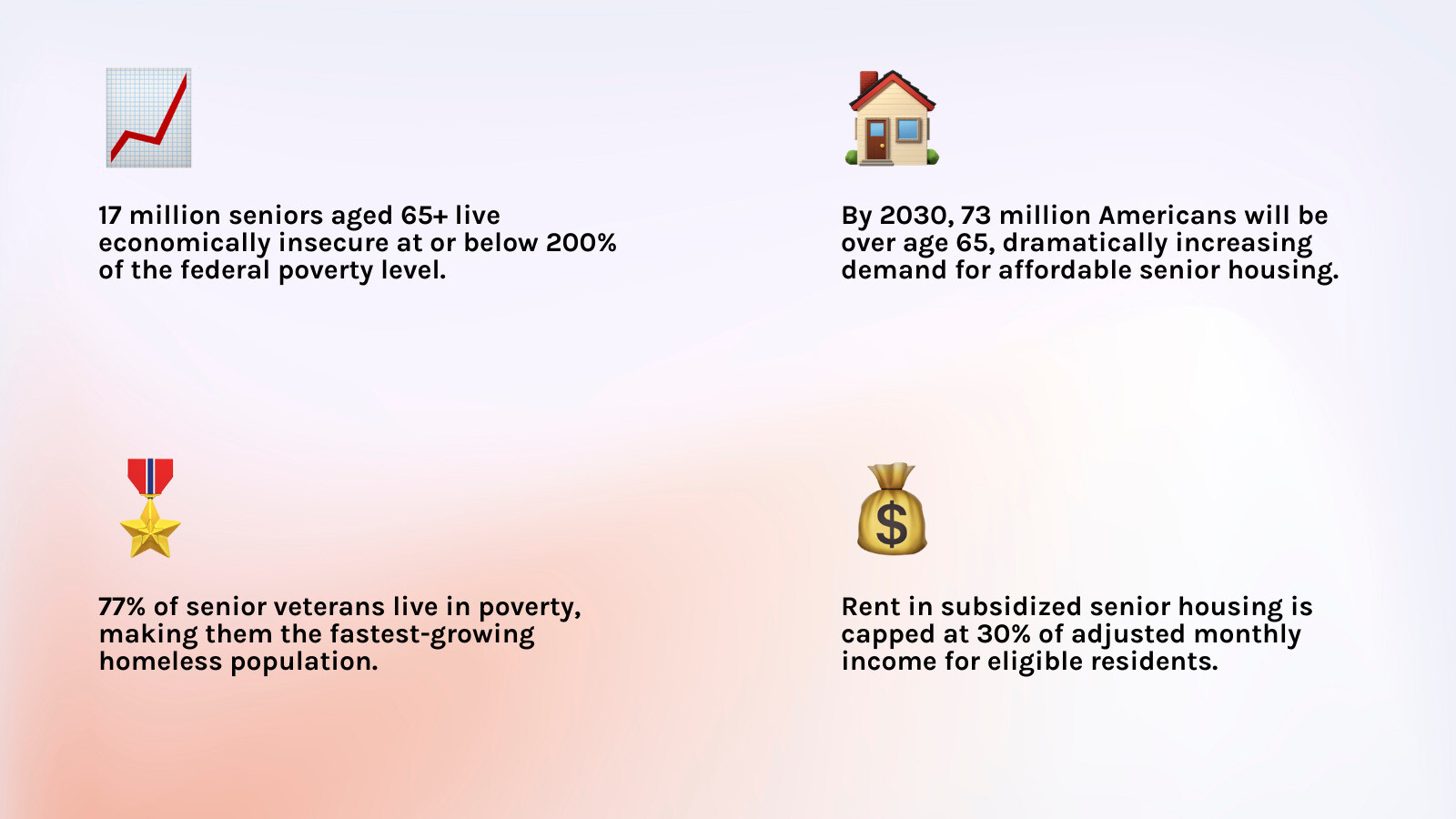
Low income housing for senior citizens is one of the most urgent and underserved needs in the United States today. More than 17 million Americans aged 65 and older are economically insecure, living at or below 200% of the federal poverty level. That is roughly $29,160 per year for a single person. And the situation is getting harder, not easier.
The main government-subsidized housing options available to low-income seniors are:
- Section 202 Supportive Housing for the Elderly – HUD-funded rentals with on-site services, for ages 62+
- Section 8 Housing Choice Vouchers – Rental assistance you can use in the private market
- Public Housing – Government-owned affordable units managed by local housing authorities
- Low-Income Housing Tax Credit (LIHTC) Properties – Privately owned apartments with income-restricted rents
- Project-Based Section 8 – Subsidized units tied to specific properties
Eligibility generally requires being age 62 or older, earning below 80% of your Area Median Income (AMI), and having net assets under $105,574 (2026 HUD guidelines). Rent is typically capped at 30% of your adjusted monthly income.
The challenge is real. By 2030, roughly 73 million Americans will be over 65 — about 1 in every 5 people. Senior veterans face an even steeper climb: 77% of all senior veterans live in poverty, and seniors are now the fastest-growing homeless population in the country.
This guide breaks down every major program, eligibility rule, and application step — so seniors and their families in California can find the right path forward without the confusion.
LifeSTEPS currently provides services in California only.
Low income housing for senior citizens vocab explained:
- income restricted housing near me
- low income housing for elderly and disabled
- low income rental assistance
Understanding Low Income Housing for Senior Citizens: Key Programs
Navigating the landscape of affordable housing can feel like trying to assemble a puzzle in the dark. Fortunately, several core government-subsidized programs are designed specifically to support older adults. Understanding these options is the first step toward finding a safe, comfortable, and affordable home.

Section 202 Supportive Housing for the Elderly
This program is HUD’s flagship initiative for seniors. Section 202 provides capital advances to private, non-profit organizations to finance the construction of supportive housing. It is designed specifically for very low-income households with at least one member who is 62 years of age or older.
What makes Section 202 properties unique is their focus on helping seniors age in place. These communities are physically built with accessibility in mind—featuring grab bars, ramps, wide doorways, and emergency call systems. Many also employ on-site service coordinators who arrange meals, transportation, and healthcare assistance, making it an excellent option for those seeking low income housing for elderly and disabled family members.
Low-Income Housing Tax Credit (LIHTC) Properties
The LIHTC program is a federal program that gives tax credits to private developers who construct or rehabilitate affordable rental housing. In exchange for the tax credits, developers must reserve a percentage of units for tenants who meet strict income limits.
LIHTC properties are not always exclusively for seniors, but many developments are built specifically as senior-only communities. Unlike traditional public housing, LIHTC rents are not based on 30% of your specific income; instead, they are capped at a set rate calculated from the Area Median Income (AMI).
Public Housing
Managed by local Public Housing Authorities (PHAs), public housing consists of government-owned and operated apartment complexes or single-family homes. A substantial portion of public housing units in California is reserved specifically for older adults and individuals with disabilities. Rent is strictly based on your income, ensuring that even those with only basic Social Security benefits can afford a place to live.
Section 8 Housing Choice Vouchers
The Section 8 program provides rental assistance vouchers directly to low-income participants. These vouchers allow you to find your own housing on the private market, as long as the landlord accepts Section 8 and the unit meets HUD health and safety standards. The voucher covers the difference between 30% of your adjusted income and the actual cost of the rent, giving seniors the freedom to choose where they live.
Eligibility Requirements for Low Income Housing for Senior Citizens
To qualify for government-subsidized senior housing, applicants must meet several strict federal and state criteria. These requirements ensure that limited public funds are directed to those who need them most.
Age Requirements
Most senior-specific programs, such as Section 202, require at least one household member to be 62 years of age or older at the time of application. However, some LIHTC and state-funded affordable housing developments lower this age threshold to 55.
Income Limits (AMI)
Eligibility is heavily tied to your local Area Median Income (AMI), which is updated annually by HUD. In California, where the cost of living varies wildly between regions like Los Angeles and Natomas, these limits are highly localized:
- Low-Income: Earning 80% or less of the local AMI.
- Very Low-Income: Earning 50% or less of the local AMI (the typical threshold for Section 202).
- Extremely Low-Income: Earning 30% or less of the local AMI.
For a detailed breakdown of how these income tiers affect placement and rent calculations, you can read The Essential HUD Low Income Senior Housing Handbook.
Asset Limits
Under the 2026 HUD guidelines, there is an asset limit of $105,574 in net family assets. While having assets below this limit is required, the actual income generated from your assets (such as interest from a savings account) is also factored into your annual household income calculation.
Citizenship Status
Applicants must be U.S. citizens or eligible non-citizens with legal residency status. When you apply, you will be required to provide documentation verifying your legal status.
Federal and State Subsidized Housing Options
Seniors in California have access to both federal HUD programs and state-specific resources designed to keep rental costs manageable.
Project-Based Section 8 vs. Housing Choice Vouchers
It is important to understand the difference between these two primary forms of Section 8 assistance:
- Housing Choice Vouchers (Tenant-Based): The voucher belongs to you. If you decide to move, you can take the voucher with you to a new apartment.
- Project-Based Section 8: The subsidy is tied directly to the apartment building. If you move out of a project-based unit, you do not keep the rental assistance; it stays with the unit for the next qualifying senior.
For those looking to explore options across the state, the California HUD Portal is an invaluable starting point. Additionally, we provide tailored resources to help navigate these state-level systems through our guide on Low Income Elderly Housing.
Navigating the Application Process and Waitlists
Securing a spot in subsidized senior housing is a journey that requires organization, patience, and persistence. Because demand far outstrips supply, understanding how to navigate the application pipeline is essential.

How to Apply for Low Income Housing for Senior Citizens
The application process begins with gathering your personal and financial documentation. Having these files organized in advance will prevent delays and ensure you are ready to act when an opening occurs. For a comprehensive overview of this process, see Senior Housing Assistance Your Roadmap to a New Home.
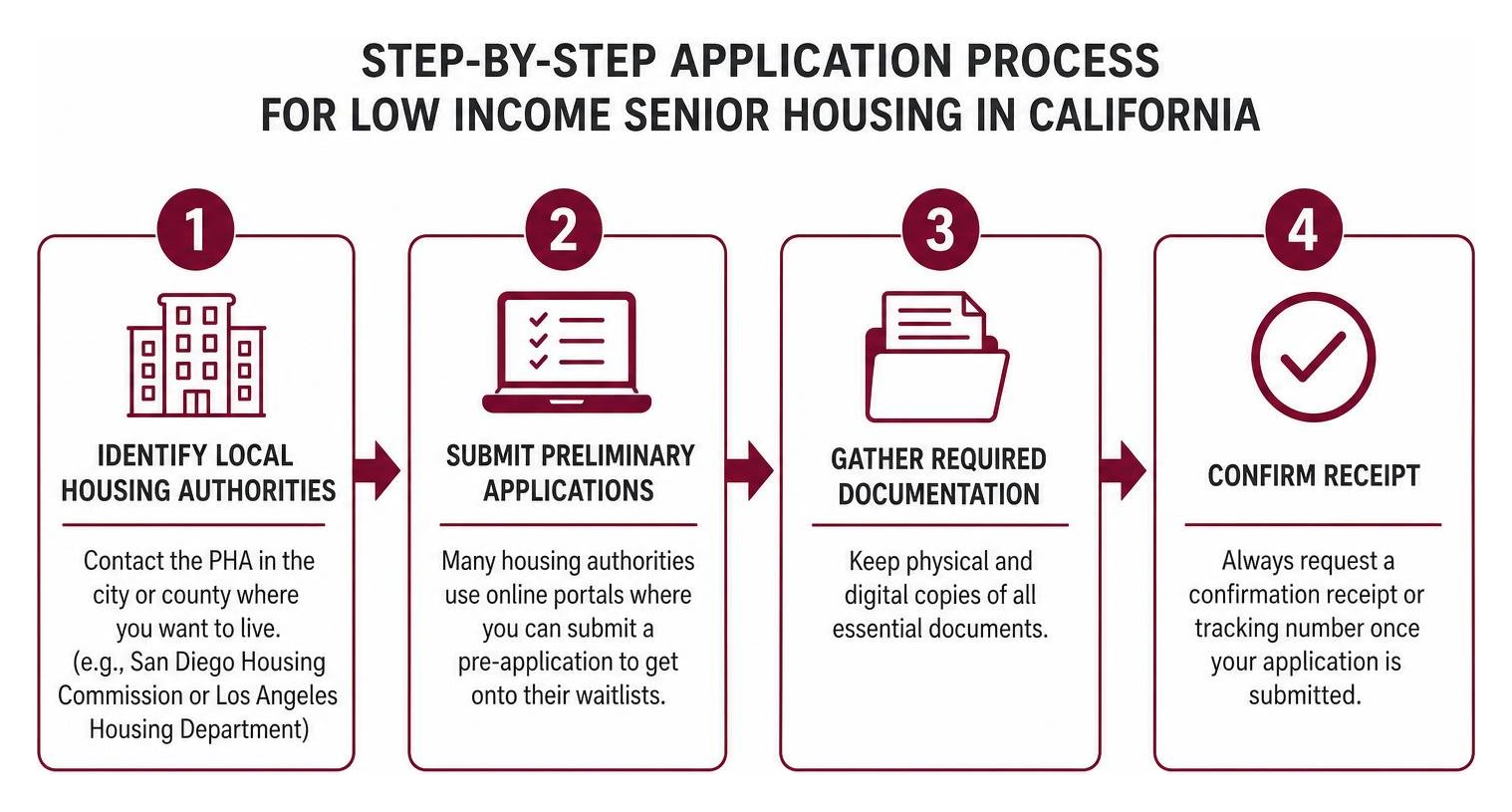
Step-by-Step Application Guide
- Identify Local Housing Authorities: Contact the PHA in the city or county where you want to live (such as the San Diego Housing Commission or the Los Angeles Housing Department).
- Submit Preliminary Applications: Many housing authorities use online portals where you can submit a pre-application to get onto their waitlists.
- Gather Required Documentation: Keep physical and digital copies of all essential documents.
- Confirm Receipt: Always request a confirmation receipt or tracking number once your application is submitted.
To make this process as smooth as possible, we have compiled a resource on Where to Find Low Cost Senior Apartments Without the Stress.
Essential Documentation Checklist
- Proof of Age: Government-issued photo ID, driver’s license, or birth certificate.
- Social Security Cards: For all members of the household.
- Proof of Income: Social Security award letters, pension statements, tax returns, or pay stubs.
- Bank Statements: Typically the most recent 3 to 6 months of statements for all checking and savings accounts.
- Housing History: Contact information for current and previous landlords.
Managing Long Waitlists and Finding Local Resources
Waitlists for low income housing for senior citizens in California are notoriously long, often ranging from 1 to 3 years, and sometimes longer in high-demand metro areas.
To maximize your chances of securing housing sooner, consider the following strategies:
- Apply Widely: Do not limit yourself to a single building or city. Apply to multiple housing authorities and individual LIHTC or Section 202 properties simultaneously.
- Keep Information Updated: If you change your phone number, email, or mailing address, notify every housing authority immediately. If they attempt to contact you and receive no response, you will be removed from the waitlist.
- Utilize Local Housing Resources:
- Seniors in Southern California can access the Low-Income Residents – LAHD – City of Los Angeles platform for local listings.
- For those in San Diego, the Rent from SDHC – San Diego Housing Commission portal offers direct access to municipal affordable units.
- If you are looking in nearby regions, check the listings for Low Income Affordable Senior Living in Riverside, California and Low Income Affordable Senior Living in Irvine, California – After55.com.
Comparing Senior Housing Options: Subsidized Rent vs. Independent Living
Choosing the right living arrangement depends on your budget, physical health, and how much daily assistance you require.
| Housing Option | Average Cost | Independence Level | Community & Support Services |
|---|---|---|---|
| Subsidized Rental Housing | 30% of adjusted gross income | High | Moderate (On-site coordinators, basic activities) |
| Congregate Housing | Income-based or low fixed rate | Moderate | High (Shared meals, light housekeeping, group activities) |
| Private-Pay Independent Living | Market rate (often high) | High | Moderate (Recreational activities, shared spaces) |
| Assisted Living | High private-pay (unless subsidized via waivers) | Moderate to Low | Very High (24/7 care, medication management, meals) |
Understanding these distinctions can help you make an informed financial and lifestyle decision. You can read more about balancing these choices in our guide to Unlock Affordable Independence Options for Senior Living That Won’t Break the Bank.
Subsidized Rental Housing vs. Private-Pay Independent Living
While both subsidized rental housing and private-pay independent living allow seniors to maintain their autonomy, their structures are vastly different.
Private-pay independent living communities operate on the open market. They offer excellent recreational amenities, but they are often financially out of reach for seniors living on a fixed income. In contrast, subsidized housing programs ensure your rent remains proportional to what you actually make.
Furthermore, subsidized senior communities often incorporate community-based support services specifically designed to prevent isolation and help residents manage daily tasks. For a deeper dive into affordable, non-subsidized independent alternatives, explore Low Cost Senior Independent Living.
Supportive Services and Aging in Place in California
For many older adults, moving into a dedicated housing facility is not the preferred choice. Most seniors wish to age in place in their own homes and communities, surrounded by familiar environments.
Programs Helping Seniors Remain in Their Homes
In California, several innovative programs make aging in place a realistic, safe, and highly affordable option. Our focus is on providing human-centered, measurable support that keeps seniors stable and housed. To see how we approach these supportive frameworks, read Affordable Homes for Seniors.
- In-Home Supportive Services (IHSS): This state-funded program pays for home care providers to assist eligible low-income seniors with daily tasks, such as housecleaning, meal preparation, grocery shopping, and personal care. This allows seniors to remain safely in their homes rather than moving into a licensed care facility.
- CalAIM (California Advancing and Innovating Medi-Cal): This program provides wrap-around services to vulnerable seniors. Through CalAIM, eligible individuals can receive deposit assistance—specifically up to 1 month paid in advance for deposit assistance—to secure stable housing.
- Housing Retention and Stability: By wrapping these services around low-income seniors, we achieve a 93% housing retention rate across our programs. This measurable outcome demonstrates that with the right financial and physical support, seniors can successfully maintain their housing stability. Learn more about these options in Financial Assistance for Seniors How to Keep Your Home Sweet Home.
Supporting Vulnerable Senior Veterans
Senior veterans face unique struggles when it comes to housing security. With approximately 77% of senior veterans living in poverty and many experiencing severe social isolation, dedicated intervention is critical.
At LifeSTEPS, we are deeply committed to serving those who served. Our unique approach involves collaborating with programs like the Family Self-Sufficiency (FSS) program to help clients, including veterans, achieve long-term homeownership and stability. By pairing permanent supportive housing with dedicated case management, we help veterans transition from housing instability to self-sufficiency. Discover how rent subsidies and veteran supports work together in Rent Subsidies for Seniors Don’t Let the Bill Collector Win.
Alternatives to Subsidized Housing: Home Modifications and ADUs
When waitlists for subsidized housing are too long, seniors and their families can look to creative housing alternatives to bridge the gap.
- Home Modifications: Installing wheelchair ramps, grab bars, non-slip flooring, and walk-in tubs can transform an existing home into a safe, accessible environment. Local area agencies on aging often provide grants to cover the costs of these modifications for low-income seniors.
- Accessory Dwelling Units (ADUs): Often called “granny flats,” ADUs are secondary housing units built on an existing residential lot. This allows older adults to live close to family members while maintaining their own private, independent living space.
- Preventing Eviction and Housing Instability: If a senior is facing immediate housing instability, legal aid organizations and tenant protection programs can intervene. Many California cities offer free mediation services and emergency rental assistance to prevent eviction and protect older adults from displacement or elder abuse. To explore these options further, read The Golden Years Golden Deals Finding Low Income Senior Housing.
Frequently Asked Questions about Low Income Senior Housing
What is the asset limit for HUD senior housing in 2026?
Under the 2026 HUD guidelines, the asset limit for subsidized senior housing is $105,574 in net family assets. If your assets exceed this amount, you may not qualify for federal housing assistance programs like Section 202 or Section 8.
How is rent calculated in subsidized senior apartments?
Rent in most subsidized senior apartments is calculated at approximately 30% of your household’s adjusted gross monthly income. HUD allows specific deductions for elderly households, and a utility allowance is often provided to help offset the cost of electricity, gas, and water.
Can a senior be evicted from subsidized housing?
Yes, seniors can be evicted from subsidized housing, but they have strong tenant protections. Landlords must have “good cause” for eviction, such as non-payment of rent, serious lease violations, or illegal activity. If you receive an eviction notice, you have the right to request a hearing and seek assistance from local legal aid organizations.
Conclusion
Finding low income housing for senior citizens requires navigating a complex web of programs, but the reward is a safe, affordable, and supportive place to call home. At LifeSTEPS, we provide the human-centered support, education, and resources necessary to help older adults transition to stable housing and self-sufficiency.
Our commitment to building stronger communities is reflected in our measurable impact:
- We maintain a 93% housing retention rate for individuals transitioning to stable housing.
- Our Summer Reading programs achieve a 97% literacy improvement among participating youth.
- We have awarded over $2.1M in scholarships to support higher education and self-sufficiency.
Whether you are a senior looking for housing stability, a veteran seeking support, or a family member researching care options, we are here to help you navigate your journey.
Learn more about LifeSTEPS programs and services to see how we can assist you.
For media inquiries, contact: bex@lifestepsusa.org
LifeSTEPS | Phone: (916) 965-2110 | LifeSTEPS Website
LifeSTEPS currently provides services in California only.


