


Income Screening Demystified: How Subsidized Housing Evaluates Your Credit
Income Screening Demystified: How Subsidized Housing Evaluates Your Credit
Finding Income-Based Apartments Without a Credit Check
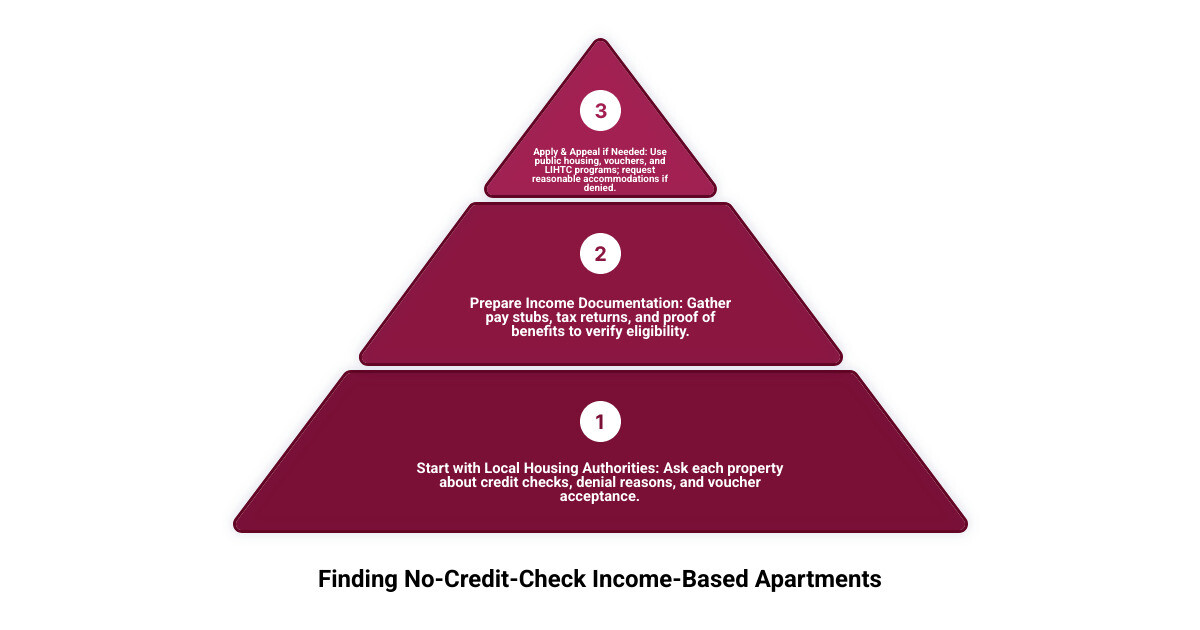
Start with your local housing authority and income-restricted apartment listings. Ask each property whether it checks credit, what could lead to a denial, and whether it accepts housing vouchers. Income-based does not automatically mean no credit check: screening rules vary by program and property.
For veterans and other renters rebuilding financial stability, a low credit score does not have to end the search. Many renters specifically look for income based no credit check apartments because public housing, vouchers, and other affordable rentals apply different income rules and screening policies than market-rate properties. Understanding income restricted housing qualifications and exploring income based apartments can help you compare options, prepare proof of income, and respond effectively if an application is denied.
The Reality of No Credit Check Income Based Apartments in Subsidized Housing
Navigating the rental market when rebuilding your credit can feel daunting. Many private landlords rely on automated credit screening algorithms that automatically reject applicants below certain three-digit scores. However, subsidized and affordable housing communities operate under entirely different regulatory frameworks designed to expand access rather than restrict it.
Many households seeking no credit check income based apartments discover that subsidized housing developments evaluate applicants based on current stability rather than past credit scores. Subsidized housing does not ignore an applicant’s background entirely, but the evaluation process focuses heavily on income eligibility, verifiable rental history, and program compliance rather than traditional credit scores.
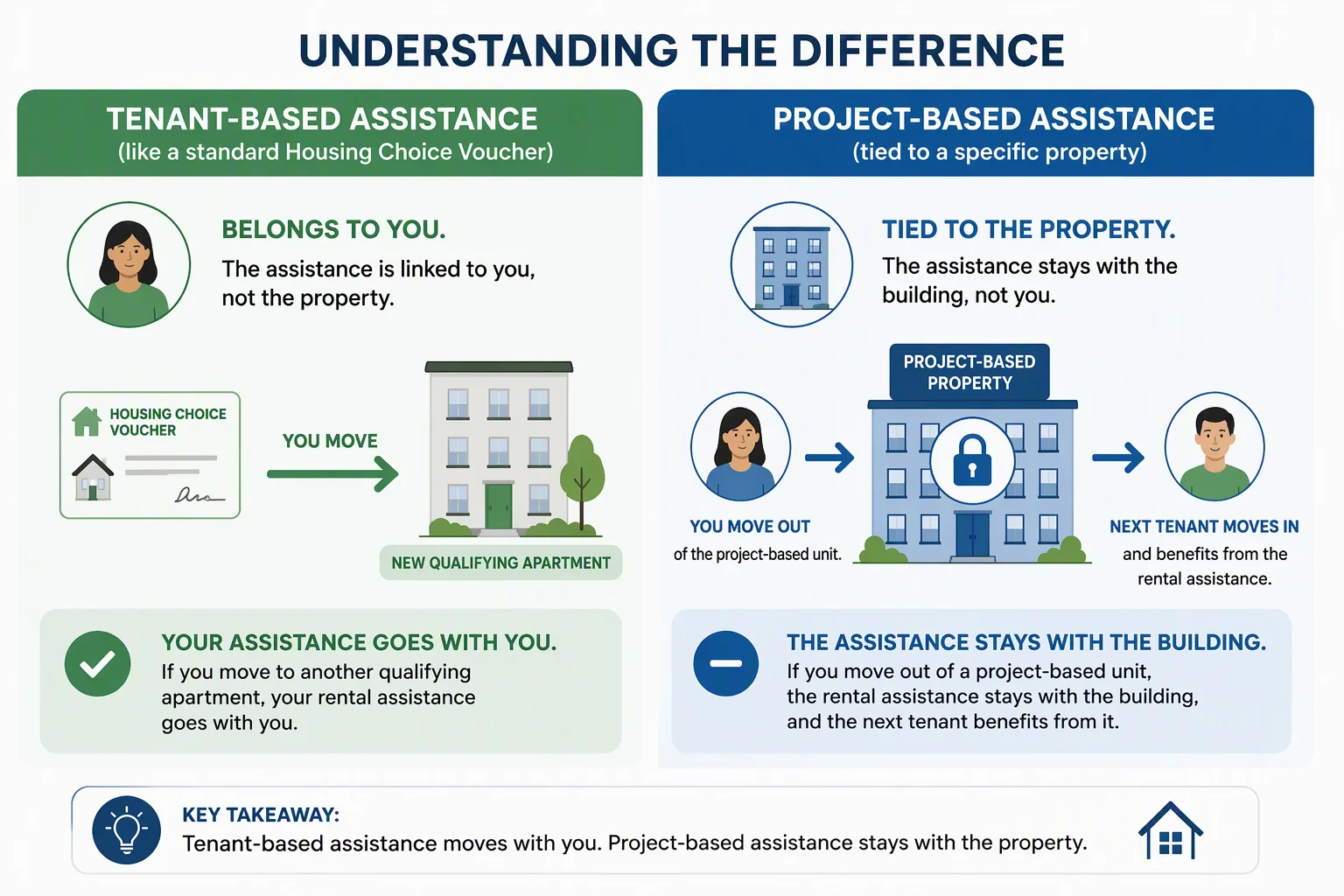
Understanding no credit check apartment availability requires knowing how affordable housing providers evaluate your background. Instead of demanding a prime credit score, many subsidized programs use flexible criteria that account for past financial hardship, focusing on whether a household can maintain stability moving forward.
Income-Based vs. Traditional Market-Rate Leases
Traditional market-rate landlords typically set rigid standards, often requiring an applicant’s gross monthly earnings to equal three times the monthly rent alongside a credit score above 650. In contrast, income-based and income-restricted communities tie rental costs directly to household earnings and local median benchmarks.
| Feature | Market-Rate Rentals | Income-Based / Subsidized Housing |
|---|---|---|
| Rent Calculation | Market demand and landlord discretion | Capped at ~30% of adjusted gross income or fixed AMI tiers |
| Credit Score Focus | Strict cutoffs (often 620–680+ minimum) | Holistic review; low credit scores rarely cause automatic denial |
| Debt Evaluation | Penalizes medical debt, student loans, consumer debt | Often excludes medical debt and deferred student loans |
| Rental Assistance | Discretionary acceptance (subject to local laws) | Vouchers and subsidies directly integrated into lease terms |
| Denial Protections | Limited recourse under standard adverse action | Formal grievance hearings and individualized review processes |
While private properties can deny applicants based on past financial collections, subsidized housing developments focus primarily on housing-related obligations, such as whether an applicant owes money to a previous public housing authority or private landlord.
How No Credit Check Income Based Apartments Handle Credit Screening
Subsidized housing developments frequently establish individualized resident selection screening criteria that explicitly waive or modify conventional credit checks.
Properties operating under specialized federal and state subsidy frameworks often apply distinct policies:
- Medical Debt and Student Loan Exclusions: Collections tied to emergency healthcare expenses or educational loans are routinely omitted from unfavorable underwriting determinations.
- Focus on Utility and Rental History: Reviewers prioritize timely utility payments and consistent lease compliance over credit card balances or lack of credit history.
- Risk-Mitigation Program Waivers: When applicants participate in structured supportive programs, standardized credit checks may be waived entirely because program guarantees mitigate financial risk for property owners.
- Mitigating Circumstances: Applicants who have experienced temporary financial distress, such as sudden illness or temporary job loss, can present documentation proving their current ability to pay rent.
How Housing Programs Calculate Rent and Income Limits
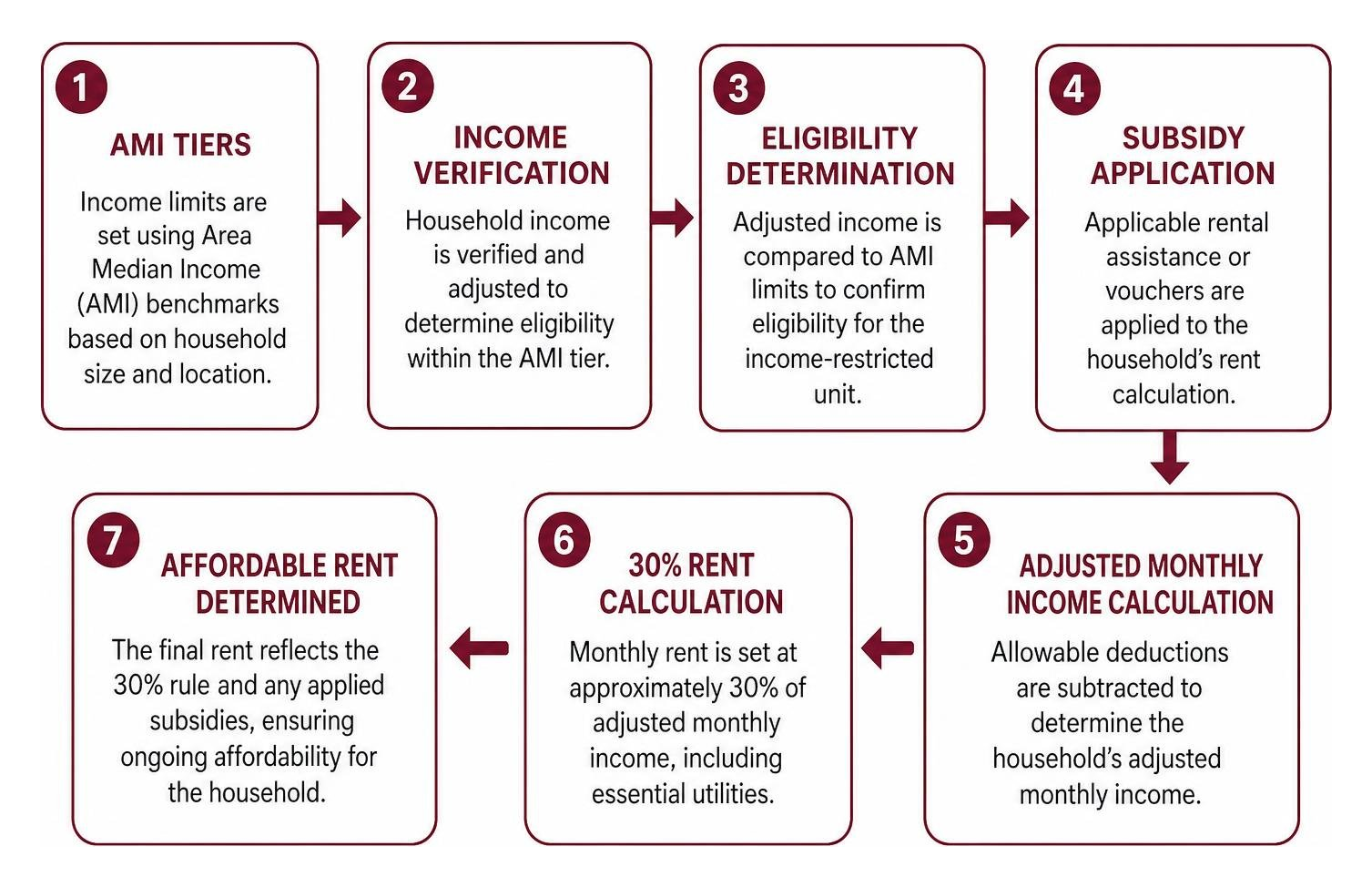
Affordable housing eligibility is established by calculating household earnings against federally defined benchmarks. Meeting income-restricted housing qualifications depends on your local area’s economic profile, your overall household composition, and verified income streams.
The 30 Percent Adjusted Income Standard
The cornerstone of subsidized housing is the 30 percent rule. Under federal guidelines, a household in an income-based unit pays roughly 30% of its adjusted monthly income toward rent and essential utilities.
Reviewing income-based housing fundamentals helps clarify how adjusted income is calculated:
- Determine Gross Annual Income: Tally all wages, pensions, public assistance, and child support across adult household members.
- Apply Mandatory Deductions: Deduct allowable amounts, such as standard allowances for dependents, verified medical expenses for elderly or disabled members, and qualifying childcare costs.
- Calculate Adjusted Monthly Income: Divide the remaining annual figure by 12.
- Determine Tenant Share: Multiply the monthly adjusted income by 30% (0.30) to establish the household rent obligation.
If basic utilities are not included in the rent, the housing provider applies a utility allowance deduction, reducing the tenant’s direct monthly payment to ensure overall housing costs remain balanced.
Area Median Income (AMI) Thresholds and Household Size
The U.S. Department of Housing and Urban Development (HUD) determines annual Area Median Income (AMI) levels for every county and metropolitan region. These thresholds scale based on the number of people living in the home.
Following the structured HUD low-income application process requires determining where your household fits within these standard income tiers:
- Extremely Low Income (ELI): Households earning at or below 30% of the Area Median Income.
- Very Low Income (VLI): Households earning between 31% and 50% of the Area Median Income.
- Low Income (LI): Households earning between 51% and 80% of the Area Median Income.
Because limits adjust based on household size, a four-person family has a higher qualifying income ceiling than a single individual applying for a studio or one-bedroom unit.
Government Programs and Tenant Protections That Bypass Poor Credit
Federal and state housing protections ensure that individuals facing financial barriers, disabilities, or unique life transitions receive equitable access to safe, affordable shelter.

The Fair Housing Act prohibits discrimination based on race, color, national origin, religion, sex, familial status, or disability. Under these protections, housing providers must consider reasonable accommodation requests for applicants with disabilities, which can include modifying standard screening policies if past credit irregularities resulted directly from a medical condition or disability.
Furthermore, protections under the Violence Against Women Act (VAWA) ensure that negative rental or credit history directly connected to incidents of domestic violence, dating violence, sexual assault, or stalking cannot serve as the basis for denying a housing application.
Section 8 Housing Choice Vouchers and Public Housing
The Housing Choice Voucher program (Section 8) and traditional public housing developments provide robust protections for renters with imperfect credit.
When searching for housing voucher rental options, the housing authority guarantees the subsidy portion directly to the property owner each month. Because the public agency covers the majority of the contract rent, private property managers who accept vouchers have less reason to evaluate traditional credit scores. The voucher acts as a financial safeguard, ensuring stable rental payments regardless of past credit issues.
LIHTC Properties and Program-Specific Screening Waivers
The Low-Income Housing Tax Credit (LIHTC) program is one of the largest sources of affordable multifamily housing. While LIHTC developments are managed by private entities, their screening criteria are governed by regulatory agreements tied to state and federal housing finance agencies.
Renters searching affordable housing directory listings often discover that LIHTC communities evaluate credit through a flexible, tiered matrix. In many instances, negative credit events older than two or three years are disregarded entirely, and participation in state-sponsored risk-mitigation initiatives allows leasing offices to waive standard application requirements.
Navigating the Application Process and Waitlists in California
Applying for affordable housing across California requires a clear, organized approach. High demand across Southern California and the Bay Area means prospective residents benefit from preparing applications thoroughly and understanding local submission procedures.
Reviewing a comprehensive California government-based apartments guide gives applicants the foundation needed to track open registries and compile required documentation effectively.
Essential Documentation and CalAIM Deposit Assistance
Securing subsidized housing requires thorough income verification. Applicants should assemble documentation early to prevent processing delays:
- Proof of Identity: Government-issued identification cards, birth certificates, and Social Security cards for all household members.
- Income Verification: Consecutive recent pay stubs, benefits award letters (such as SSI, SSDI, or TANF), child support verification, and recent tax returns.
- Asset Statements: Recent statements for all checking, savings, and investment accounts.
- Rental History: Contact information for previous housing providers and verification of consistent utility payments.
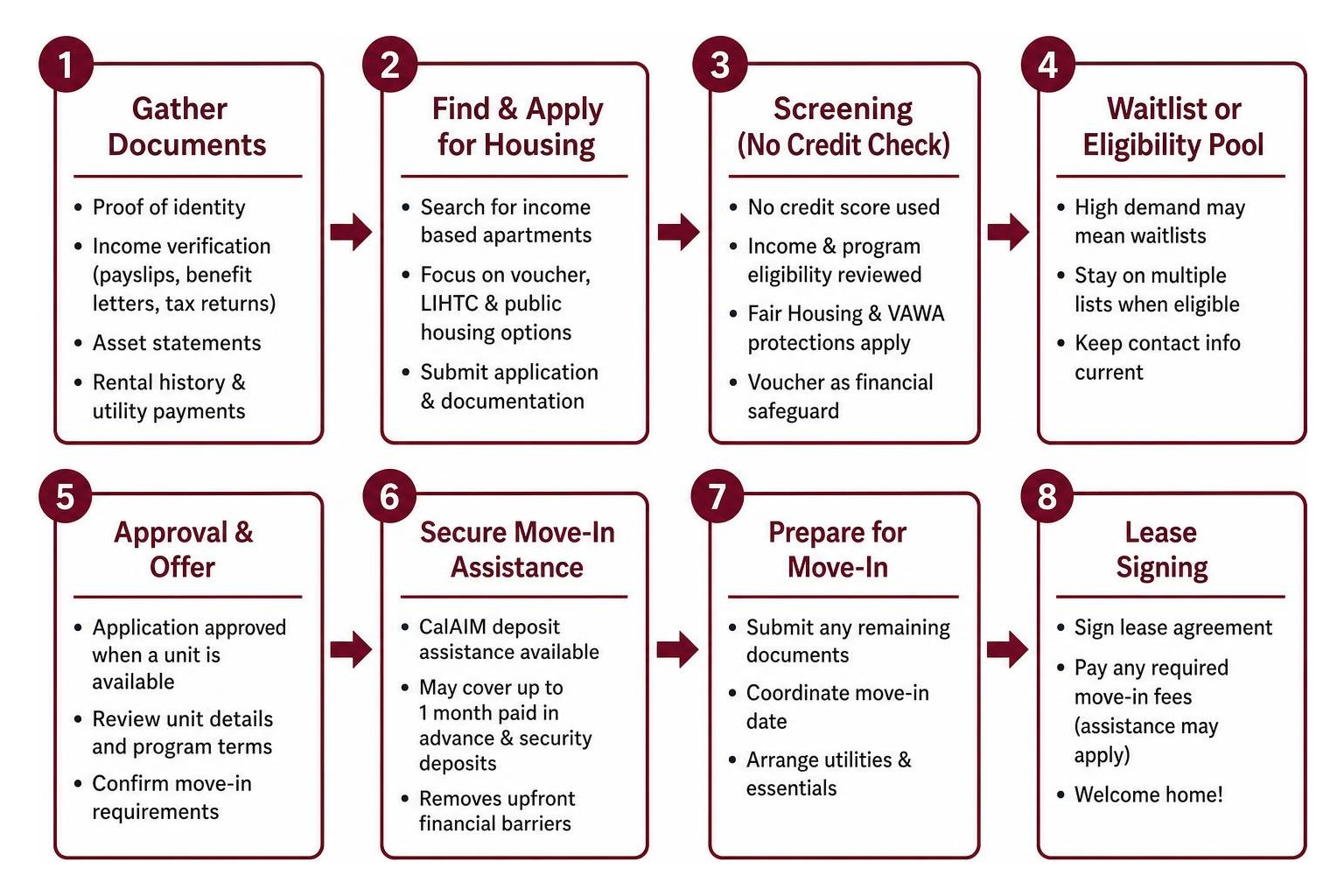
Covering move-in expenses is often an obstacle for low-income households. LifeSTEPS provides support by connecting individuals to vital transition resources. Through California’s CalAIM program, qualifying individuals can access housing deposit assistance—covering up to 1 month paid in advance along with security deposits—to eliminate upfront financial hurdles.
Utilizing structured resources outlined in this guide to rental and deposit assistance helps families transition into permanent homes. In LifeSTEPS’ supportive housing communities, comprehensive case management contributes to an exceptional 93% housing retention rate, demonstrating that stable support leads to long-term community success.
Finding No Credit Check Income Based Apartments in California
Renters across Southern California can explore affordable properties through regional housing registries:
- Los Angeles County: Consult local housing authority portals and county-wide affordable housing registries that list developments with specialized screening criteria.
- San Diego County: Explore municipal housing commission databases and county-sponsored low-income housing directories.
- Riverside and Orange Counties: Check regional community development portals, including affordable listings in Irvine and surrounding neighborhoods.
- Bay Area Centers: Explore regional registries across the greater Bay Area.
Because waitlists open and close periodically, navigating low-income housing waitlists requires submitting pre-applications across multiple properties and checking statuses regularly.
Consider the experience of Maria, whose name has been changed for privacy. When applying for subsidized housing across Southern California, past medical bills had lowered her credit score. By applying to an income-restricted community with flexible screening guidelines and providing letters of support, she secured an affordable two-bedroom home where her family continues to thrive.
Frequently Asked Questions About Subsidized Housing Screening
Can I be denied an income-based apartment purely for a low credit score?
In most subsidized programs, a low credit score alone is not valid grounds for an automatic denial. Public housing authorities and federally subsidized communities are guided by HUD standards to evaluate the total context of an application.
Denials typically require specific, documented concerns—such as an active balance owed to another housing authority or utility company that prevents essential services from being connected. If an application is rejected based on consumer reporting, the property must issue a formal adverse action notice explaining the exact reason and providing an opportunity to respond.
How long are the waiting lists for subsidized housing?
Wait times vary significantly depending on unit size, geographic demand, and property funding:
- Studio and 1-Bedroom Units: Wait times often range from several months to several years due to high demand among single adults and seniors.
- 2- and 3-Bedroom Family Units: Depending on turnover rates, waits commonly range from 12 to 24 months.
- Specialized Supportive Housing: Units paired with specific supportive services or preference categories may have shorter processing queues.
Maintaining current contact information with each property management office is crucial while remaining on a waiting list.
What can I do if my housing application is rejected?
If your application is denied, you have the legal right to request an informal review or formal grievance hearing within a designated timeframe (often 10 to 14 days from receiving the notice):
- Review the Written Denial: Identify the exact screening criteria cited by the leasing office.
- Collect Rebuttal Evidence: Gather receipts, payment plan confirmations for past debts, or proof that negative credit items resulted from medical emergencies.
- Request a Formal Meeting: Submit a written request for an appeal or grievance conference.
- Submit Reasonable Accommodations: If the negative history was connected to a disability, submit a formal request for an exception to standard screening policies.
Conclusion
Securing affordable housing is the foundation for personal well-being, education, and career advancement. While traditional rental screening can create barriers for individuals with past financial difficulties, income-based and subsidized housing programs provide clear pathways to stable living arrangements through flexible evaluation standards, rent caps, and legal protections.
LifeSTEPS provides comprehensive supportive services within affordable housing communities, assisting individuals and families as they build self-sufficiency. Beyond housing stability, our initiatives make measurable impacts across generations—including supporting youth education where participants achieve a 97% literacy improvement in Summer Reading programs, as well as helping students access over $2.1M in scholarships for higher education. By combining stable housing with human-centered community programs, residents gain the tools they need to achieve lasting independence.
Explore our supportive housing programs and services to learn more about how we help communities thrive.
For media inquiries, contact: bex@lifestepsusa.org
LifeSTEPS currently provides services in California only.


