


Finding the Perfect Affordable Senior Housing Near You
Is Affordable Senior Housing Near You Actually Affordable? Here’s What to Know First
Affordable senior housing near me is one of the most common searches older adults and their families make — and for good reason. Rents keep rising, fixed incomes stay fixed, and the gap between the two keeps growing. For veterans transitioning out of military service, that gap can feel even wider.
Here is a quick overview of your main options:
| Housing Type | Age Requirement | Typical Cost | Best For |
|---|---|---|---|
| HUD-Subsidized Apartments | 62+ | ~30% of monthly income | Very low-income seniors |
| LIHTC (Tax Credit) Communities | 55+ or 62+ | Based on % of Area Median Income | Low-to-moderate income seniors |
| Section 8 / Housing Choice Voucher | Varies | Tenant pays ~30% of income | Seniors with portable rental subsidies |
| Permanent Supportive Housing | Varies | Income-proportional rent | Seniors with disabilities or housing instability |
| Market-Rate 55+ Communities | 55+ | Fixed market rent | Active adults with stable income |
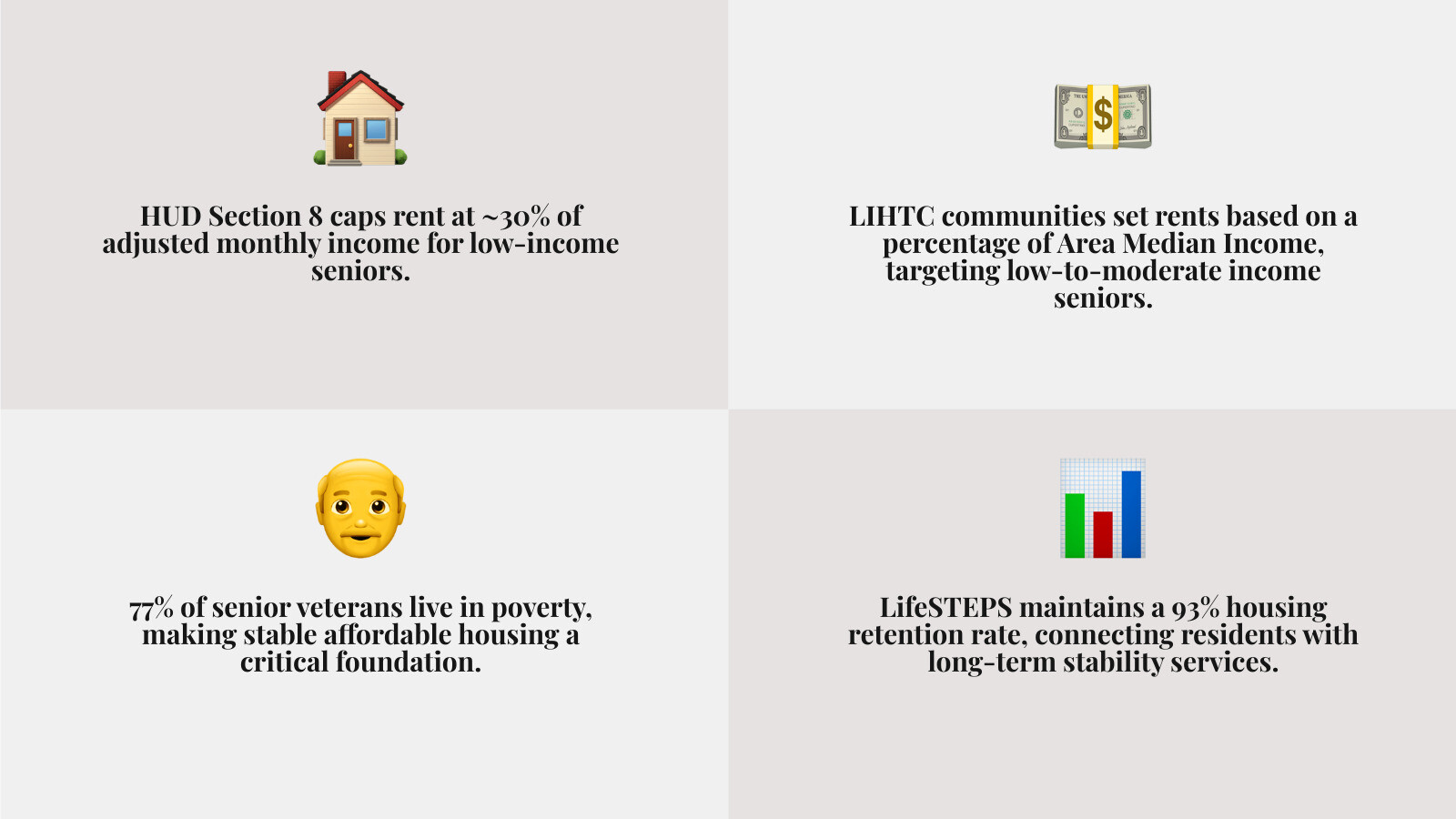
The good news: programs like HUD Section 8 cap your rent at roughly 30% of your adjusted monthly income. That means if your only income is Social Security, your rent adjusts to match. Many communities also include utilities, which makes budgeting more predictable.
For veterans specifically, the numbers paint a stark picture. According to data from Swords to Plowshares, 77% of senior veterans are living in poverty, and nearly half report feeling socially isolated. Stable housing is not just a comfort — it is the foundation everything else is built on.
LifeSTEPS works within California to help residents not just find housing, but keep it. The organization maintains a 93% housing retention rate, connecting residents with services that support long-term stability.
LifeSTEPS currently provides services in California only.
Easy affordable senior housing near me glossary:
Understanding Affordable Senior Housing Options
When beginning your search for affordable senior housing near me, it is essential to realize that “affordable housing” is not a single, one-size-fits-all program. Instead, it is a broad umbrella that covers several different housing structures, care levels, and financial models. Understanding these distinctions is the first step toward finding a living situation that matches both your budget and your physical needs.

Many older adults prefer to live independently for as long as possible. However, as we age, our physical needs can change, making certain home environments less practical. Affordable senior communities are specifically designed to address these transitions, offering everything from completely independent apartments to buildings with rich supportive services.
To explore these models further, you can read our comprehensive low-income senior housing guide or learn more about the broader landscape of senior living affordable housing options. By aligning your physical requirements with the right housing category, you can secure a home that promotes both safety and self-sufficiency. For general information on directories across the country, you can also consult the Low-Income & Affordable Housing for Seniors database.
Independent Living Communities
For older adults who do not require daily medical care or assistance with activities of daily living, independent living communities offer the perfect balance of privacy, community, and affordability. These communities are designed to foster an active lifestyle while removing the burdens of heavy home maintenance.
These properties typically enforce age restrictions, usually requiring at least one member of the household to be 55 or older, or in many subsidized cases, 62 or older. In these environments, residents live in their own private apartments but have access to shared spaces, such as community rooms, gardens, libraries, and fitness centers. To learn more about securing these placements, see our guide on how to snag affordable 55 and older apartments without the stress.
Many of these properties are built using government tax credits, which keep the rents lower than the surrounding market rate. If you are looking for creative ways to keep costs low, you can also explore these 10 cheaper alternatives to affordable senior independent living to expand your search.
Assisted Living and Supportive Housing
For seniors who need help with daily activities—such as bathing, dressing, medication management, or meal preparation—independent living may no longer be the safest choice. In these situations, assisted living and supportive housing communities provide a vital safety net.
These facilities combine housing with personal care services and 24-hour staff support. While traditional assisted living can be incredibly expensive, there are subsidized and low-income options available for qualifying seniors. Many municipal partnerships and state programs help offset these costs, allowing lower-income older adults to access the care they need.
For a detailed breakdown of these options, refer to our guide to housing for elderly and disabled individuals. Additionally, you can search for local care options using our resources on assisted living within reach how to find budget friendly care in your area and explore listings for cheap assisted living facilities.
For individuals with specific physical or cognitive disabilities, specialized programs offer targeted assistance. You can find more targeted resources through our articles on low income assisted living for disabled and assisted living for low income disabled adults.
How Income Limits and Rent Calculations Work
The financial side of affordable housing can seem complex at first glance. Rents are not determined by simple market demand; instead, they are heavily regulated and tied directly to the local economy and your household income.
Two primary frameworks govern how rents and eligibility are calculated in affordable senior housing: the HUD 30% adjusted income rule and the Low-Income Housing Tax Credit (LIHTC) program.
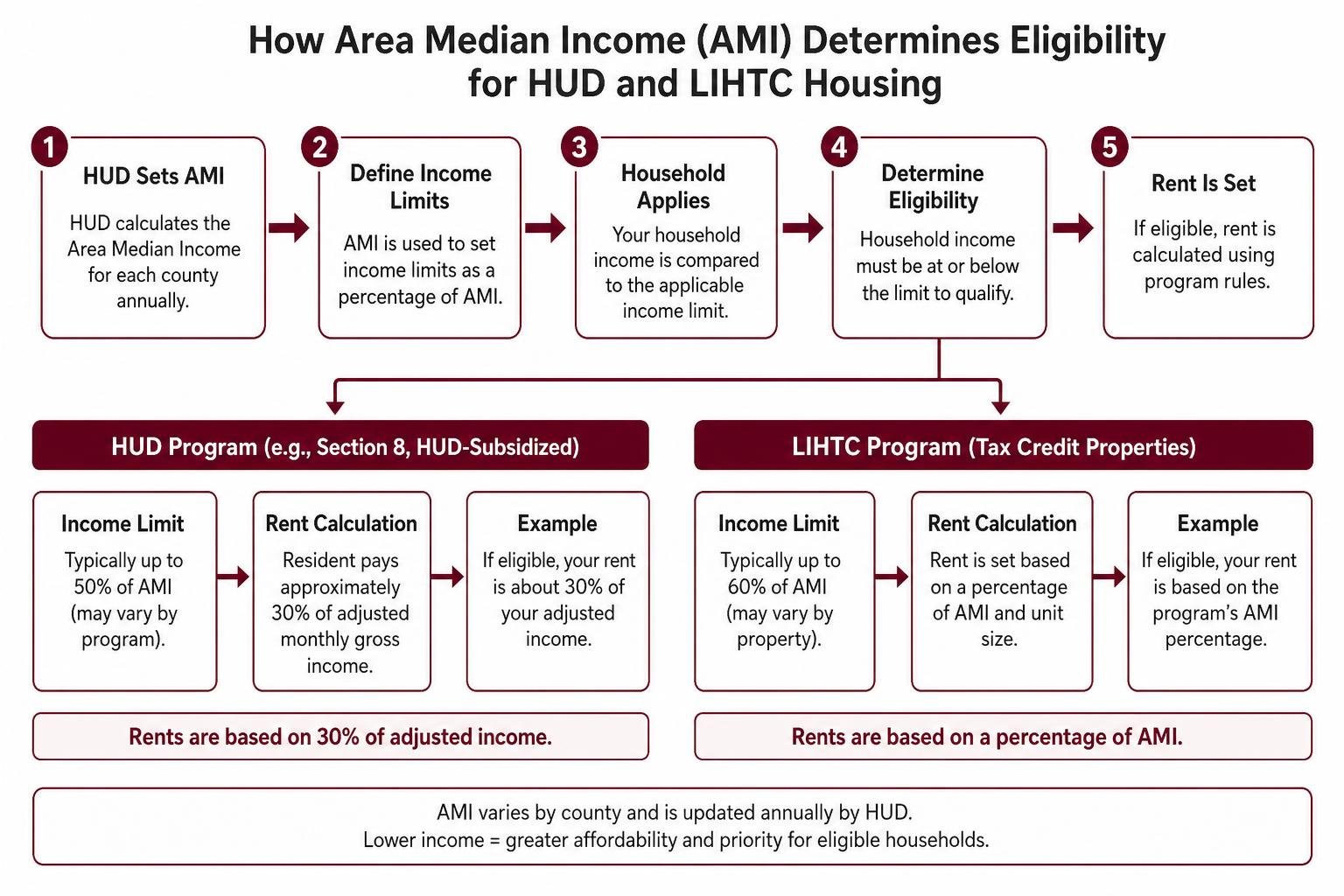
Understanding how your local Area Median Income (AMI) affects your eligibility is crucial. Income limits are updated annually by HUD and vary significantly by county. To see how these calculations translate to actual apartment options, explore our guide on senior living apartments based on income near me or read the grandparents guide to affordable housing for elderly folks.
The 30% Adjusted Income Rule
For federal programs like Section 8 vouchers and HUD-subsidized senior developments, rent is calculated using a straightforward formula: residents pay approximately 30% of their adjusted monthly gross income.
This calculation takes your gross income and subtracts qualifying medical expenses, disability assistance allowances, and other approved deductions to arrive at your “adjusted” income. If your only source of income is a monthly Social Security check, your rent will be set at roughly 30% of that check.
It is important to note how utility allowances work under this rule. In many HUD properties, basic utilities like water, gas, and trash are included in the rent. If you are responsible for your own electricity, the housing authority will often apply a utility allowance, which reduces your rent contribution to offset the estimated cost of your electric bill. For a deeper look at these federal programs, check out our government subsidized housing guide as well as the essential hud low income senior housing handbook.
Low-Income Housing Tax Credit (LIHTC) Limits
Unlike HUD developments, where rent rises and falls dynamically with your income, LIHTC properties set fixed maximum rents based on local income brackets. These properties do not use the 30% rule directly; instead, they target specific percentages of the Area Median Income (typically 30%, 50%, or 60% of AMI).
To qualify for an LIHTC apartment, your total household income must fall below the maximum limit designated for that unit’s income tier. For instance, in a typical California county, a one-person household applying for a 60% AMI unit must prove their annual income is below that specific threshold.
At the same time, because these properties do not receive ongoing federal rent subsidies, they often enforce a minimum income requirement. This is usually set at 2 to 2.5 times the monthly rent to ensure the tenant can afford the apartment. However, if you hold a portable Section 8 voucher, or if you can show significant cash assets (such as savings equal to at least six months of rent), this minimum income requirement is typically waived. You can learn more about finding these specific tax-credit units in our resource on where to find low cost senior apartments without the stress.
Finding the Best Affordable Senior Housing Near Me
Knowing the rules is helpful, but the most critical step is finding actual, physical vacancies in your local area. Because affordable senior housing is in high demand, finding an open apartment requires using localized directories and state-specific search tools.

For seniors living in California, there are several regional and state-level resources designed to streamline this process. For instance, the Los Angeles County Housing Resource Center provides updated listings and directories on LA County Senior Resources.
When comparing different options, it is helpful to look at multiple properties in your immediate neighborhood. We recommend reading our guide on comparing low income rentals for seniors in your neighborhood and bookmarking our ultimate affordable senior housing list to keep your search organized.
Searching for Affordable Senior Housing Near Me in Southern California
Southern California has a robust network of affordable housing options, though navigating them requires a targeted local approach. If you are looking in San Diego, you can find localized listings through San Diego Income-Restricted Housing.
For those searching in neighboring counties, check out the dedicated directories for Low Income Affordable Senior Living in Riverside, California and Low Income Affordable Senior Living in Irvine, California.
Because California has unique funding programs and state-level housing protections, understanding the state’s specific landscape is highly beneficial. You can find specialized state-level advice in our guide to affordable senior housing california.
Navigating the Search for Affordable Senior Housing Near Me in the Bay Area
In the Bay Area, local housing authorities manage centralized waitlists and portals for affordable senior apartments. These portals allow you to filter by age restrictions, income limits, and accessibility features.
Because vacancy rates in the Bay Area can be incredibly low, it is vital to check these portals frequently and submit applications as soon as waitlists open. To help you navigate these regional hurdles, we have put together a localized local search guide.
If you are hoping to find a placement quickly, you can also read our low income senior housing no waiting list guide for practical tips on finding immediate openings.
Application Processes, Waitlists, and Special Programs
Once you have identified a community that fits your needs, the next step is navigating the application process. Applying for affordable housing is more rigorous than renting a standard market-rate apartment, as it requires extensive third-party verification of your income, assets, and household size.
Because demand is high, many properties maintain extensive waitlists. Some housing authorities grant priority placement to specific demographics, such as seniors aged 62 or older, local residents, or individuals with documented physical disabilities.
To prepare yourself for this process, we recommend reviewing our resources on financial assistance for seniors to understand what funding might be available to you. You can also use our senior housing assistance your roadmap to a new home and learn how to secure safe and affordable housing programs for elderly relatives.
Programs for Veterans and Disabled Seniors
There are specialized housing programs designed specifically for veterans and seniors living with disabilities. For veterans, the HUD-VASH program combines HUD rental assistance with case management and clinical services provided by the Department of Veterans Affairs (VA).
Permanent supportive housing models are also highly effective, especially for older adults transitioning out of housing instability. These programs combine stable, income-proportional rent with on-site supportive services—such as mental health counseling, wellness workshops, and physical therapy coordination—to ensure residents can successfully age in place.
To explore these programs in detail, read our affordable housing for disabled seniors guide. You can also access veteran-specific resources through our articles on veteran senior living assistance and navigating veteran housing what you need to know about transitional and senior care.
Under California’s CalAIM program, qualifying seniors can also access specialized deposit assistance. This program can cover up to 1 month paid in advance for your security deposit, helping to clear one of the biggest financial hurdles to moving into a new home.
Frequently Asked Questions About Affordable Senior Housing
What is the age requirement for affordable senior housing?
The age requirement depends entirely on the specific housing program and property. Many active-adult, tax-credit (LIHTC) communities are designated as 55+ communities, meaning at least one household member must meet that age threshold. However, federal HUD-subsidized properties and municipal housing authority senior programs typically set their preferential age threshold at 62 or older.
Are utilities included in affordable senior apartments?
In many HUD-subsidized senior developments, basic utilities such as water, gas, and trash collection are included in your monthly rent. For properties where you must pay your own electric or heating bills, a utility allowance is usually deducted from your monthly rent calculation to keep your overall housing costs affordable. To learn more about how these utility structures work, consult our rent subsidies guide.
Can I use a Section 8 voucher for senior housing?
Yes. Most affordable senior housing developments, including LIHTC properties, are legally required to accept Housing Choice Vouchers (Section 8). If you hold a portable voucher, your rent contribution will still be capped at roughly 30% of your adjusted monthly income, and the voucher will cover the remaining balance of the rent directly to the property management.
Conclusion
Finding and securing affordable senior housing near me can feel like a daunting task, but understanding the different housing models, income limits, and local application processes makes the journey manageable. Whether you are looking for an independent 55+ community in Southern California or supportive housing in the Bay Area, there are programs designed to keep you safe, housed, and connected to your community.
At LifeSTEPS, we are dedicated to helping older adults navigate these transitions. By offering human-centered support and connecting residents to vital community resources, we help seniors achieve lasting housing stability. Our housing programs maintain a 93% housing retention rate, ensuring that once you find a home, you have the support needed to keep it.
Beyond housing, we believe in supporting the entire family. Our summer reading programs have achieved a 97% literacy improvement among youth in our communities, and we have helped students achieve their educational goals by providing over $2.1 million in scholarships. To learn more about our services and how we can support your transition to stable housing, we invite you to Explore LifeSTEPS Programs.
LifeSTEPS | Phone: (916) 965-2110 | LifeSTEPS
LifeSTEPS currently provides services in California only.


