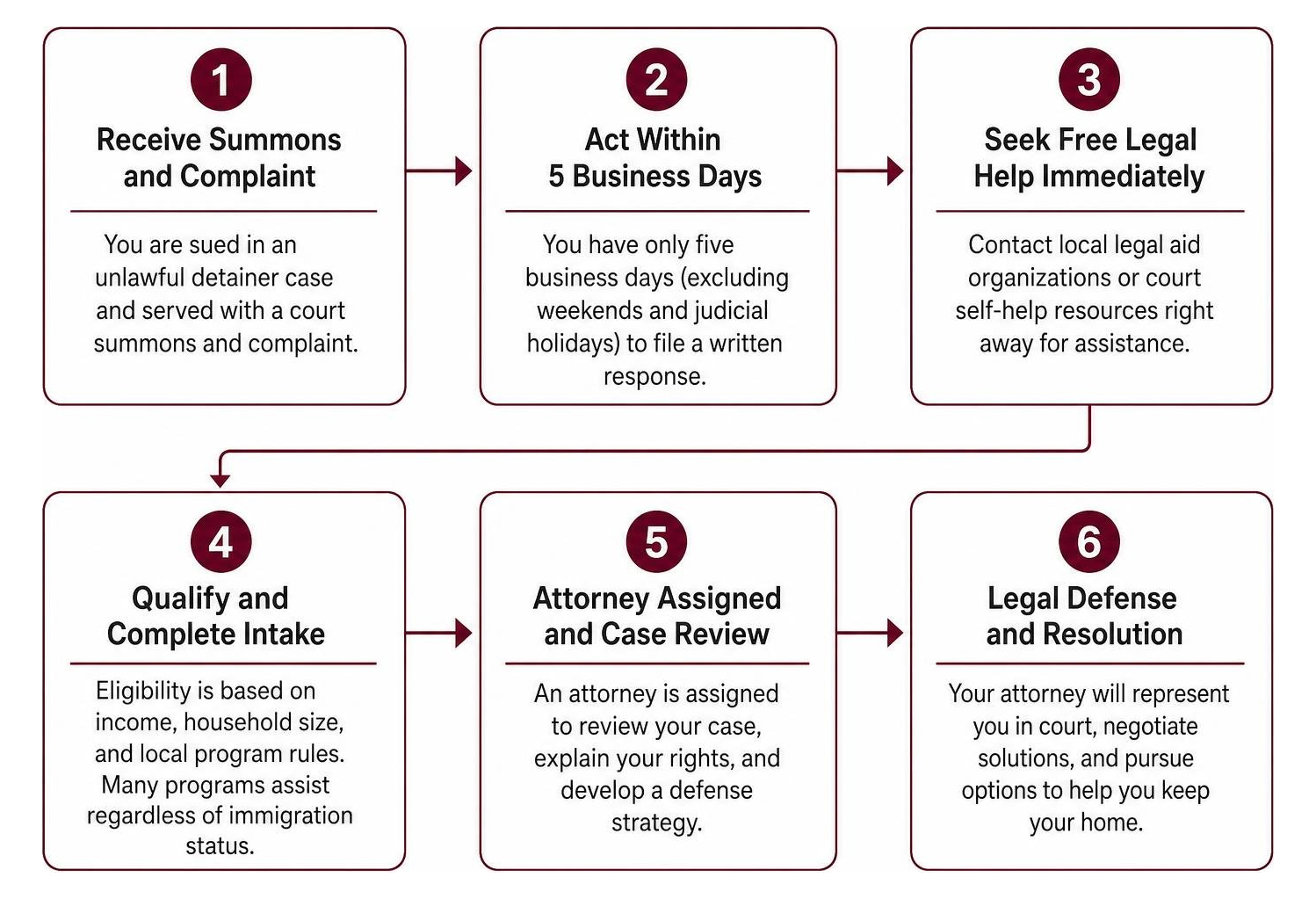
Tag Archive for: affordable housing

is emergency rental assistance legit

Emergency Rental Assistance Legit? Step-by-Step Guide to CalAIM Program

Is Emergency Rental Assistance Legit or a Scam?

When facing back rent or a sudden loss of income, it is natural to wonder: is emergency rental assistance legit? The answer is an absolute yes. Authorized federally under Section 501 of the Consolidated Appropriations Act, 2021 (ERA1) and Section 3201 of the American Rescue Plan Act of 2021 (ERA2), the federal Emergency Rental Assistance initiative delivered more than $46 billion nationwide to prevent evictions and stabilize vulnerable households.

Under federal guidelines provided in the U.S. Department of the Treasury Emergency Rental Assistance Frequently Asked Questions, these funds were disbursed directly to states, territories, and local governments with populations exceeding 200,000 residents. Rather than operating through a single national clearinghouse, legitimate relief is managed locally by county departments of social services, municipal housing authorities, and certified nonprofit service organizations.

Because official programs operate under strict statutory mandates, authentic relief efforts will never charge an application fee, screening charge, or administrative cost. For households navigating urgent financial barriers, our free rent assistance near me guide highlights trusted community entry points that connect families directly to legitimate resources without hidden costs.

How to Verify Is Emergency Rental Assistance Legit Across California

To determine if an emergency housing assistance opportunity is authentic in California, always check the source domain and municipal program backing. Legitimate initiatives are hosted on official .gov portals, established public housing authority platforms, or vetted community resource networks.

Across California communities—from Los Angeles and Irvine to San Diego, Riverside, and the greater Bay Area—local jurisdictions established dedicated rent relief pathways. Exploring rent relief near you unlocking city and county assistance ensures you are interfacing directly with approved administrative bodies rather than suspicious third parties.

Steps to verify rental assistance legitimacy

When reviewing local housing programs:

  • Verify Web Addresses: Look for secure .gov or recognized local government domains.
  • Use Trusted Community Directories: Connect with local 2-1-1 operators, who facilitate millions of connections to verified housing and emergency shelter programs annually.
  • Consult Approved Housing Navigators: Connect with certified housing organizations that guide families through verified paperwork without charging service fees.

Common Red Flags and Imposter Scams to Avoid

Fraudulent operators routinely target individuals in severe housing distress by mimicking official agency branding. Protecting your personal information starts with identifying clear red flags:

  • Demands for Upfront Fees: Scammers often promise to “expedite” or “guarantee” your relief funds if you pay an application fee via wire transfer, gift cards, cash apps, or cryptocurrency. Legitimate government programs are prohibited by law from charging fees.
  • Unsolicited Communications: Federal and state agencies do not send direct text messages, social media direct messages, or automated phone calls demanding sensitive banking credentials or Social Security numbers.
  • Spoofed Websites: Fraudulent websites often copy government logos but use suspicious non-governmental URLs. Always check for legitimate administrative contact points.

If you encounter a suspicious website or message, report it immediately to the Federal Trade Commission (FTC) and your local consumer protection office. Recognizing these warning signs is an essential step in staying put how community programs can prevent eviction safely.

Eligibility Requirements and Covered Housing Costs

To qualify for government-backed rental relief, applicants must satisfy clear statutory criteria established by the Treasury and local housing agencies. These guidelines prioritize households experiencing severe financial hardship and imminent displacement:

  1. Income Thresholds: Household gross income must be at or below 80% of the Area Median Income (AMI) for the local county, with statutory prioritization given to households earning at or below 50% AMI.
  2. Financial Hardship: A member of the household must have qualified for unemployment benefits or experienced significant financial hardship (such as substantial medical debt, reduction in work hours, or unexpected living expenses).
  3. Risk of Housing Instability: The applicant must demonstrate a clear risk of experiencing homelessness or housing instability, typically shown through a past-due rent notice, utility shutoff warning, or eviction notice.

Applicants can navigate these criteria through established financial hardship assistance programs designed to help households establish categorical eligibility.

Eligible Expenses: Rent, Utilities, and Arrears

Legitimate emergency assistance covers a wide range of housing-related debts to secure total housing stabilization.

Expense Category Covered by Emergency Relief Not Covered by Emergency Relief
Past-Due Rent (Arrears) Yes (accrued back rent) Rent debt accrued prior to March 13, 2020
Prospective Rent Yes (in forward increments) Mortgage payments on owned real estate
Home Utilities Yes (electric, gas, water, sewer, trash) Personal loans, credit cards, or car payments
Energy & Heating Debt Yes (fuel oil and home energy arrears) Discretionary entertainment subscriptions
Housing Stability Costs Yes (security deposits, screening fees) Unapproved personal property repairs

According to the Emergency Rental Assistance Frequently Asked Questions | Internal Revenue Service, assistance payments made to cover rent and home utilities are completely excluded from the tenant’s gross income and do not trigger tax liabilities for the renter.

Understanding Why Landlord Participation in Emergency Rental Assistance Is Legit

Property owners have clear statutory incentives to participate in emergency rental assistance programs. When a landlord participates:

  • Direct disbursements clear accumulated rental arrears from tenant ledgers.
  • Program conditions require landlords to waive late fees accrued during the covered assistance months.
  • Landlords agree to standard eviction protections, preventing no-fault lease terminations while assistance is active.

Even if a property owner initially hesitates to participate, Treasury regulations permit distributing agencies to disburse payments directly to qualified tenants after documented outreach attempts. Understanding these built-in protections is detailed in our eviction prevention programs complete guide.

Step-by-Step Application Process and Required Documentation

Diverse group of adults in a support circle discussing housing resources

Applying for legitimate rental relief requires organized documentation. Having your paperwork prepared in advance ensures your application moves smoothly through administrative verification pathways. Reviewing how emergency rental assistance works and how to get it can help streamline this preparation.

Essential Documents for Tenants and Housing Providers

Gather the following items before submitting your application:

  • Proof of Identity: Government-issued photo identification, driver’s license, or municipal ID.
  • Proof of Residence & Lease Agreement: A signed formal residential lease, or alternate verification such as recent utility bills, bank statements showing regular rent withdrawals, or a written property owner attestation.
  • Income Verification: Recent pay stubs, W-2 forms, 1099 tax statements, or unemployment benefit determination letters. If formal wage documentation is unavailable (such as for gig workers), written self-attestation pathways are permitted under federal and local guidelines.
  • Proof of Housing Instability: Past-due rent ledgers, formal 3-day or 30-day notices to pay rent or quit, utility disconnect notices, or documentation used when seeking rental assistance with eviction notice.
  • Housing Provider Details: Landlord contact information, completed IRS Form W-9, and direct deposit routing details for direct disbursement.

CalAIM Housing Support and Security Deposit Assistance

For California residents transitioning from housing insecurity or navigating major life transitions, the state’s CalAIM (California Advancing and Innovating Medi-Cal) program provides a powerful framework of Community Supports.

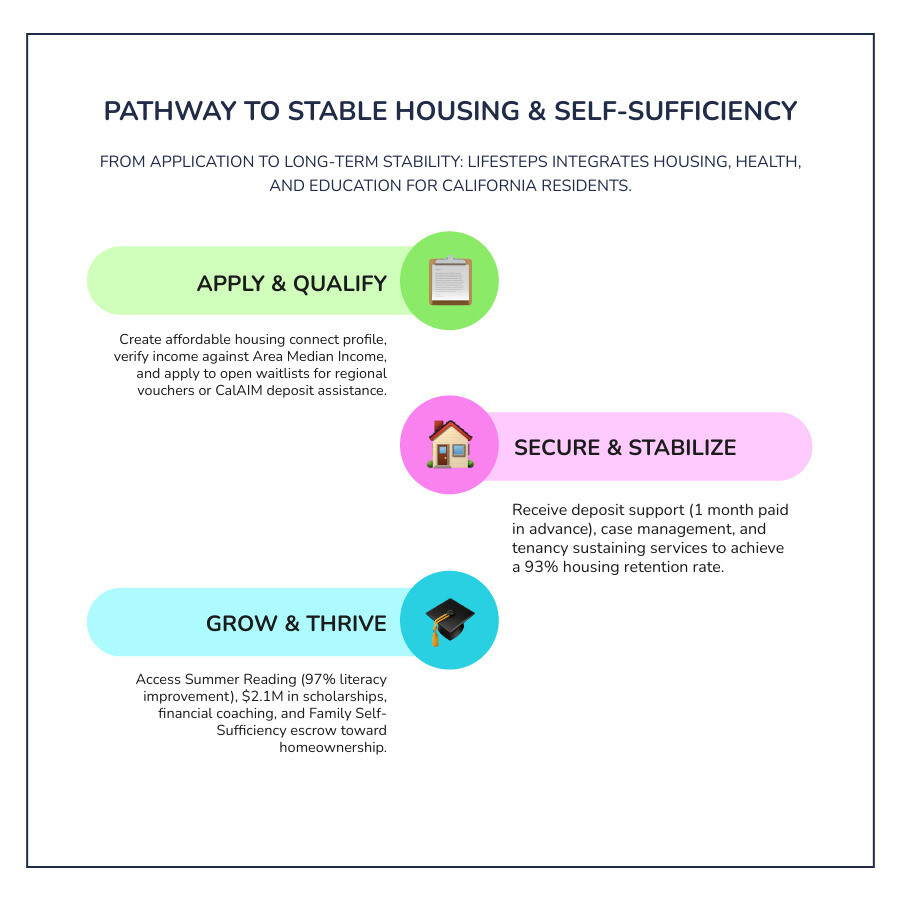
Through CalAIM, eligible participants can receive comprehensive housing transition navigation, tenancy sustaining services, and housing deposit assistance. For eligible households entering a new home, deposit assistance through CalAIM includes 1 month paid in advance for deposit assistance, helping eliminate the upfront financial barriers of relocation.

Discover more about leveraging these resources through your guide to rental aid securing help for deposits and initial rent payments.

For example, when a veteran client, Marcus (name changed to protect privacy), faced sudden displacement after unexpected medical costs, our team connected him with housing stability services. Through comprehensive case navigation and CalAIM deposit support, Marcus secured permanent housing and maintained his tenancy with ongoing wraparound support.

Long-Term Housing Stability and Educational Support

Resolving immediate rent arrears is the first step toward lifelong independence. Long-term housing security requires connecting immediate housing relief with multi-generational support systems, including educational enrichment and career advancement.

LifeSTEPS provides housing support across California that achieves an outstanding 93% housing retention rate, keeping families stably housed year after year. Beyond direct housing stability, empowering communities requires investing in the next generation. Our comprehensive educational programs deliver measurable outcomes, including a 97% literacy improvement for youth participating in Summer Reading programs and $2.1M in scholarships awarded to support residents pursuing higher education.

Building these foundational pillars ensures that families not only retain their front doors today, but also build self-sufficiency for tomorrow, as detailed in the ultimate guide to rental and deposit assistance.

Frequently Asked Questions About Emergency Rental Assistance

Is Emergency Rental Assistance Still Available in California?

While broad, pandemic-era federal programs (such as ERA1 and ERA2) completed their main disbursement cycles, emergency rental assistance remains available across California through localized municipal funds, county housing stability initiatives, and state healthcare integration programs like CalAIM. Renters can learn more about active regional relief channels in our emergency rental assistance california complete guide.

Are There Any Fees to Apply for Emergency Rent Relief?

No. There are never any fees to apply for or receive legitimate emergency rental assistance. Charging an application fee, screening fee, or fee to “speed up” approval is illegal under program guidelines and is an immediate sign of a scam. You can read more about consumer protections in dont pack your bags yet the ultimate guide to rental assistance programs.

Are Rental Assistance Payments Considered Taxable Income for Renters?

No. The Internal Revenue Service (IRS) has confirmed that emergency rental and utility assistance payments are excluded from gross income for eligible renter households. However, property owners and utility companies who receive payments on behalf of tenants must report those disbursements as taxable business revenue, as outlined in the complete guide to government rental subsidy and erap assistance.

Conclusion

Emergency rental assistance is a fully legitimate, government-authorized safety net designed to protect individuals and families from displacement during financial crises. By verifying programs through official channels, preparing your application documentation in advance, and watching out for imposter scams, you can safely secure the relief you need.

LifeSTEPS provides comprehensive housing navigation, afterschool programs, and higher education support to help California communities achieve permanent self-sufficiency. If you or a family member need guidance navigating housing stability pathways, explore our emergency rental assistance services to connect with trusted support.

For media inquiries, contact: bex@lifestepsusa.org

LifeSTEPS currently provides services in California only.

LifeSTEPS Participate in First Annual Supportive Housing Week

Ultimate Checklist for Below Market Rate Housing Eligibility & Apply

Below Market Rate Housing: A Practical Path to Affordable California Homes


Below market rate housing includes rent-restricted apartments and deed-restricted homes sold below local market prices. It is designed for income-qualified households, including many workers and veterans, who earn too much for deeply subsidized housing but cannot reasonably afford nearby market-rate housing.

Start with this quick checklist:

  1. Check your city or county’s income limits for your household size.
  2. Gather proof of income, assets, household members, and local residence or work if required.
  3. Apply through the property, city portal, lottery, or approved housing administrator named by the local program.
  4. If buying, prepare for homebuyer education, mortgage pre-approval, a down payment, and resale restrictions.

Eligibility, waitlists, and financial rules vary by community. Some programs give priority to people who live or work locally, while ownership programs may require first-time buyer status, fixed-rate financing, and limits on assets or future resale prices.

For Californians who need broader support, LifeSTEPS provides housing stability services that contribute to a 93% housing retention rate. Through the CalAIM program, deposit assistance may provide 1 month paid in advance. LifeSTEPS also connects housing stability with opportunity through afterschool programs that achieved 97% literacy improvement for Summer Reading and higher education support totaling $2.1M in scholarships.

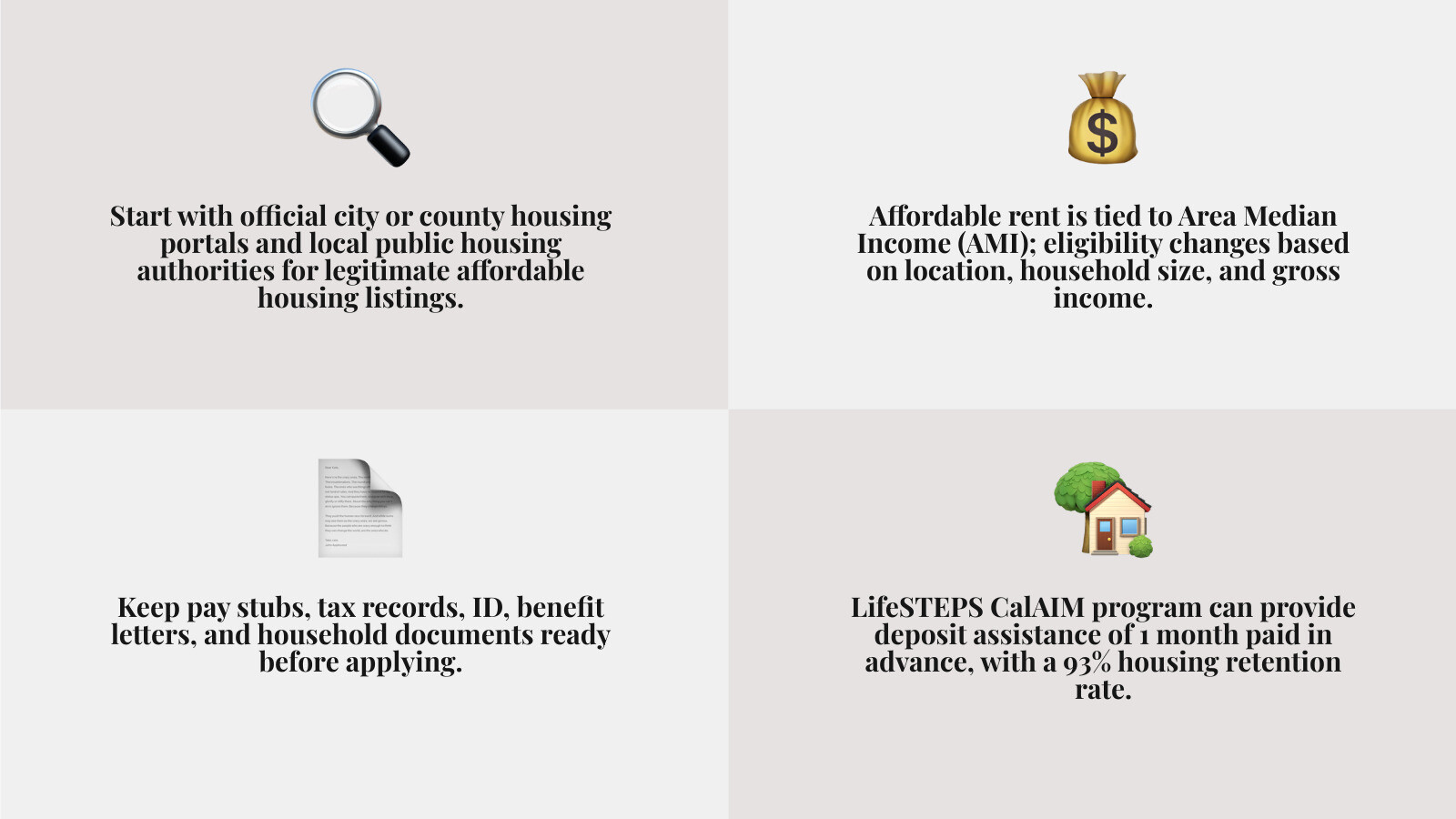
BMR housing eligibility and application steps infographic

Below market rate housing word guide:

Understanding Below Market Rate Housing: Rental vs. Ownership Programs

Below market rate (BMR) programs bridge the critical gap between market prices and subsidized social safety net housing. Created through local affordable housing initiatives and municipal inclusionary zoning, these homes enable middle- and lower-income workforces—teachers, healthcare workers, administrative staff, service professionals, and veterans—to reside in the communities where they work. Rather than relying on direct ongoing government rental vouchers, BMR units are integrated into private market developments with legally binding deed restrictions that preserve affordability over long horizons.

Across California communities such as Los Angeles, San Diego, Irvine, and Riverside, local agencies partner with developers to offer both rental and for-sale opportunities. Prospective applicants can review resources such as the Affordable Rental Housing – LAHD – City of Los Angeles platform to explore municipal housing options.

Program Feature BMR Rental Programs BMR Homeownership Programs
Target Income Group Very Low to Low Income (typically 50% to 80% AMI) Low to Moderate Income (typically 80% to 120% AMI)
Pricing Basis Fixed rent caps indexed to Area Median Income Subsidized sales prices calculated by affordable cost formulas
Occupancy & Resale Standard lease terms with annual income recertification Long-term deed restrictions; restricted equity growth upon resale
Financing Needed Security deposit (e.g., 1 month paid in advance) and credit check Mortgage pre-approval, down payment (1% to 5%+), cash reserves
Program Purpose Immediate rent stabilization and community retention Long-term asset building and permanent homeownership

Key Differences Between BMR Rental and For-Sale Properties

For tenants seeking income-restricted rentals, BMR rents are calculated based on published Area Median Income (AMI) levels rather than individual tenant income percentages. These rents include adjustments for utility allowances and often include proportional parking spaces. While landlords can adjust rents annually as regional median income schedules change, rates cannot exceed established program caps (often capped at 75% to 80% of market comparables).

In contrast, BMR homeownership focuses on deed-restricted purchases. Buyers purchase properties at deeply discounted prices but agree to equity-sharing covenants or restrictive resale price formulas. These covenants ensure that when the home is resold, it is offered to another income-qualified buyer at an affordable rate, preserving community affordability across successive generations.

Municipal Inclusionary Zoning and Developer Requirements

Municipalities implement inclusionary zoning ordinances that require private developers to dedicate a specific portion of new residential construction to affordable housing. For example, local ordinances outlined in Chapter 16.96: BELOW MARKET RATE HOUSING PROGRAM – City of Menlo Park, CA mandate that developments of 5 to 19 units provide at least 10% BMR units, while projects with 20 or more units provide at least 15%.

To ensure equitable living conditions, municipal codes demand architectural parity and unit dispersal. Affordable homes must mirror the exterior design, square footage proportionality, and interior finish standards of adjacent market-rate units, distributed evenly across all floors rather than clustered together. Commercial developers also contribute via commercial linkage impact fees assessed per square foot, funding local housing trust accounts.

Inclusionary zoning and developer BMR allocation process

Income Limits, Household Composition, and Asset Verification

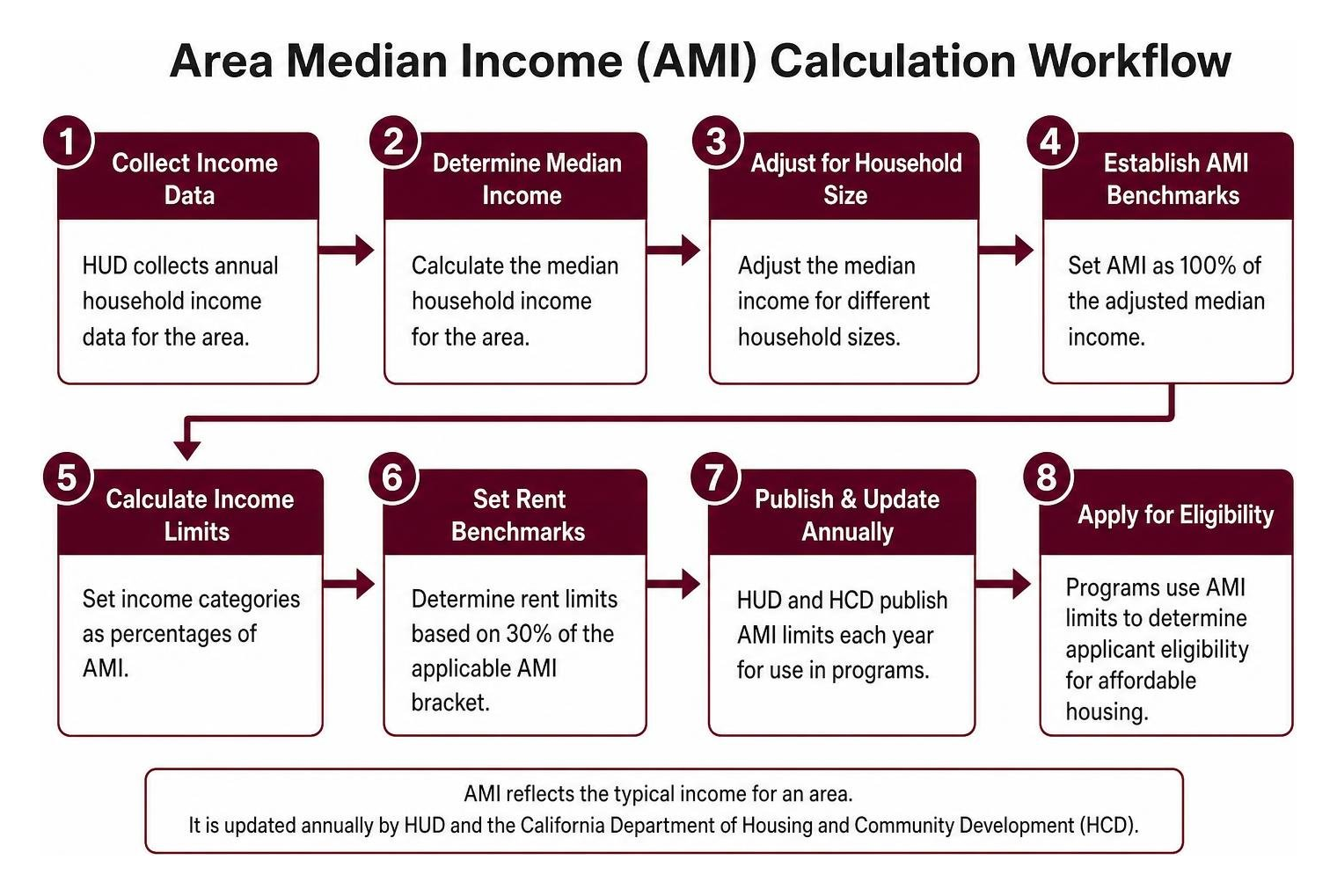
Eligibility for BMR units relies on the Area Median Income (AMI) figures published annually by the California Department of Housing and Community Development (HCD). Household limits adjust according to family size, using statutory formulas defined under the California Health and Safety Code.

For instance, in Santa Monica, the maximum income for a 1-person household to qualify for the Below Market Housing waitlist is $139,900 (effective May 4, 2026), scaling up to $215,900 for a 5-person household. In Santa Clara County, the 2024 annual income limit for a 1-person household at 80% AMI is $102,000, and $146,100 for a 4-person household.

Eligibility Criteria for Below Market Rate Housing

Finding affordable housing for low-income families and how to get it requires navigating specific occupancy and priority standards. To prevent overcrowding or underutilization, BMR programs enforce minimum occupancy rules:

  • Bedroom Occupancy Standards: Most jurisdictions require at least one person per bedroom (a single individual cannot qualify for a two-bedroom unit).
  • Local Live/Work Priorities: Programs in cities like Mountain View and Santa Monica grant higher lottery ranking to applicants who live or work locally (often requiring 25+ hours per week of local employment).
  • Displaced Household Protections: Highest priority tiers are frequently reserved for households displaced by natural disasters, government action, or Ellis Act evictions.
  • Veteran Families: Specific developments allocate specialized units to veteran households with acceptable military service documentation (e.g., DD-214 or VA identification).

Asset Tests, Income Calculations, and Student Restrictions

Calculating BMR income involves more than looking at W-2 wages. Program administrators apply comprehensive asset tests to ensure subsidies benefit households with genuine financial need. As detailed in the City of Alameda Inclusionary Housing Homeownership Guidelines, accessible liquid assets exceeding specific thresholds (such as $5,000) trigger an imputed asset calculation, where 10% of the excess or actual asset earnings is added to gross annual income.

Key asset and income rules include:

  • Retirement Account Exclusions: Federally recognized retirement savings (401k, 403b, IRAs) are generally excluded from liquid asset caps.
  • Gift Fund Limitations: While gift funds can assist with down payments and closing costs, jurisdictions often cap gifts (e.g., up to 17% in Alameda) and require buyers to contribute a minimum percentage from personal savings.
  • Student Restrictions: Households consisting entirely of full-time college students are ineligible unless they qualify under specific exemptions (e.g., single parents, military veterans, former foster youth under 25, or recipients of public assistance).

Step-by-Step Checklist for BMR Buyers and Renters

Preparing your financial profile ahead of open application windows ensures you can move quickly when opportunity drawings open.

Document checklist and financial preparation for BMR housing

To position your household for success, consult the ultimate guide to affordable homeownership programs and grants alongside this preparation checklist:

  1. Verify Income & Household Size: Compare your household’s total gross income against your target county’s current AMI schedule.
  2. Collect Financial Records: Gather 3 years of filed federal tax returns, W-2s, 3 to 6 months of consecutive bank statements, and recent paystubs for all adult members aged 18 and older.
  3. Complete Homebuyer Education: Complete an 8-hour HUD-approved first-time homebuyer education course to receive your official certification.
  4. Obtain Lender Pre-Approval: Secure a pre-approval letter for a 30-year fixed fully amortizing loan from an approved program lender.
  5. Monitor City Portals: Register with local third-party administrators and city housing portals to enter lotteries and opportunity drawings.

Application workflows vary by municipality. In San Diego, buyers can review deed-restricted for-sale homes across developments restricted between 60% and 120% AMI directly through the Affordable For-Sale Housing – San Diego Housing Commission directory and apply through licensed listing agents.

In other jurisdictions, cities use centralized lotteries or contracted third-party administrators. Applicants enter opportunity drawings, where priority ranking points dictate the processing order. Maintaining standing requires active compliance; for example, Santa Monica enforces a strike policy where failing to respond to verification notices or declining multiple offered units results in removal from the waitlist.

BMR application and verification workflow

Financial Requirements for BMR Homebuyers

Purchasing a BMR home through low-income homeownership programs requires compliance with strict lending and underwriting rules:

  • Down Payment Minimums: In Alameda, buyers must contribute a minimum of 3% of the purchase price from personal funds. In Mountain View, down payments range between 5% and 30%, with at least half coming from personal savings.
  • Housing Debt Ratios: Front-end debt-to-income ratios (mortgage principal, interest, taxes, HOA dues, and insurance) are capped—typically between 28% and 35% for low-income tiers, and up to 40% for moderate-income buyers.
  • Post-Purchase Liquid Reserves: Buyers must demonstrate post-closing liquid reserves, typically 2 to 3 months of full PITI housing payments held in savings for at least 60 days.
  • Prohibited Loan Structures: Stated-income, adjustable-rate mortgages (ARMs), interest-only loans, balloon payments, and all-cash purchases are strictly prohibited.
  • County Gap Financing: In regions like Santa Clara County, buyers can pair local inclusionary purchases with county-sponsored 0% interest, deferred junior loans due in 30 years or upon resale.

Supportive Housing Pathways and Long-Term Stability

Achieving housing stability involves pairing affordable rent or homeownership with resident-centered supportive services. At LifeSTEPS, our housing stability services empower California residents through individualized case management, skill-building, and education, contributing to an overall 93% housing retention rate.

Through partnerships with the CalAIM program, qualifying participants can access essential move-in support, including deposit assistance providing 1 month paid in advance to reduce initial leasing barriers. Our educational initiatives also foster generational stability, including afterschool programs that achieved a 97% literacy improvement for Summer Reading and higher education resources that have awarded $2.1M in scholarships to date.

For example, Marcus (name changed for privacy), a veteran living in Southern California, worked with our supportive services team to establish a dedicated savings plan, complete financial literacy workshops, and transition into permanent stable housing.

Frequently Asked Questions About Below Market Rate Housing

How does living or working in a city improve selection chances for BMR housing?

Most California municipal BMR programs utilize a tiered preference system that awards higher priority to applicants who currently reside or work within city boundaries. Live/work preferences require documented proof, such as residential utility bills, commercial leases, or employer paystubs showing a minimum number of weekly working hours (typically 25 hours per week).

What happens if household income increases after moving into a BMR property?

For BMR rental properties, tenants complete an annual recertification process. In many programs, if your income rises moderately, your lease remains valid; however, exceeding program caps (such as 140% of the AMI limit) may require transitioning to standard market rent or relocating. For BMR homeowners, post-purchase income increases do not impact ownership, as eligibility is verified solely at the time of purchase.

Can Section 8 vouchers be used in below market rate rental units?

Yes. Housing Choice Voucher (Section 8) holders are eligible to apply for BMR rental units. In these cases, the tenant pays their standard portion (typically 30% of adjusted household income), and the local public housing authority pays the remaining balance directly to the property landlord up to the approved BMR rent limit.

Conclusion

Adults sitting in a circle of chairs chatting supportively in a community room

Below market rate housing provides an essential pathway to stable, affordable living for thousands of California households. By understanding local AMI income thresholds, maintaining organized financial records, and learning program rules, applicants can navigate both rental and homeownership lotteries with confidence.

Coupled with community-based support and collaboration with self-sufficiency initiatives, residents can build lasting economic stability. Explore how our team supports individuals and families across California by reviewing LifeSTEPS supportive programs and services.

For media inquiries, contact: bex@lifestepsusa.org

LifeSTEPS currently provides services in California only.
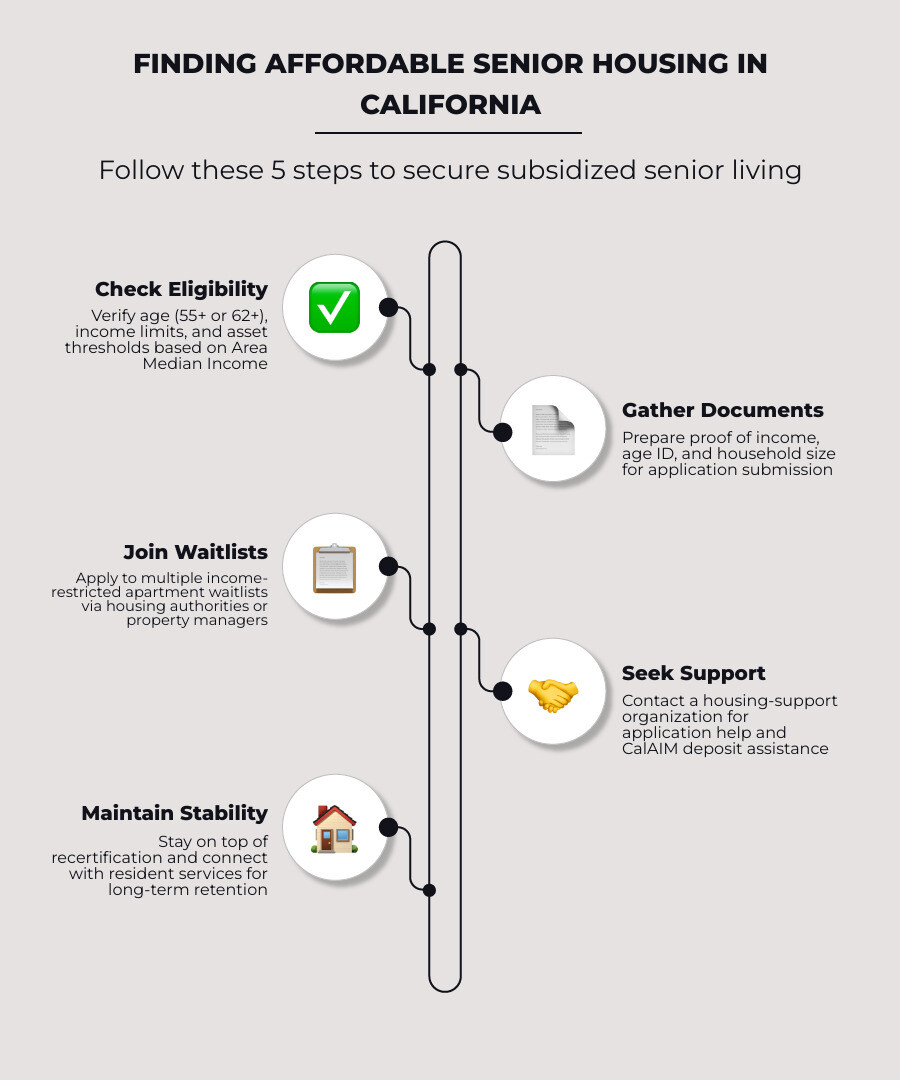
affordable apartments Riverside

The Best Affordable Apartments Riverside on a Budget

Find Affordable Apartments in Riverside With the Right Support


To find affordable apartments Riverside residents can realistically apply for, start with income-restricted communities, Housing Choice Voucher waiting lists, and city- or county-assisted rentals. Check eligibility before applying, prepare income and household documents early, and contact property managers directly to ask about vacancies and waitlists. For eligible California residents, the CalAIM program may also provide 1 month paid in advance for deposit assistance.

Riverside’s average monthly rent is about $1,849, while some apartments may be listed from roughly $1,483. That gap makes affordable housing programs and well-timed applications important, especially for veterans building a stable civilian life.

LifeSTEPS provides housing-focused resident services in California that help people strengthen stability and stay connected to practical support. Its community-centered approach is reflected in a 93% housing retention rate. LifeSTEPS also supports long-term opportunity through afterschool programs, including a 97% literacy improvement for Summer Reading, and $2.1M in scholarships for higher education.

Infographic showing Riverside affordable rental paths: income restricted units, vouchers, waitlists, deposit help infographic

Affordable apartments riverside further reading:

Understanding the Market for Affordable Apartments Riverside

Securing budget-friendly rentals across the Inland Empire requires understanding baseline costs, regional growth patterns, and local inventory trends. In Riverside, the overall average monthly rent sits near $1,849, though lower-cost units exist across multiple zip codes for proactive applicants who know where and when to look.

Standalone studio apartments across the city average roughly $1,483 per month, representing an entry point for single working adults. Standard one-bedroom floor plans typically average $1,848 monthly, while two-bedroom apartments hover around $2,258. Larger family units featuring three bedrooms frequently command upwards of $2,650 on the open private market. For households operating on fixed earnings or entry-level wages, these numbers highlight why knowing how to navigate the riverside low-income housing market is essential.

A realistic search plan should compare market-rate listings with income-restricted openings, then prioritize applications where the rent standard, household size, and documentation requirements align. Renters can also improve their chances by setting weekly check-in reminders, saving copies of submitted applications, and responding quickly when a property manager requests updated paperwork. This level of organization is especially useful when multiple waiting lists open and close at different times.

Adults sitting in a circle of chairs chatting in a community center

Average Rent Costs and Budget Neighborhoods

Rental rates fluctuate substantially depending on the specific neighborhood, transit proximity, and property age. Exploring options outside the historic downtown core often yields lower baseline rents and more flexible lease terms for prospective tenants.

Unit Type Average Monthly Rent Entry-Level Budget Range Prominent Neighborhood Pockets
Studio $1,483 $1,200  $1,350 Eastside, Magnolia Center
1-Bedroom $1,848 $1,375  $1,550 Arlington, University District
2-Bedroom $2,258 $1,750  $1,950 Tyler / La Sierra, Banbury Area
3-Bedroom $2,650 $2,100  $2,350 Arlington, Eastside

Conducting your search during the winter off-season (December through February) can provide better leverage. During these months, rental turnover slows and property owners may offer move-in concessions, reduced holding deposits, or waived administrative fees to fill vacancies quickly. Comparing listings across adjacent submarkets like Arlington and Magnolia Center also reveals pockets of rent-stabilized multi-family housing.

Key Subsidies and Programs for Affordable Apartments Riverside

Affordable housing developments in the region rely on various funding mechanisms to keep rents manageable for lower-income households. Understanding riverside county housing assistance and self-sufficiency programs explained helps renters identify which programs match their circumstances and financial goals:

  • Housing Choice Vouchers (Section 8): Funded through the U.S. Department of Housing and Urban Development and administered locally to bridge the gap between household income (typically 30% of adjusted earnings) and reasonable market rents.
  • Low-Income Housing Tax Credit (LIHTC): Subsidizes private developers to construct or renovate properties with restricted rent caps tied to Area Median Income (AMI).
  • Deposit Assistance Through CalAIM: Helps eligible individuals secure housing by covering upfront move-in costs, including 1 month paid in advance for deposit assistance to ensure smooth transitions into permanent living environments.

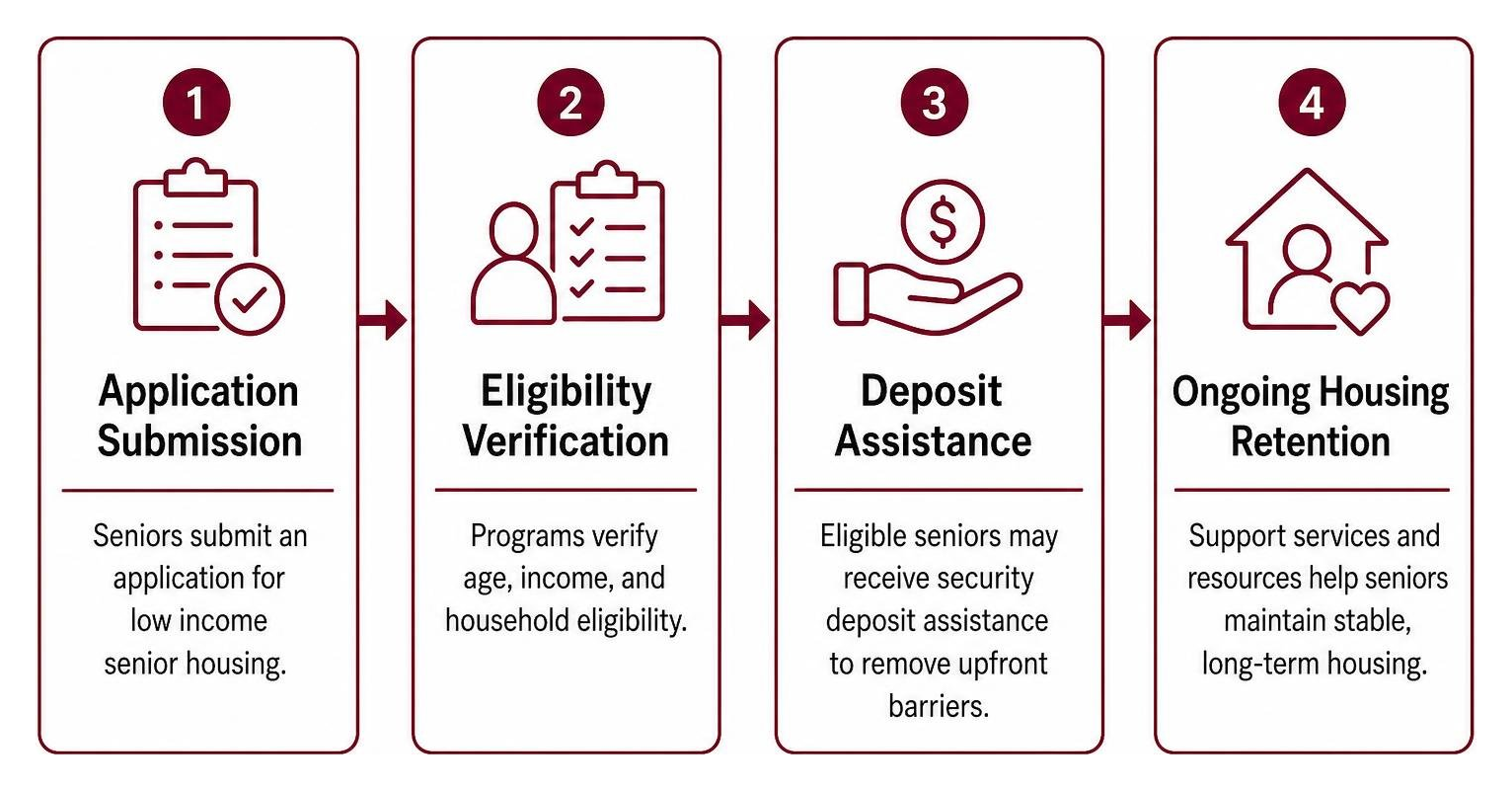
Pathway flow of affordable rental assistance and voucher programs

Top Types of Affordable Housing Communities in Riverside

Riverside features a diverse range of specialized affordable housing communities designed to serve working families, older adults, and students pursuing educational goals. These properties differ from conventional market-rate complexes because their rental limits and tenant eligibility criteria are governed by state and federal affordability agreements.

Diverse group of people working together in a community garden

Multi-Family and Senior Affordable Apartments Riverside

Income-restricted multi-family developments provide stable housing tailored for households of various sizes. These properties often feature on-site amenities such as playgrounds, computer labs, laundry facilities, and educational support programs. Families seeking stable environments can explore options for affordable housing for low-income families and how to get it to locate communities with dedicated service coordination and enriching afterschool resources.

For older residents, age-restricted communities (categorized as 55+ or 62+) provide accessible, quiet, and affordable living environments. Senior properties in Riverside frequently feature single-story floor plans, elevator access, grab bars, and active social activity centers. Income-restricted senior rents generally range between $883 and $1,605 per month, allowing older adults on fixed incomes to retain independence without experiencing severe rent burden.

Budget Student Housing Options Near Campus

Students attending local higher education institutions often face unique housing constraints due to rising tuition and living expenses. In university-dense neighborhoods, budget-conscious renters frequently utilize per-bed leasing, cooperative living arrangements, or shared-room arrangements starting around $465 to $700 per month. Pairing affordable living arrangements with supportive higher education scholarships and financial literacy coaching helps students complete their degrees and step confidently into future career opportunities.

How to Qualify and Apply for Low-Cost Housing

Applying for affordable housing requires careful preparation, thorough organization, and a clear understanding of Area Median Income (AMI) categories. Because demand for affordable units in Riverside remains high, prospective tenants must stay organized and proactive throughout each phase of the application pipeline.

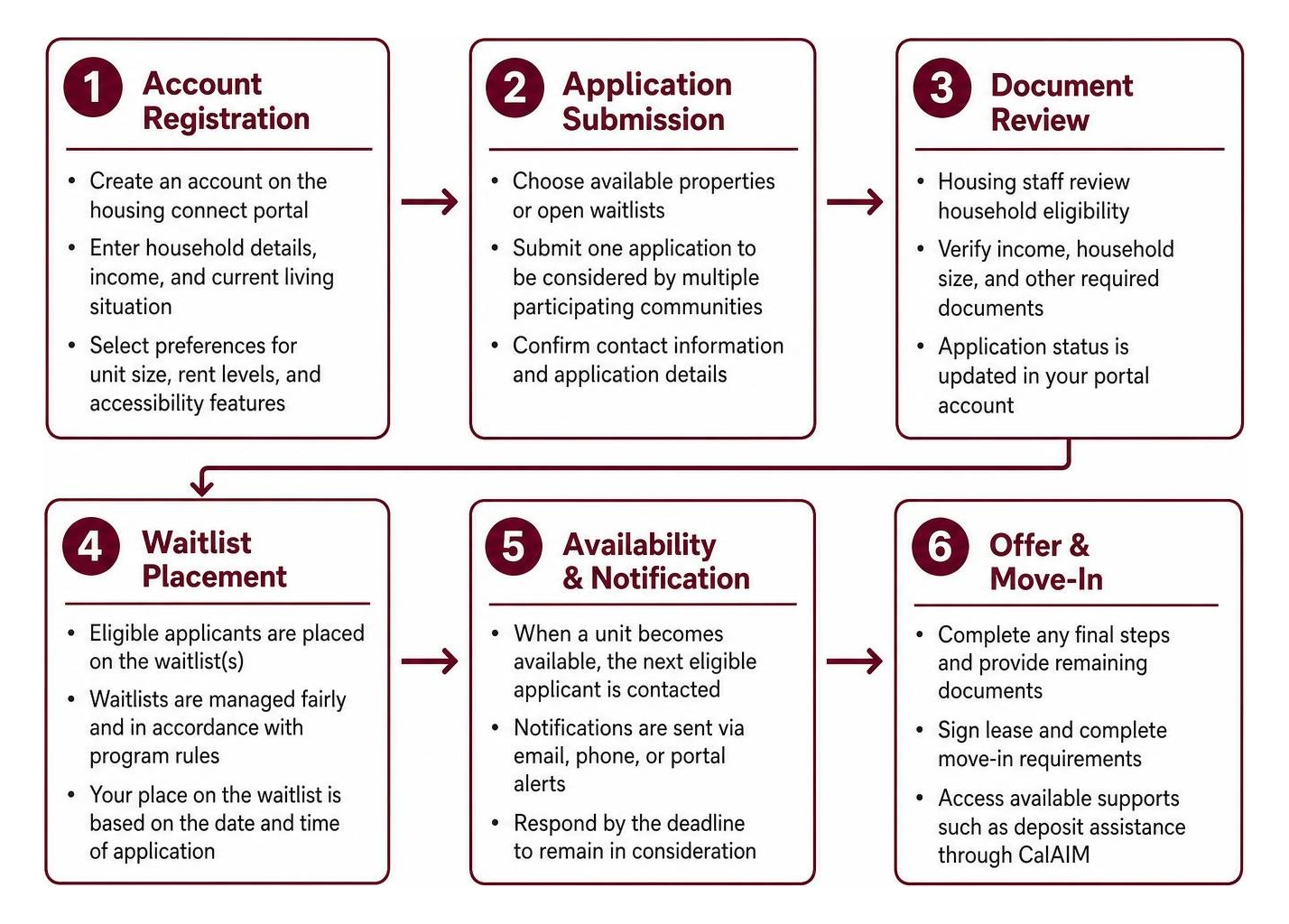
Diagram of the step by step application process for affordable housing

Income Limits and Voucher Application Steps

Eligibility for income-restricted properties is calculated based on total household size and local AMI thresholds published each year. Following a structured roadmap streamlines the process:

  1. Identify Income Tier: Most income-restricted units target households earning between 30% and 60% of the regional median income. Check local thresholds before beginning your search to determine your target bracket.
  2. Organize Documentation: Gather recent pay stubs, consecutive bank statements, prior-year tax returns, government benefit verification letters, and valid photo identification for all adult household members.
  3. Register on Housing Portals: Monitor open municipal and county waiting lists, maintain up-to-date contact information, and submit applications as soon as registration windows open.
  4. Engage Property Management Directly: Contact individual tax-credit apartment communities to join property-specific waiting lists, as many properties maintain independent tenant rosters.

For individuals starting their housing search, reviewing the best income-based apartments for beginners provides clear guidance on navigating initial paperwork, eligibility calculations, and ongoing compliance requirements.

Rental Housing Safety and Lease Guidelines

Affordable communities maintain clear lease agreements, code compliance standards, and tenant safety protocols to protect residents. Property management teams conduct standard background checks, income verifications, and safety reviews to maintain positive community environments. Adhering to lease terms, respecting communal facilities, and participating in resident advisory meetings helps households build long-term tenancy stability and peace of mind.

Frequently Asked Questions About Riverside Rentals

What is the average rent for a cheap apartment in Riverside?

Studio apartments in Riverside average around $1,483 per month, while budget-tier one-bedroom apartments generally start between $1,375 and $1,550 monthly depending on location and amenities.

What is the difference between project-based and tenant-based vouchers?

Tenant-based vouchers remain with the individual or family, allowing them to move between approved rental units. Project-based vouchers are tied directly to specific apartment units, meaning the subsidy stays with the property if the tenant relocates.

How do rental property safety standards affect tenants in Riverside?

Rental safety initiatives encourage active collaboration between property managers and residents to maintain secure, drug-free communities through consistent lease compliance and routine property upkeep.

Conclusion

Finding stable, affordable housing in Riverside creates a strong foundation for personal and family growth. LifeSTEPS provides supportive housing services across California that empower residents to maintain their homes and work toward long-term goals. Through collaborative case management and community initiatives, our programs achieve a 93% housing retention rate, helping families stay securely housed.

Beyond housing support, investing in the next generation remains a central focus. LifeSTEPS afterschool programs have achieved a 97% literacy improvement for Summer Reading, while our higher education initiatives have awarded $2.1M in scholarships to students reaching for academic success. Discover how our programs and services create lasting community impact across California.

For media inquiries, contact: bex@lifestepsusa.org

LifeSTEPS currently provides services in California only.