Tag Archive for: affordable housing

Independent Living Facilities in California: A Practical Cost and Feature Breakdown

Finding Independent Living Facilities in California That Fit Your Next Chapter

Independent living facilities in California offer older adults a private home with less daily upkeep and more chances to connect. The best fit depends on your budget, preferred location, and whether you want only housing and amenities or a community with future care options.

Start by comparing communities in areas such as Los Angeles, San Diego, Riverside, and the Bay Area. Ask what the monthly fee includes, whether pets are welcome, how meals work, and if assisted living or memory care is available later. Most independent living communities are designed for people who can manage daily activities on their own but want help with tasks like maintenance, housekeeping, transportation, or cooking.

Unlike assisted living, independent living does not usually include regular help with bathing, dressing, or medication. It also differs from a 55+ community because services, dining, and social programming may be built into the monthly fee. Some Life Plan Communities also offer higher levels of care on the same campus if health needs change.

For households facing a move-related financial barrier, CalAIM deposit assistance may help with 1 month paid in advance. LifeSTEPS supports housing stability with a 93% housing retention rate, connecting Californians with practical resources for affordable housing for seniors, comprehensive housing programs for elderly residents, and sustainable senior housing low income opportunities.
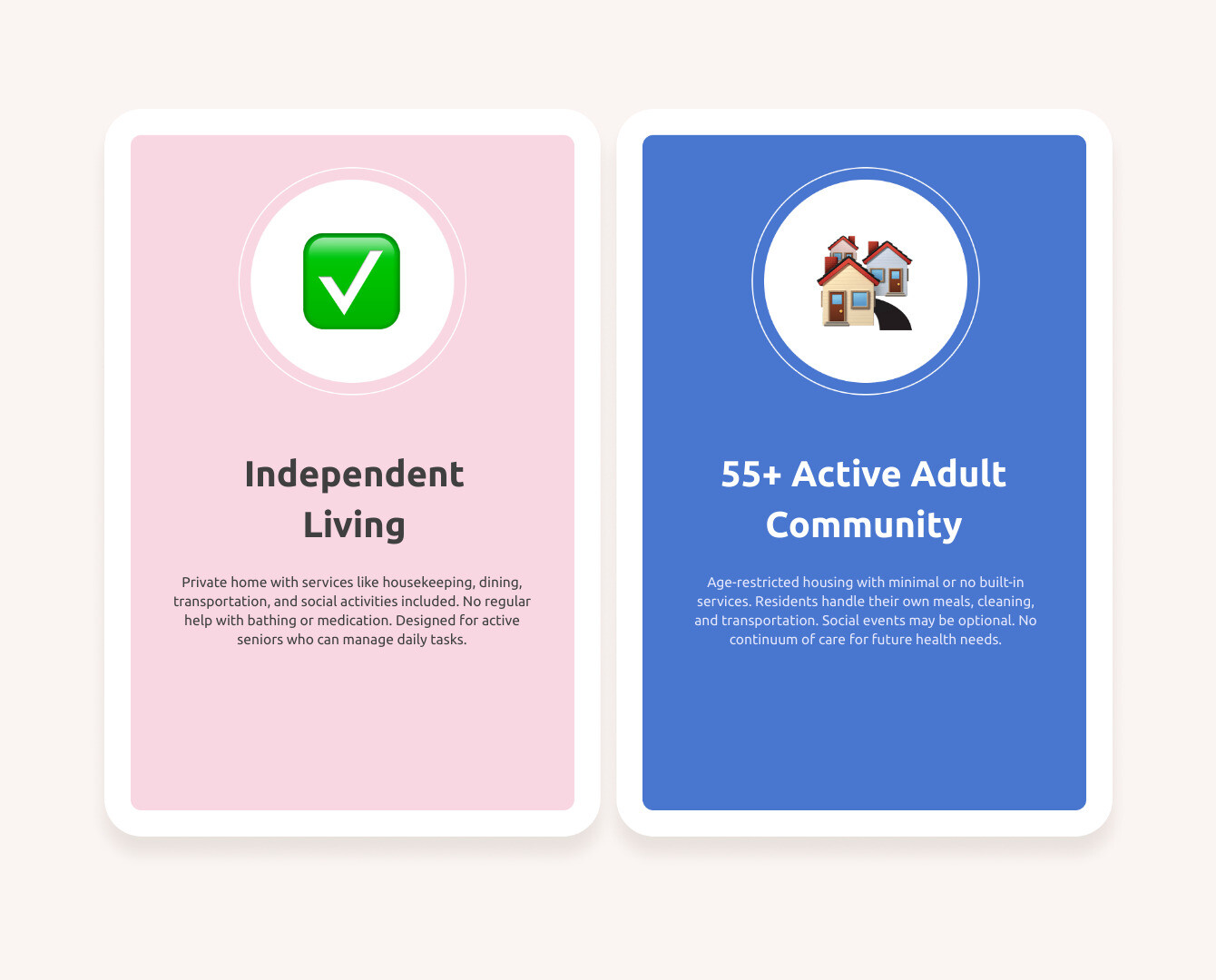
California independent living options and care continuum infographic

Understanding Independent Living Facilities California: Key Definitions and Differences

Navigating the senior living landscape in California can feel overwhelming given the variety of housing types available. Independent living is designed specifically for older adults who maintain self-sufficiency with their activities of daily living (ADLs)—such as dressing, bathing, and personal care—but wish to trade home maintenance, yard work, and daily meal preparation for a vibrant, socially engaging community.

To make an informed decision, it is helpful to understand how independent living compares to age-restricted 55+ neighborhoods and licensed assisted living facilities. While a 55+ active adult community generally offers age-restricted rental or ownership housing with shared neighborhood amenities (like a pool or clubhouse), it rarely includes daily hospitality services such as chef-prepared meals, scheduled group transit, or routine housekeeping.

Conversely, assisted living communities provide hands-on personal care, wellness supervision, and medication administration alongside housing. Independent living bridges this gap by delivering a hospitality-rich residential setting without paying for medical or caregiving services you do not currently need. For individuals evaluating options across various price points, exploring senior living affordable housing options can help establish realistic baseline expectations for community amenities.

Feature / Model 55+ Active Adult Communities Independent Living Communities Assisted Living Residences Life Plan / CCRC Campuses
Target Audience Self-sufficient adults seeking age-restricted neighborhoods Active seniors desiring a maintenance-free lifestyle Seniors requiring daily ADL or medication assistance Adults planning ahead for multi-stage aging in place
Primary Focus Autonomous housing & lifestyle amenities Hospitality, social programming & daily convenience Hands-on personal care & wellness monitoring Integrated multi-level care on a single campus
Meal Plans Rarely included Typically 1 to 3 chef-prepared meals daily All daily meals & snacks included Full dining plans with flexible monthly credits
Housekeeping & Linen Handled by resident Weekly or bi-weekly service included Full daily/weekly service included Included across all campus care tiers
Medical / ADL Support Not provided on-site Third-party private hire only Staff-provided personal care assistance Transition pathways to assisted living & nursing

Comparison framework of senior living care levels

Continuing Care Retirement Communities (CCRCs), also referred to as Life Plan Communities, combine these various models onto a unified campus. In a CCRC, a resident can enter into an independent living cottage or apartment and maintain priority access to on-campus assisted living, memory support, or skilled nursing if their physical health needs evolve over time.

Average Costs and Fee Structures for Independent Living Across California

Pricing for independent living throughout California reflects the state’s diverse geographic and real estate markets. Private-market independent living monthly fees generally range from $3,000 to over $7,500 per month, depending on location, unit square footage, dining packages, and campus amenities.

Understanding what these fees cover is vital for financial planning. In most communities, the monthly base fee functions as an all-inclusive bundle covering property taxes, structural maintenance, landscaping, basic utilities (water, trash, sewer, and electric), scheduled local transportation, weekly housekeeping, and daily dining allowances. When evaluating your budget, applying structured rent budgeting strategies helps compare your current homeownership expenses—such as roof repairs, yard care, food costs, and utility bills—against a consolidated senior living invoice.

For seniors with limited incomes or transitioning from unstable housing, navigating these costs requires specialized support. Programs like CalAIM deposit assistance can cover 1 month paid in advance to help qualifying residents secure housing. When paired with supportive services, LifeSTEPS achieves a 93% housing retention rate, ensuring residents remain safely and permanently housed. To explore subsidized and income-restricted options, review resources on affordable senior housing California.

Pricing Differences in Independent Living Facilities California by Region

California’s regional markets feature notable cost variations:

  • Los Angeles & Orange County (including Irvine): Monthly independent living rents in these metropolitan areas often start around $4,000 to $6,500 per month for standard one-bedroom apartments, with luxury coastal residences reaching significantly higher rates.
  • San Diego County: Rents generally range from $3,800 to $6,000 per month, offering a wide selection of active adult communities near coastal and inland hubs.
  • Riverside & Inland Empire: Communities in Riverside provide more accessible market-rate options, typically starting between $2,800 and $4,500 per month.
  • Bay Area: Communities across Contra Costa and surrounding counties frequently range from $4,500 to $7,500 per month, reflecting regional living costs.

Exploring regional options, such as retirement communities in Thousand Oaks, CA, provides insight into how local geography impacts monthly pricing.

Entrance Fees vs. Rental Models in California Communities

When researching communities, you will encounter two primary financial models:

  1. Month-to-Month Rental Communities: These communities operate on a traditional lease model, requiring a security deposit, community move-in fee, and ongoing monthly rent. This structure offers flexibility without long-term capital commitments.
  2. Entrance Fee (Buy-In) Communities: Often utilized by Life Plan Communities, this model requires an upfront entrance fee alongside monthly service fees. Entrance fees can range from $100,000 to over $800,000 depending on home size and contract type.

Entrance fee contracts typically fall into two categories: rebatable (refundable) contracts, which return a percentage (e.g., 50% to 90%) of the initial entrance fee to the resident or their estate upon departure, and non-rebatable contracts, which amortize over time in exchange for lower upfront costs. For older adults seeking alternatives to large entry fees, exploring cost-effective alternatives to senior living can help clarify which financial path matches your retirement goals.

Essential Amenities, Services, and Continuum of Care

Modern independent living communities in California emphasize wellness, active lifestyles, and hassle-free living. Rather than simply providing shelter, these campuses operate like residential clubs tailored to older adults.

Standard amenities and services bundled into base fees generally include:

  • Nutritional Dining Programs: Flexible dining credits redeemable across formal dining rooms, casual bistros, and cafés, featuring chef-prepared meals accommodating specialized dietary needs.
  • Housekeeping & Linen Care: Weekly or bi-weekly deep cleaning, vacuuming, dusting, and fresh linen service.
  • Health & Wellness Facilities: Heated pools, yoga and fitness studios, walking trails, and pickleball or bocce courts.
  • Scheduled Local Transit: Group shuttles for grocery shopping, cultural outings, medical appointments, and retail centers.
  • Pet-Friendly Accommodations: Dedicated dog runs, pet-washing stations, and scenic paths for companion animals.

Understanding these offerings helps families locate community-specific resources for independent living that encourage daily fulfillment and active aging.

While independent living caters to autonomous adults, health needs can shift. A major advantage of multi-level campuses or rental communities with integrated home health access is the ability to age in place without disruptive relocations.
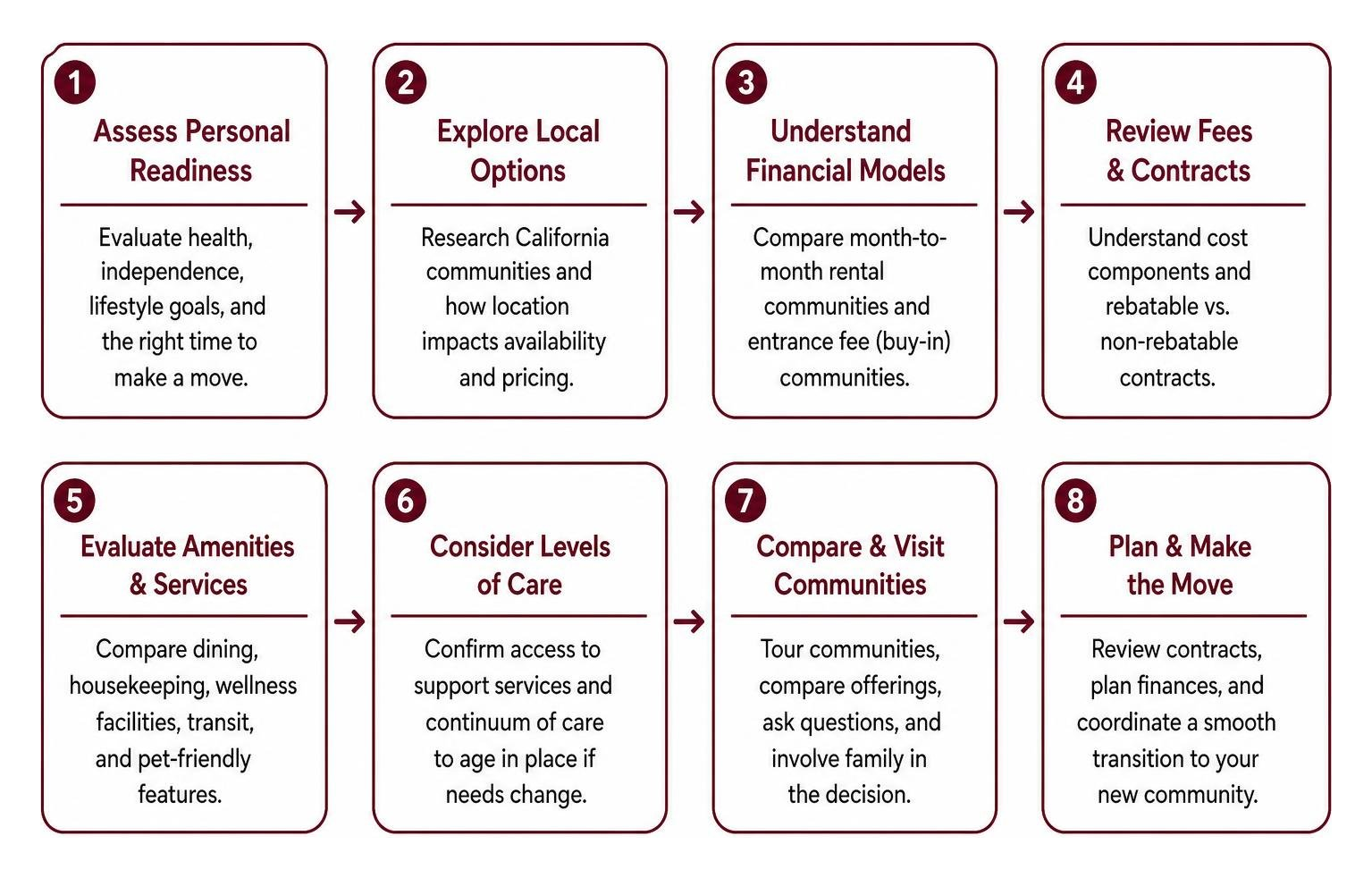
Step-by-step pathway for evaluating senior living care options

In rental independent living, residents experiencing minor mobility changes can arrange private, third-party caregiver visits for medication reminders or bathing assistance while remaining in their apartments. On CCRC campuses, structured transitional care pathways allow seamless transitions into assisted living or specialized memory support wings. Evaluating these senior living independence options early ensures that you and your loved ones have a proactive plan in place for every stage of retirement.

Evaluating Readiness and Community Selection

Determining the ideal time to transition into an independent living facility is a personal decision. Many seniors choose to move proactively while in good health to eliminate the physical burdens of home maintenance—such as clearing gutters, managing repairs, and keeping up with yard work—and expand their daily social network.

Signs that indicate it may be time to consider independent living include:

  • Feeling isolated or spending excessive time at home without regular social activities.
  • Struggling to manage household upkeep, deep cleaning, or grocery shopping.
  • Desiring the security of 24-hour on-site personnel and integrated emergency response systems.
  • Wanting to downsize belongings and simplify daily life.

Professional move management and downsizing specialists frequently work with incoming residents to space-plan floor layouts, organize personal belongings, and streamline the moving process.

Adults working together in a sunny community garden

Key Checklist for Touring Independent Living Facilities California

When touring prospective communities across California, use this checklist to guide your visit:

  1. Floor Plan Safety and Design: Are doorways wide enough for mobility aids? Are bathrooms equipped with walk-in showers, grab bars, and emergency pull cords?
  2. Dining Experience: Request a sample meal in the dining room. Are ingredients fresh, and does the menu accommodate your dietary preferences?
  3. Resident Engagement: Observe common areas. Are residents actively socializing, participating in classes, or enjoying outdoor patios?
  4. Staff Interactions: Is the staff attentive, welcoming, and responsive to questions?
  5. Community Policies: What are the pet deposit fees, parking rules, guest policies, and storage options?
  6. Care Progression: What specific support is available if your mobility or daily care needs change down the road?

Frequently Asked Questions About Independent Living in California

What is the average monthly cost of independent living in California?

Monthly costs in California generally range from $3,000 to $6,500 for market-rate rental apartments, with regional variances between Southern California coastal areas, inland communities like Riverside, and the Bay Area. Subsidized senior housing programs offer lower rates based on household income.

Are pets permitted in California independent living communities?

Yes, most independent living communities in California welcome companion pets, including dogs and cats. Communities typically have reasonable guidelines regarding weight limits, breed restrictions, and standard one-time pet deposits or nominal monthly pet rent.

Does Medicare or Medi-Cal cover independent living facilities in California?

No, Medicare and standard Medi-Cal do not cover independent living rent, entrance fees, or dining plans because independent living is classified as residential housing rather than medical care. However, for supportive housing transitions, programs like CalAIM can provide deposit assistance covering 1 month paid in advance for eligible individuals working toward housing stability.

Conclusion: Securing Your Next Chapter in California

Transitioning into an independent living community offers an opportunity to simplify your life, eliminate household chores, and embrace an active, socially connected retirement. Whether exploring rental apartments in Los Angeles, San Diego, Riverside, or Irvine, finding the right community begins with clear financial planning, assessing campus amenities, and understanding future care options.

LifeSTEPS is committed to building thriving communities through comprehensive housing support, social services, and education. Working alongside community programs and initiatives, LifeSTEPS empowers individuals, older adults, and veterans to achieve stability, self-sufficiency, and long-term home security. Through human-centered support, LifeSTEPS maintains a 93% housing retention rate across its California residential communities, while also uplifting youth through a 97% literacy improvement in Summer Reading and awarding $2.1M in scholarships for higher education.

To explore affordable housing solutions and supportive programs, view resources on low-cost senior independent living or connect with LifeSTEPS.

For media inquiries, contact: bex@lifestepsusa.org

LifeSTEPS currently provides services in California only.

family receiving rental keys

How CalAIM and LifeSTEPS Help Families Secure Rental Housing Across San Diego and Riverside

Help With Rental Security Deposit: A Faster Path to Stable Housing

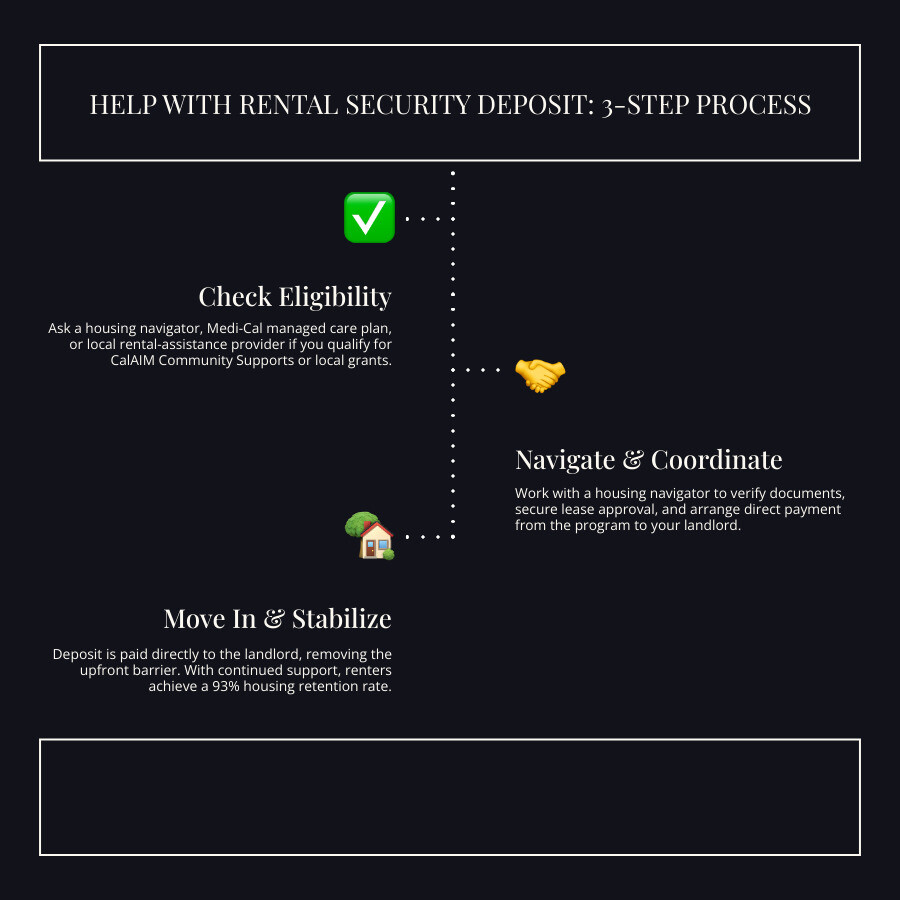
If you need help with rental security deposit costs in San Diego or Riverside, start by asking a housing navigator, Medi-Cal managed care plan, or local rental-assistance provider whether you qualify for CalAIM Community Supports. Eligible renters may receive support for a deposit, often paid directly to the landlord, so a lack of upfront cash does not stop a safe move-in. LifeSTEPS provides CalAIM-connected housing support, including up to 1 month paid in advance for deposit assistance when eligible.

For many transitioning veterans and families, obtaining emergency rental assistance funds or specialized assistance with apartment deposits is essential to bridge the gap between an approved rental and a stable home. California generally limits security deposits to one month’s rent, although limited exceptions apply to certain small landlords. Timely rental and deposit assistance reduces that hurdle while helping renters begin a lease with a clear plan for long-term stability. LifeSTEPS reports a 93% housing retention rate, reflecting the value of continued, person-centered support after move-in.

Rental deposit assistance steps: eligibility, housing navigator, landlord payment, move-in infographic

Key Programs Providing Help With Rental Security Deposit in Southern California

housing specialist reviewing rental assistance options

Finding the necessary funds to secure a home in Southern California can be challenging. Fortunately, multiple targeted initiatives exist to bridge the gap between signing a lease and paying upfront move-in expenses.

CalAIM Community Supports and Housing Tenancy Services

California’s Department of Health Care Services transformed Medi-Cal through California Advancing and Innovating Medi-Cal (CalAIM). Under CalAIM Community Supports, Medi-Cal managed care plans can offer Housing Transition Navigation and Housing Tenancy Services.

These services are designed to help individuals and families who are experiencing housing instability find, apply for, and maintain long-term housing. For qualified members, CalAIM can provide direct funding for move-in expenses—including security deposits, utility setup fees, and essential initial tenancy costs. By addressing housing needs through healthcare-connected supports and CalAIM rent deposit help in CA, LifeSTEPS helps maintain a 93% housing retention rate across our served communities.

Local Municipal Grants in San Diego and Riverside Counties

Local city and county agencies often manage emergency grants to keep residents housed or assist them when relocating to permanent homes.

  • San Diego County Initiatives: Regional municipalities, such as Imperial Beach, coordinate local initiatives and grant funding to support vulnerable households facing high move-in costs. Programs like the Tenant Assistance in Imperial Beach provide structured resources for individuals needing help navigating landlord negotiations and local housing relief.
  • Riverside County Initiatives: In Riverside, municipal and county-level community development departments operate relief programs designed to prevent homelessness. The Riverside CARES housing initiatives connect households with emergency funding and housing resources, helping cover move-in expenses that could otherwise delay tenancy.

Voucher and Veteran Move-In Support Programs

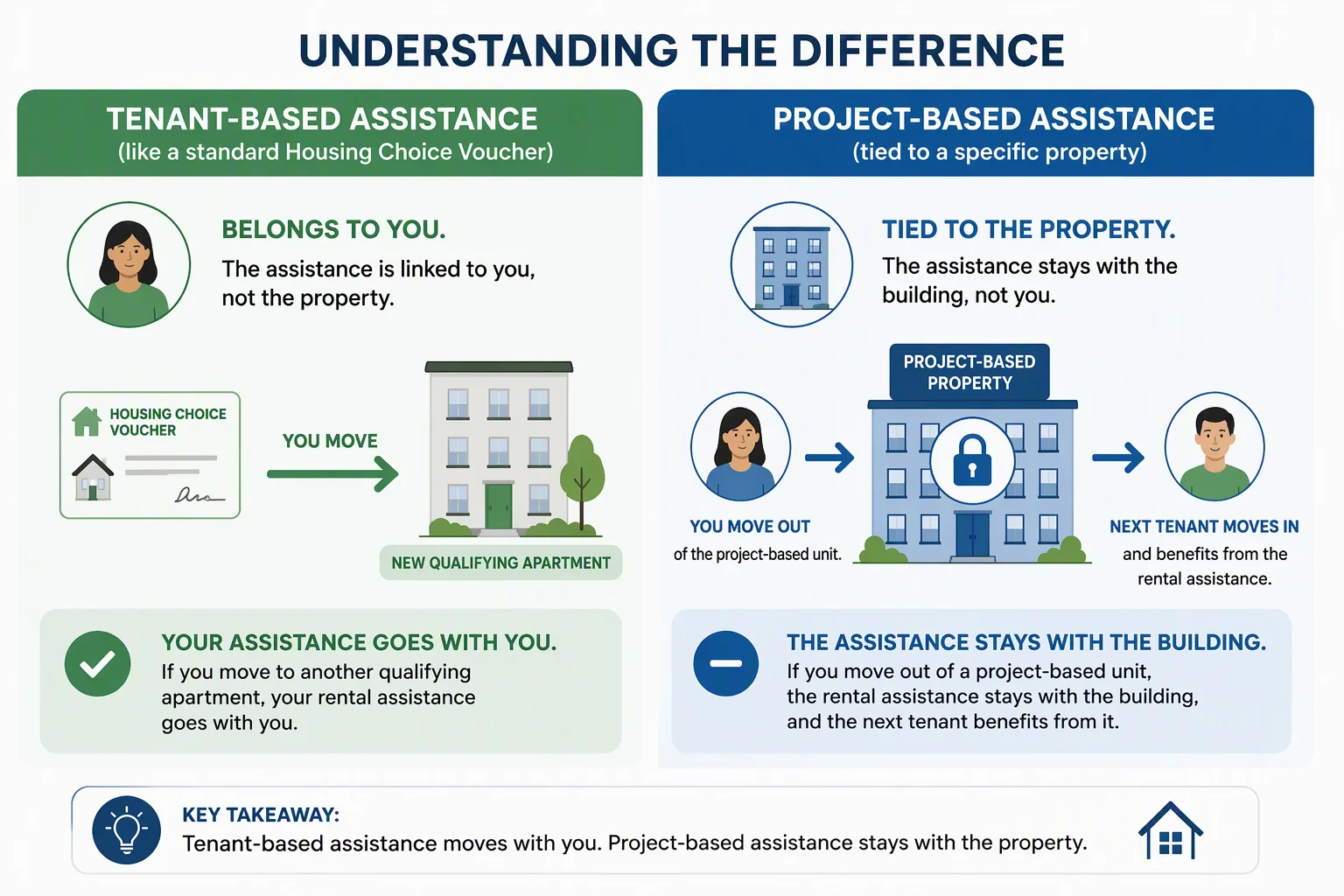
Federally backed and locally administered housing choice vouchers significantly reduce monthly rent burdens, but participants must still manage upfront move-in deposits.

  1. Housing Choice Vouchers (Section 8): In standard voucher scenarios, landlords can charge a security deposit up to the maximum legal contract rate, making dedicated help with deposit for Section 8 essential for families transitioning into stable homes.
  2. HUD-VASH for Veterans: The HUD-Veterans Affairs Supportive Housing (HUD-VASH) program combines voucher rental assistance with clinical case management. When veterans transition into permanent residences, specialized veterans deposit assistance programs and partner organizations assist with moving expenses and deposits.

Understanding California Security Deposit Limits and Tenant Rights

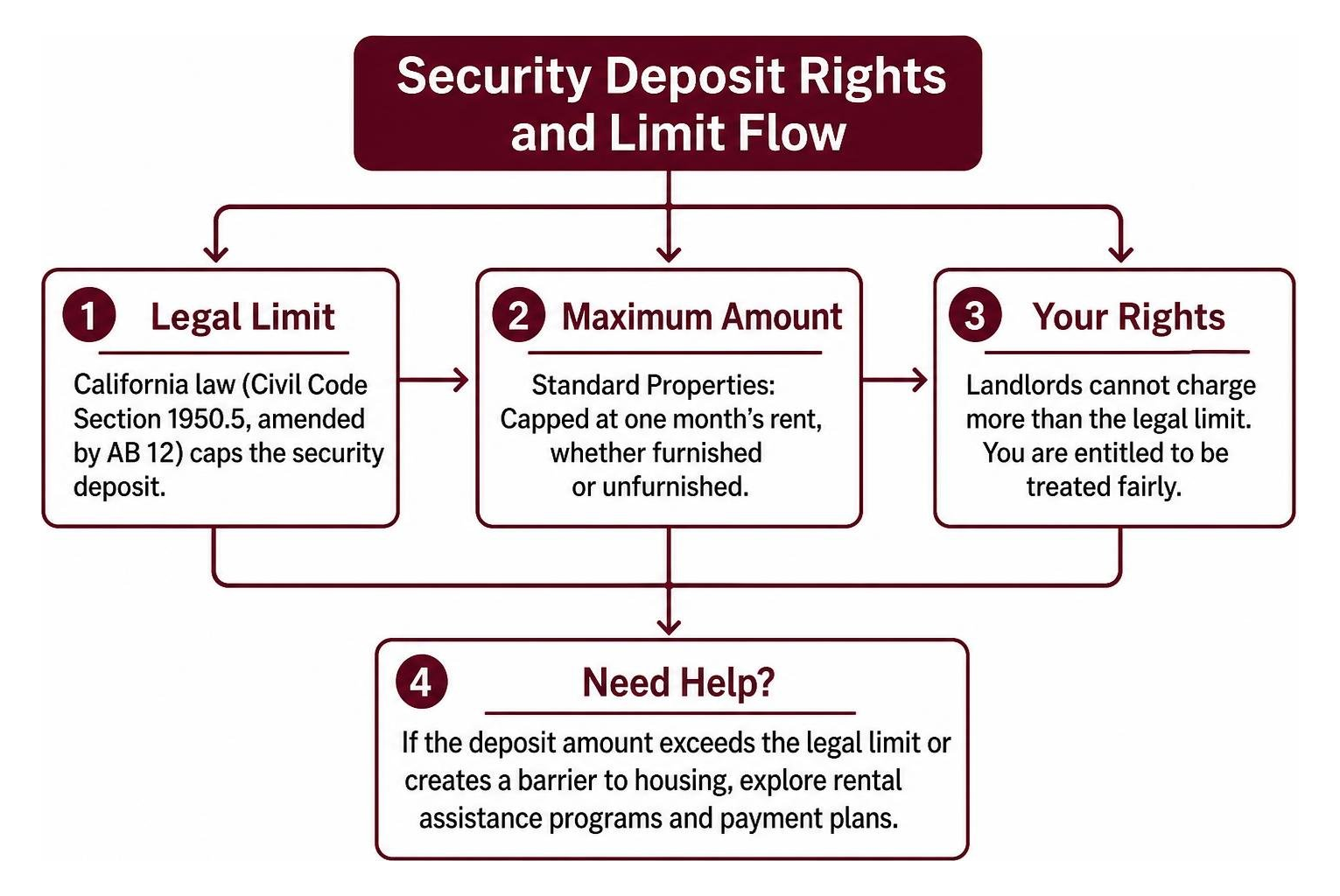
Understanding California security deposit laws ensures that you are treated fairly during the leasing process.

Security deposit rights and limit flow

Statutory Limits and How to Request Help With Rental Security Deposit Plans

California law (Civil Code Section 1950.5, amended by AB 12) strictly caps the amount a landlord can charge for a residential security deposit:

  • Standard Properties: Capped at one month’s rent, whether the apartment is furnished or unfurnished.
  • Small Landlord Exception: A landlord who is an individual or natural person (or LLC where all members are natural persons) and owns no more than two residential properties totaling four or fewer rental units may charge up to two months’ rent.
  • Active Military Service Members: Special protections apply to active military personnel, capping deposits to ensure relocation does not create unfair financial burdens.

If upfront payments remain difficult to assemble all at once, tenants can request a written installment plan from their property manager or use community support navigation to bridge the initial deficit.

Move-In Documentation and Inspection Protocols

The best way to protect your deposit is thorough documentation on day one:

  • Complete a Written Condition Checklist: Walk through every room with the landlord and document existing marks, scuffs, or plumbing concerns. Check out the Guide to security deposits in California for official court self-help procedures.
  • Take Timestamped Photos and Videos: Record high-resolution photos and video walkthroughs of appliances, walls, floors, and fixtures before moving in furniture.
  • Save Correspondence in the Cloud: Keep digital copies of all inspection forms, payment receipts, and communications with your property manager.

caseworker assisting a resident with a housing application

Applying for move-in funding requires organization, clear documentation, and proactive communication.

Eligibility Criteria and Required Verification

Assistance programs typically evaluate applications based on specific vulnerability and income standards. When preparing to request first month rent and security deposit assistance, you will generally need to gather:

  • Proof of Medi-Cal enrollment (for CalAIM Community Supports)
  • Government-issued identification
  • Verification of total household income (paystubs, benefit award letters)
  • A signed lease agreement or an official written pre-approval letter from the property management detailing the deposit amount

Application Steps to Receive Help With Rental Security Deposit Funding

The typical path from approval to payment disbursement follows a clear sequence:

  1. Intake and Assessment: Connect with a housing navigator or case manager to evaluate your eligibility for CalAIM or local municipal funds.
  2. Document Submission: Provide the required verification records and your landlord’s contact information.
  3. Direct Landlord Disbursement: Most assistance programs disburse funds directly to the landlord or property management company via ACH or check, typically covering up to 1 month paid in advance for deposit assistance.

Protecting Your Deposit and Resolving Move-Out Disputes

Permissible Deductions Versus Normal Wear and Tear

Under California Civil Code 1950.5, a security deposit is the legal property of the tenant and is held in trust by the landlord. Landlords may only make deductions for valid, documented reasons. Review the Know Your Rights Security Deposits guidelines published by state authorities.

Category Normal Wear and Tear (Not Deductible) Tenant Damage (Deductible)
Walls & Paint Minor scuffs, small picture-hanging nail holes, faded paint from sunlight Large holes, unapproved wall colors, major gouges in drywall
Flooring Gentle carpet traffic wear, minor scuffs on hardwood Pet stains, large carpet burns, deep water damage on wood floors
Fixtures & Hardware Loose door knobs from normal use, worn faucet washers Broken cabinet doors, cracked mirrors, smashed light fixtures
Cleanliness Dust on baseboards consistent with regular tenancy Piles of trash left behind, grease-caked ovens, mold from neglect

If deductions exceed $125, the landlord is legally required to attach invoices, receipts, and a detailed accounting of labor costs and hours.

  • 21-Day Statutory Window: California landlords must return the full deposit balance, or an itemized deduction statement with receipts, within 21 calendar days after you surrender the keys.
  • Pre-Move-Out Inspection: Renters have the legal right to request an initial walk-through inspection within two weeks prior to moving out. This gives you time to make repairs yourself and avoid deductions.
  • Small Claims Resolution: If a landlord wrongfully withholds your deposit, you can file a claim in small claims court (for claims up to $12,500). If the court determines the landlord acted in bad faith, the tenant may be awarded their actual damages plus statutory damages of up to twice the deposit amount.

Frequently Asked Questions About Rental Deposit Assistance in California

How much can a landlord legally charge for a security deposit in California?

In California, residential security deposits are generally capped at one month’s rent. Small landlords who own no more than two properties containing a total of four or fewer rental units can charge up to two months’ rent.

What should I do if my landlord does not return my deposit within 21 days?

Send a formal written demand letter citing California Civil Code Section 1950.5. If the landlord fails to return the funds or provide an itemized list with necessary receipts, you can pursue the balance in small claims court, where statutory penalties may apply for bad-faith withholding.

Can CalAIM cover both my security deposit and first month’s rent?

Yes. Eligible Medi-Cal members participating in CalAIM Community Supports can receive assistance with housing transition expenses, including security deposit assistance and upfront move-in costs to secure permanent housing.

Conclusion

Securing stable housing is a vital step toward long-term independence. By taking advantage of CalAIM Community Supports, municipal programs, and supportive housing tenancy services, renters across Southern California can successfully overcome upfront financial hurdles. Beyond housing stability, our educational initiatives empower families, reflected in a 97% literacy improvement during Summer Reading programs and over $2.1M awarded in higher education scholarships.

Whether you need guidance navigating Medi-Cal supports or access to first month rent and security deposit assistance, proactive navigation makes all the difference in sustaining a home.

For media inquiries, contact: bex@lifestepsusa.org

LifeSTEPS currently provides services in California only.
affordable housing management companies

How to Find Affordable Housing Management Companies Near You

Find Affordable Housing Management Companies That Put Residents First

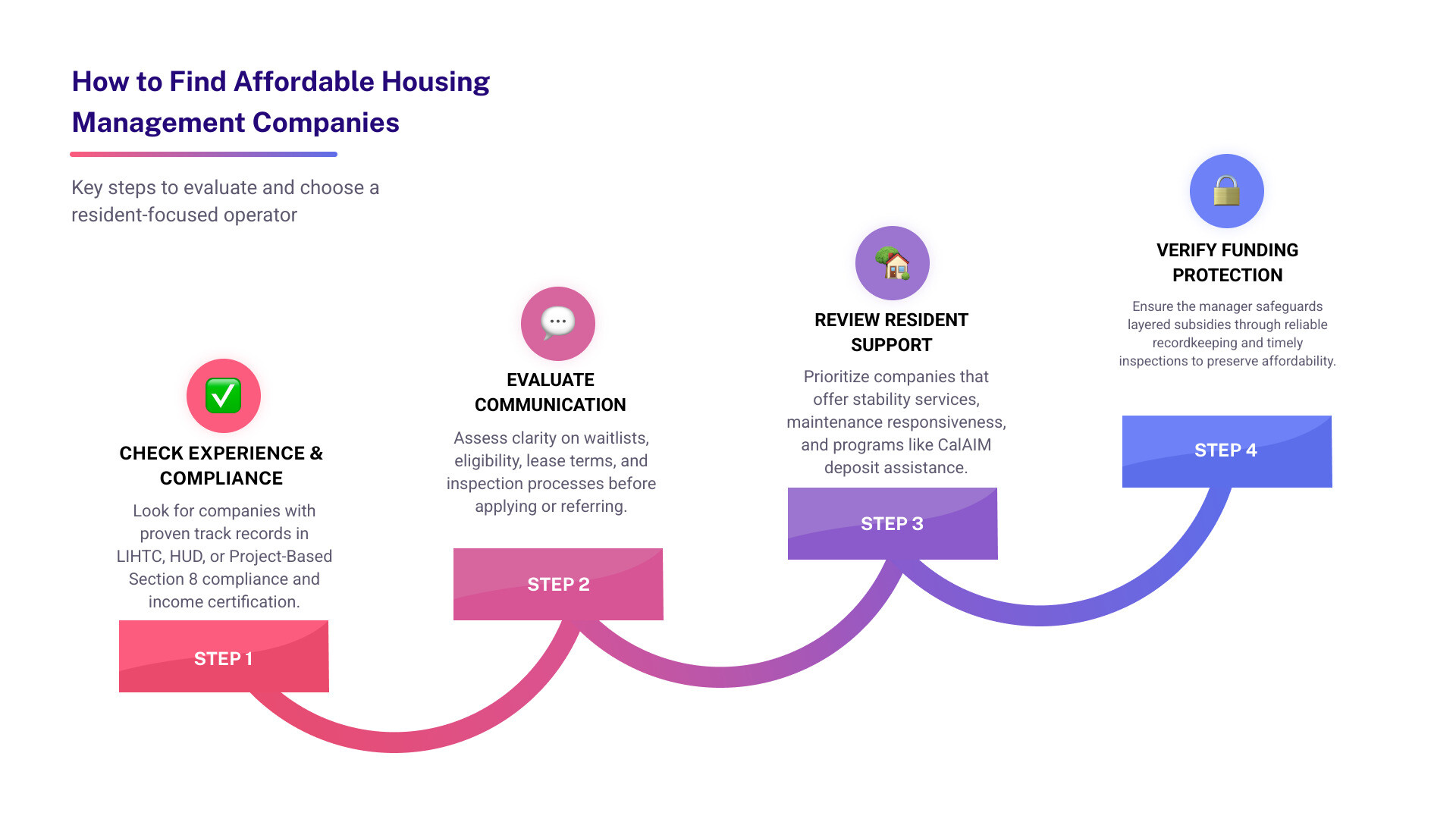
To find affordable housing management companies near you, start with properties in your area and compare each manager’s experience with your housing program, compliance record, maintenance response, resident services, and leasing performance. For veterans seeking stable housing in Los Angeles, San Diego, Riverside, or the Bay Area, a strong manager should make the process clear, keep homes safe, and connect residents with practical support.

Look for these signs before you apply or recommend a property:

  1. Experience with affordable housing rules, including income certifications and HUD or tax-credit requirements.
  2. Clear communication about waitlists, eligibility, inspections, repairs, and lease terms.
  3. A resident-support approach that helps people stay housed, not just fill units.
  4. Reliable maintenance, safety planning, and fair follow-up when problems arise.

The right management partner does more than collect rent. It protects the property’s funding and physical condition while helping residents build stability. This matters when a community navigates government subsidized housing, layered programs such as LIHTC, or broader public housing assistance options like hud affordable housing, where missed paperwork or failed inspections can put affordability at risk.

LifeSTEPS provides resident-centered housing support in California communities, with a 93% housing retention rate. For eligible residents, CalAIM deposit assistance may cover 1 month paid in advance, helping remove one common barrier to securing a home.

Steps for finding and vetting affordable housing management companies infographic

Key Types of Affordable Housing Management Companies

housing manager conducting property walkthrough

Operating subsidized residential real estate requires specialized organizational structures. Unlike standard multifamily assets, affordable developments operate under strict regulatory agreements that tie financing to household income limits, rent caps, and physical property standards.

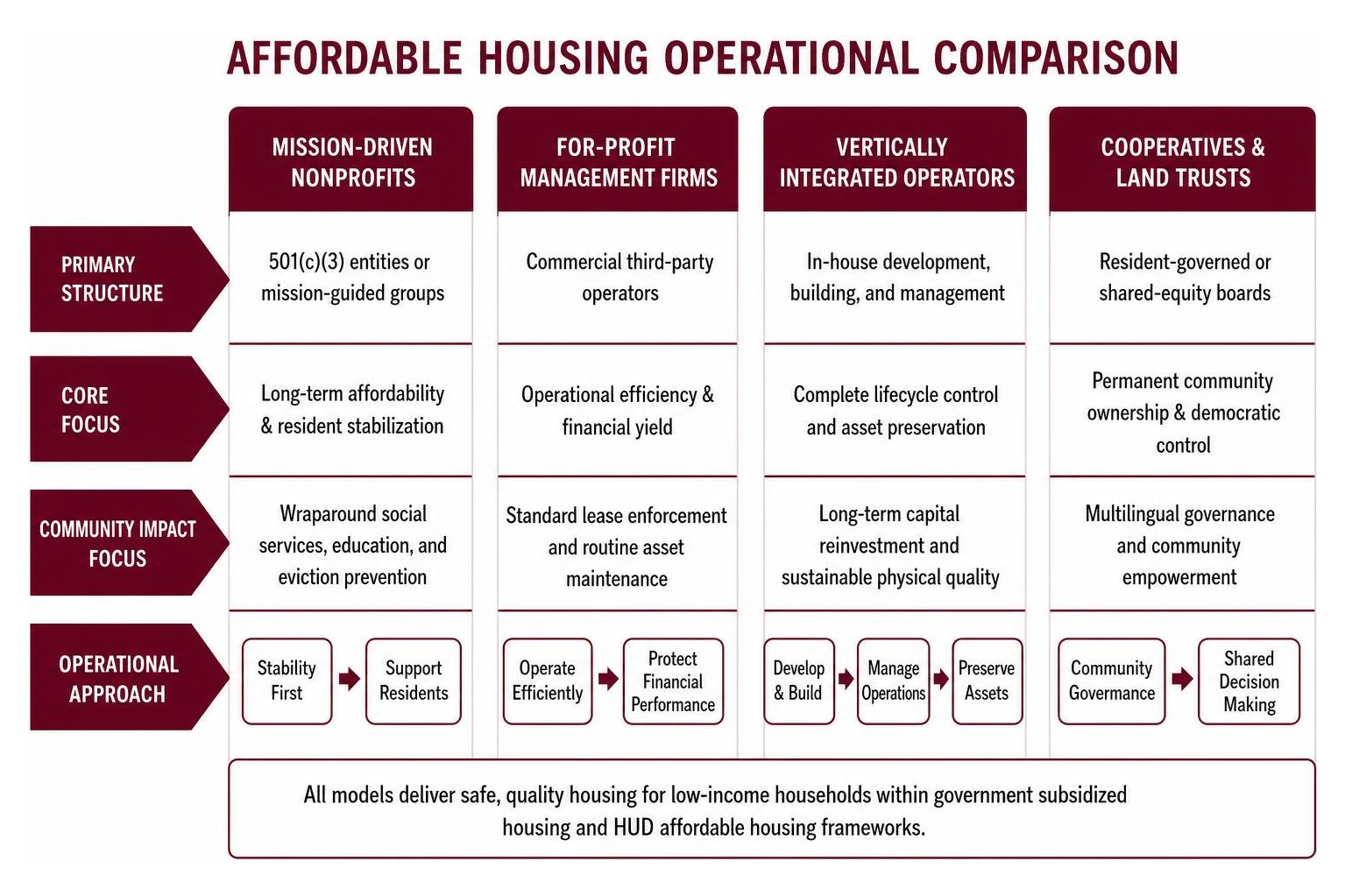
Organizations managing these properties generally fall into distinct operating models:

Management Model Primary Structure Core Focus Community Impact Focus
Mission-Driven Nonprofits 501(c)(3) entities or mission-guided groups Long-term affordability & resident stabilization Wraparound social services, education, and eviction prevention
For-Profit Management Firms Commercial third-party operators Operational efficiency & financial yield Standard lease enforcement and routine asset maintenance
Vertically Integrated Operators In-house development, building, and management Complete lifecycle control and asset preservation Long-term capital reinvestment and sustainable physical quality
Cooperatives & Land Trusts Resident-governed or shared-equity boards Permanent community ownership & democratic control Multilingual governance and community empowerment

Mission-Driven vs. For-Profit Affordable Housing Management Companies

The operational philosophy of an affordable housing manager directly shapes daily community life. Commercial management companies primarily focus on rent collections, occupancy targets, and physical upkeep to safeguard bottom-line financial performance. While these metrics remain vital for fiscal health, focusing solely on financials can overlook the social complexities vulnerable households face.

Mission-driven operators approach property management with a broader objective: preserving community stability and fostering resident upward mobility. By collaborating with nonprofit housing organizations, properties pair traditional operational oversight with meaningful social support.

When a resident experiences an unexpected emergency, mission-driven teams coordinate relief resources rather than initiating immediate legal actions. For example, Marcus, whose name has been changed, faced a sudden job transition that threatened his tenancy. On-site service coordinators helped him establish a workable payment arrangement while connecting him with workforce development tools, preventing eviction and preserving stable housing.

Affordable Housing Operational Comparison

Vertically Integrated and Cooperative Housing Models

Vertically integrated entities oversee the complete property lifecycle—from initial land acquisition and architectural design through construction, lease-up, and daily operations. By managing both the physical build and ongoing operations, these firms eliminate communication gaps between builders and operators. They select durable, energy-efficient building materials that lower long-term maintenance costs and preserve physical quality over multi-decade compliance periods.

Cooperative housing models and community land trusts introduce a distinct, community-led management structure. In these models, residents participate directly in governance decisions. Property managers serving cooperatives provide full financial transparency, localized maintenance oversight, and multilingual administrative communication. This resident-led framework empowers individuals by turning property management into a collaborative tool for permanent neighborhood stability.

Core Criteria for Evaluating Management Partners

property manager reviewing resident service documentation

Selecting an experienced management partner requires evaluating performance metrics that extend beyond standard physical occupancy. High-quality operators maintain operational balance across compliance, asset protection, and resident well-being.

Key performance indicators to evaluate include:

  • Sustained Occupancy and Fast Turnaround: Maintaining high physical occupancy while completing unit turns efficiently to minimize vacancy loss.
  • Audit-Ready Regulatory Compliance: Flawless tracking of household income limits, annual certifications, and housing finance regulations.
  • Proactive Preventative Maintenance: Routine inspections of building mechanicals, safety systems, and living spaces to prevent deferred maintenance.
  • High Tenant Retention: LifeSTEPS achieves a 93% housing retention rate by pairing standard property management with proactive supportive interventions.

Vetting Local Affordable Housing Management Companies for Quality and Compliance

Housing property owners and community advocates must vet prospective management partners across rigorous regulatory baselines. A qualified operator must maintain a verifiable track record with municipal housing authorities and state housing finance agencies.

Staff credentials serve as a vital indicator of competence. Professional teams should hold recognized certifications such as Certified Professional of Occupancy (CPO) or Housing Credit Certified Professional (HCCP). Management partners that benchmark operational metrics against national industry standards by NAHMA demonstrate systematic compliance rigor. Furthermore, working with partners certified as a Woman-Owned Business Enterprise (WBE) supports supplier diversity while ensuring professional excellence.

Balancing Financial Stability with Resident Services

A financially healthy property is essential for maintaining high-quality living environments. However, financial sustainability should complement, not replace, human-centered community care. Subsidized housing operations rely on steady subsidy streams, Low-Income Housing Tax Credits (LIHTC), and accurate accounting.

Integrating resident supportive services directly reinforces financial stability. When on-site teams assist residents in navigating programs like CalAIM—which provides deposit assistance covering 1 month paid in advance—move-in delays decrease significantly.

Proactive service coordination helps vulnerable individuals avoid lease defaults. Dedicated property initiatives, such as supportive housing for individuals with disabilities, ensure that residents access needed resources while maintaining their independent living arrangements. As research demonstrates, improving health outcomes through housing stability creates healthier, more stable neighborhood environments.

How Property Managers Navigate Compliance and Regulatory Programs

Affordable housing compliance requires navigating multi-layered federal, state, and local frameworks. Property management teams must balance the rigorous requirements of Section 42 of the Internal Revenue Code alongside direct HUD subsidy programs and municipal covenants.

Key regulatory frameworks include:

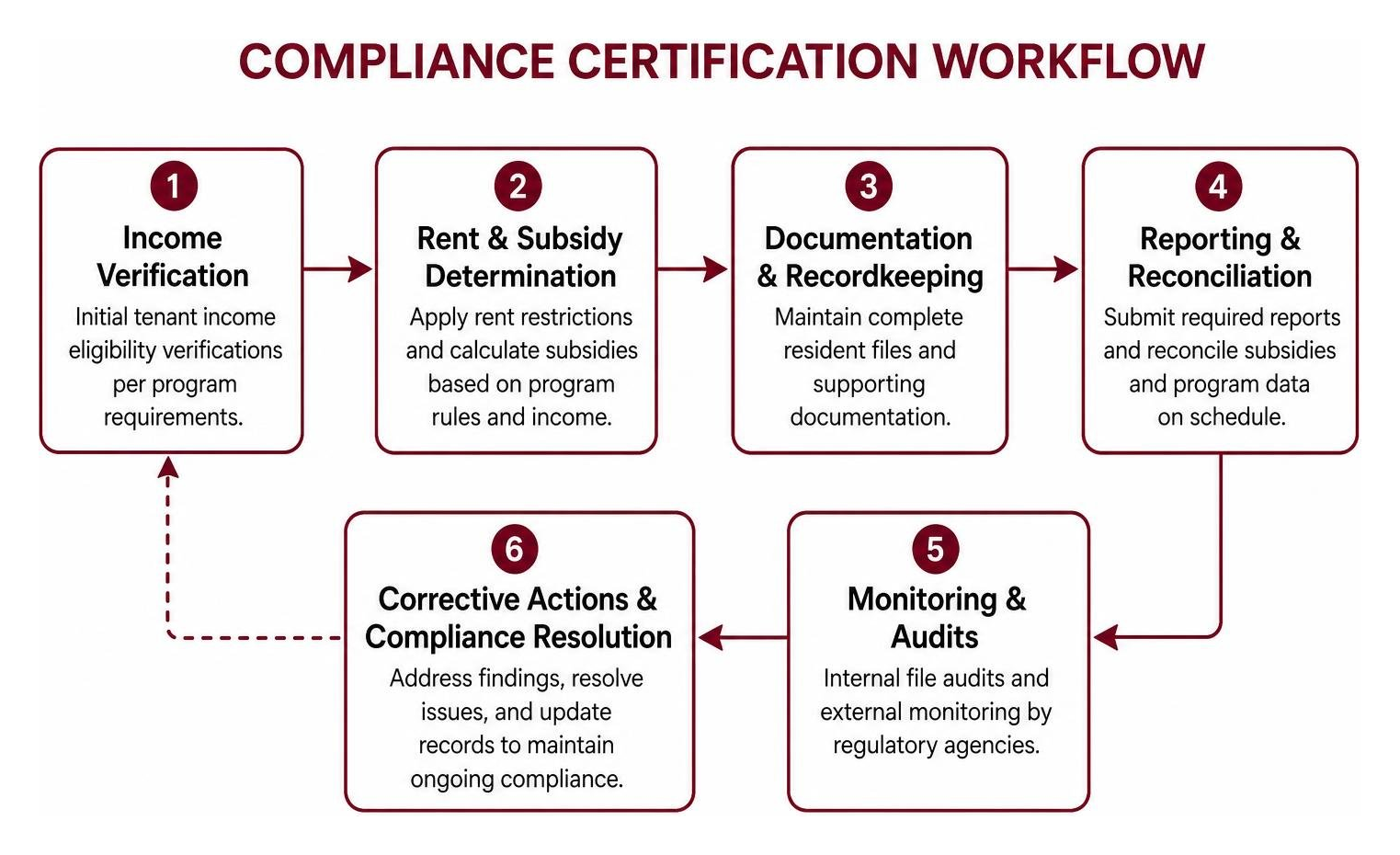
  1. Low-Income Housing Tax Credit (LIHTC): Governed by Section 42, requiring rigorous initial tenant income eligibility verifications, ongoing rent restrictions, and annual reporting.
  2. Project-Based Section 8: Requires strict monthly subsidy voucher reconciliation and tenant income calculations according to our HUD subsidy programs guide.
  3. USDA Rural Development: Involves specialized tenant qualification rules and property preservation standards for rural multifamily communities.
  4. Physical Inspection Standards: Adhering to National Standards for the Physical Inspection of Real Estate (NSPIRE) and Housing Quality Standards (HQS) enforced through public housing authority oversight.

Managing Income Certifications and Blended Financing

Modern affordable housing developments rarely rely on a single funding stream. Communities frequently blend Low-Income Housing Tax Credits, tax-exempt bond financing, HOME Investment Partnerships Program funds, and Community Development Block Grants (CDBG).

Each funding layer carries its own income caps, reporting deadlines, and compliance rules:

Compliance Certification Workflow

Managing blended portfolios in regions like San Diego affordable developments and subsidized communities in Riverside requires advanced digital tracking systems. Property managers must conduct systematic file audits and variance reporting to prevent non-compliance findings that could jeopardize underlying tax credit allocations.

Specialized Senior and Supportive Housing Standards

Managing communities tailored for older adults or individuals requiring supportive housing involves distinct accessibility and operational protocols. Managers must ensure full compliance with the Americans with Disabilities Act (ADA) and Fair Housing Act standards, maintaining physical modifications that support aging in place.

Effective management teams work alongside service coordinators to activate on-site community rooms with meaningful educational programming and social engagement. Exploring specialized senior housing communities in California shows how tailored property management enhances quality of life. For individuals and families seeking suitable placements, navigating affordable rental options provides a structured pathway toward long-term residential stability.

The affordable property management landscape continues to evolve through technological and environmental innovations:

  • Disaster Resiliency and Energy Efficiency: Forward-thinking management firms are integrating solar arrays, high-efficiency mechanical systems, and emergency preparedness plans into daily operations. These upgrades lower utility expenses for residents while protecting properties against severe weather disruptions.
  • Digital Compliance and Streamlined Portals: Cloud-based property management software allows residents to submit maintenance requests, track recertification timelines, and access community notices digitally, improving communication speed.
  • Youth Educational Enrichment: High-performing affordable communities integrate structured youth development initiatives. In our educational enrichment initiatives, participating youth achieve a 97% literacy improvement through dedicated Summer Reading programs.
  • Higher Education Support: Mission-aligned housing models actively open pathways to academic achievement, helping award $2.1M in scholarships to students pursuing higher education goals.

Frequently Asked Questions About Affordable Housing Operations

How do property managers maintain LIHTC and HUD compliance?

Property managers maintain compliance by conducting thorough initial tenant income verifications and mandated annual recertifications. They perform continuous internal file audits, prepare properties for annual NSPIRE physical inspections, and submit timely occupancy data to state housing finance agencies.

What is the difference between fee-managed and vertically integrated housing companies?

Fee-managed operators are third-party contractors hired strictly to handle day-to-day property operations, leasing, and maintenance under an annual service agreement. Vertically integrated companies handle the entire asset lifecycle in-house—including site development, general contracting, property management, and long-term asset preservation.

How do management companies support long-term resident stability?

Management companies support long-term stability by embedding on-site service coordinators who assist residents with financial literacy, workforce resources, educational youth programs, and emergency assistance navigation. These supportive measures help households maintain their leases and achieve personal self-sufficiency.

Conclusion

Finding the right affordable housing management partner requires evaluating both technical operational expertise and human-centered community commitment. Whether overseeing complex compliance across layered financing programs or maintaining high physical standards, the best management teams recognize that properties thrive when residents are supported.

LifeSTEPS bridges the gap between traditional property management and lasting resident empowerment across California communities. By empowering communities through comprehensive resident supportive services, we help create stable, thriving environments where individuals and families can flourish.

For media inquiries, contact: bex@lifestepsusa.org

LifeSTEPS currently provides services in California only.

California family receiving keys from housing counselor

What It Takes to Qualify as an FHA Loan Second Time Home Buyer in California

Can a Second-Time Home Buyer Qualify for an FHA Loan in California?

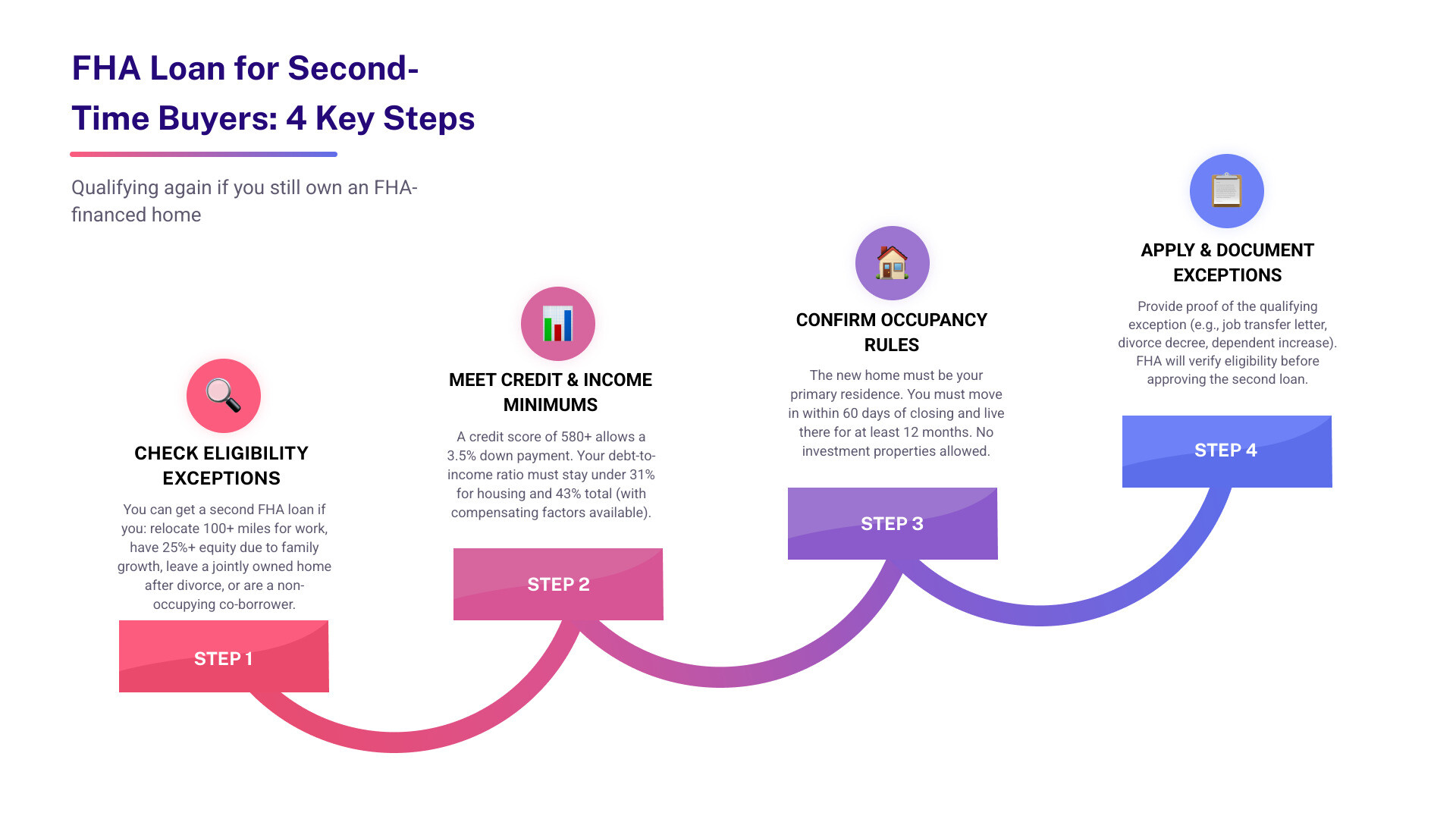
Yes. A repeat buyer can qualify for an FHA loan in California. FHA financing is not limited to first-time buyers. If you have sold or paid off a prior FHA loan, you can apply again if the new home will be your primary residence and you meet current credit, income, down payment, and property rules.

If you still have an FHA mortgage, you may qualify for another one only in limited cases, such as:

  1. Moving for work more than 100 miles away.
  2. Outgrowing your current home because your household has increased, with at least 25% equity in the existing home.
  3. Leaving a jointly owned home after a divorce or other change in ownership.
  4. Being a non-occupying co-borrower on someone else’s FHA loan.

For most borrowers, a credit score of 580 or higher can support a 3.5% down payment. The new home generally must be occupied within 60 days of closing and used as your main home.

LifeSTEPS supports housing stability in California, with a 93% housing retention rate. Through the CalAIM program, LifeSTEPS also provides deposit assistance with 1 month paid in advance. Repeat buyers can also explore statewide home buyer programs, regional Bay Area home buyer aid, or qualification criteria for a first home loan grant. Its community work also includes afterschool support, including a 97% literacy improvement for Summer Reading, and $2.1M in scholarships for higher education.

FHA repeat buyer qualification steps and two-loan exceptions infographic

Qualifying as an FHA Loan Second Time Home Buyer in California

Reviewing mortgage documents and loan approval paperwork

One of the most persistent myths in real estate is that government-backed mortgages are exclusively reserved for entry-level purchasers. In truth, an fha loan second time home buyer can tap into the exact same Federal Housing Administration backing as someone buying their very first property.

Federal underwriting rules focus on your current financial capacity and occupancy plans rather than your prior homeownership history. Whether you sold a starter property years ago, went through a period of renting, or are looking to upsize, you can access FHA financing repeatedly over your lifetime. For those exploring home financing pathways after an ownership gap, the federal government even recognizes you as a first-time buyer again if you have not held title to a principal residence during the past three years. This 3-year gap rule opens doors to specialized assistance while letting you leverage standard FHA flexibility.

Core Mortgage Requirements for an FHA Loan Second Time Home Buyer

Qualifying for repeat FHA financing requires meeting clear underwriting standards established by the Department of Housing and Urban Development (HUD):

  • Credit Score Tiers: A minimum credit score of 580 allows you to put down just 3.5%. Borrowers with credit scores between 500 and 579 can still obtain approval but must provide a 10% down payment.
  • Mortgage Insurance Premiums (MIP): Every FHA borrower pays an Upfront Mortgage Insurance Premium (UFMIP) equal to 1.75% of the base loan amount (often rolled into the mortgage balance), alongside an ongoing annual MIP (typically 0.55% for 30-year loans when putting 3.5% down).
  • Gift Funds and Reserves: The entire 3.5% down payment may come from documented family gift funds or regional assistance grants, though maintaining 1 to 3 months of cash reserves strengthens your underwriting profile.

Understanding how different home buying options align with your household budget ensures you utilize these loan features effectively.

Occupancy Rules and Primary Residence Mandates

The primary gatekeeper for repeat FHA lending is owner occupancy. FHA loans cannot be used to purchase pure investment properties or vacation getaways. Borrowers must certify that the property will serve as their principal residence:

  1. 60-Day Move-In: You must take physical possession and move into the home within 60 days of loan closing.
  2. One-Year Occupancy: You must intend to live in the home as your main residence for at least one full calendar year.
  3. Multi-Unit Flexibility: You may use an FHA loan on properties containing up to 4 residential units, provided you occupy one unit as your primary residence while renting out the remaining spaces.

The Four HUD Exceptions: How to Hold Two FHA Loans at Once

Modern exterior of a California home

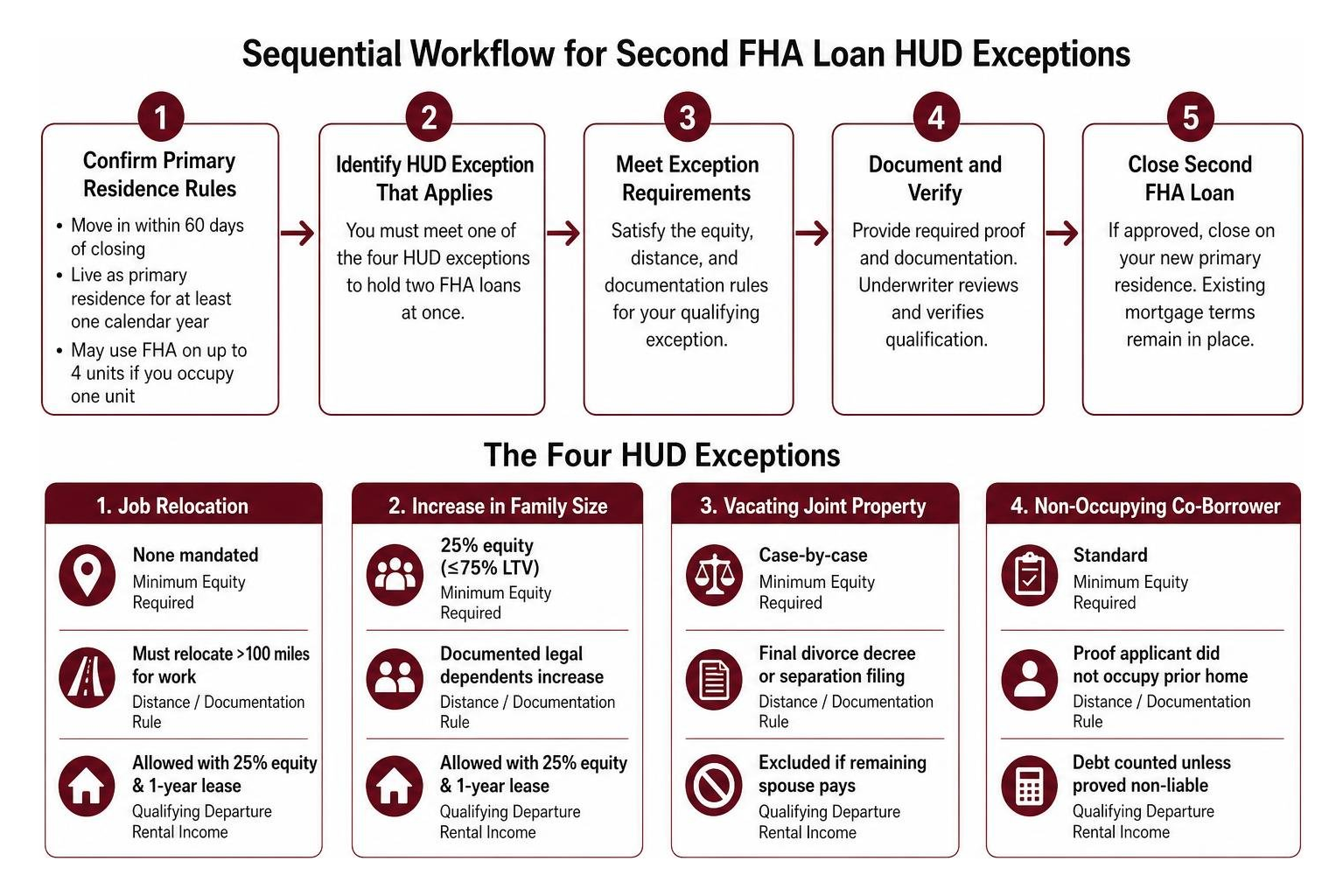
Under standard rules, HUD prohibits holding two active FHA mortgages simultaneously to prevent investors from building rental portfolios using government-insured funds. However, HUD handbook guidelines outline four distinct exceptions that allow qualified borrowers to take out a second FHA loan without selling their existing home.

HUD Exception Category Minimum Equity Required Distance / Documentation Rule Qualifying Departure Rental Income
Job Relocation None mandated Must relocate >100 miles for work Allowed with 25% equity & 1-yr lease
Increase in Family Size 25% equity (≤75% LTV) Documented legal dependents increase Allowed with 25% equity & 1-yr lease
Vacating Joint Property Case-by-case Final divorce decree or separation filing Excluded if remaining spouse pays
Non-Occupying Co-Borrower Standard Proof applicant did not occupy prior home Debt counted unless proved non-liable

Job Relocation and the 100-Mile Commute Rule

If you are transferred by your employer or accept a new job position that requires establishing a new primary residence, HUD permits a second active FHA loan under the relocation exception.

The new home must be situated more than 100 miles from your departure residence. Underwriters verify your employment offer letter, relocation agreement, and commute feasibility. If you choose to keep your former home as a rental property, the existing mortgage payment must be factored into your debt-to-income ratio unless you have at least 25% equity documented by a recent appraisal and provide an executed 12-month lease agreement.

Sequential workflow for second FHA loan HUD exceptions

Growing Families, Divorce, and Co-Borrower Exceptions for an FHA Loan Second Time Home Buyer

Life changes frequently prompt housing transitions. HUD accommodates these shifts through three additional pathways:

  • Growing Family Exception: If your number of legal dependents has increased since purchasing your first home and the property no longer meets your family’s basic functional needs, you can qualify for a larger FHA-financed home. You must prove at least 25% equity (a loan-to-value ratio of 75% or less) in your existing home based on a current appraisal.
  • Vacating a Jointly Owned Property: In the event of a divorce or legal separation, if your former spouse remains in the original FHA-insured residence, you may obtain a new FHA mortgage to establish an independent primary home. Submitting a recorded divorce decree or separation agreement awarding the property to the remaining party enables lenders to process your new application.
  • Non-Occupying Co-Borrower: If you previously co-signed an FHA loan to help a family member purchase a property without living there yourself, you retain the right to secure your own FHA-insured mortgage for your personal principal residence.

Clients navigating complex housing transitions—such as David (name changed), a veteran who partnered with community housing programs to stabilize his finances—often benefit from pairing structured homeownership assistance with specialized loan exceptions.

Waiting Periods, DTI Limits, and 2026 California Loan Limits

Second-time purchasers often return to the market after resolving past financial hardships. FHA guidelines offer some of the most forgiving recovery timelines in the lending industry.

Underwriting Guidelines: Credit Scores, DTI, and Financial Recovery Timelines

Standard FHA underwriting applies baseline debt-to-income (DTI) benchmarks of 31% for housing expenses (front-end) and 43% for total monthly obligations (back-end). However, automated underwriting systems can approve back-end DTIs up to 45% to 50% when supported by compensating factors such as substantial cash reserves or minimal consumer debt.

For repeat buyers rebuilding credit, FHA waiting periods are notably shorter than conventional mortgage rules:

  • Foreclosure or Deed-in-Lieu: 3-year mandatory waiting period from the completion date.
  • Chapter 7 Bankruptcy: 2-year waiting period from the official discharge date.
  • Chapter 13 Bankruptcy: Eligible after 12 months of verified on-time plan payments with written bankruptcy court approval.

Learning foundational financial mechanics through FSS homebuyer education helps repeat buyers manage these timelines and rebuild solid underwriting profiles.

California County Loan Limits and Down Payment Assistance

In California’s high-cost real estate environment, FHA limits adjust annually by county to reflect median sale prices. For 2026, baseline low-cost county limits start at $541,287, while high-cost metropolitan areas reach the statutory ceiling of $1,249,125:

  • Los Angeles County: High-cost ceiling up to $1,249,125 for single-family residences.
  • San Diego County: Maximum high-cost limit reaching $1,249,125.
  • Riverside County & Irvine Areas: Balanced limits accommodating suburban single-family housing choices.

Repeat buyers needing cash-to-close support can explore regional programs such as the CalHFA Homebuyers Loan Program, alongside targeted low income home buyer programs that offer second-lien down payment assistance. Furthermore, qualifying residents participating in the CalAIM program can receive deposit assistance covering 1 month paid in advance to ensure smooth household transitions. Those seeking comprehensive support can reference homeownership down payment assistance programs for detailed program structures.

Frequently Asked Questions About FHA Financing for Repeat Buyers

Can you get an FHA loan if you currently own another home?

Yes, provided you qualify under one of HUD’s four official exceptions (job relocation over 100 miles, increase in family size with 25% equity, divorce/departure from joint property, or co-borrower status). Otherwise, you must sell your current home or pay off the existing FHA mortgage before closing on your new purchase.

How does mortgage insurance differ for a second-time FHA buyer?

The structure of FHA mortgage insurance is identical for both first-time and repeat buyers. All borrowers pay the 1.75% upfront fee and monthly annual MIP. Unlike conventional private mortgage insurance (PMI), which cancels automatically once you reach 20% equity, FHA MIP remains for the life of the loan when putting down 3.5% (or 11 years if you provide a 10% down payment or more).

Can repeat California buyers qualify for down payment assistance?

Yes. While certain localized grants are restricted to first-time purchasers, many regional initiatives, including homeownership assistance for moderate income frameworks, allow repeat buyers who meet area median income thresholds to participate. Community resources through the San Diego Housing Commission and Riverside County Down Payment Assistance offer viable pathways for qualified applicants.

Conclusion

Securing an FHA mortgage as a repeat homebuyer provides an accessible bridge back into the California property market. By leveraging lower credit score barriers, manageable 3.5% down payments, and clear HUD exception guidelines, you can successfully navigate your next purchase. LifeSTEPS remains committed to strengthening communities through comprehensive housing loan guidance and long-term stability initiatives. Our organization proudly maintains a 93% housing retention rate, delivers CalAIM deposit assistance covering 1 month paid in advance, achieves a 97% literacy improvement for Summer Reading, and has awarded $2.1M in scholarships for higher education.

To learn more about sustainable community resources, explore our low-income homeownership programs or connect with our team. For media inquiries, contact: bex@lifestepsusa.org.

LifeSTEPS currently provides services in California only.