Tag Archive for: affordable housing

assistance with apartment deposits

Your Ultimate Guide to Assistance with Apartment Deposits and Move-In Fees

When Upfront Costs Stand Between You and a Stable Home

Assistance with apartment deposits is available through government programs, nonprofits, faith-based charities, and deposit alternatives — and many California renters qualify even if they have steady income.

Here are the fastest ways to get help:

  1. Call 211 — free, 24/7, available across California, connects you to local deposit and move-in programs
  2. Apply to a local Community Action Agency — administers state and municipal deposit assistance funds
  3. Contact faith-based charities — organizations like Catholic Charities and St. Vincent de Paul offer one-time emergency grants
  4. Ask your landlord for an installment plan — many will split the deposit over two or three months to avoid vacancy
  5. Explore deposit alternatives — services like Rhino or Jetty let you pay a small monthly fee instead of a large lump sum

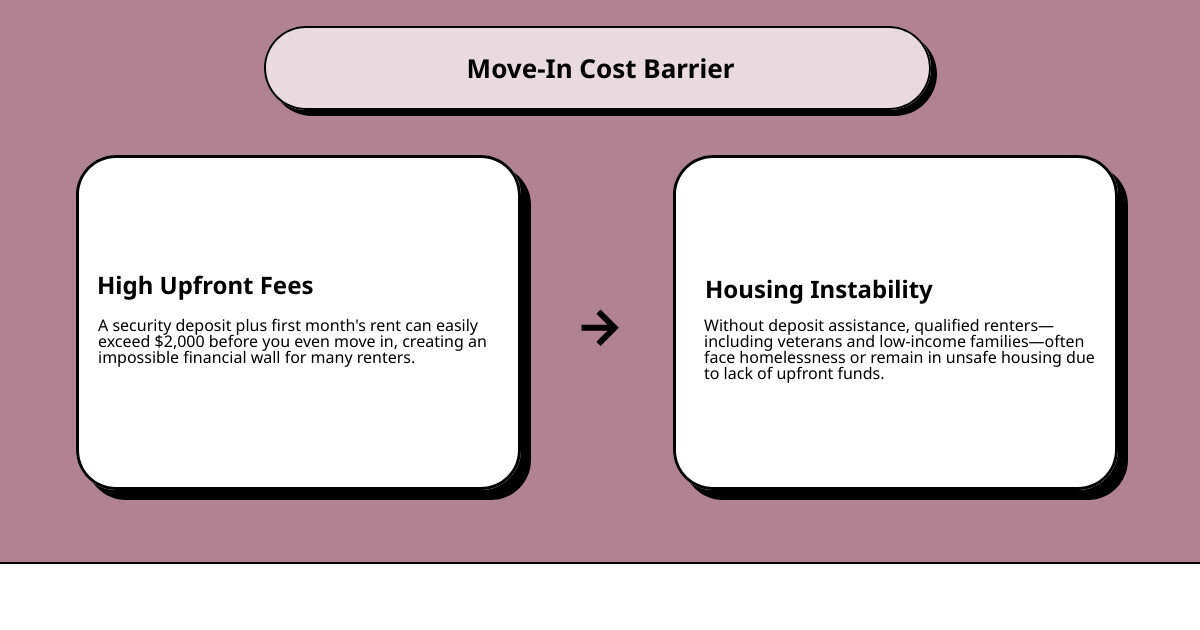
The numbers make the barrier very clear. A security deposit plus first month’s rent can easily exceed $2,000 before you’ve spent a single night in the place. For a veteran transitioning to civilian life — already navigating a new financial reality — that wall can feel impossible to clear.

The good news: there are real, structured programs designed to help you get past it. From federally funded Rapid Re-Housing initiatives to local California-based nonprofits, options exist at nearly every income level and urgency timeline.

This guide walks you through all of them.
Breakdown of typical apartment move-in fees including security deposit, first month rent, and other costs infographic

LifeSTEPS currently provides services in California only.

Glossary for assistance with apartment deposits:

Understanding Assistance with Apartment Deposits and Who Qualifies

When you finally find an apartment that fits your budget, the excitement can quickly turn to stress when you calculate the move-in costs. Landlords routinely request the first month’s rent plus a security deposit equivalent to one or two months of rent. If you are struggling to gather these funds, a security deposit assistance program can bridge the gap, preventing a temporary cash shortage from turning into long-term housing instability.

These programs are designed to provide financial aid specifically targeted at the upfront costs of moving. In California, eligibility criteria are typically tied to your household income relative to the Area Median Income (AMI). Most programs require your household income to be at or below 50% to 60% of the AMI for your county.

Priority is almost always given to individuals experiencing housing insecurity, those transitioning out of temporary shelters, or households facing an immediate threat of displacement. For example, under the state’s CalAIM program (California Advancing and Innovating Medi-Cal), eligible participants can access Enhanced Care Management and Community Supports. This includes housing transition navigation and direct financial support for security deposits, often structured as up to 1 month paid in advance to secure a safe and stable home.

Understanding these eligibility metrics is key to finding the right resource. You can explore a broader overview of how these programs function in The Ultimate Guide To Rental And Deposit Assistance.

At the legislative level, there is ongoing recognition of how high deposits restrict housing access. The Delivering Essential Protection, Opportunity, and Security for Tenants Act, also known as H. R. 1087 (the DEPOSIT Act), was introduced in Congress to authorize federal security deposit and moving cost assistance for low-income households. The bill highlights a growing national movement to treat upfront move-in costs as a critical public policy issue rather than an individual financial failure.

Types of Organizations Offering Move-In Help

A family moving boxes into a new home

When you need assistance with apartment deposits, knowing where to look can save you weeks of fruitless searching. Assistance generally comes from three distinct sectors: government agencies, local non-profit charities, and private financial alternative programs.

Government programs are usually funded through federal grants like the Emergency Solutions Grants (ESG) or the HOME Investment Partnerships Program. These funds are distributed locally through municipal housing authorities and Community Action Agencies. While government programs are highly reliable and offer substantial aid, they often involve rigorous background checks, income verification, and longer processing times.

Local charities and faith-based organizations operate with more flexibility. Groups such as Catholic Charities, the Salvation Army, and the St. Vincent de Paul Society manage emergency funds to help families secure housing. While their individual grants might be smaller, they can process requests much faster than government entities.

Rapid Re-Housing programs, which are often a collaborative effort between government funding and local non-profits, prioritize individuals leaving shelters or unsafe living situations. These programs routinely cover security deposits and initial rent payments to ensure a seamless transition into stable housing.

To help you decide which avenue fits your current situation, here is a quick comparison of the primary options:

Program Type Typical Eligibility Approval Speed Key Feature
Government Programs (ESG, CalAIM) Under 50%–60% AMI; must meet specific vulnerability criteria 2 to 4 weeks Offers comprehensive, long-term housing transition support
Local Nonprofits & Charities Low-to-moderate income; facing immediate housing crisis 3 to 7 business days Flexible guidelines; may offer smaller emergency grants
Deposit Alternatives (Rhino, Jetty) Subject to credit check and steady income verification Instant to 24 hours Replaces cash deposit with a small, non-refundable monthly fee

If you are unsure where to start, dialing the 211 helpline is the most effective first step. This free, confidential service connects you directly to a local specialist who can identify active deposit assistance programs in your specific neighborhood.

How to Find Local Assistance with Apartment Deposits Near You

Finding local programs requires focusing your search on your immediate county or city. Because funds are decentralized, a program operating in one part of California might not be available in another.

For residents in Southern California, including Los Angeles, San Diego, and Riverside, as well as those in Irvine, municipal housing authorities are excellent starting points. These agencies manage local housing stability funds and can direct you to active nonprofit partners in your neighborhood.

When searching, look specifically for local Community Action Partnerships (CAP). These agencies are mandated to administer state and federal community service block grants, which frequently include allocations for security deposit assistance. For a step-by-step strategy on navigating these local resources, check out our guide on How To Find Places That Help You Pay Your Security Deposit Without The Stress.

Section 8 and Voucher-Based Assistance with Apartment Deposits

For households utilizing Housing Choice Vouchers (Section 8), finding an affordable apartment is only half the battle. Many voucher holders mistakenly assume that their voucher automatically covers the security deposit. In reality, Section 8 vouchers only cover a portion of the monthly rent; the tenant is still responsible for the upfront security deposit.

This disconnect is one of the primary reasons why voucher holders struggle to utilize their vouchers before they expire. Fortunately, public housing agencies and local nonprofits offer targeted supplements to help Section 8 tenants. Some jurisdictions allow HOME program funds to be decoupled from ongoing rental assistance, meaning you can receive a one-time security deposit grant even if your monthly rent is already subsidized by a voucher.

Proposed federal legislation like the DEPOSIT Act aims to make security deposit assistance a standard component of the Housing Choice Voucher program. Until such laws are fully implemented, tenants must rely on local discretionary funds. To learn more about securing these specific resources, read our detailed guide on Securing The Bag How To Find Help With Deposit For Section 8.

Landlord Negotiations and Security Deposit Alternatives

If you do not qualify for public assistance or need to move immediately, you can explore direct negotiations with your landlord or utilize modern deposit alternatives.

Many landlords prefer to get a reliable tenant into their property quickly rather than letting the unit sit vacant while searching for someone who can pay the entire deposit upfront. When negotiating, consider proposing a structured installment plan. For instance, you can ask to pay the security deposit in three equal installments over the first three months of your lease. If you have strong references from previous landlords, present them as proof of your reliability. Always ensure that any agreed-upon payment plan is put in writing and signed by both parties as an amendment to your lease.

Another increasingly popular option is the use of security deposit alternatives. Companies like Rhino, Jetty, and Obligo allow tenants to purchase deposit insurance or a surety bond for a fraction of the cost of a traditional deposit.

Instead of paying a $1,500 cash deposit, you might pay a non-refundable fee of $10 to $20 per month. The insurance policy protects the landlord against property damage or unpaid rent up to the value of a traditional deposit.

However, it is vital to understand the fine print. Unlike a traditional security deposit, these monthly fees are non-refundable. Furthermore, if you cause damage to the apartment, the insurance company will pay the landlord, but they will subsequently bill you to recover those costs.

To explore how to navigate these private landlord agreements safely, take a look at Help With Deposit Private Renting and review additional tips on Security Deposit Assistance — How to Get Help With Your Deposit .

Frequently Asked Questions About Apartment Deposit Assistance

Navigating the application process for move-in assistance can feel overwhelming. Below are answers to some of the most common questions renters ask when trying to secure deposit help.

What documents do I need to apply for deposit assistance?

To expedite your application, you should gather all required documentation before contacting an agency. While specific requirements vary, most programs will ask for:

  • Valid Photo Identification: For all adult members of the household.
  • Proof of Income: Paystubs from the past 30 days, tax returns, or public benefit award letters (such as SSI, SSDI, or TANF).
  • A Signed Lease or Intent to Rent Form: Landlords must verify that they are willing to rent the unit to you and participate in the program.
  • Proof of Housing Instability: Eviction notices, shelter discharge papers, or utility shut-off notices that demonstrate an immediate need for housing support.

Having these documents organized in a single folder can significantly reduce your processing time.

How long does it take to get approved for deposit help?

Approval timelines depend heavily on the type of organization you apply to. Government-administered programs and large housing authorities typically take two to four weeks to process applications, verify landlord participation, and issue checks.

If you face an immediate crisis, local charities and faith-based groups can often make decisions within three to seven business days. Because funding is limited and usually distributed on a first-come, first-served basis, it is highly recommended to apply the moment you begin your apartment search.

Can deposit assistance cover first month’s rent or moving costs?

Yes, depending on the program. While some municipal grants are strictly limited to security deposits, comprehensive housing stabilization programs like Rapid Re-Housing and CalAIM are designed to cover multiple upfront moving expenses.

These programs can package deposit assistance with first month’s rent, utility connection fees, and even moving truck costs to ensure you transition successfully. If you need help covering both your deposit and your initial rent payment, you can find a comprehensive breakdown of combined programs in our guide on First Month Rent And Security Deposit Assistance.

Conclusion: Securing Your Path to Stable Housing

Overcoming the financial barrier of upfront move-in costs is a critical step toward long-term housing stability. Whether you negotiate an installment plan directly with your landlord, utilize a deposit alternative, or secure a grant through a local community program, taking proactive steps can help you get the keys to your new home without draining your savings.

At LifeSTEPS, we understand that securing an apartment is about more than just paying the initial fees—it is about building a foundation for a stable, thriving life. As a nonprofit organization dedicated to the social services industry, we provide human-centered support and resources to individuals transitioning to stable housing and self-sufficiency.

Our unique strength lies in our collaboration with programs like the Family Self-Sufficiency (FSS) initiative. Through these partnerships, we help our clients—including veterans—navigate housing transitions, build financial capability, and ultimately move toward independent homeownership and long-term stability.

Our commitment to measurable outcomes speaks for itself. We are proud to maintain a 93% housing retention rate among the participants in our housing programs. By integrating our services with statewide initiatives like the CalAIM program, we ensure that eligible individuals receive the targeted deposit assistance and case management they need to remain securely housed.

Our impact extends beyond housing. We believe in supporting the entire community, which is why our youth programs have achieved a 97% literacy improvement through our Summer Reading initiatives, and we have awarded over $2.1M in scholarships to help residents pursue higher education and build brighter futures.

If you or someone you know needs assistance navigating housing resources, we are here to support you every step of the way. Explore our First Month Rent and Security Deposit Assistance resources to learn more about how we can help you build a path to a stable home.

Visit our website for more information: LifeSTEPS

LifeSTEPS currently provides services in California only.

affordable senior housing near me

Finding the Perfect Affordable Senior Housing Near You

Is Affordable Senior Housing Near You Actually Affordable? Here’s What to Know First

Affordable senior housing near me is one of the most common searches older adults and their families make — and for good reason. Rents keep rising, fixed incomes stay fixed, and the gap between the two keeps growing. For veterans transitioning out of military service, that gap can feel even wider.

Here is a quick overview of your main options:

Housing Type Age Requirement Typical Cost Best For
HUD-Subsidized Apartments 62+ ~30% of monthly income Very low-income seniors
LIHTC (Tax Credit) Communities 55+ or 62+ Based on % of Area Median Income Low-to-moderate income seniors
Section 8 / Housing Choice Voucher Varies Tenant pays ~30% of income Seniors with portable rental subsidies
Permanent Supportive Housing Varies Income-proportional rent Seniors with disabilities or housing instability
Market-Rate 55+ Communities 55+ Fixed market rent Active adults with stable income

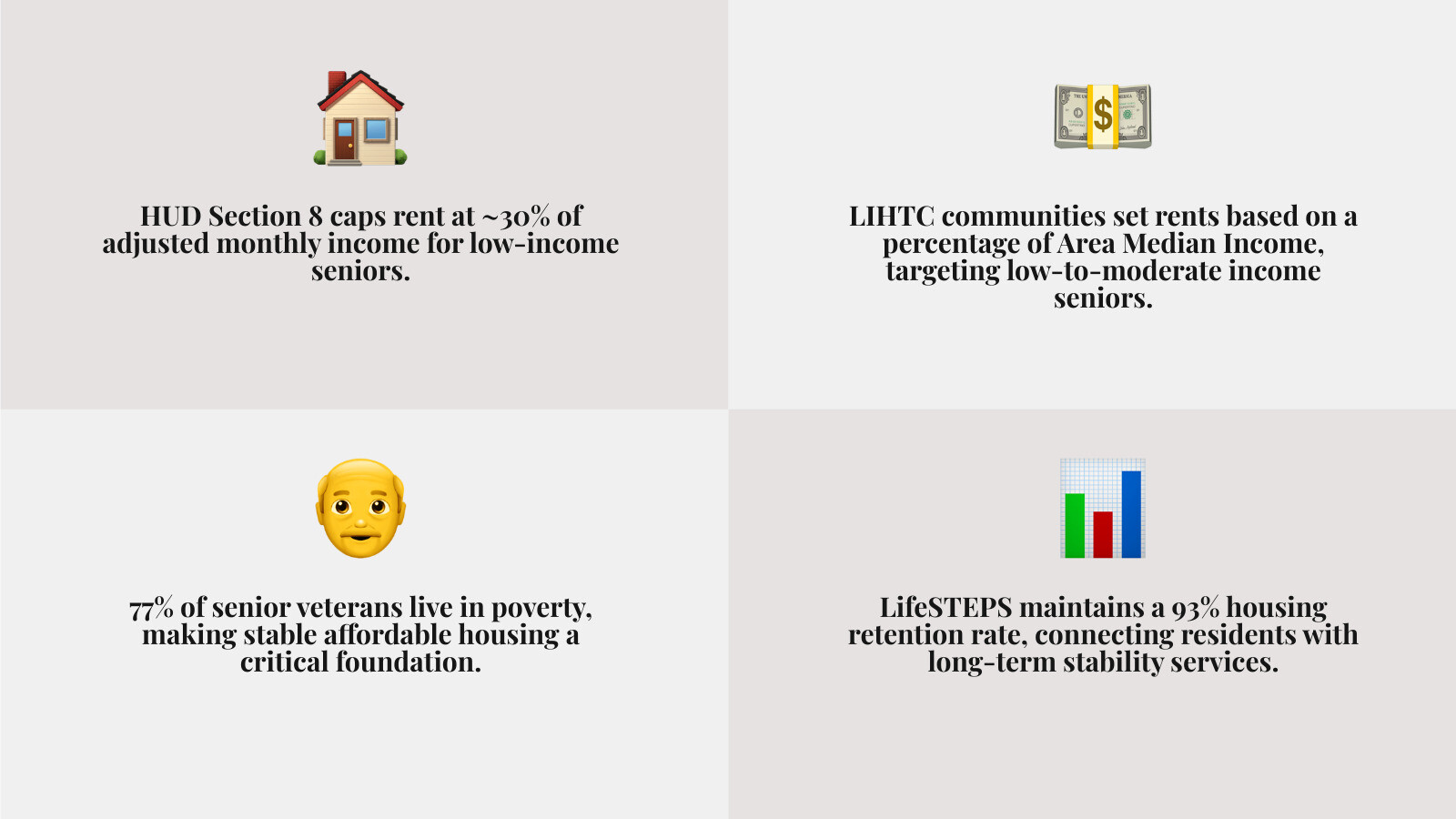
The good news: programs like HUD Section 8 cap your rent at roughly 30% of your adjusted monthly income. That means if your only income is Social Security, your rent adjusts to match. Many communities also include utilities, which makes budgeting more predictable.

For veterans specifically, the numbers paint a stark picture. According to data from Swords to Plowshares, 77% of senior veterans are living in poverty, and nearly half report feeling socially isolated. Stable housing is not just a comfort — it is the foundation everything else is built on.

LifeSTEPS works within California to help residents not just find housing, but keep it. The organization maintains a 93% housing retention rate, connecting residents with services that support long-term stability.

Types of affordable senior housing: HUD, LIHTC, Section 8, supportive housing, 55+ communities infographic

LifeSTEPS currently provides services in California only.

Easy affordable senior housing near me glossary:

Understanding Affordable Senior Housing Options

When beginning your search for affordable senior housing near me, it is essential to realize that “affordable housing” is not a single, one-size-fits-all program. Instead, it is a broad umbrella that covers several different housing structures, care levels, and financial models. Understanding these distinctions is the first step toward finding a living situation that matches both your budget and your physical needs.

Seniors chatting in a circle of chairs in a bright community room

Many older adults prefer to live independently for as long as possible. However, as we age, our physical needs can change, making certain home environments less practical. Affordable senior communities are specifically designed to address these transitions, offering everything from completely independent apartments to buildings with rich supportive services.

To explore these models further, you can read our comprehensive low-income senior housing guide or learn more about the broader landscape of senior living affordable housing options. By aligning your physical requirements with the right housing category, you can secure a home that promotes both safety and self-sufficiency. For general information on directories across the country, you can also consult the Low-Income & Affordable Housing for Seniors database.

Independent Living Communities

For older adults who do not require daily medical care or assistance with activities of daily living, independent living communities offer the perfect balance of privacy, community, and affordability. These communities are designed to foster an active lifestyle while removing the burdens of heavy home maintenance.

These properties typically enforce age restrictions, usually requiring at least one member of the household to be 55 or older, or in many subsidized cases, 62 or older. In these environments, residents live in their own private apartments but have access to shared spaces, such as community rooms, gardens, libraries, and fitness centers. To learn more about securing these placements, see our guide on how to snag affordable 55 and older apartments without the stress.

Many of these properties are built using government tax credits, which keep the rents lower than the surrounding market rate. If you are looking for creative ways to keep costs low, you can also explore these 10 cheaper alternatives to affordable senior independent living to expand your search.

Assisted Living and Supportive Housing

For seniors who need help with daily activities—such as bathing, dressing, medication management, or meal preparation—independent living may no longer be the safest choice. In these situations, assisted living and supportive housing communities provide a vital safety net.

These facilities combine housing with personal care services and 24-hour staff support. While traditional assisted living can be incredibly expensive, there are subsidized and low-income options available for qualifying seniors. Many municipal partnerships and state programs help offset these costs, allowing lower-income older adults to access the care they need.

For a detailed breakdown of these options, refer to our guide to housing for elderly and disabled individuals. Additionally, you can search for local care options using our resources on assisted living within reach how to find budget friendly care in your area and explore listings for cheap assisted living facilities.

For individuals with specific physical or cognitive disabilities, specialized programs offer targeted assistance. You can find more targeted resources through our articles on low income assisted living for disabled and assisted living for low income disabled adults.

How Income Limits and Rent Calculations Work

The financial side of affordable housing can seem complex at first glance. Rents are not determined by simple market demand; instead, they are heavily regulated and tied directly to the local economy and your household income.

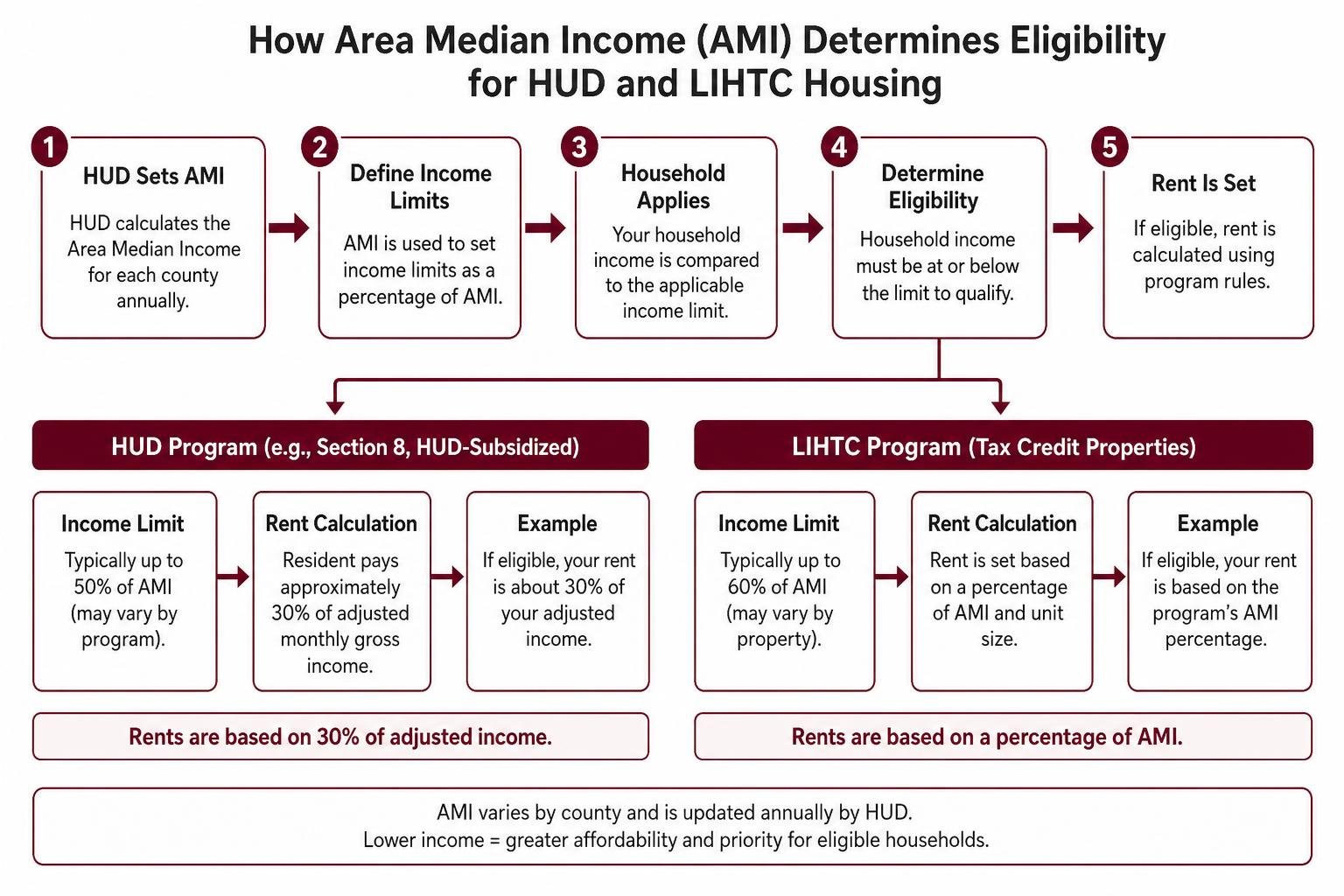
Two primary frameworks govern how rents and eligibility are calculated in affordable senior housing: the HUD 30% adjusted income rule and the Low-Income Housing Tax Credit (LIHTC) program.

Diagram illustrating how Area Median Income determines eligibility for HUD and LIHTC housing

Understanding how your local Area Median Income (AMI) affects your eligibility is crucial. Income limits are updated annually by HUD and vary significantly by county. To see how these calculations translate to actual apartment options, explore our guide on senior living apartments based on income near me or read the grandparents guide to affordable housing for elderly folks.

The 30% Adjusted Income Rule

For federal programs like Section 8 vouchers and HUD-subsidized senior developments, rent is calculated using a straightforward formula: residents pay approximately 30% of their adjusted monthly gross income.

This calculation takes your gross income and subtracts qualifying medical expenses, disability assistance allowances, and other approved deductions to arrive at your “adjusted” income. If your only source of income is a monthly Social Security check, your rent will be set at roughly 30% of that check.

It is important to note how utility allowances work under this rule. In many HUD properties, basic utilities like water, gas, and trash are included in the rent. If you are responsible for your own electricity, the housing authority will often apply a utility allowance, which reduces your rent contribution to offset the estimated cost of your electric bill. For a deeper look at these federal programs, check out our government subsidized housing guide as well as the essential hud low income senior housing handbook.

Low-Income Housing Tax Credit (LIHTC) Limits

Unlike HUD developments, where rent rises and falls dynamically with your income, LIHTC properties set fixed maximum rents based on local income brackets. These properties do not use the 30% rule directly; instead, they target specific percentages of the Area Median Income (typically 30%, 50%, or 60% of AMI).

To qualify for an LIHTC apartment, your total household income must fall below the maximum limit designated for that unit’s income tier. For instance, in a typical California county, a one-person household applying for a 60% AMI unit must prove their annual income is below that specific threshold.

At the same time, because these properties do not receive ongoing federal rent subsidies, they often enforce a minimum income requirement. This is usually set at 2 to 2.5 times the monthly rent to ensure the tenant can afford the apartment. However, if you hold a portable Section 8 voucher, or if you can show significant cash assets (such as savings equal to at least six months of rent), this minimum income requirement is typically waived. You can learn more about finding these specific tax-credit units in our resource on where to find low cost senior apartments without the stress.

Finding the Best Affordable Senior Housing Near Me

Knowing the rules is helpful, but the most critical step is finding actual, physical vacancies in your local area. Because affordable senior housing is in high demand, finding an open apartment requires using localized directories and state-specific search tools.

A senior woman happily using a tablet in her living room to search for local housing

For seniors living in California, there are several regional and state-level resources designed to streamline this process. For instance, the Los Angeles County Housing Resource Center provides updated listings and directories on LA County Senior Resources.

When comparing different options, it is helpful to look at multiple properties in your immediate neighborhood. We recommend reading our guide on comparing low income rentals for seniors in your neighborhood and bookmarking our ultimate affordable senior housing list to keep your search organized.

Searching for Affordable Senior Housing Near Me in Southern California

Southern California has a robust network of affordable housing options, though navigating them requires a targeted local approach. If you are looking in San Diego, you can find localized listings through San Diego Income-Restricted Housing.

For those searching in neighboring counties, check out the dedicated directories for Low Income Affordable Senior Living in Riverside, California and Low Income Affordable Senior Living in Irvine, California.

Because California has unique funding programs and state-level housing protections, understanding the state’s specific landscape is highly beneficial. You can find specialized state-level advice in our guide to affordable senior housing california.

In the Bay Area, local housing authorities manage centralized waitlists and portals for affordable senior apartments. These portals allow you to filter by age restrictions, income limits, and accessibility features.

Because vacancy rates in the Bay Area can be incredibly low, it is vital to check these portals frequently and submit applications as soon as waitlists open. To help you navigate these regional hurdles, we have put together a localized local search guide.

If you are hoping to find a placement quickly, you can also read our low income senior housing no waiting list guide for practical tips on finding immediate openings.

Application Processes, Waitlists, and Special Programs

Once you have identified a community that fits your needs, the next step is navigating the application process. Applying for affordable housing is more rigorous than renting a standard market-rate apartment, as it requires extensive third-party verification of your income, assets, and household size.

Because demand is high, many properties maintain extensive waitlists. Some housing authorities grant priority placement to specific demographics, such as seniors aged 62 or older, local residents, or individuals with documented physical disabilities.

To prepare yourself for this process, we recommend reviewing our resources on financial assistance for seniors to understand what funding might be available to you. You can also use our senior housing assistance your roadmap to a new home and learn how to secure safe and affordable housing programs for elderly relatives.

Programs for Veterans and Disabled Seniors

There are specialized housing programs designed specifically for veterans and seniors living with disabilities. For veterans, the HUD-VASH program combines HUD rental assistance with case management and clinical services provided by the Department of Veterans Affairs (VA).

Permanent supportive housing models are also highly effective, especially for older adults transitioning out of housing instability. These programs combine stable, income-proportional rent with on-site supportive services—such as mental health counseling, wellness workshops, and physical therapy coordination—to ensure residents can successfully age in place.

To explore these programs in detail, read our affordable housing for disabled seniors guide. You can also access veteran-specific resources through our articles on veteran senior living assistance and navigating veteran housing what you need to know about transitional and senior care.

Under California’s CalAIM program, qualifying seniors can also access specialized deposit assistance. This program can cover up to 1 month paid in advance for your security deposit, helping to clear one of the biggest financial hurdles to moving into a new home.

Frequently Asked Questions About Affordable Senior Housing

What is the age requirement for affordable senior housing?

The age requirement depends entirely on the specific housing program and property. Many active-adult, tax-credit (LIHTC) communities are designated as 55+ communities, meaning at least one household member must meet that age threshold. However, federal HUD-subsidized properties and municipal housing authority senior programs typically set their preferential age threshold at 62 or older.

Are utilities included in affordable senior apartments?

In many HUD-subsidized senior developments, basic utilities such as water, gas, and trash collection are included in your monthly rent. For properties where you must pay your own electric or heating bills, a utility allowance is usually deducted from your monthly rent calculation to keep your overall housing costs affordable. To learn more about how these utility structures work, consult our rent subsidies guide.

Can I use a Section 8 voucher for senior housing?

Yes. Most affordable senior housing developments, including LIHTC properties, are legally required to accept Housing Choice Vouchers (Section 8). If you hold a portable voucher, your rent contribution will still be capped at roughly 30% of your adjusted monthly income, and the voucher will cover the remaining balance of the rent directly to the property management.

Conclusion

Finding and securing affordable senior housing near me can feel like a daunting task, but understanding the different housing models, income limits, and local application processes makes the journey manageable. Whether you are looking for an independent 55+ community in Southern California or supportive housing in the Bay Area, there are programs designed to keep you safe, housed, and connected to your community.

At LifeSTEPS, we are dedicated to helping older adults navigate these transitions. By offering human-centered support and connecting residents to vital community resources, we help seniors achieve lasting housing stability. Our housing programs maintain a 93% housing retention rate, ensuring that once you find a home, you have the support needed to keep it.

Beyond housing, we believe in supporting the entire family. Our summer reading programs have achieved a 97% literacy improvement among youth in our communities, and we have helped students achieve their educational goals by providing over $2.1 million in scholarships. To learn more about our services and how we can support your transition to stable housing, we invite you to Explore LifeSTEPS Programs.

LifeSTEPS | Phone: (916) 965-2110 | LifeSTEPS

LifeSTEPS currently provides services in California only.

Your Next Chapter: A Guide to Senior Housing and Homes for Rent

Your Next Chapter Starts Here: Finding Senior Rental Apartments in California

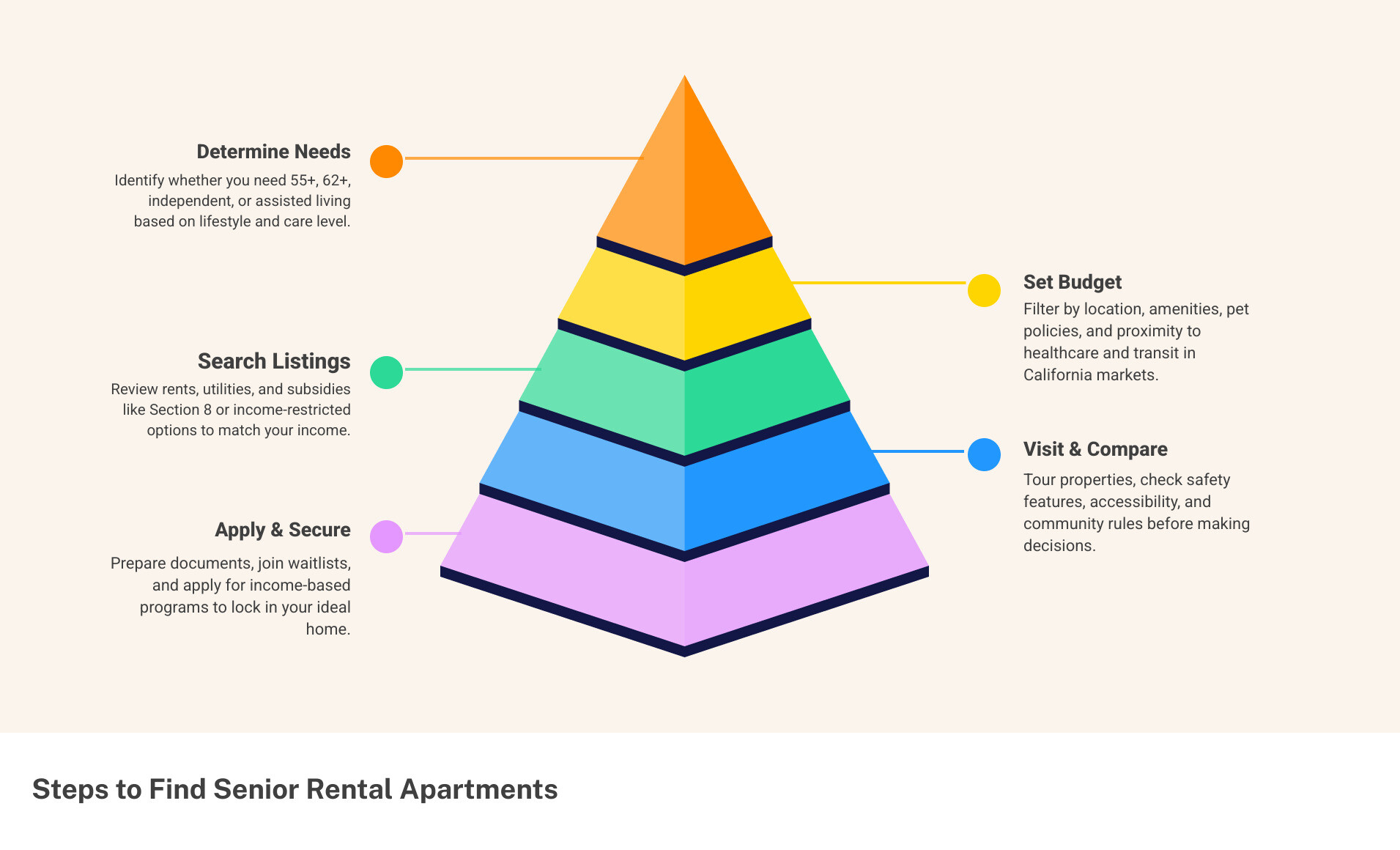
Senior rental apartments in California come in several types, each designed for a different level of independence and budget. Here’s a quick overview to help you find the right fit:

  • 55+ communities — Age-restricted apartments for active adults who live independently
  • 62+ communities — Stricter age requirements, often with more affordable or income-restricted options
  • Independent living — Private apartments with shared amenities; no medical care provided
  • Assisted living — Licensed communities with meals, daily activities, and personal care support
  • Subsidized/income-restricted housing — Rent based on income, often through HUD or local housing authorities; waitlists are common

Finding the right home after a major life transition — like leaving military service — takes more than a quick search. It means understanding what type of housing fits your needs, what you can afford, and what support is available to help you stay housed long-term.

California has over a thousand senior housing options, from resort-style 55+ communities to income-restricted apartments in Southern California. Rents vary widely, and eligibility rules differ by property. Knowing where to start makes all the difference.

Steps to find senior rental apartments in California infographic infographic

LifeSTEPS currently provides services in California only.

Common senior rental apartments vocab:

The search for the perfect apartment can feel a bit like searching for a parking spot at a busy California beach—demanding, but incredibly rewarding once you secure your spot. As we look at the landscape in July 2026, the demand for dedicated senior living spaces is higher than ever. Whether you are looking to downsize, find a community of peers, or locate a home that takes the hassle out of daily maintenance, navigating California senior housing options requires a clear strategy.

When exploring the market, it helps to understand that senior living is not a one-size-fits-all solution. Different properties cater to different lifestyles, physical needs, and financial situations. Some communities focus on luxury resort-style amenities, while others prioritize deep affordability and proximity to public transit. To make an informed decision, it is highly beneficial to begin by comparing local low-income rentals and market-rate options side-by-side to see how they align with your retirement goals.

Understanding 55+ and 62+ Age-Restricted Communities

Age-restricted communities are designed to foster vibrant, peer-focused environments. The two most common designations you will encounter are 55+ and 62+ communities. While they might seem similar on the surface, they operate under slightly different legal frameworks and offer distinct lifestyles.

  • 55+ Communities: These properties are tailored for active adults. They often feel like resort neighborhoods, emphasizing social clubs, fitness centers, and group outings. Under the federal Housing for Older Persons Act (HOPA), at least 80% of the occupied units must have at least one resident who is 55 or older. This leaves some flexibility for younger spouses or adult children. If you are looking for an upscale, active lifestyle, you might explore options like luxury 55+ apartments, which feature wellness facilities, community kitchens, and beautifully maintained grounds.
  • 62+ Communities: These properties have stricter age requirements. Under HOPA, 100% of the residents in a 62+ community must meet the age threshold (with very few exceptions for younger spouses or live-in caregivers). Because of these stricter rules, 62+ communities are often quieter and are frequently associated with federal and state housing assistance programs.

Understanding these nuances is the first step in learning how to find 55 and older apartments that match both your social expectations and your daily routine.

Independent Living vs. Assisted Living Options

A common point of confusion for families is the difference between independent living and assisted living. Choosing the wrong one can lead to unnecessary expenses or, conversely, a lack of necessary physical support.

Independent living is all about convenience and community. Residents live in their own private apartments and are fully capable of managing their daily lives, medical needs, and personal care. The community typically handles exterior maintenance, landscaping, and security. Many independent living communities also offer communal dining options, housekeeping services, and organized social calendars, but no medical or physical care is provided on-site.

Assisted living, on the other hand, is licensed and regulated. It is designed for older adults who want to maintain some independence but need help with daily activities such as medication management, bathing, dressing, or meal preparation. These communities have trained staff available 24/7 to provide personalized care plans.

If you or your loved one do not require daily physical assistance, focusing your search on independent living will help you avoid the higher monthly fees associated with licensed care. Taking the time to research these differences is essential when finding the best senior apartment complexes in your preferred neighborhood.

Evaluating Safety, Accessibility, and Proximity to Care

When touring potential senior rental apartments, it is easy to get swept up in beautiful lobby designs or modern paint colors. However, the most critical factors for long-term comfort and safety are accessibility and location.

accessible senior apartment bathroom with grab bars modern design

When walking through a unit, we recommend using a physical checklist to evaluate the space:

  1. Universal Design Features: Look for step-free entryways, wider doorways that can easily accommodate a walker or wheelchair, lever-style door handles (which are much easier on arthritic hands than round knobs), and rocker-style light switches.
  2. Bathroom Safety: The bathroom is the most common site for household slips and falls. Ensure the shower has a low or zero-threshold entry, slip-resistant flooring, and securely anchored grab bars. Handheld showerheads and built-in shower benches are also major pluses.
  3. Emergency Response Systems: Many dedicated senior communities feature pull-cords or wireless emergency buttons that instantly alert on-site management or emergency services in the event of an accident.
  4. Proximity to Key Services: A great apartment is only as good as its neighborhood. Evaluate how close the property is to your primary care physicians, local hospitals, grocery stores, and pharmacies. If you prefer not to drive, check if the community is near reliable public transit or if the property offers its own scheduled shuttle service for shopping and medical appointments.

Key Factors Influencing Rent and Pricing in California

It is no secret that California’s rental market can be challenging. Rent prices for senior rental apartments are influenced by several factors, including geographic location, proximity to coastal areas, the level of luxury amenities offered, and local demand.

To help you visualize the differences across some of our primary service areas in Southern California, we have compiled a comparison of typical starting rental ranges for market-rate senior apartments as of July 2026:

Region Average Starting Rent (1-Bedroom) Key Pricing Drivers
Los Angeles CA $1,800 – $2,900+ High urban density, close proximity to world-class healthcare, transit access
San Diego CA $1,750 – $2,800+ Coastal desirability, high demand for active adult communities
Irvine CA $2,100 – $3,200+ Planned master communities, premium luxury amenities, high safety ratings
Riverside CA $1,400 – $2,100+ Inland location, more spacious floor plans, relatively lower cost of living

Budgeting for Senior Rental Apartments in Southern California

When budgeting for your new home, it is important to look beyond the base rent. In highly competitive markets like Los Angeles and San Diego, prices can fluctuate based on seasonal demand and vacancy rates.

Currently, in July 2026, Los Angeles County remains under a local state of emergency regarding housing affordability, which triggers strict price-gouging protections. These laws limit how much landlords can increase rents for existing tenants during emergency periods—a crucial protection for seniors living on fixed incomes.

If you are beginning your search in these bustling metropolitan areas, utilizing localized search tools can save you hours of frustration. For example, you can explore active listings directly through platforms like Los Angeles senior living options or browse neighborhood-specific vacancies via San Diego 55+ community apartments.

Hidden Fees and Utility Costs in Senior Communities

One of the most common budget pitfalls is failing to account for “ancillary fees”—those extra charges that do not appear in the headline rent price but show up on your monthly statement. When comparing properties, always ask for a complete written schedule of fees.

  • Utility Bundles: Some properties include all utilities (water, gas, trash, electricity) in the base rent, which makes monthly budgeting incredibly simple. Others charge a flat monthly utility fee, while some require you to set up individual accounts with local utility companies.
  • Pet Policies and Fees: Many seniors share their homes with beloved pets. While most senior communities are pet-friendly, they often charge a non-refundable pet deposit (frequently ranging from $200 to $500) plus a monthly “pet rent” of $35 to $50 per pet. If you are looking at inland options, you can check specific pet guidelines through Riverside 55+ community living.
  • Parking and Storage: Assigned carport spaces, garage rentals, or additional on-site storage lockers often carry extra monthly fees. If you plan to move to highly walkable master-planned neighborhoods, such as those found in Irvine active adult living, confirm whether parking is included in your lease agreement.

Affordable and Subsidized Housing Options for Older Adults

For seniors living on fixed incomes, such as Social Security or modest pensions, market-rate rentals may simply be out of reach. Fortunately, there are several federal, state, and local programs designed to keep housing affordable.

Navigating these programs can be complex, but starting with a comprehensive low-income senior housing guide can help demystify the process. These programs are designed to ensure that older adults do not have to choose between paying rent and buying groceries or medication. Knowing where to find low-cost senior apartments is essential to maintaining financial peace of mind.

Eligibility and Income Restrictions for Subsidized Senior Rental Apartments

Subsidized senior apartments are generally funded through the U.S. Department of Housing and Urban Development (HUD), Low-Income Housing Tax Credit (LIHTC) programs, or local housing authorities. Rent in these properties is typically capped at 30% to 40% of the household’s adjusted gross income.

To qualify for these units, applicants must meet specific income limits, which are based on the Area Median Income (AMI) of the county where the property is located:

  • Extremely Low-Income: Households earning 30% or less of the AMI.
  • Very Low-Income: Households earning 50% or less of the AMI.
  • Low-Income: Households earning 80% or less of the AMI.

Additionally, many affordable properties accept Housing Choice Vouchers (Section 8), which allow seniors to rent privately owned apartments while paying a subsidized rate. If you are searching for properties that calculate your rent directly from your monthly earnings, we recommend looking specifically for income-based senior living apartments in your target county.

Perhaps the most challenging aspect of affordable housing is the waitlist. Because the demand for subsidized senior rental apartments far exceeds the supply, waitlists can range from several months to several years. Some waitlists open for only a few days a year before closing again.

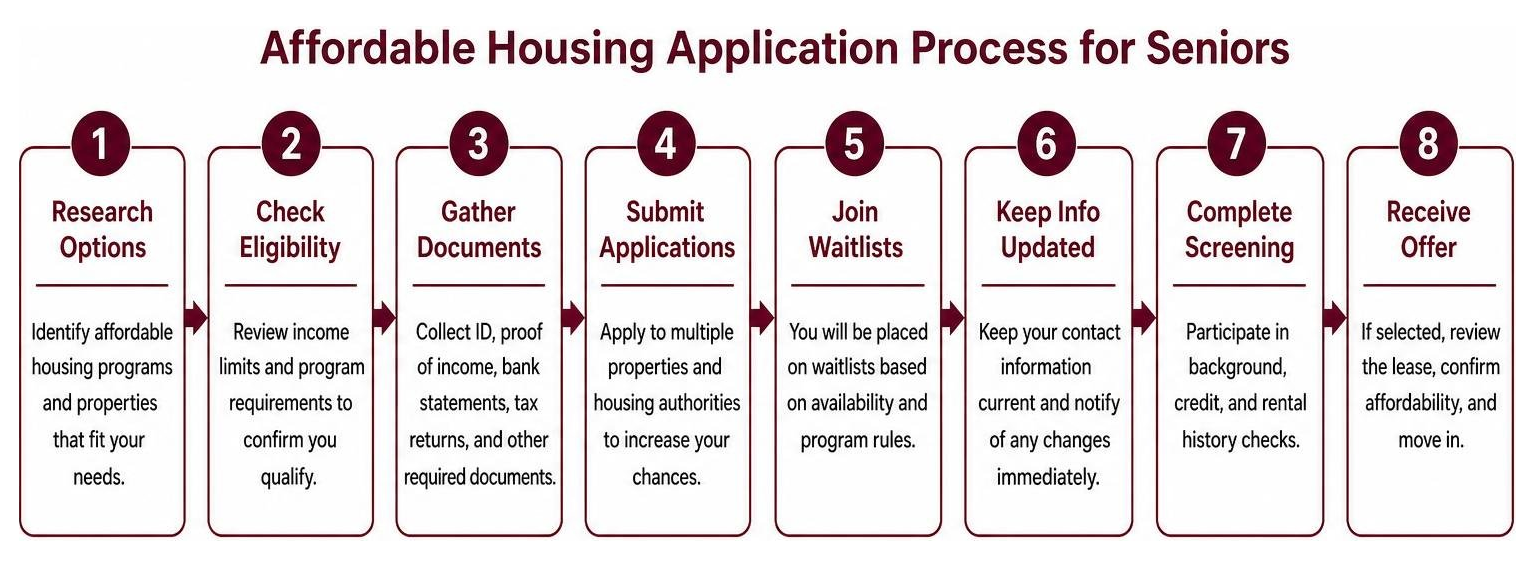
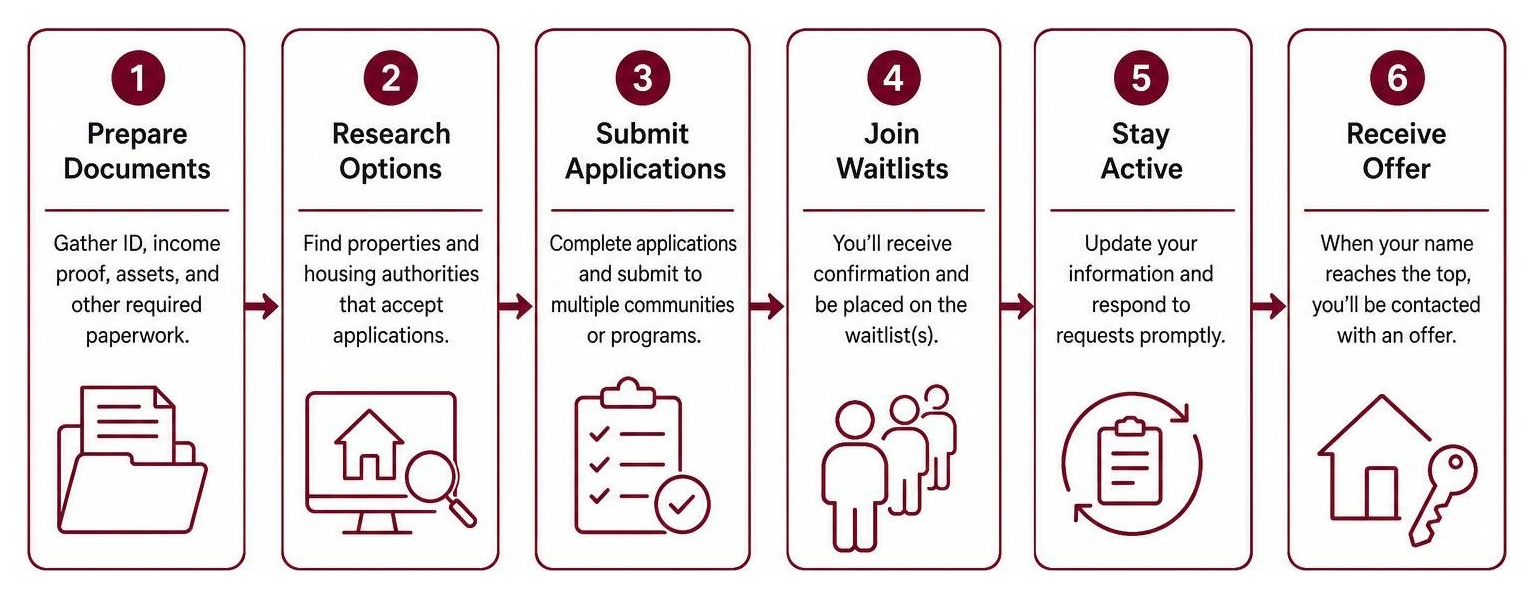
To put yourself in the best position to secure a unit, follow this step-by-step sequence:

Affordable housing application process diagram

  1. Gather Documentation Early: You will need government-issued identification, Social Security cards, proof of income (such as Social Security benefit letters or pension statements), bank statements, and tax returns.
  2. Apply to Multiple Properties: Do not put all your eggs in one basket. Apply to multiple housing authorities and individual tax-credit properties to increase your chances.
  3. Keep Your Contact Information Updated: If a housing authority tries to contact you and your phone number or mailing address has changed, you will be removed from the waitlist. Always notify them of any changes immediately.
  4. Prepare for Background Checks: Landlords of subsidized properties will run credit, criminal, and rental history checks. Be prepared to explain any past issues honestly.

Frequently Asked Questions About Senior Housing

What is the difference between 55+ and 62+ senior rental apartments?

The primary difference lies in the strictness of the age requirements and the governing federal laws under HOPA. A 55+ community requires at least one person aged 55 or older to reside in 80% of the occupied units, allowing some younger residents to live on the property. A 62+ community requires all residents to be 62 or older, creating a quieter environment that is often paired with federal income-based housing subsidies.

How do income-restricted senior apartments determine rent?

In subsidized properties (such as HUD Section 202 communities), rent is calculated as a direct percentage of your household’s adjusted monthly income—typically 30%. In tax-credit (LIHTC) properties, rents are set at a flat rate based on a percentage of the Area Median Income (e.g., a unit designated for households at 50% AMI), meaning the rent remains fixed regardless of individual income fluctuations, provided you meet the initial eligibility requirements.

Are pets allowed in senior rental apartments?

Yes, most senior communities recognize the immense physical and emotional benefits of pet ownership and allow household pets (usually cats and small dogs under a certain weight limit, such as 25 to 50 pounds). Under the federal Fair Housing Act, legitimate service animals and Emotional Support Animals (ESAs) are not considered “pets” and are exempt from standard pet fees, deposits, or breed restrictions, provided you have the appropriate documentation from a licensed healthcare provider.

Conclusion: Securing Your Ideal Senior Housing Community

Finding the right senior rental apartments is about more than just finding a roof over your head; it is about finding a community where you can thrive, feel safe, and maintain your independence. At LifeSTEPS, we walk alongside older adults and families during these critical transitions. As a nonprofit organization dedicated to social services, we provide the human-centered support and resources needed to move from housing instability to long-term self-sufficiency.

Our commitment to our clients is reflected in our measurable outcomes:

  • We maintain a 93% housing retention rate across our programs, helping seniors stay safely in their homes.
  • We tie deposit assistance directly to the CalAIM program, helping eligible seniors cover up to 1 month paid in advance for deposit assistance to ease the financial burden of moving.
  • Through our collaboration with programs like the Family Self-Sufficiency (FSS) program, we help clients, including veterans, build pathways toward financial stability and homeownership.
  • We believe in building strong communities for all generations, supporting programs that have achieved a 97% literacy improvement in summer reading programs for youth, and awarding over $2.1 million in scholarships to help families achieve their educational dreams.

To begin building your roadmap today, explore our ultimate affordable senior housing list to find resources near you.

Please visit our website for more information: LifeSTEPS

LifeSTEPS currently provides services in California only.
affordable senior housing community with diverse happy seniors outdoors

Top Subsidized Senior Housing Communities You Can Actually Afford

The Real Cost of Finding Affordable Senior Housing in California


Affordable senior housing in California is harder to find than ever — and for recently discharged veterans, the stakes couldn’t be higher.

Here is a quick overview of the main subsidized housing options available to seniors:

Program Who It’s For How Rent Is Set
HUD Section 202 Very low-income seniors 62+ ~30% of adjusted gross income
LIHTC Properties Low-to-moderate income seniors Capped at 30%-60% of Area Median Income
Housing Choice Vouchers (Section 8) Low-income renters, including seniors 30% of adjusted gross income
Public Housing Low-income seniors Income-based
Project-Based Vouchers Seniors at specific communities Income-based, tied to the unit

Seniors are currently the fastest-growing homeless population in the United States. Among senior veterans, the situation is especially urgent — 77% live in poverty, and nearly half report feeling socially isolated. For veterans transitioning out of military service, finding stable, affordable housing is not just a preference. It is the foundation that makes everything else possible.

The good news is that real options exist — subsidized communities, rental assistance programs, and supportive services designed specifically for low-income seniors and veterans in California.

This guide cuts through the confusion and lists the top affordable senior housing communities you can actually get into.

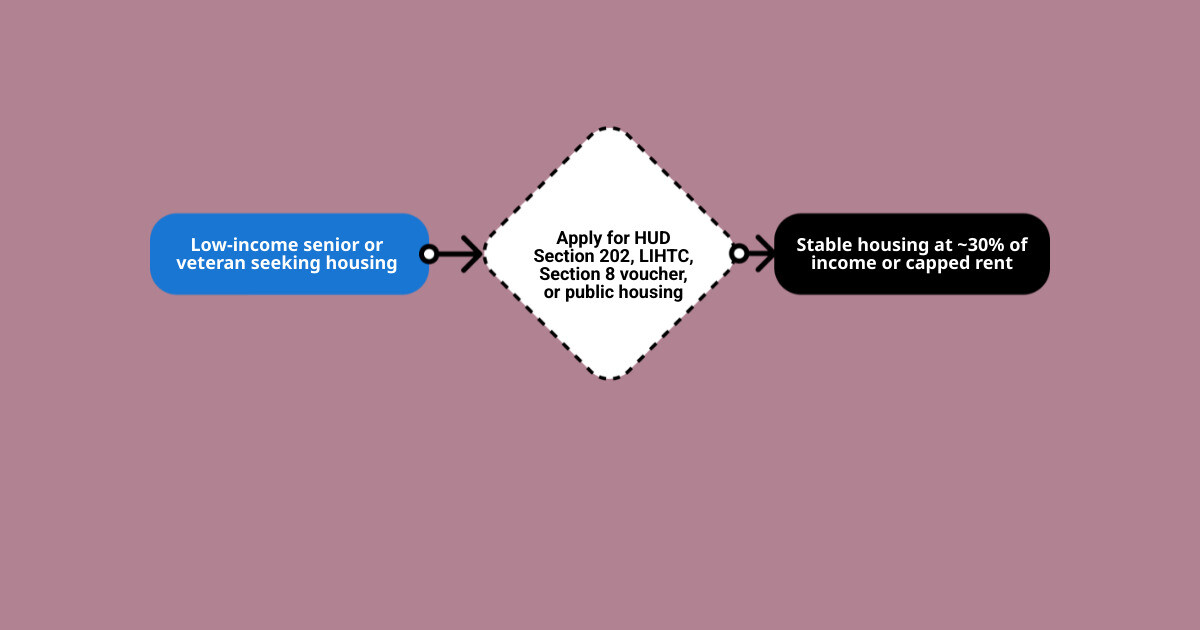
Pathways to affordable senior housing in California: programs, eligibility, and how rent is calculated infographic

Common affordable senior housing vocab:

Understanding Affordable Senior Housing Options and Programs

Navigating subsidized housing can feel like trying to solve a Rubik’s Cube blindfolded. To find a home that fits your budget, it helps to understand how subsidized housing differs from market-rate options.

Market-rate housing is priced solely on what the local real estate market will bear. Subsidized housing, on the other hand, relies on government funding or tax incentives to keep rents artificially low. This ensures that older adults on fixed incomes are not priced out of their neighborhoods.

The foundation of almost all affordable housing programs is the Area Median Income (AMI). Calculated annually by the U.S. Department of Housing and Urban Development (HUD), the AMI represents the midpoint income for a specific county or metropolitan area.

Eligibility for senior housing programs is typically grouped into income tiers based on this metric:

  • Moderate Income: 80% of the AMI.
  • Low Income: 50% of the AMI.
  • Very Low Income: 30% of the AMI.

If you want to dive deeper into how these metrics shape local housing options, our comprehensive low-income senior housing guide breaks down the numbers county by county.

HUD Section 202 and Affordable Senior Housing

The HUD Section 202 program is specifically designed to help very low-income seniors age in place with dignity. Unlike general public housing, Section 202 funds are used exclusively to build and operate multifamily communities for very low-income elderly households (typically defined as individuals aged 62 or older).

One of the greatest benefits of Section 202 housing is the integration of supportive services. These communities often employ on-site Service Coordinators. These professionals help residents navigate healthcare systems, arrange transportation, organize social activities, and access meal programs.

This model allows seniors to live independently in their own private apartments while enjoying the safety net of a supportive community. If you are looking for localized options in Southern California, you can explore the Los Angeles County senior housing resources directory to find open Section 202 waitlists and local senior services.

LIHTC and Affordable Senior Housing

The Low-Income Housing Tax Credit (LIHTC) is the nation’s primary tool for creating new affordable rental housing. Instead of directly subsidizing rents, the federal government issues tax credits to private developers who commit to keeping a percentage of their units affordable for a set period (usually 30 to 55 years).

LIHTC properties are not strictly “income-based” in the way HUD properties are. Instead, rents are capped based on designated income tiers—usually targeting households earning 30%, 40%, 50%, or 60% of the Area Median Income.

Because rents are set based on these percentages rather than a dynamic 30% of your specific income, many LIHTC properties enforce minimum income guidelines to ensure you can afford the rent. However, exceptions are frequently made. For instance, minimum income requirements are typically waived if you hold a tenant-based rental subsidy like a Section 8 voucher, or if you have cash assets equal to at least six months of rent.

To learn more about how tax credits keep senior living communities within reach, check out our guide on affordable homes for seniors.

Housing Choice Vouchers and Rental Assistance

The Housing Choice Voucher (HCV) program, commonly known as Section 8, is a tenant-based subsidy that allows low-income seniors to find their own housing in the private market. Under this program, the local public housing authority pays a portion of the rent directly to the landlord, and the senior pays the remaining balance.

The beauty of Section 8 is the “30 percent income rule.” No matter how much the market-rate rent is (within reasonable limits set by the housing authority), the senior resident’s share of the rent is strictly capped at approximately 30% of their adjusted gross monthly income. This provides immense financial relief for older adults living on modest Social Security benefits or pensions.

In addition to tenant-based vouchers, some communities offer Project-Based Vouchers. In this setup, the voucher is tied directly to a specific apartment unit rather than the individual tenant. If you move out, the voucher stays with the property.

To understand how to maximize these vouchers and other federal safety nets, read the grandparents’ guide to affordable housing for elderly folks.

Top Subsidized Senior Housing Communities in California

beautiful California senior apartments with walkable green spaces and a community garden

Finding affordable senior housing in California requires knowing where to look. From the quiet suburbs of the East Bay to the bustling neighborhoods of Southern California, communities are utilizing innovative designs to help seniors stay active, connected, and financially stable. Many of the most successful developments emphasize transit-oriented design, placing apartments within walking distance of light rail stations, bus lines, and medical centers to ensure residents maintain their mobility without the expense of owning a car.

If you are looking for a comprehensive directory of properties across the state, our ultimate affordable senior housing list is an excellent place to start your search.

Affordable Senior Apartments in Gilroy

Located in Southern Santa Clara County, Gilroy offers excellent options for active seniors who value walkability and green spaces. By converting older properties or developing new, transit-oriented complexes, housing providers in this region have created thriving communities.

A prime example of this is the renovated senior living model in Gilroy. Originally built in the late 1970s and fully rehabilitated to modern standards, this community offers spacious one-bedroom apartments designed specifically for low-income seniors.

What makes this location stand out is its emphasis on active lifestyle amenities. It features community gardens where residents can grow their own fresh produce and socialize with neighbors. It is also highly walkable, situated directly adjacent to major transit lines and bus stops, making it easy for residents to run errands or attend medical appointments without a car.

Affordable Senior Rentals in San Diego

San Diego is famous for its beautiful coastline, but it is also home to some of the state’s most progressive affordable housing initiatives. The local housing authority plays a direct role in creating and preserving affordable rental units for seniors on fixed incomes.

By partnering with private developers and non-profit organizations, the city offers a variety of senior-dedicated properties where rents are kept well below market rates. These communities frequently feature secured entryways, elevators for easy accessibility, and on-site laundry facilities.

To view active listings, check income limits, and learn how to apply for municipal senior units, visit the San Diego Housing Commission rentals portal.

Income-Restricted Senior Living in Irvine and Riverside

In Orange County and the Inland Empire, cities like Irvine and Riverside have embraced income-restricted senior housing models that prioritize holistic wellness. These properties are designed to help seniors stretch their monthly budgets as far as possible.

In these regions, many affordable senior apartments offer all-inclusive pricing models. This means utilities—and sometimes even Wi-Fi—are included in the monthly rent price, eliminating the stress of fluctuating utility bills during hot California summers. These properties are also strategically located near shopping centers, pharmacies, and public transit hubs.

To explore available options in these Southern California cities, you can browse the Irvine income-restricted senior apartments database or research local municipal programs through the Riverside affordable rentals housing authority page.

How to Apply and Navigate Waitlists Successfully

Applying for affordable senior housing requires patience, organization, and a proactive strategy. Because the demand for subsidized housing in California far exceeds the supply, waitlists are incredibly common. It is not unusual for a waitlist to extend from one to three years, making early planning essential.

Step-by-step application and waitlist management process for subsidized housing

To navigate this process successfully, we recommend taking the following steps:

  1. Gather Your Documentation: Before you apply, compile all necessary paperwork. This includes government-issued ID, Social Security cards, proof of income (such as Social Security award letters, pension statements, or tax returns), and asset verification (bank statements).
  2. Consult a HUD-Approved Housing Counselor: These counselors provide free or low-cost advice on renting, budgeting, and navigating public housing programs. They can help you identify open waitlists and ensure your application is filled out correctly.
  3. Apply to Multiple Properties: Don’t put all your eggs in one basket. Apply to multiple communities and housing authorities simultaneously to increase your chances of securing a unit.
  4. Keep Your Contact Information Updated: If a housing authority or property manager tries to contact you and your phone number or address has changed, you will be removed from the waitlist. Update your information immediately if you move or change numbers.
  5. Understand the Screening Process: Once you reach the top of a waitlist, you will undergo a thorough screening process. This includes income verification, credit checks, and background checks.

For a detailed walkthrough on how to support an aging family member through this transition, read our guide on how to secure safe and affordable housing programs for elderly relatives.

Frequently Asked Questions About Subsidized Senior Housing

Who qualifies for subsidized senior housing in California?

In California, eligibility is primarily determined by age and income. Most senior-dedicated housing communities require the head of household to be at least 62 years old, though some LIHTC properties lower this requirement to 55.

Additionally, some communities extend eligibility to adults aged 18 or older who require barrier-free, accessible housing due to physical or mobility disabilities. Economically, your household income must fall below the limits established by HUD for your county—typically capped at 50% or 60% of the Area Median Income (AMI), with many programs prioritizing those at or below 30% AMI.

Are there housing options specifically for veterans or seniors with disabilities?

Yes. Older veterans and seniors with disabilities have access to dedicated housing resources. The HUD-VASH program combines Housing Choice Vouchers with case management and clinical services provided by the Department of Veterans Affairs (VA) to help homeless veterans find permanent housing.

Furthermore, community-based supportive housing models exist throughout California. These programs often feature a low case manager-to-resident ratio (such as 1:25) to provide intensive, personalized care. They also offer specialized services like legal clinics for VA benefits, wellness workshops, and social activities designed to combat isolation and support cognitive health.

What is the difference between independent living and assisted living?

The primary difference lies in the level of daily care provided. Subsidized senior housing is almost always designed for independent living. This means residents live in their own private apartments and must be capable of fulfilling standard lease requirements on their own or with the help of outside, self-arranged personal care.

Assisted living facilities, by contrast, provide hands-on help with daily activities such as bathing, dressing, medication management, and meals. While some municipal programs offer subsidized assisted living on a limited basis, standard HUD and LIHTC properties do not provide medical or personal care services as part of the rent.

Conclusion: Securing Stability and Peace of Mind

Finding safe, affordable senior housing is about more than just securing a roof over your head; it is about reclaiming your independence, health, and peace of mind.

At LifeSTEPS, we believe that stable housing is the absolute foundation of a healthy, fulfilling life. Without a secure place to call home, it is nearly impossible to focus on personal wellness, education, or long-term goals.

Our human-centered supportive services are designed to walk alongside individuals and families as they build pathways to self-sufficiency. We are proud of our measurable community impact, including:

  • An outstanding 93% housing retention rate for the vulnerable populations we serve.
  • Direct financial support through the CalAIM program, which can provide critical deposit assistance (including paying 1 month of rent in advance) to help seniors transition into stable homes.
  • A strong commitment to education and youth development, achieving a 97% literacy improvement in our Summer Reading programs and awarding over $2.1 million in scholarships to help the next generation thrive.

By combining physical housing stability with wrap-around social services, we help seniors, veterans, and families across California build strong, resilient communities.

To learn more about how we can support you or your loved ones during this transition, explore our ultimate affordable senior housing list.

Please visit our website for more information: LifeSTEPS

LifeSTEPS currently provides services in California only.